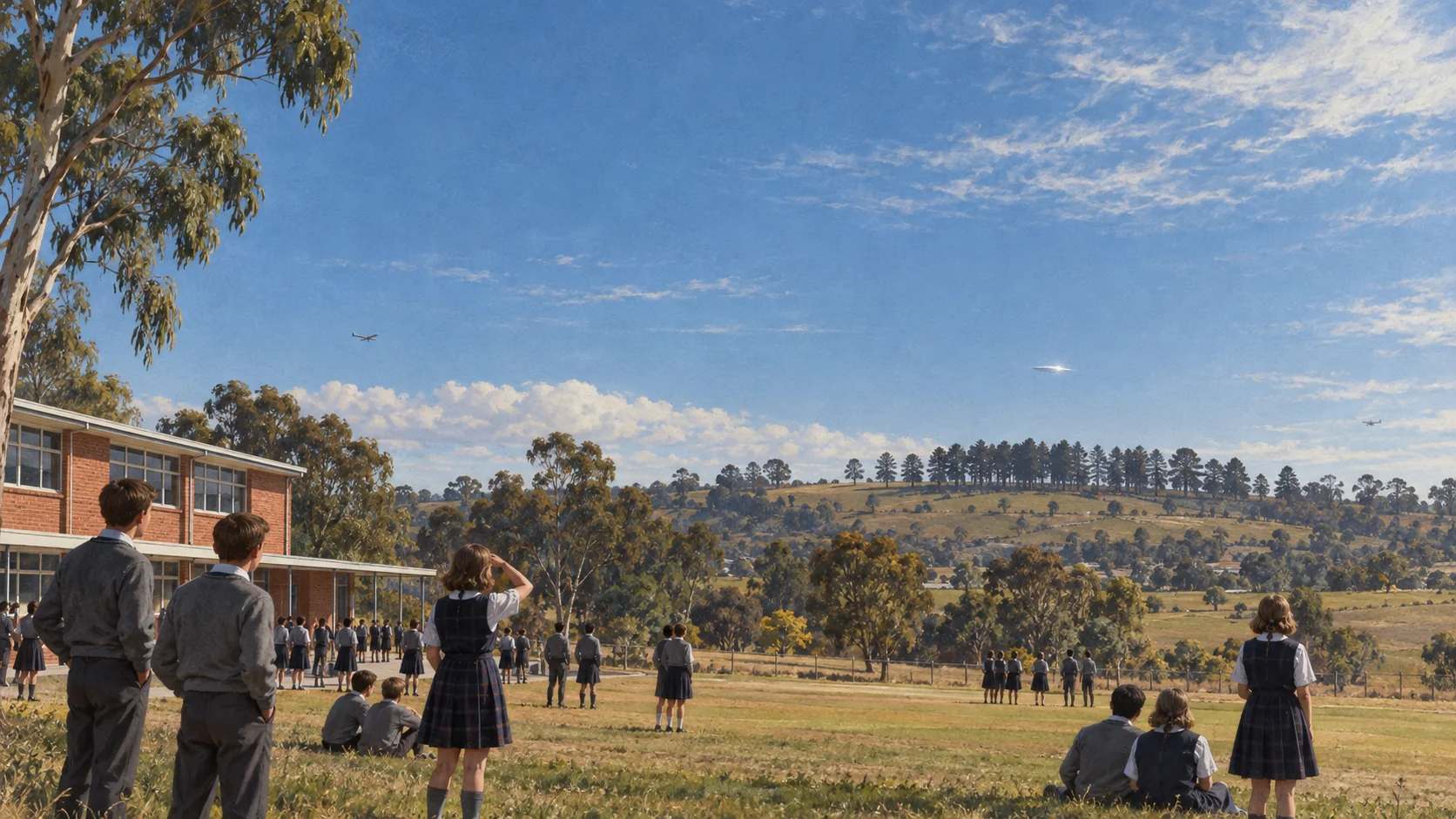
The girls at the far end of the Westall school oval were already looking past the playing field.
Inside a classroom, another pupil had noticed a disturbance outside. He did not follow it immediately. When the bell rang for morning recess, he collected his things and walked into the yard. Then, as he recalled in an account published that year, the school seemed to surge towards the girls. He went with the crowd.
Above the pines beyond the school was something dazzling and silver. He watched it move from the trees across open paddocks and back again. The classroom interruption had become an event for the children spread across the oval, all trying to follow the same small part of the sky.
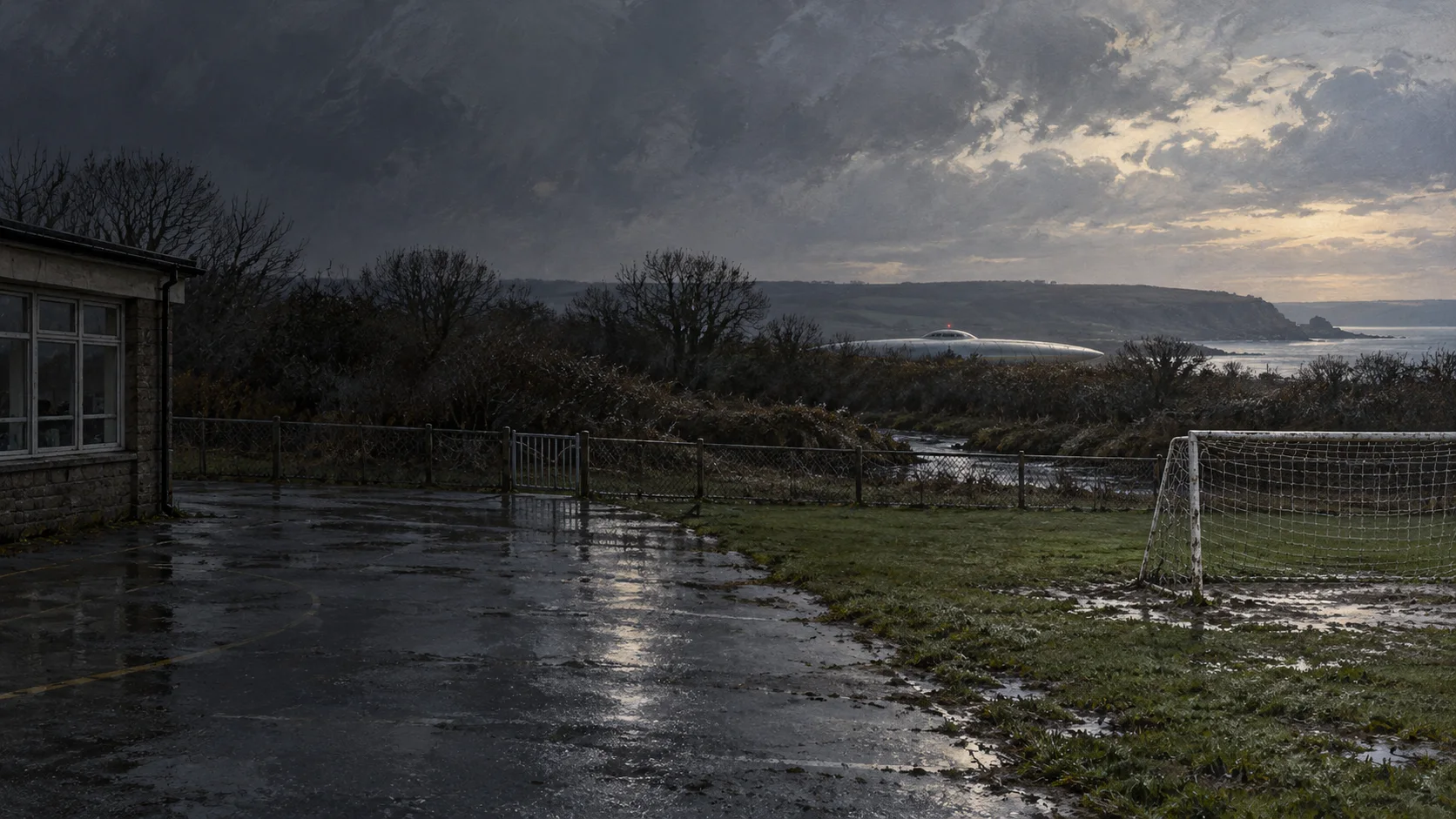
It was Wednesday, April 6, 1966, at Westall High School in Clayton, on Melbourne’s southeastern fringe. Behind the school lay the pine-lined area known as The Grange. The trees made a horizon the pupils could recognize. They also hid whatever passed behind them.
From the classroom to the oval
The first alarm did not arrive as a formal announcement. Science teacher Andrew Greenwood later told physicist James E. McDonald that a girl came into his class saying there was a flying saucer outside. Greenwood let the lesson continue. Five or ten minutes later, at recess, he went out to see what the children were talking about.
By his 1967 account, a large part of the school was already on the oval. Against a blue-grey sky, he could not pick out the grey object until pupils pointed it out.
Greenwood described a silver-grey thing that looked long and narrow, then thicker through the middle, shifting side to side and up and down. The student writing in The Clayton Calendar remembered a brilliant, very thin object near the same pines.
When the shape moved behind the pines, a pupil on the oval could lose sight of it without knowing whether it had reached the ground.
Over the pines
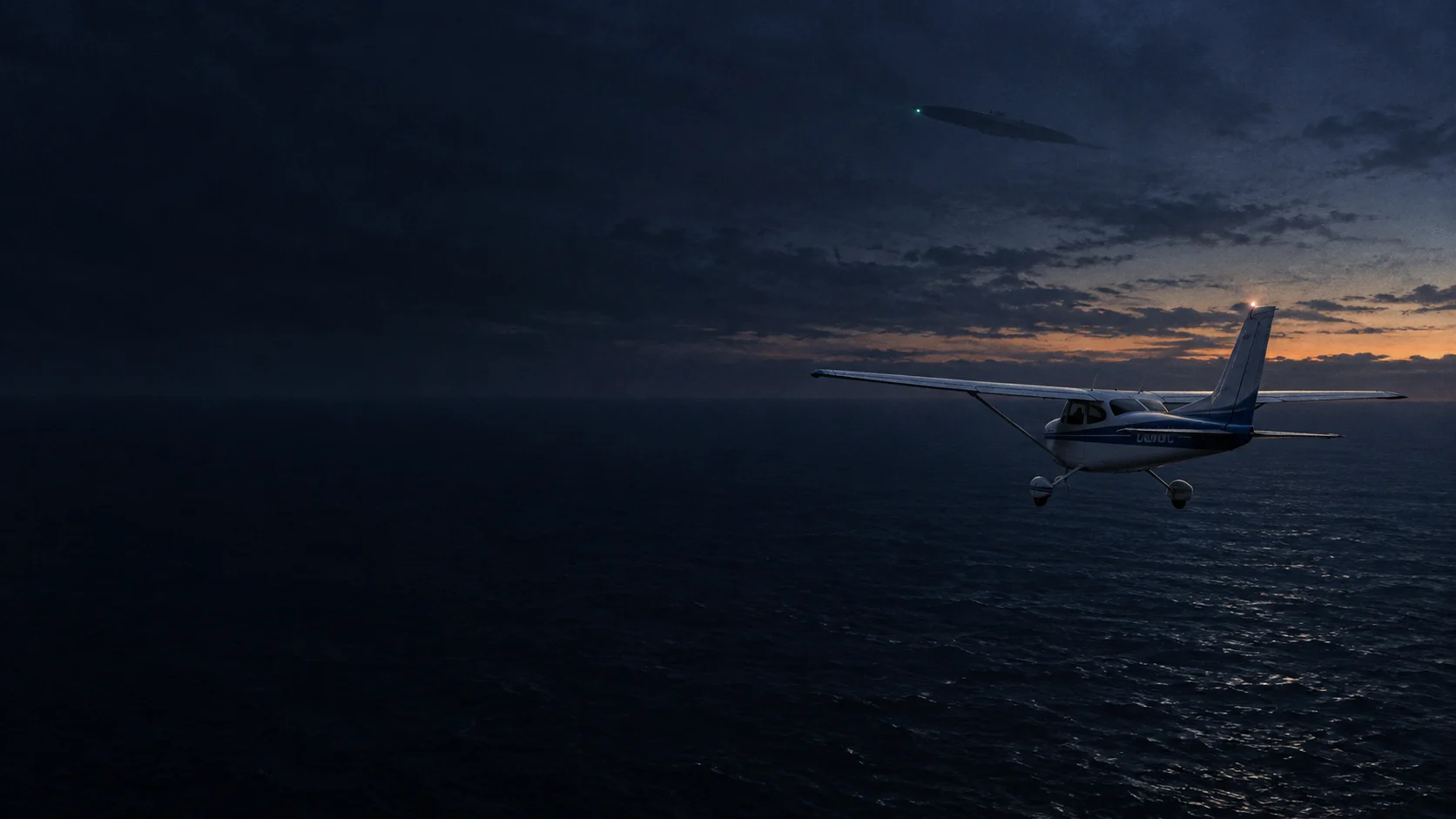
The anonymous pupil said the silver shape crossed the paddocks and returned to the pines. He thought it hovered there, then descended behind the trees. For a time he could see no more of it. He could see aircraft, however: private planes heading towards the same area. When the shape rose again, he used an approaching aircraft to guess its length, judging it roughly as long as a Cessna but much thinner.
In his telling, the shape turned at an angle and began to gain height. The planes followed, then fell behind as it moved into the distance. The children waited for it to come back. It did not. He wrote that they returned to school fifteen minutes late.
Greenwood’s account supplied another line of sight. He told The Dandenong Journal on April 21 that he first saw the shape rise from behind the pines. He too reported light aircraft, first one and then several, appearing to track it. He likened their movement to a game of cat and mouse. He watched for about twenty minutes; when he looked away and back, the shape had gone.
The pupil thought he saw a descent and later departure. Greenwood began watching after an apparent rise and missed the final moment. In 1967, he said the object had remained airborne throughout what he saw.
In its April 21 issue, the Journal published student Marilyn Eastwood’s sketch of something rounded and humped, with features underneath. Her outline differed from Greenwood’s thin, sometimes thickening form.
The planes without a report
The Journal asked Moorabbin airport about the apparent aircraft. Officials said roughly a dozen had taken off that morning. One pilot who had been somewhere in the area told reporters he had noticed nothing unusual.
The paper’s April 21 headline asked who the five pilots were. Greenwood and the student saw aircraft; reporters could not establish their routes or what, if anything, the crews observed.
The pupils had another place to search. In the Calendar account, the boy and two friends went out after school to the field behind the pines. They passed beneath a barbed-wire fence and pushed through waist-high grass. There, he said, they found an area some 25 to 30 feet across where the grass lay crushed against the ground. He wondered whether the object he had watched could have made it.
He had not seen an object touch the grass. He connected the patch with the disappearance behind the trees, but ended his article leaving the thing’s identity in doubt.
The story reaches the newspapers
The next morning, The Age gave readers a plainer possibility. A Weather Bureau balloon had gone up from Laverton at 8:30 a.m. The westerly wind might have carried it towards Clayton. No commercial, private or RAAF pilot had reported anything unusual there.
By April 14, the local Dandenong Journal had spent more than a week asking what happened. Its front page announced a “Flying Saucer Mystery” and complained that the school’s reluctance to permit interviews had obstructed reporting. Judith Magee of the Victorian Flying Saucer Research Society told the paper that, at that stage, her group had only second-hand accounts. It had advertised for witnesses rather than treating the rumours as a finished investigation.
Magee and two colleagues had visited the area and found a couple of flattened patches. She said an object might have made them, but also that strong winds during the week could have done so. The boy’s later description of a single circular area and the investigators’ report of a couple of patches do not give us a surveyed landing site. They record what different people said they found in the grass.
The Journal also reported talk of military personnel at the scene. An Army spokesman said there was no record of Army personnel being there on the day in question. A week later the paper reached Greenwood and printed his observations in detail. The school itself had offered little explanation.
A pupil writes it down
The fullest early first-person narrative did not come from the newspaper. It appeared in The Clayton Calendar, a term-one magazine produced by children at Brown’s Road State School in Clayton. Its anonymous writer was a Westall High pupil who had previously attended that school. A former teacher endorsed him in a note beneath the piece. The account was reprinted later in 1966 in the Australian Flying Saucer Review.
The pupil’s picture was already on paper in 1966: the girls at physical education, the rush at recess, the pines, the aircraft, and the grass beyond the fence. His interpretation of a descent was still one pupil’s account, not a measured observation of a landing.
Westall had several voices: a teacher, pupils, investigators and reporters. What survived was a school morning recorded in fragments before the larger legend formed.
What Is Known
The sighting was reported immediately. The Age carried it on April 7; The Dandenong Journal investigated on April 14 and interviewed Greenwood by April 21. A Victorian Flying Saucer Research Society form signed by 12-year-old Joy Tighe on April 7 describes two silver circular objects, a roughly fifteen-minute observation, and flattened grass. The form documents what she reported, including details that differ from Greenwood’s one-object description.
The Clayton Calendar account is also early, though its exact publication day is unclear. State Library Victoria’s 2024 article calls it a Westall High journal; a correction in the comments identifies Brown’s Road State School as its publisher. Basterfield dates the reprinting Australian Flying Saucer Review issue July 1966; the library article gives June.
The Bureau confirmed a Laverton balloon release that morning, and The Age reported a westerly wind that might have carried it towards Clayton. A letter to the Journal on April 28 proposed a towed aerial target. Neither proposal reconstructs what each witness saw.
Greenwood’s 1967 interview added detail more than a year later. Later retellings expanded claims about landings, military activity and silenced witnesses. The April 1966 paper described difficulty obtaining school interviews; that is narrower than proof of an official cover-up.
The Bigger Picture
The oval and pines gave pupils a shared direction to look, but no single fixed image. Some described one object, others two. Greenwood’s long shape differs from Eastwood’s rounded drawing. Reporters found no pilots who could confirm the apparent pursuit.
State Library Victoria’s account preserves the contemporary press clippings beside the continuing local memory of The Grange. David Halperin’s examination of The Clayton Calendar draws attention to how much of the familiar narrative is already present in the pupil’s early words. Reading those words beside Greenwood’s interview and the newspapers gives the case its shape: a crowd drawn across a schoolyard, a silver thing repeatedly lost near the pines, and people trying, almost at once, to make those partial views into one story.
Sources
- The Age, “Object perhaps balloon,” April 7, 1966, p. 6. Contemporary newspaper report; text reproduced in Keith Basterfield’s source compilation.
- The Dandenong Journal, April 14 and 21, 1966, pp. 1, and April 28 letter. Contemporary reporting, witness interview, investigation and reader’s proposed explanation; transcribed by Basterfield.
- Anonymous Westall pupil, The Clayton Calendar, term one 1966. First-person student account, reprinted in Australian Flying Saucer Review no. 5, dated July 1966 in the archival compilation.
- Joy Tighe, VFSRS report form, April 7, 1966, and James E. McDonald’s notes of a June 28, 1967 interview with Andrew Greenwood. Early witness report and later teacher interview, transcribed by Basterfield.
- Terri Berends, State Library Victoria, “Strange lights in the sky,” April 6, 2024. Library account with images of contemporary material and a comment correcting the Calendar’s provenance.
- David Halperin, “Westall UFO 1966: The Clayton Calendar story,” October 29, 2016. Later analysis of the student’s early account and its publication history.