At 7:06 in the evening, Frederick Valentich asked Melbourne about another aircraft.
His Cessna was over Bass Strait. Behind his reported position lay Cape Otway and the Australian mainland; ahead lay King Island. He had been flying for nearly an hour when he called Flight Service to ask whether there was any known traffic below five thousand feet.
The answer was simple: none was known.
Twelve seconds later, he came back. Something seemed to be there—a large aircraft below five thousand feet. Melbourne asked what type it was.
Valentich could not identify it. What he could describe was four bright lights, resembling landing lights.
The exchange began with the language of ordinary flying: a call sign, an altitude, a question about traffic. Within minutes, that same channel would carry an account of repeated passes, a green light and a shape the pilot struggled to name.
Leaving Moorabbin
Earlier that afternoon, the journey had existed on paper.
Valentich attended the briefing office at Moorabbin, obtained weather information and submitted a flight plan at 5:23. He intended to fly to King Island and return. The official accident report records a planned route via Cape Otway, then directly across the water, cruising below five thousand feet.
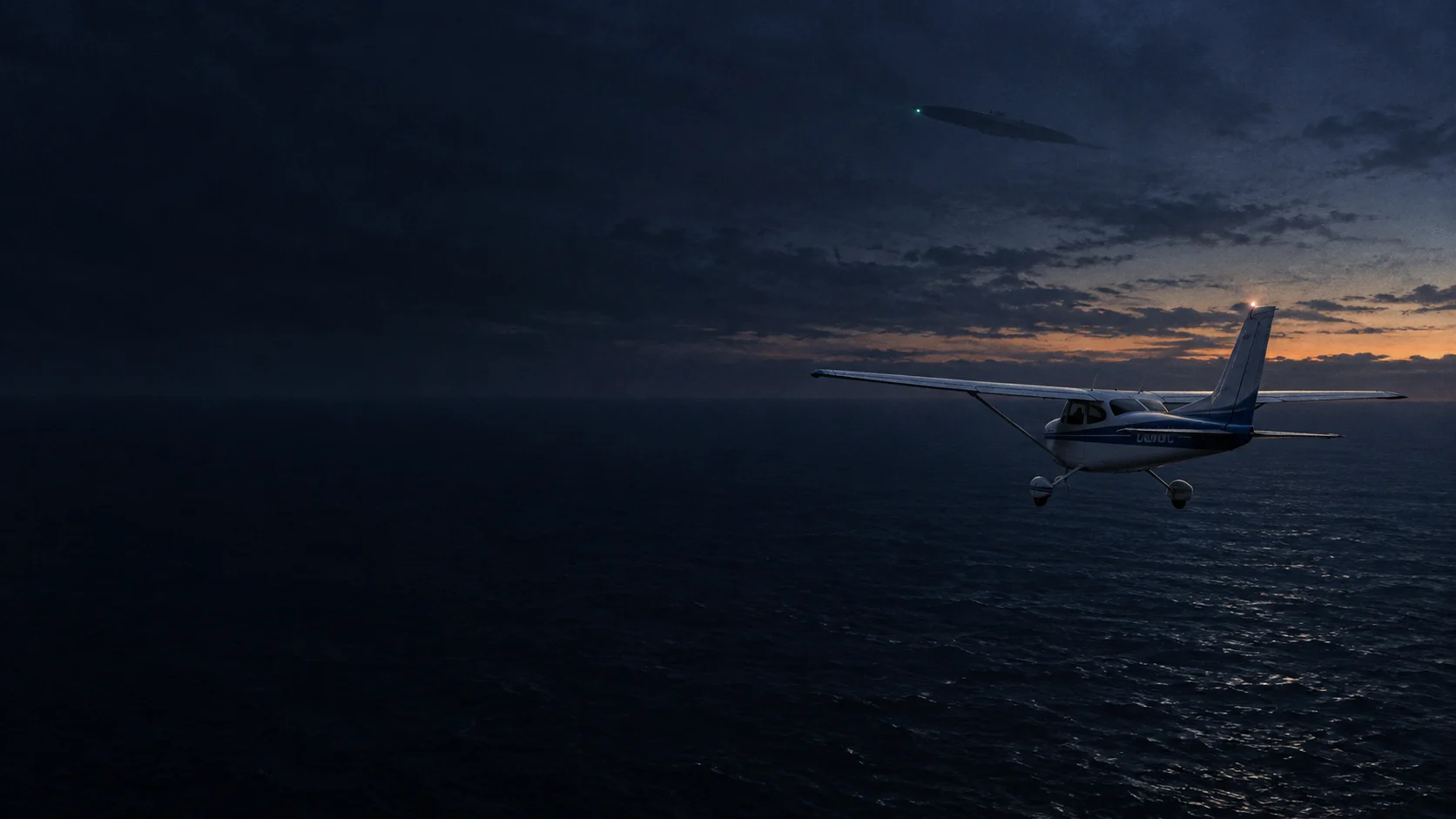
He was twenty years old, with approximately 150 hours of flying experience. His Class Four instrument rating authorized night flying in visual conditions. The aircraft was a Cessna 182L, registered VH-DSJ. Over the radio, its final three letters became Delta Sierra Juliet.
The Cessna was refueled to capacity at 6:10. Nine minutes later, it departed Moorabbin. Valentich established two-way communication with Melbourne Flight Service after takeoff.
At seven, he reported Cape Otway. The flight had reached the landmark that divided its coastal approach from the crossing to the island. The next report, six minutes later, concerned the lights.
The Tasmanian Aviation Historical Society’s later account places the journey within a planned outward leg of sixty-nine minutes. King Island was a destination with an expected arrival, a place where the aircraft should eventually come down out of the evening sky.
A Thousand Feet Above
At 7:07:32, Valentich called again. He said the aircraft had just passed over him, at least a thousand feet above.
Melbourne asked him to confirm that it was a large aircraft. The speed made identification difficult, he replied. Then he asked whether any Air Force aircraft were nearby.
Again, Flight Service reported no known aircraft in the vicinity.
In the recorded sequence preserved by the Department of Transport, the sight had already changed position. What began as lights at a level below five thousand feet was now being reported above the Cessna. Valentich kept trying to describe it in terms Melbourne could use: height, movement, a possible military aircraft.
At 7:08:18, he reported it approaching from due east.
Then came a brief interval with the microphone open. A few seconds later, he described repeated passes: the object was flying over him two or three times, at speeds he could not identify. To him, the behavior seemed like a game.
The conversation continued to alternate between the pilot’s changing view and Melbourne’s attempts to make it precise. On one side of the radio was someone looking out of an aircraft. On the other was someone asking him to turn that sight into information.
Four Five Zero Zero
Melbourne asked for his actual altitude.
Valentich answered: four and a half thousand feet. He repeated the number in the form used over the radio, four five zero zero.
The next question returned to identity. Could he confirm that he could not recognize the aircraft? He could.
For a moment, the exchange held to that small, definite piece of information: his altitude. Around it, the descriptions remained in motion. The lights had become a passing aircraft, then something making repeated approaches. Melbourne acknowledged him and asked him to stand by.
At 7:09:28, Valentich changed the description again.
He said it was not an aircraft.
The sentence continued only as far as an attempt to say what it was. The microphone stayed open for two seconds. Melbourne then asked him to describe the thing he was seeing.
As it flew past, he said, it had a long shape. He referred again to its speed. There were further pauses with the microphone open, followed by another position: it was in front of him now.
The words arrived in fragments, separated by acknowledgments and moments when the channel carried no completed sentence. Each return of his voice gave Melbourne another part of the view.
The Green Light
At 7:10:07, Melbourne asked how large the object was.
Valentich’s answer shifted from size to movement. It seemed stationary, he said. He was orbiting, and the thing was orbiting above him too.
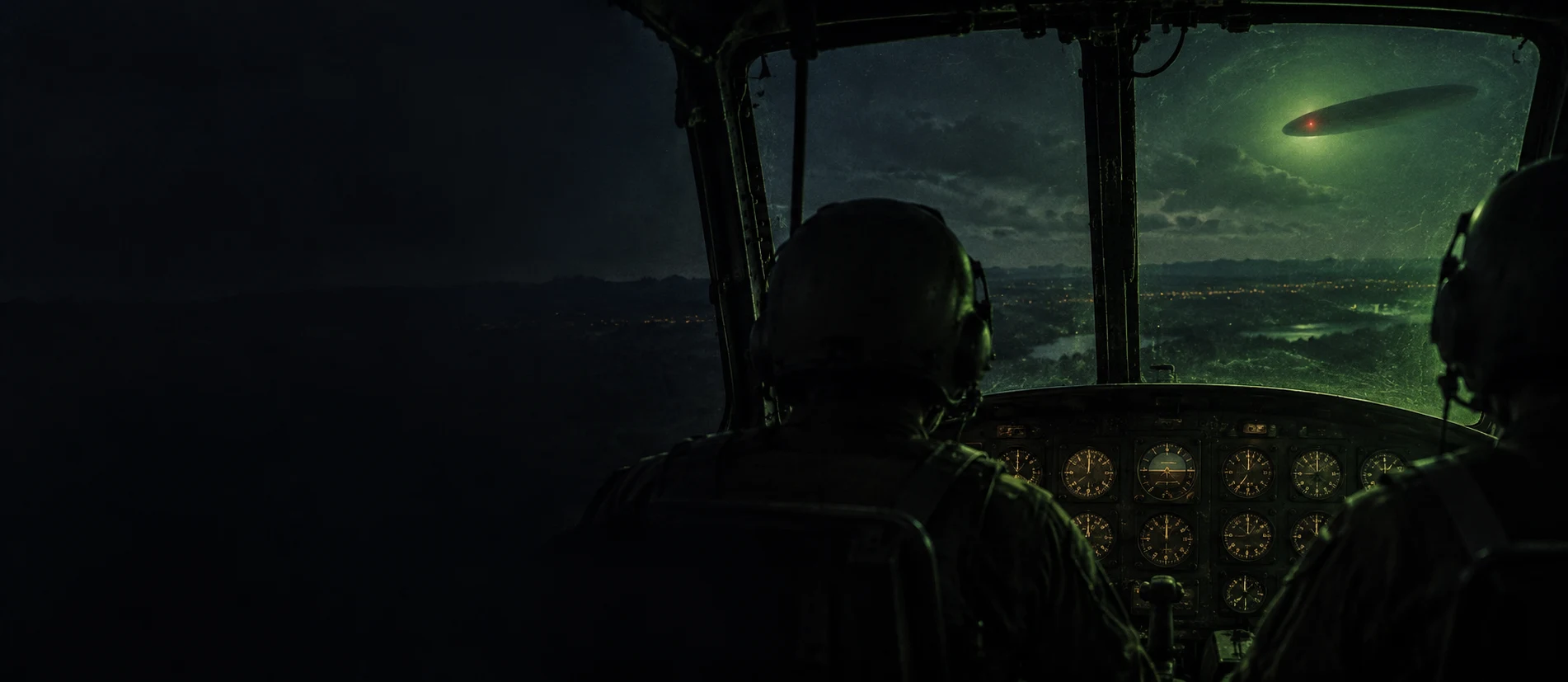
Then he supplied the details that would remain among the case’s most recognizable images: a green light, a metallic appearance, an exterior that looked shiny.
For someone reading the exchange afterward, this is the closest the description comes to a surface. The earlier report had offered brightness and speed. Now there was color and something that looked like material around it, seen while the pilot described his own aircraft turning.
Melbourne acknowledged the call.
At 7:10:48, Valentich reported that the object had vanished.
The conversation did not stop with that disappearance. He asked whether Melbourne knew what kind of aircraft it was, returning once more to the possibility that it might be military. Flight Service sought confirmation that it had gone.
Valentich asked for the question to be repeated. Melbourne asked whether the aircraft was still with him.
At 7:11:23, he reported another approach, this time from the southwest.
The position had changed again. A little more than five minutes after the first traffic query, the radio was still connecting Melbourne to a pilot describing something around his Cessna. Each apparent departure had been followed by another description.
The Engine Changes
At 7:11:52, his attention turned to the aircraft he was flying.
He reported rough engine running. He gave a power setting, twenty-three to twenty-four, and described the engine as coughing.
Melbourne asked his intentions.
He intended to go to King Island.
The answer kept the original destination in the conversation. There was still a place ahead, still a journey he said he meant to complete. But in the same transmission he returned to the thing above him, reporting that it was hovering over the Cessna again.
He ended that description with the words:
“It is hovering and it’s not an aircraft.”
Melbourne acknowledged him at 7:12:22.
Six seconds later, Valentich transmitted his call sign and addressed Melbourne. Then the microphone remained open for seventeen seconds. An annotated reproduction of the transcript describes an unusual pulsed sound during this final transmission.
At 7:12:49, Flight Service called Delta Sierra Juliet again.
The written exchange ends there.
The Island Waits
The radio conversation had lasted a little over six minutes. The expected journey continued to exist in the flight plan after the voice had stopped.
Search and rescue procedures entered their alert phase at 7:12. At 7:33, when the Cessna had not arrived at King Island, the distress phase was declared and search action began. Aircraft and people on sea and land searched through October 25. The official summary records the operation’s dates and outcome.
The disappearance was soon a story far beyond the strait. A UPI report published on October 25 described the continuing search and the questions surrounding the recorded conversation. Guido Valentich, Frederick’s father, spoke publicly of his belief that his son was still alive.
For his family, the final messages belonged to someone they were waiting to hear from again. For Flight Service, Delta Sierra Juliet was an aircraft that had stopped answering. The search brought those two kinds of waiting to the same stretch of water.
Twenty years later, the family placed a memorial plaque at Cape Otway. ABC’s retrospective records that it was unveiled by Steve Robey, the Flight Service officer who had spoken to Frederick that evening.
The man on the other end of the radio returned to the coast from which the pilot had reported his crossing. The final conversation had outlasted the flight, becoming something people could return to, word by word, while the water remained before them.
What Is Known
The principal record is the Department of Transport’s accident investigation summary, approved for publication on April 27, 1982 and now preserved by the Australian Transport Safety Bureau. It documents the preparations, departure, Cape Otway report, timed radio exchange and search. Its conclusion states that the reason for the aircraft’s disappearance was not determined. The pilot’s injury is recorded as presumed fatal.
The larger archival investigation file, held in National Archives series B1497 under control symbol V116/783/1047, preserves departmental correspondence and investigation material. These official records establish the flight and what Valentich reported. His description of an unidentified object does not establish its origin or a cause for the disappearance.
All times here are local standard time, following the official summary. The report places the end of daylight at Cape Otway at 7:18 p.m., several minutes after the final exchange. This was a flight into the evening, rather than an encounter that should automatically be pictured in complete darkness.
The narrative follows the official transcript’s wording. The UFO Research NSW version includes later annotations and interpretations; those are distinct from the original exchange. Its note about the final sound is presented as an annotation, without assigning that sound a physical cause.
The Bigger Picture
Cape Otway was already a place where people looked across dangerous water and thought about journeys that might not end as planned.
The Great Ocean Road Coast and Parks Authority’s history dates its lighthouse to 1848. The tower stands above sea cliffs where Bass Strait meets the Southern Ocean. Its purpose gives the coastline a long association with navigation, arrival and the effort to make a passage safer.
In Valentich’s story, the coast is both a reporting point and a place of remembrance. The aircraft continued toward the island; decades later, those connected to the flight gathered back at the cape.
ABC Radio National’s 2019 documentary, Last Light, returned to the case through people including Robey and Rhonda Rushton, Frederick’s girlfriend at the time. That choice of voices restores the human scale of a story often reduced to a strange final sentence. Someone was flying. Someone was answering. Other people expected him home.
The radio preserved that relationship while the encounter unfolded. The call sign recurs through the conversation, keeping an identifiable aircraft at the center of increasingly unfamiliar descriptions. Then Melbourne uses it once more and the exchange ends.
The lasting mystery is inseparable from that last attempt at contact: an ordinary call made across the strait, addressed to a young man who had been answering only moments before.
Sources
- Department of Transport, Aircraft Accident Investigation Summary Report, April 27, 1982, preserved by ATSB. Official report and radio transcript, reference V116/783/1047; the main chronology used here.
- Department of Transport investigation file, NAA B1497 V116/783/1047, barcode 10491375. Archival scan mirrored by The Black Vault; includes the summary and departmental papers.
- ATSB occurrence record 197802563. Official catalogue record and report access.
- UFO Research NSW, final communications transcript. Reproduction with later analytical annotations, distinguished from the official text.
- W. Dearing, “Mysteries of Aviation — Frederick Valentich and VH-DSJ,” July 2020. Tasmanian Aviation Historical Society retrospective drawing on the report.
- UPI, “Officials Deny Cover-Up,” Manchester Evening Herald, October 25, 1978, p. 17. Contemporary reporting on the search, transcript controversy and Guido Valentich’s statements.
- Carol Rääbus, ABC News, July 7, 2016. Later reporting, including the 1998 memorial ceremony.
- ABC Radio National, Last Light: the Valentich Mystery, June 4, 2019. Documentary featuring later participant interviews; program description used for the closing context.
- Great Ocean Road Coast and Parks Authority, Cape Otway Lightstation history. Independent historical and geographical context.