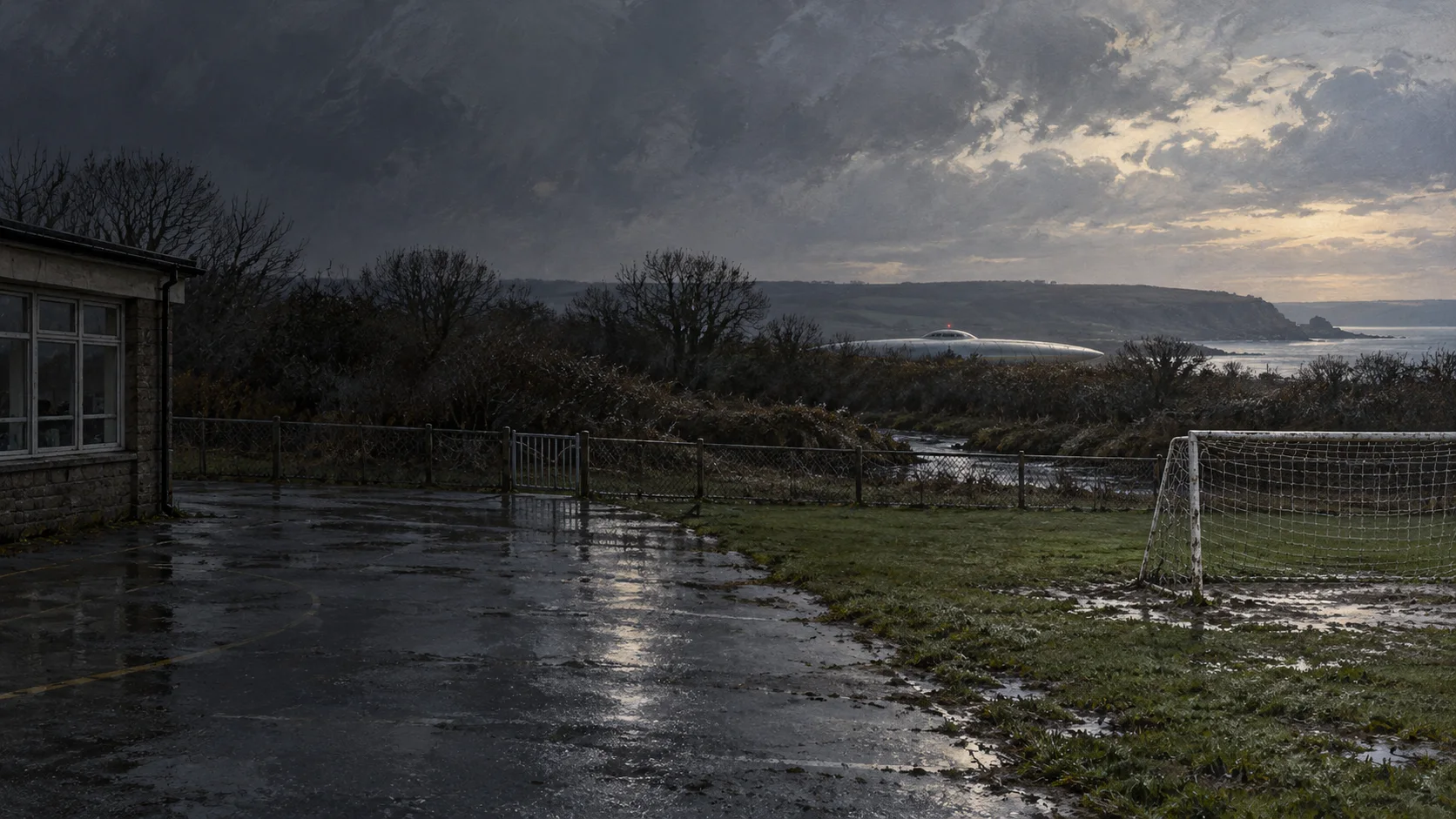
Someone on the football field pointed past the school boundary.
Beyond the fence and the stream, a line of bushes interrupted the view into the neighbouring field. On Friday, February 4, 1977, pupils at Broad Haven County Primary School in Pembrokeshire said they could see something silver there. It looked low to the ground and partly hidden. Some thought it was trying to rise.
The children were at school for an ordinary lunch break. According to historian David Clarke’s account of the school records, boys had been playing football in the rain when one of them noticed the object. Word spread among the pupils. A few reported more than a shape: they said a figure in a silver suit stood near it.
By the time the story reached the adults, it had already passed through several sets of eyes. The school would eventually have drawings, written accounts and a diary entry. But first there was only a group of children looking across the hedgerow and trying to tell someone what they had seen.
Across the stream
The object was reported in the field beyond the playground, not directly above the school. That distance matters to the scene. The British UFO Research Association’s account published later that spring placed it within a quarter-mile of the school and partly behind bushes. The journal said the playground was fenced, with a stream between the children and the field. They could watch, but they could not simply walk across for a closer look.
Descriptions overlapped without being identical. Some pupils called the shape a cigar. Nine-year-old Jeremy Passmore described a silvery-green lower part, a raised dome and a yellow-orange to red light. He also reported a person in a similarly coloured suit hundreds of yards away. Other children described a silver-suited figure, but the figure did not appear in every account.
The journal gives the reports a broad window, from about one o’clock until 3:45 that afternoon. It does not say that every child watched continuously for nearly three hours. Passmore’s own description put his sighting at up to twenty minutes. Decades later another pupil, David Davies, would remember only a few seconds. The differing lengths are part of the historical record, not a single shared stopwatch.
One reported motion gave the strange shape a narrative of its own. Some children said it first seemed stuck, then appeared to try to take off before going behind the bushes. From their side of the fence, the hedge could conceal both the object’s lower part and whatever happened when it left their view. In the moment, they saw an apparent movement; afterward, they were left trying to describe a disappearance.
The boy who went to look
Davies, then ten, later recalled that other pupils had tried to alert the headteacher during the day. He did not begin as one of the children trying to convince an adult. In a BBC interview many years afterward, he said he went out expecting to show his classmates they were mistaken.
What he remembered seeing was an elongated silver object, roughly the size of a bus, with a domed upper section and a red glow on top. In a 2017 interview for The One Show, he described it appearing from behind the tree line, then disappearing again. The sight lasted perhaps ten seconds. He remembered running away.
That is a later memory, recorded forty years after the school day. It gives Davies’s own path into the story: first hearing others’ claims, then going to the spot himself. It also leaves a difference between his brief view and Passmore’s longer account. Their recollections cannot be fused into one continuous sighting, though both attached the same basic silver, domed shape to the field beyond the school.
The reports were enough to make the pupils persist. Clarke’s reconstruction says that after school, some continued looking for the object. With their parents’ support, children also went to the local police station. The story had travelled from the football field to the school building, then out into the village before the weekend began.
Monday’s pages
Headteacher Ralph Llewellyn faced the children again on Monday, February 7. According to the school diary that Clarke examined, Llewellyn interviewed fifteen pupils separately and studied their written accounts and drawings. The pages became the most enduring objects in the Broad Haven case: children translating a fleeting view past the hedges into a shape that could be compared and shown to others.
The accounts repeated several elements. There was a broad silver form, a raised part above it, sometimes a light. The drawings also varied, as children’s drawings do. Llewellyn noticed both the resemblances and the differences. He was reluctant to think the children had mounted a sustained, elaborate deception. He accepted that they believed they had seen something unfamiliar while still seeking an ordinary explanation.
The timing is easily lost when the pages are reproduced. Llewellyn asked for them on Monday, three days after the Friday sighting. The pupils had been apart from school but had an entire weekend in which they could speak to one another and to their families. They drew separately in the schoolroom; they did not bring completely untouched memories to the paper. That distinction belongs to the story of how the evidence was made.
Llewellyn’s task was more immediate than deciding what crossed the field. A group of pupils had come to him with an account they insisted was true. Separating them for interviews gave each a chance to describe it in their own way. Preserving the drawings gave the school a record that would outlast that Monday and soon be seen well beyond Pembrokeshire.
The picture leaves the school
Local investigator Randall Jones Pugh, working with the British UFO Research Association, gathered accounts from the area. The association’s May–June 1977 journal printed a short Broad Haven report and reproduced four impressions made by the school’s children. The same page included drawings from a separate Welsh school sighting; the figures were labelled so readers could tell which belonged to Broad Haven.
The journal’s editor did not pretend the brief article was a complete investigation. He noted the volume of reports and hoped for fuller treatment later. What it did preserve was close to the event: a date, a place, a count of pupils, Passmore’s description, the field and its intervening bushes. The story was already beginning to travel through magazines, newspapers and television, but the early report still kept the scale of the schoolyard view.
National television brought cameras back to Broad Haven. Clarke notes that the pupils were interviewed at the school. The children were no longer only witnesses for their teachers and parents. Their drawings could be held up for a broadcast audience, and the silver form beyond the playground became a public image of the village.
The physical field did not follow the story. The hedge, fence and stream stayed where they were; the accounts moved from page to page. That shift helps explain why Broad Haven remained compelling. Viewers far away could compare outlines on paper without ever seeing the angle or distance from which the children had made their observations.
A second look from the school
Thirteen days after the pupils’ reports, the school appeared in another entry. The BUFORA retrospective chronology records that on February 17 a teacher leaving at about 10:30 a.m. reported a large, shiny oval object in the sky, with a small dome and ridges along its body.
This was a separate sighting with a different witness and position. It did not turn the children’s February 4 observation into an adult observation of the same object. It did, however, keep the school within the unfolding Pembrokeshire wave. Other reports across the area soon drew attention, and the press gave the region a name: the Dyfed Triangle.
The Ministry of Defence received drawings and accounts from the school, as Clarke recounts from the released files. Its interest in the wider 1977 reports belongs to that larger wave, not to a secret confirmation of what stood behind the playground. For Broad Haven, the decisive public record remained the children’s accounts, Llewellyn’s diary and drawings, and the early investigator’s report.
Years later, Davies returned to the spot with a television crew. The camera could show the school and the field; his memory supplied the ten seconds between them. In the 2017 interview he would go no further than saying he had seen an unidentified object. The case that had expanded into a regional legend still returned, for one witness, to a shape emerging above the bushes and then vanishing from sight.
What Is Known
The Broad Haven report has a contemporary paper trail. The May–June 1977 BUFORA Journal printed an early summary, a description attributed to Jeremy Passmore and several pupil drawings. It said up to fourteen pupils reported an object in the field and that some reported a suited figure. Clarke, using the school diary and Ministry of Defence material, counted fifteen pupils interviewed by Llewellyn. Those figures describe slightly different things: the early publication’s reported witnesses and the headteacher’s Monday interviews.
The drawings were collected separately on February 7. Their shared outline is a useful record of what the pupils were willing to put on paper. It is not proof that their descriptions developed without contact: the event was on February 4 and the intervening weekend gave time for discussion. Llewellyn’s own position was measured. He was unwilling to dismiss a coordinated group of pupils as fabricating the entire account, but he remained open to a natural explanation.
Davies’s 2017 BBC interview and 2024 BBC News account are firsthand testimony recorded decades later. They preserve his continuing belief that he saw something strange, as well as the short duration he remembers. Passmore’s longer duration belongs to the 1977 published account. Neither timing should silently replace the other.
The official files show that reports and drawings reached the Ministry of Defence; the National Archives’ guide explains the wider collection of released UK UFO correspondence. The existence of an official file shows that the report was received and retained. It does not identify the object or establish that a craft landed beside the school.
The Bigger Picture
Broad Haven’s most distinctive evidence is also a record of a school responding to its pupils. Llewellyn listened to children who had been telling one another and the adults around them about the field. He separated them, collected accounts and kept the pages. The drawings took a local report beyond the village precisely because they could be copied and compared.
Clarke places Broad Haven among several British school sightings reported in 1977. He notes another Welsh school in which children and a teacher described an unusual object, and a much wider spread of news coverage. That context explains why the Broad Haven pages found an audience without making the separate sightings proof of one another. Once the schoolyard story was on television, it became part of the setting in which later reports were heard.
The contrast between the Friday view and Monday’s drawings remains the case’s most useful boundary. The children described a distant object with overlapping features. Their headteacher treated them seriously enough to preserve their words and pictures. The resulting record tells us a great deal about what was reported and how the story grew, while leaving the shape beyond the hedge unidentified.
The playground fence divided the pupils from the field. The diary, drawings and early journal now divide a brief afternoon from nearly fifty years of retelling. Across both distances, Broad Haven is still a story of children pointing beyond their ordinary school day and asking adults to look with them.
Sources
- BUFORA Journal, vol. 6 no. 1, May–June 1977, pp. 13–14. Contemporary investigator’s summary with Jeremy Passmore’s description and reproduced pupil drawings, digitized by the Archives for the Unexplained.
- Ralph Llewellyn’s 1977 school diary, examined and quoted by David Clarke. Contemporary school record accessed through a later historian’s account; the original diary is not reproduced in full here.
- David Davies, interview on BBC The One Show, April 25, 2017. Later firsthand recollection, available as a programme transcript.
- Shola Lee, “UFOs: From psychology to air traffic, are we closer than ever to an answer?”, BBC News, June 30, 2024. Later interview with Davies and independent context on eyewitness accounts.
- David Clarke, “Close Encounters of the Playground Kind,” 2017. Archival reconstruction and context by a researcher who examined the school diary and Ministry of Defence files.
- BUFORA New Journal, no. 4, October 2002. Retrospective Welsh case chronology, including the separate February 17 school report.
- The National Archives, “UFOs” research guide. Institutional guide to the provenance and release of UK Ministry of Defence UFO files.