The dog would not stop barking.
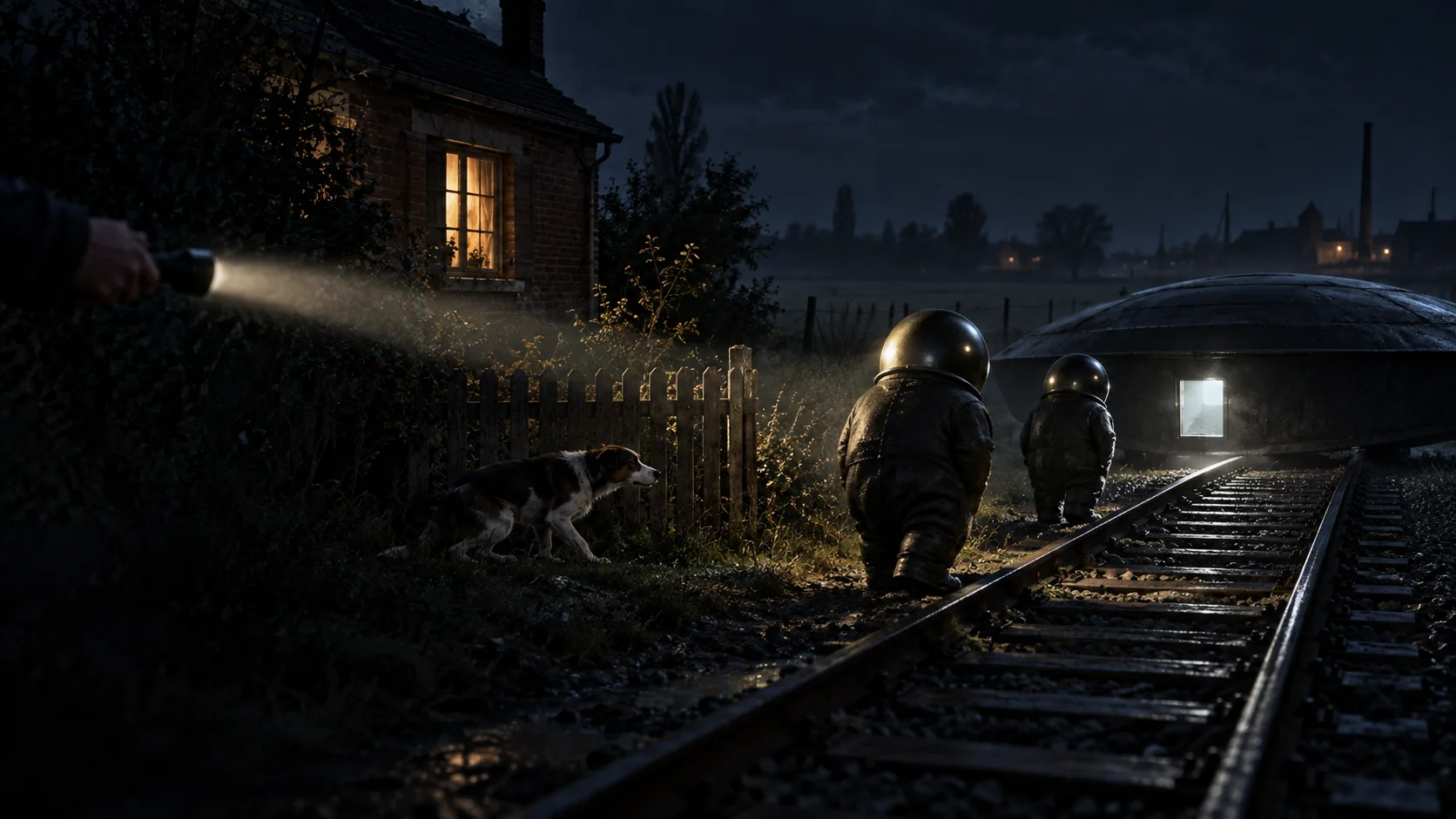
Marius Dewilde was reading at home when the noise drew him outside with a torch. It was late on Friday, September 10, 1954. His small house stood beside a railway crossing at Quarouble, near the Belgian border in northern France.
He expected a prowler.
In the account published two days later by La Croix du Nord, Dewilde first noticed a dark shape a few metres away. He took it for a farmer’s cart. Then he saw small figures coming from a nearby path towards the crossing.
His torch caught the head of one of them. Something reflected the light like glass.
The dog had brought him to the door. Within moments, the metalworker would be describing a brilliant light, an object rising from the railway and a disappearance towards the west.
Beyond the garden fence
Dewilde worked at the Ateliers du Nord de la France in Blanc-Misseron. His address was level crossing 79. Living in a crossing keeper’s house would cause some later accounts to turn him into a railway employee, but the early reporting identified him as an industrial worker.
The railway was part of the view from his home. In La Voix du Nord’s September 12 report, the dog alternated its attention between Dewilde and the line beside the house. Looking more carefully, he distinguished an oval, domed mass resting there.
He estimated it at roughly six metres long and three metres high. At first, its darkness and position suggested something ordinary left in an inconvenient place. The unfamiliarity came in stages: an obstruction on the track, the dog’s attention shifting, and movement in another direction.
According to Nord-Matin that same day, the dog crawled towards him. Dewilde turned towards a small path leading into pasture and saw two short figures moving towards the crossing.
His first explanation was smugglers bent beneath their loads. People sometimes used that path at night. Then the torchlight reached one of their heads, and the comparison ceased to fit what he thought he was seeing.
The reflection in the torchlight
The fuller account attributed to Dewilde in Paris-Presse on September 14 placed the figures just beyond the palisade, only three or four metres away. They moved one behind the other towards the dark mass on the railway.
The leading figure turned towards him.
Dewilde described a reflection where its face should have been. He had the impression of a head enclosed inside a helmet, with the body covered by a single suit resembling a diver’s outfit. The figures were very short, perhaps less than a metre tall, but exceptionally broad across the shoulders. Their helmet-like heads looked enormous above the small bodies.
He could make out legs. He could not distinguish arms.
That distinction matters to the remembered scene: he described the limits of a brief torchlit view, rather than giving an anatomical inventory. The strange appearance lay in the proportions and the enclosing clothing, with no visible face to recognise.
In this version, his first astonishment gave way to action. He moved towards the garden gate, intending to get around the fence and intercept at least one of the figures.
The square of light
Then the dark object became a source of light.
The September 14 report in Libération described a square opening and a green beam. Dewilde, it said, found himself paralysed where he stood. He could move again when the light went out, by which time the figures had disappeared and the object was rising.
For the man holding the torch, the encounter had reversed. A moment earlier, he had been illuminating something beyond his fence. Now a much stronger light was directed towards him, interrupting his attempt to approach.
The earliest accounts convey his distress through simpler descriptions too. Nord-Matin compared the brightness to a magnesium flash and described him as blinded and paralysed by fear. La Voix du Nord recorded that he closed his eyes and afterwards found his legs numb.
In each telling, the light breaks the continuity of his view. He sees the figures near the object, is dazzled, and then sees the object depart. The interval that would become the most dramatic part of the encounter is also the moment when he could see least.
Above the railway
When Dewilde looked again, the mass was lifting from the line.
In the account carried by La Voix du Nord, it swayed slightly as it rose vertically, giving off smoke. At an estimated height of ten metres, its underside reddened. Then it disappeared quickly. Dewilde described little sound, apart from a breath-like noise at departure.
The dark shape he had mistaken for a cart had become, in his account, something capable of leaving the railway altogether.
Nord-Matin gave the direction as west, towards Anzin. A place he could have pointed out from his garden became the starting point of a flight he could no longer follow.
He went to wake his wife.
The episode had taken seconds. Reporting it would occupy the rest of the night, then draw investigators and journalists back to the small house for days.
The journey to Onnaing
Journalist Michel Duforest later reconstructed Dewilde’s efforts to reach the authorities in a signed September 16 report for Nord-Eclair.
Dewilde left on his motorcycle for the gendarmerie at Quiévrechain. He rang and knocked, but the office remained closed. At a nearby café, he explained what he said had happened. Someone suggested the police station at Onnaing.
He continued there, arriving shortly before midnight. Duforest reported that the officers remembered him as pale and shaking. They initially declined to wake their commissioner, but promised a visit in the morning. After Dewilde left, they changed their minds and alerted him.
Commissioner Gouchet subsequently went to the house and took an account at the scene. The air police also became involved.
The night thus acquired a second route: away from the garden, along roads to a closed office, through a café and into a police station. Dewilde had brought a startling claim into places where other people could observe him, question him and arrange to inspect the railway.
Looking at the sleepers
The first regional reports described searches that found no convincing trace. By midweek, the newspapers were reporting marks on the wooden railway sleepers.
France-Soir on September 15 described five indentations on one sleeper, each covering about four square centimetres. The marks were said to lie in a line, with measured intervals between them. An unnamed inspector compared their arrangement to what a craft resting on supports might leave.
The report also described searches of the surrounding ground that found no footprints. Attention had shifted from the path of the figures to the place where Dewilde said the object had rested.
The same newspaper carried reports of a red glow seen from Onnaing and Vicq around the stated time. Those accounts brought other observers into the developing story, watching the sky from different locations.
At the house, meanwhile, the encounter could be represented in drawings. A sketch could locate the palisade, the railway, the figures and the object’s departure in relation to the door where the evening had begun.
A house full of questions
In a September 24 interview in Le Soir Illustré, Dewilde insisted that he would maintain his account, while objecting to having the word “Martians” put into his mouth. He said he did not know what the figures were.
The distinction was already difficult to preserve. A pair of unfamiliar silhouettes had become newspaper passengers from another world.
Nord-Matin’s September 25 follow-up described reporters, photographers and film crews converging on the house. Mrs. Dewilde was receiving many of the visitors. The paper also reported that her husband intended to complain about defamatory rumours, and that he had been told to leave the railway-owned premises because he was not an employee of the railway company.
The account had travelled far beyond the fence. For the family, the aftermath arrived at the same door through which Dewilde had gone to quiet his dog: more callers, more questions, and a dispute about the home itself.
What Is Known
Contemporary newspapers establish that Dewilde reported the encounter promptly and that police inquiries followed. The source archive preserves scans, transcriptions and translations of that coverage. It gives access to the developing public record; the newspaper articles are not themselves signed police findings.
Important differences appear within that early record. Some reports connect his inability to move with a green beam; others describe dazzling light and fear. Initial accounts report no significant trace, while later ones describe marks on sleepers. Even the number and arrangement of those marks vary between reports. The much-repeated estimate of a thirty-ton object belongs to subsequent interpretations, rather than a measurement of a vehicle.
The other reported lights concern observations of the sky. They do not establish that anyone else saw the figures beside Dewilde’s garden. His descriptions of helmet-like heads and bulky suits leave the occupants unidentified. Calling them robots adds an interpretation that their appearance alone cannot settle.
The Bigger Picture
Quarouble belongs to the French reporting wave of 1954, when accounts of lights, landed objects and supposed occupants moved quickly through local and national newspapers. Here, the contrast between everyday comparisons and extraordinary headlines is especially clear: Dewilde first thought of a cart and smugglers; the papers soon spoke of Martians.
France’s Service historique de la Défense places its UFO holdings within the history of official reporting. Its collection includes documents dating from 1954 to 1983. Collecting such testimony formed part of the gendarmerie’s intelligence duties, while a formal requirement to record the declarations came in 1974. From 1977, copies went to the newly created GEPAN at CNES. That history explains how unusual civilian accounts could enter official channels without an official inquiry establishing an extraterrestrial explanation.
Dewilde’s story retains its force at a much smaller scale. A dog barks, a man reaches for a torch, and familiar shapes fail to remain familiar. The fence and railway bring the reported encounter almost to his doorstep. The subsequent headlines enlarge the event, but its most arresting image remains that brief reflection: light returning from a head he could not recognise.
Sources
The newspaper material below is preserved in Patrick Gross’s archive. These are distinct contemporary publications, often drawing on overlapping testimony and news circulation, rather than ten independent confirmations.
- La Croix du Nord, September 12, 1954, pp. 1, 8. Early regional account; scan and transcription.
- Nord-Matin, September 12, 1954, pp. 1, 8. Early account, including the dog and fear description.
- La Voix du Nord, September 12, 1954, p. 3. Early encounter narrative and initial police search.
- Paris-Presse, September 14, 1954. Fuller account attributed to Dewilde, transcribed in the dossier.
- Libération, September 14, 1954. Contemporary French report describing suits and a green beam.
- France-Soir, September 15, 1954, pp. 1, 6. Reports of railway marks, searches and nearby lights.
- Michel Duforest, Nord-Eclair, September 16, 1954. Signed on-site reporting, including the journey to notify police.
- Le Soir Illustré, September 24, 1954. Contemporary interview, drawings and photographs.
- Nord-Matin, September 25, 1954, p. 2. Follow-up on publicity and the housing dispute.
- Service historique de la Défense, UFO collection inventory. Independent institutional context for French reporting procedures.