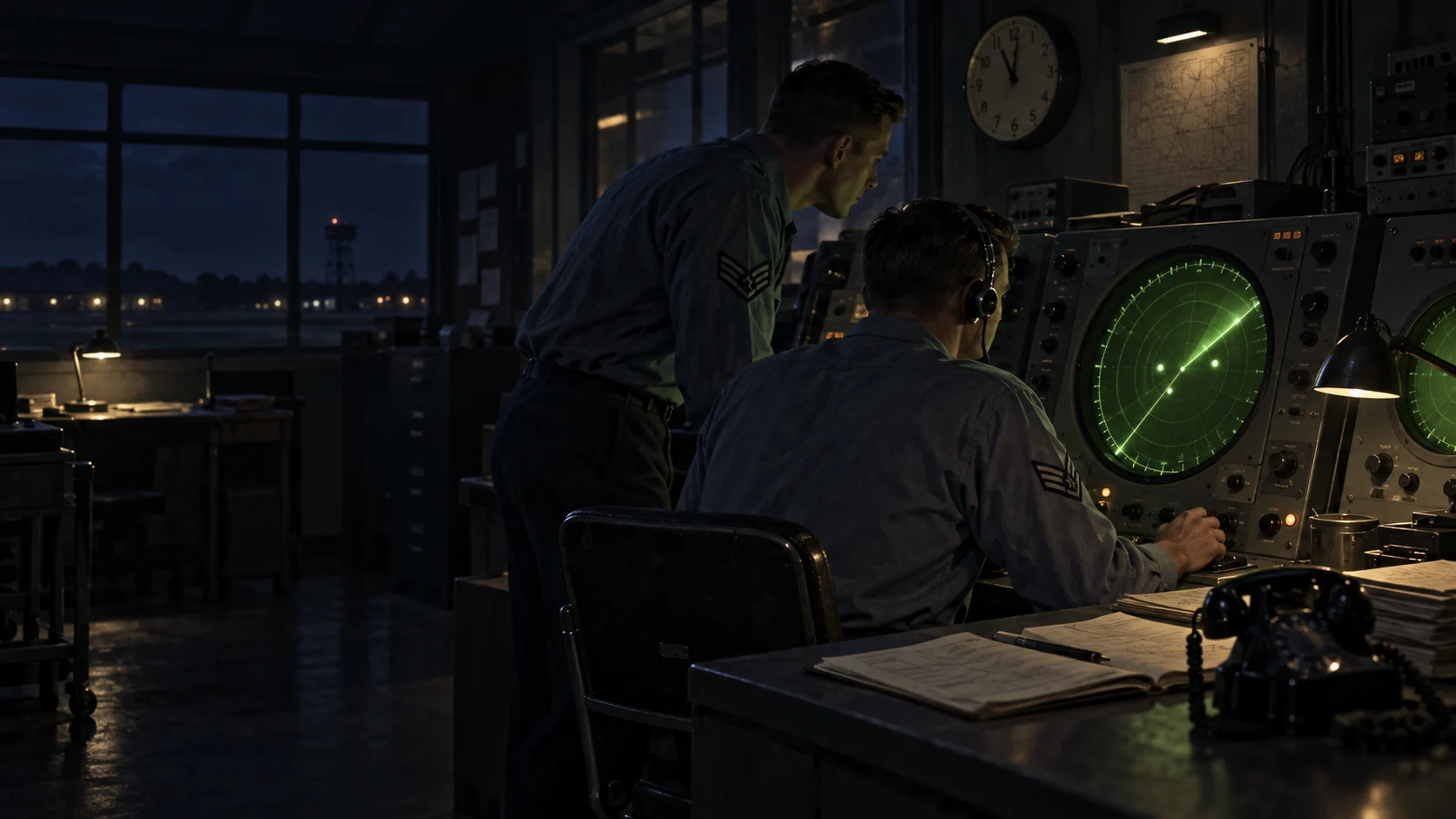
Edward Nugent was watching the radar at Washington National Airport when he called his supervisor over to the screen. It was the night of July 19–20, 1952. The returns on the Air Route Traffic Control Center display did not belong to flights the controllers could identify.
Harry G. Barnes came to Nugent’s position and counted several of them. In the report Barnes submitted to the Air Force days later, the marks moved through the airspace around the capital at speeds he estimated were roughly 100 to 130 miles per hour. The controllers were responsible for knowing what occupied that airspace. Now they were looking at positions without names.
Barnes had the radar equipment checked. He also asked other facilities what they could see. The questions carried the incident out of his windowless radar room and across the city’s network of towers, controllers and pilots. Before the night ended, people at several stations would report radar returns or lights. A commercial aircraft crew would be asked to look into the same sky.
The following Saturday, the screens would fill again. That time, the Air Force would send fighters.
A second screen
The first call went to the tower at Washington National. Its radar served a different part of the airport operation. The tower staff reported unidentified returns of their own, then contacted the Air Route Traffic Control Center. Personnel at Andrews Air Force Base, across the Potomac, also reported observations during the night. The Air Force’s July 22 account based on tower personnel records the tower’s five radar targets shortly after midnight on its clock, along with reports of three objects seen from Andrews in the indicated area.
The tower account also describes an orange, disk-shaped light seen visually by controllers over Washington. A separate observer at Bolling Air Force Base described a roundish object moving toward the southeast. Those reports came from different positions and by different means. For the controllers trying to manage traffic, the immediate problem was simpler: unfamiliar indications were appearing while ordinary aircraft still had to be guided safely through the region.
Barnes’s center checked its radar with maintenance personnel. The unidentified marks remained part of the night’s work. Barnes later wrote that they sometimes disappeared and reappeared, and that his staff compared their movement against flights under control. The observations did not settle into a single, easily tracked route. They drew more people into the watch.
One of those people was already flying out of Washington National.
Pierman’s departure
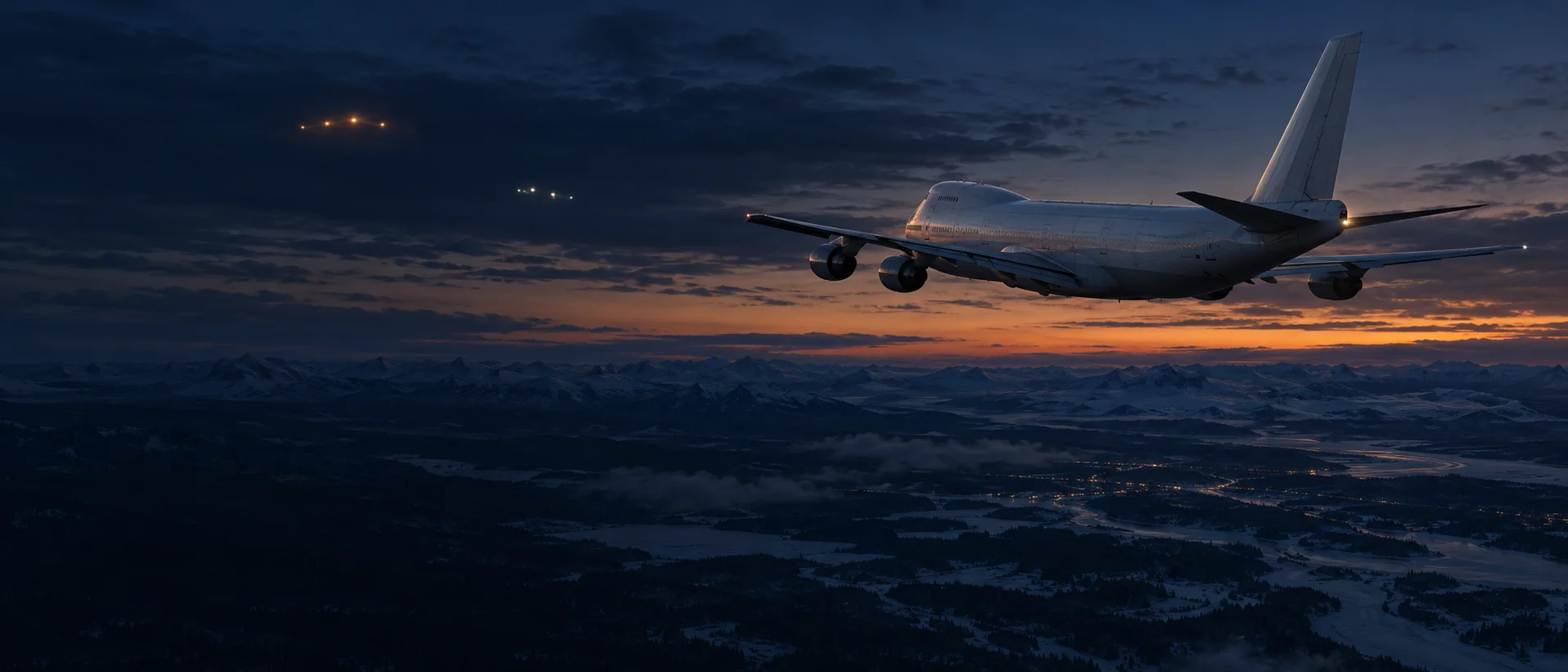
Captain S. C. “Casey” Pierman and copilot Charles Wheaton were operating a Capital Airlines DC-4. After takeoff, air traffic control told them about unidentified targets ahead of their aircraft. In Pierman’s Project Blue Book report, preserved in an archival transcription, the crew’s account becomes a second view of the night: not a radar sweep from the airport, but lights seen from a moving airplane.
Pierman reported bluish-white lights, as many as seven in his account. Some seemed to approach and then move away; others appeared off to the side. The crew could see them for only a portion of the flight. Pierman’s report and the controllers’ radar observations were later brought together as one case, but the pilot described what he saw through the cockpit windows. He did not claim to have identified the marks on the ground radar screen.
The separation matters to the story as it happened. Barnes’s controllers were following returns and asking pilots to check the air outside. Pierman and Wheaton supplied a visual report while continuing their flight. Each group knew a piece of the night; the telephone and radio traffic connected their accounts.
Daniel Lang’s contemporary reporting captured the unusual exchange between air and ground: controllers looking at their screens, a pilot watching bright lights, and other aircraft in the area whose crews saw nothing remarkable. As dawn approached, Barnes’s team was still recording unidentified targets. His account gives no moment when the mystery ended. Traffic continued, and the reports passed into Air Force files.
For six days, the first weekend was a remarkable set of observations. Then a new set appeared in the same airspace.
The next Saturday
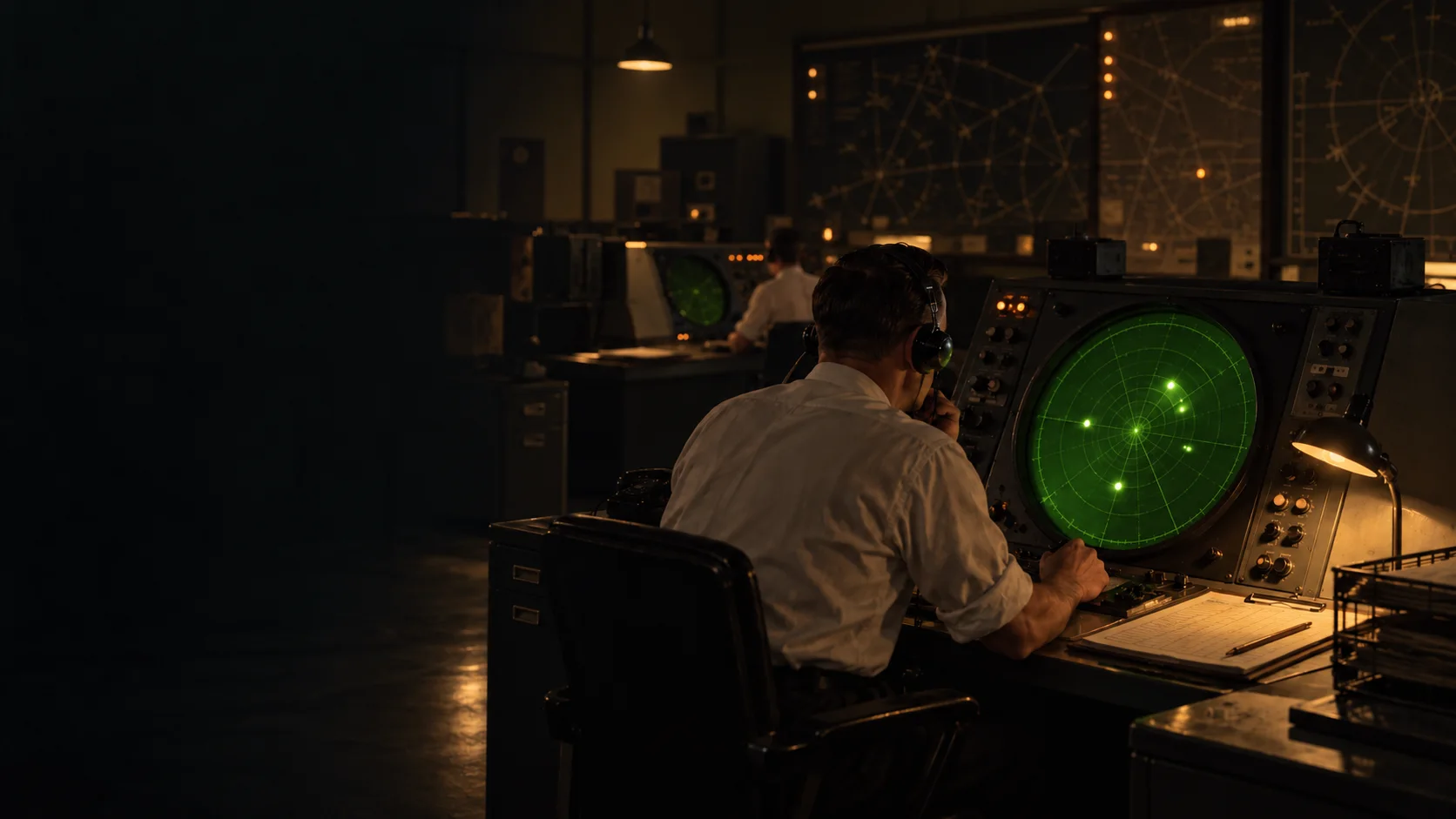
On July 26, at about 9:50 p.m. Eastern daylight time, controllers in the Air Route Traffic Control Center again saw unidentified returns. The contemporary Air Force report for the second weekend records as many as twelve on the center’s scope at once. Four appeared roughly in a line and moved together; others were scattered elsewhere on the display. The center called Andrews Approach Control at 10 p.m. and was told that unidentified targets were appearing there too.
The tower at Washington National had a more limited observation that night. Its radar operators positively identified one return as unexplained, describing it as a strong target moving west to east. They did not report the center’s twelve-target pattern on their own screen. The airport’s radar positions looked at the same broad region for different purposes, and the Air Force record kept their accounts distinct.
Reports from aircraft added another layer. A Civil Aeronautics Administration flight-inspection pilot told controllers that he had seen five lights, orange to white, while flying at about 2,200 feet. Some commercial pilots also reported lights. Near the same time, a military B-25 was directed toward several radar positions. According to the center’s report, its pilot noticed that the directions repeatedly brought him over busy highway intersections below.
The controllers continued to handle their usual traffic while these calls arrived. Their radar sets showed known aircraft as well as the returns they could not identify. At 10:38 p.m., the Air Force command post was notified of the unidentified targets. The decision to send fighters followed.
Fighters from Delaware
Two F-94 interceptors were scrambled from New Castle, Delaware, at 11 p.m. Controllers at Washington National directed them toward targets shown on radar. The crews made passes through areas where marks appeared on the center’s scope, generally without seeing anything ahead of their aircraft. The Air Force case report records that one pilot reportedly saw four lights on one occasion and, later, a single light he could not close on before it went out.
That description reached the report through conversations with the radar controllers. The writer stated that the interceptors’ official reports had not yet arrived. In the record available at that moment, the controllers’ account of what the pilots said was the route by which their observations entered the case.
At about 12:15 a.m. on July 27, Major Dewey Fournet of Air Force intelligence and Navy Lieutenant John Holcomb arrived at the Air Route Traffic Control Center. Holcomb watched the scopes and counted seven returns he considered solid. He also checked the airport’s weather information. It showed a slight temperature inversion, a shallow layer in which air warmed with height rather than cooling as usual. Holcomb did not initially think that layer accounted for the strong returns he was watching. He recommended another fighter flight.
By the time the second flight reached the area, the strong targets had gone. Controllers directed the fighters toward weaker marks, without a visual result. Fournet and Holcomb stayed until after 4 a.m. The report says the later returns were dim and unstable; its authors assumed those were associated with the inversion. A screen that had drawn fighters from another state was now showing a different, fading kind of return.
By morning, the case already contained two separate Saturday nights, several radar stations, aircraft reports and an Air Force response. It had also acquired a public audience. News reports made the capital’s airspace the focus of a national UFO story. Three days after the second weekend, the Air Force faced reporters at the Pentagon.
The Pentagon briefing
At the July 29 press conference, Major General John A. Samford and Captain Roy James discussed a possible radar explanation: unusual bending of radar waves through layers of air with different temperatures. Such conditions could make distant ground objects appear as targets on a screen. James described the phenomenon as known to radar specialists, but said the information then available was not enough to say it had caused the particular Washington returns.
Samford treated the explanation as probable. That was an interpretation offered after the events, not a claim that the pilots and controllers had knowingly watched highway lights or that every report had been matched to a cause. The question that began beside Nugent’s screen had moved into meteorology, radar engineering and a much larger public argument about what people had seen.
What Is Known
The surviving record is unusually immediate. Barnes’s July 25 report and the July 22 tower account describe the first weekend within days of it. Pierman’s Blue Book statement records the airline crew’s reported visual experience. The second-weekend Air Force report sets out radar observations, calls to other facilities, pilot reports and fighter dispatches. It explicitly says its author had not yet received the fighters’ official reports or interviewed all the civilian pilots who reported lights.
Those documents establish that trained operators recorded unidentified radar returns and that pilots and ground observers reported lights. They do not demonstrate that every screen showed the same physical object, or that each visual report corresponded to a particular radar mark. Even within the second weekend, the center reported up to twelve simultaneous returns while the National tower radar crew positively identified one unexplained target. The Pentagon briefing transcript acknowledged that the records did not allow precise triangulation between radar sites.
The strongest technical explanation came from later work. In Civil Aeronautics Administration Technical Development Report No. 180, published in May 1953, Richard C. Borden and Tirey K. Vickers studied radar behavior and weather conditions around Washington. During controlled observations on August 13–14 and 15–16, 1952, they recorded eighty unexplained radar targets and concluded that many were likely secondary ground returns produced by anomalous propagation during temperature inversions. Those observations were made weeks after the July encounters. They showed a plausible way for Washington radar to display such marks, rather than a replay of every July target.
The Bigger Picture
The sightings came during the American UFO wave of 1952, when the Air Force’s Project Blue Book was receiving many reports and the capital’s proximity gave the Washington case exceptional attention. The National Archives’ account of Blue Book places the July episode within that wider period of investigation. Lang’s reporting that September shows how quickly the controllers’ overnight problem became a national public story.
The case also exposed a practical difficulty for early radar operations. A return could be strong enough to prompt a call to another station and a fighter scramble, yet still lack the synchronized measurements needed to establish what, if anything, occupied that point in the sky. Later CAA tests gave investigators a physical mechanism for at least some such returns. The visual accounts remained accounts of what individual observers reported from their own positions. Washington’s enduring image is a crowded radar screen; its enduring record is several people, in different places, trying to work out what that screen meant while the night was still unfolding.
Sources
- Original Air Force record: Harry G. Barnes’s report to the Air Force, July 25, 1952, scanned contemporary statement of the first weekend’s Air Route Traffic Control Center observations, reproduced by NICAP.
- Original Air Force record: Washington National tower personnel report, July 22, 1952, scanned contemporary account of tower radar and visual reports, reproduced by NICAP.
- Archival transcription: Captain S. C. Pierman’s Project Blue Book report, indexed transcription of the Capital Airlines pilot’s contemporary statement.
- Archival transcription of an original Air Force report: Project Blue Book case 1661, July 26–27, 1952, including the Air Route Traffic Control Center investigation and its stated source limits, reproduced by CUFON/NICAP.
- Contemporary official transcript: Pentagon press conference, July 29, 1952, remarks by Major General John A. Samford and Captain Roy James, reproduced by Saturday Night Uforia.
- Official technical investigation: Richard C. Borden and Tirey K. Vickers, A Preliminary Study of Unidentified Targets Observed on Air Traffic Control Radars, CAA Technical Development Report No. 180, May 1953, archived by the U.S. Department of Transportation.
- Contemporary independent reporting: Daniel Lang, “Something in the Sky,” The New Yorker, September 6, 1952.
- Archival context: U.S. National Archives, “Saucers over Washington: The History of Project Blue Book,” 2019.