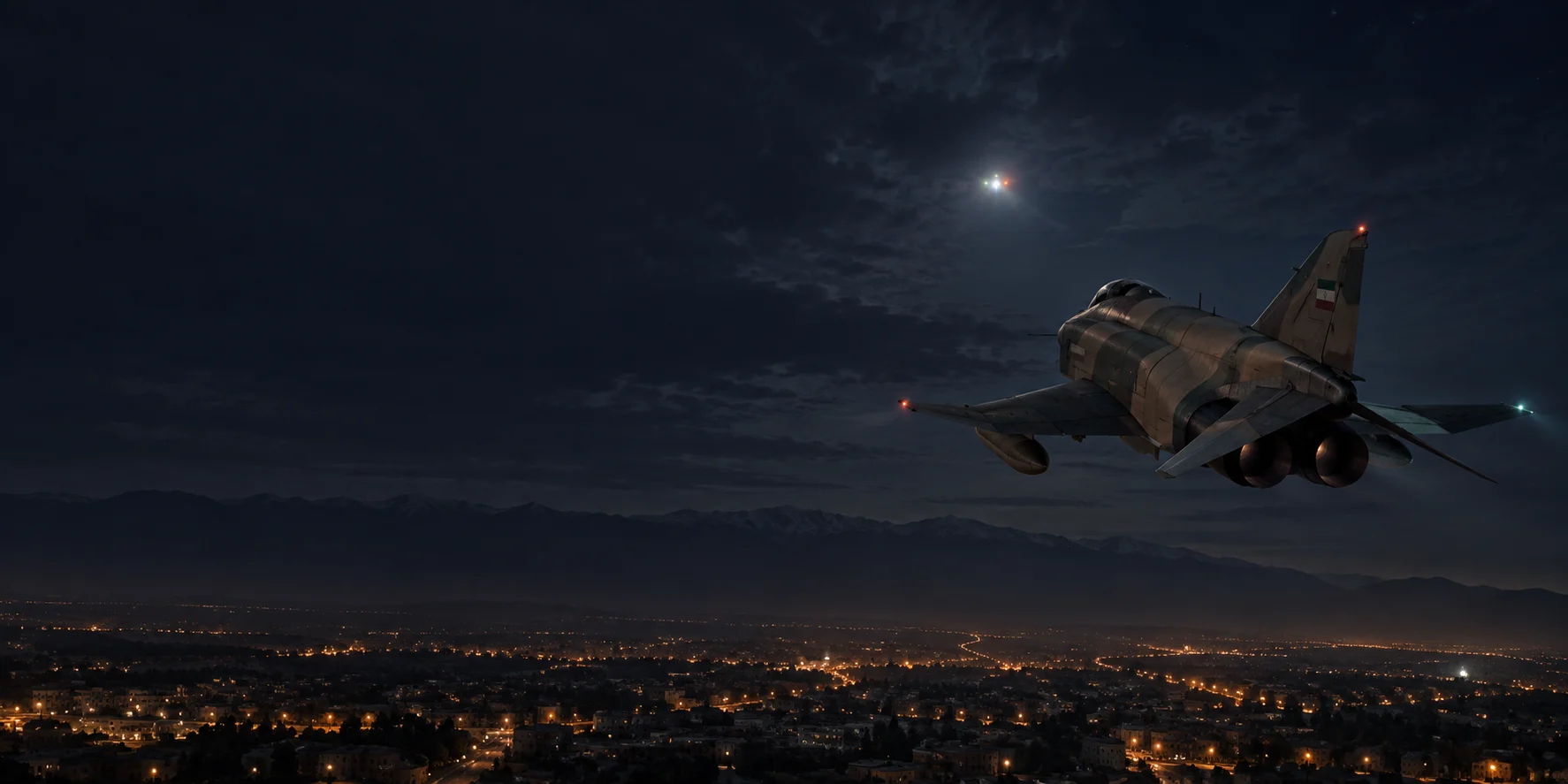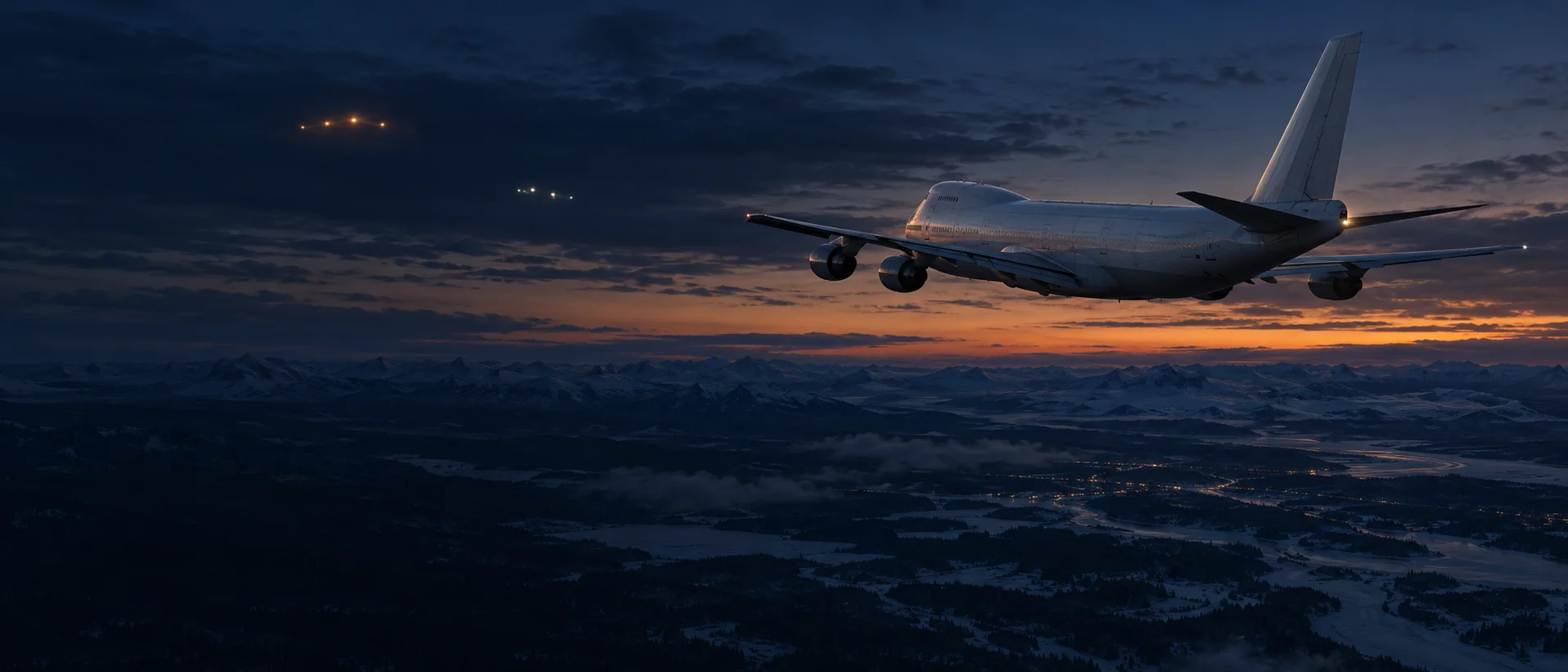
At 02:19 UTC—5:19 p.m. in Alaska—Japan Air Lines Flight 1628 asked whether anyone else was flying nearby.
The answer from the controller was no. The crew of the cargo 747 reported traffic about a mile ahead, apparently at their altitude. They could make out white and yellow lights. A routine request for traffic information had become an exchange about something the crew could see and the controller could not identify.
It was still the evening of November 17, 1986, in Alaska; the FAA’s chronology uses UTC, which had already advanced to November 18. Over the next half hour the crew would describe changing positions and lights, request room to manoeuvre, descend, turn near Fairbanks and watch for another aircraft sent to look. Several people were drawn into the same stretch of sky. They did not all see the same thing.
A cargo flight crossing the border
Flight 1628 was carrying cargo towards Anchorage on the Iceland-to-Alaska leg of a longer journey to Japan. Captain Kenju Terauchi commanded the Boeing 747. First Officer Takanori Tamefuji and Flight Engineer Yoshie Tsukuba completed the three-man crew named in the FAA’s notes taken after landing.
Their route brought them across northern Canada and into eastern Alaska. In a written account submitted to the FAA in January, Terauchi described a long crossing over Greenland and the Arctic, then a turn towards Talkeetna after contact with Anchorage Center. He placed the first unfamiliar lights off the left front of the aircraft. They looked to him like the lights of other aircraft, moving in roughly the same direction.
The setting mattered. They were approaching Alaska at dusk, high above a wide area with little traffic visible from the cockpit. Terauchi’s later statement described a narrow red band from the setting sun, with darker sky beyond it. The crew could still watch their instruments and the lights outside. They could also ask the people responsible for separating aircraft whether traffic was known in that sector.
The controller’s answer gave them no ordinary flight to associate with what they were watching.
Lights to the left
The first report was simple: apparent traffic ahead, white and yellow strobes. In his later written statement, Terauchi described two groups of lights that stayed in view and then seemed to move in ways he did not expect from conventional aircraft. He said they came close to the cockpit, and that a bright, fire-like glow illuminated it for a few seconds. He reported feeling warmth on his face. Those vivid details belong to the captain’s January account; the contemporaneous controller chronology begins with the more limited description of visible lights.
Tamefuji’s January 5 FAA interview gives another view from the cockpit. He first took the lights for oncoming traffic. He saw what he described as two small aircraft, but could not see an outline clearly enough to draw a craft. He remembered lights, their apparent size and their changing strength. He and the captain discussed asking air traffic control about them. He was also flying the aircraft, dividing his attention between the view outside and the work inside.
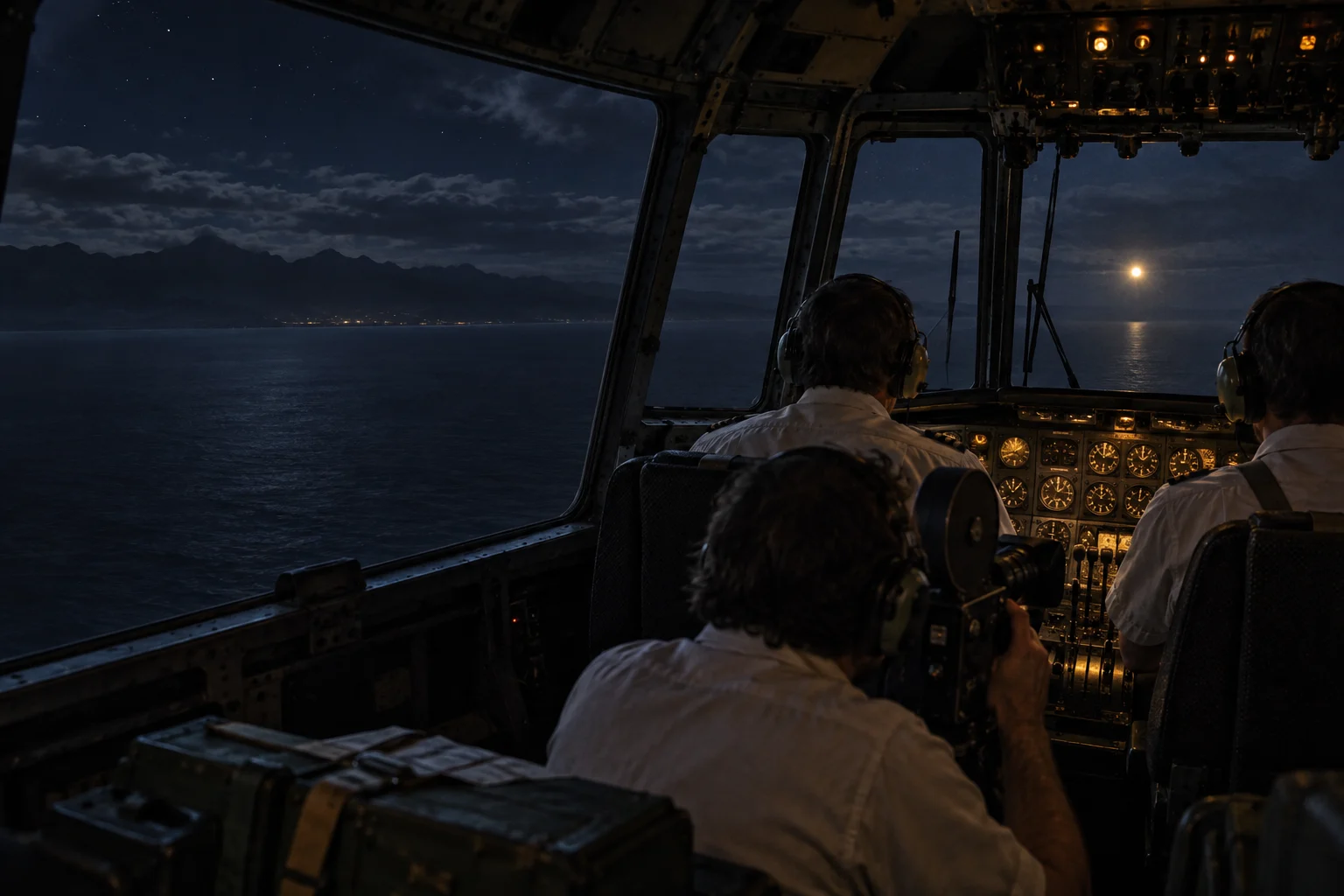
Tsukuba, at the engineer’s station, later recalled clusters of white or amber lights through the left window. They seemed larger than ordinary navigation lights and moved or undulated. He said he watched the first lights for perhaps ten minutes. When the captain asked for his camera bag, Tsukuba handed it over, then took it back after Terauchi could not obtain a picture. In Tsukuba’s January 15 interview, this small task became a way of estimating how long he had been looking.
No photograph came from the attempt. The three men nevertheless carried distinct descriptions of the first lights into their later interviews. The captain’s language became the most elaborate. His colleagues remembered an unusual pattern of lights without claiming the same detailed view of a body behind them.
The green mark on the screen
By 02:25 UTC, the crew reported something on their onboard weather radar, about eight miles away at eleven o’clock. Terauchi later wrote that he had adjusted the range and tilt before seeing a green, rounded return near the direction of the lights. Tsukuba remembered a green, stream-like mark at roughly ten miles, though he was uncertain whether it represented the same thing he had seen outside. Tamefuji also recalled a radar echo and said he had experience recognizing aircraft returns.
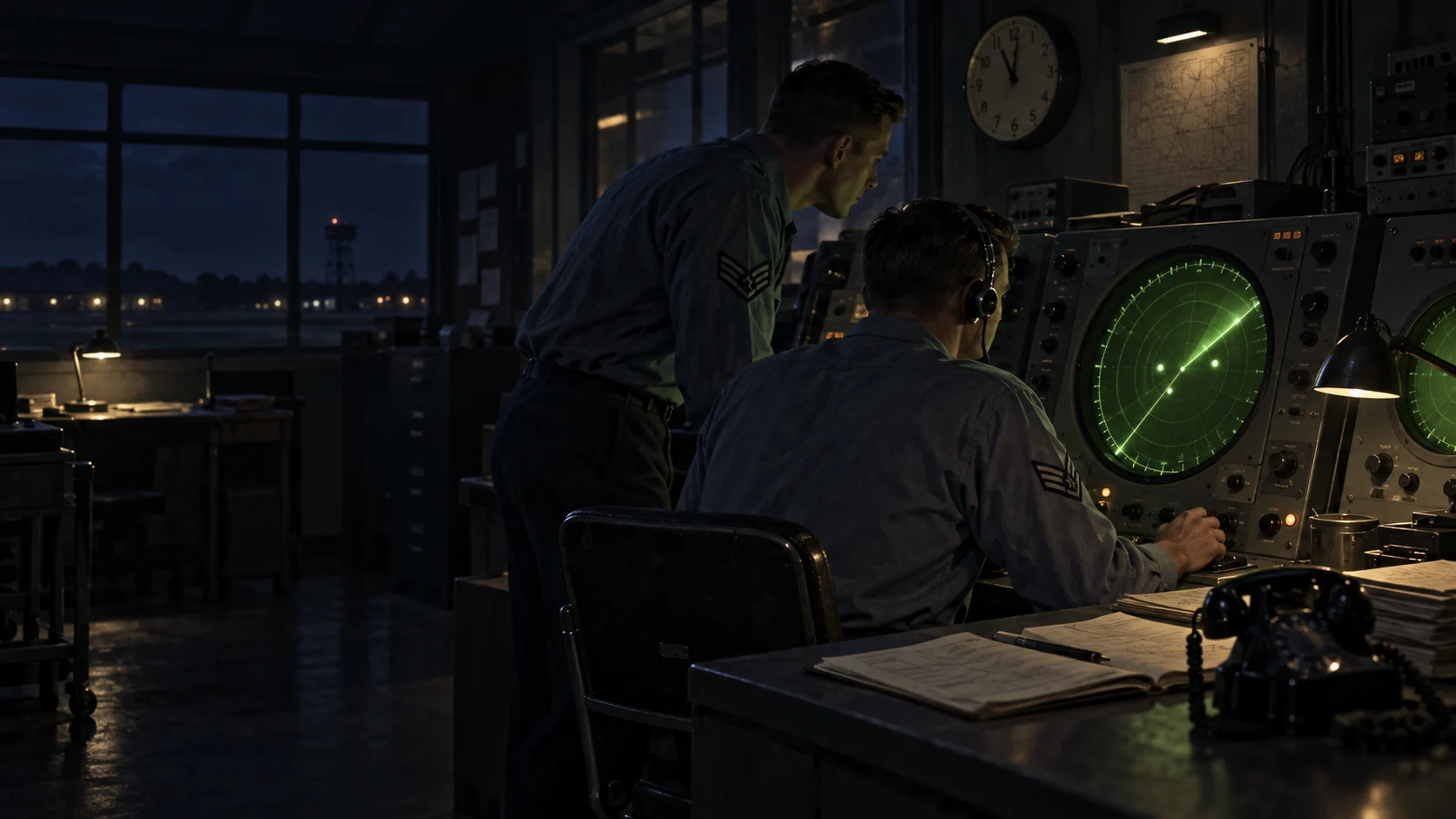
The controller then called the military Regional Operations Control Center. At 02:26, according to the FAA chronology, its operators reported a primary return about eight miles from the JAL flight, at ten o’clock. A minute later they said they no longer had it. The short-lived report entered the chain of communication while the 747 continued south.
That sequence can feel like a sudden convergence: lights seen from a cockpit, a mark on an aircraft display, a military radar operator reporting a return. Each was a report made at the time. The people involved still had to decide what the returns represented. For the crew, the immediate concern was the possible traffic outside their windows.
At 02:31, the JAL flight said the apparent aircraft was quite big. The controller approved whatever course deviation the crew needed to avoid it. The following minute the crew requested a descent from flight level 350 to flight level 310. Asked whether the traffic was descending too, they said it was doing so in formation.
Those requests changed the flight from an observation to a set of actions. The 747 moved lower. Its crew watched to see whether the lights would remain with it. Controllers kept asking other stations what appeared on their displays.
The turn near Fairbanks
Near Fairbanks, Flight 1628 asked for a new heading. Fairbanks Approach was consulted and reported no nearby radar return. At 02:36, Anchorage Center issued the JAL crew a full 360-degree turn and asked them to report whether the traffic stayed with them. A turn could change the relationship between an aircraft and a distant fixed light; it could also let the crew see whether apparent traffic moved through the same arc.
Terauchi’s written account described looking behind the aircraft as it circled and believing the object was still there. He described a huge silhouette against a paler part of the sky, far larger than the lights first seen ahead. It was the image that later made the case famous: a vast shape accompanying a cargo jet over Alaska.
The other crew members were more guarded when interviewed separately. Tamefuji told the FAA interviewer that the later light was on the captain’s side, limiting his own view. Asked whether he had seen the detailed shape in Terauchi’s published drawing, he said he had not. He had glimpsed lights and could imagine that connecting them might suggest a large object, but he could not identify a definite outline. Tsukuba said the later lights were much harder to see. At one point he was unsure whether they were unusual lights or distant town lights.
Meanwhile, the military center reported another intermittent indication. At 02:38 it told Anchorage Center it had a “flight of two” near the JAL position, one a primary target only. The crew then said they had lost sight of the traffic. Minutes later they reported it again, this time to the left and rear. The event did not resolve in a single turn. The controller continued to handle a moving airliner whose crew still believed another presence was nearby.
Another cockpit looks back
At 02:45, Anchorage Center asked a northbound United Air Lines flight to alter course slightly for a visual check. The JAL crew described the traffic at seven o’clock and eight miles while the other airliner approached its line of sight. This was a chance for people outside the 747 to look towards it, rather than relying only on the original crew and instrument reports.
The United crew saw Flight 1628 against a light background. They did not see anything else near it. Their observation, recorded at 02:50 in the FAA chronology, was specific: they identified the JAL aircraft, then reported no other traffic visible. It did not erase what the JAL crew had reported earlier, but it did leave the final minutes without a second visual confirmation.
Terauchi later wrote that the large shape disappeared as the United aircraft came near. In the controller timeline, Flight 1628 told Anchorage at 02:53 that it no longer had contact with the traffic. The extraordinary sequence had entered its last ordinary phase: the cargo aircraft continuing to Anchorage, the controller moving on to other traffic, and the crew arriving with an account to give investigators on the ground.
At Anchorage
FAA personnel met the flight after landing and interviewed all three crew members that night. One investigator’s notes concentrated on Terauchi’s description of coloured lights and an apparent object; another summarized the crew’s shared report of strange lights, a weather-radar indication, a turn, and static on the VHF radio. The interviews were close to the event, but they compressed three perspectives into short official notes.
The more detailed separate accounts came later. Terauchi’s statement supplied the closest approach and gigantic silhouette in his own words. Tamefuji and Tsukuba described the early lights clearly, then placed limits around what each could say about the later view. Their interviews make the flight more human than a single dramatic sketch: one man at the controls, one at the engineer’s station, and a captain repeatedly looking left and behind as the aircraft changed course.
The crew had flown through a complicated stretch of sky with something they could not identify. Air traffic control had answered their calls and made room for the manoeuvres they requested. The ending was quiet: no collision, no photograph, no aircraft landing beside them. What remained was an unusually detailed trail of transmissions, notes and later interviews.
What Is Known
The December 18, 1986 FAA chronology documents the crew’s reports and the controller’s actions from 02:19 to 02:53 UTC. It records the requested descent and headings, the 360-degree turn, intermittent statements from military radar operators and the United flight’s unsuccessful visual check for other traffic. The same-night crew notes establish that FAA personnel spoke with the crew after landing. The later captain’s statement, first officer’s interview and engineer’s interview preserve fuller but differently bounded recollections.
Radar needs the same care as testimony. Operators described possible returns during the event, and the crew reported a mark on its weather radar. But the Anchorage air traffic manager wrote in December that a subsequent review of the center’s recorded radar data did not confirm a target close to Flight 1628. In its March 5, 1987 release, the FAA said a nearby second target in its reviewed data was a split return from the 747 itself. The agency said it could not confirm the reported event and was satisfied that air traffic control safety had not been compromised. That assessment addresses the radar evidence and aviation-safety question; it does not identify every light the crew described.
The enormous silhouette is chiefly Terauchi’s account. Tamefuji and Tsukuba corroborated unusual early lights, but their later interviews did not provide an equally definite sighting of the giant shape. The United crew saw the 747 without seeing a companion object. Keeping those views separate is essential to understanding what the record actually contains.
The Bigger Picture
The JAL case arrived in public view before the FAA had finished reviewing its radar data. A January 1987 Washington Post report carried Terauchi’s account and described radar confirmation. The FAA’s March release later stated a narrower conclusion after technical review. Both belong to the case’s history: the first shows how the captain’s story reached readers; the second shows where the agency’s examination came to rest.
The FAA said its inquiry was about air traffic safety. It wanted to know whether an unreported aircraft had been near the JAL flight. That explains the form of the surviving record: pilot-controller communications, radar displays, interviews, a flight path and the decisions made to keep an aircraft clear of possible traffic. The National Archives lists the material as a distinct FAA record series, identifier 733667. Its preservation allows the voices and decisions behind the familiar headline to be followed in sequence.
This is why the flight remains so striking. A crew saw lights. Controllers responded as controllers should when pilots report nearby traffic. Radar operators briefly thought they saw another return. A second airliner looked and saw only the 747. Then analysts revisited the recorded data and reached a different view of the radar mark. The mystery is not a single frozen image over Alaska. It is the distance between what each person could see from a particular position and what the whole file can establish.
Sources
- Contemporary FAA record: Notes from interviews with all three crew members, November 17, 1986, recorded after landing.
- Contemporary FAA operational summary: Anchorage air traffic manager’s memorandum and chronology, December 18, 1986, based on communications and radar review.
- Later firsthand statement: Captain Kenju Terauchi, written account, translated into English and received by the FAA January 2, 1987.
- Later firsthand interviews: First Officer Takanori Tamefuji, January 5, 1987, and Flight Engineer Yoshie Tsukuba, January 15, 1987, both interviewed by the FAA.
- Official conclusion: FAA Alaskan Region news release, March 5, 1987, reporting the agency’s radar analysis and safety finding.
- Independent contemporary reporting: Jeff Berliner, The Washington Post, January 1, 1987, documenting Terauchi’s public account before the FAA’s final radar review.
- Archival context: U.S. National Archives, Record Group 237 listing, identifying the FAA JAL 1628 release series as National Archives Identifier 733667.