The radar return crossed miles between sweeps.
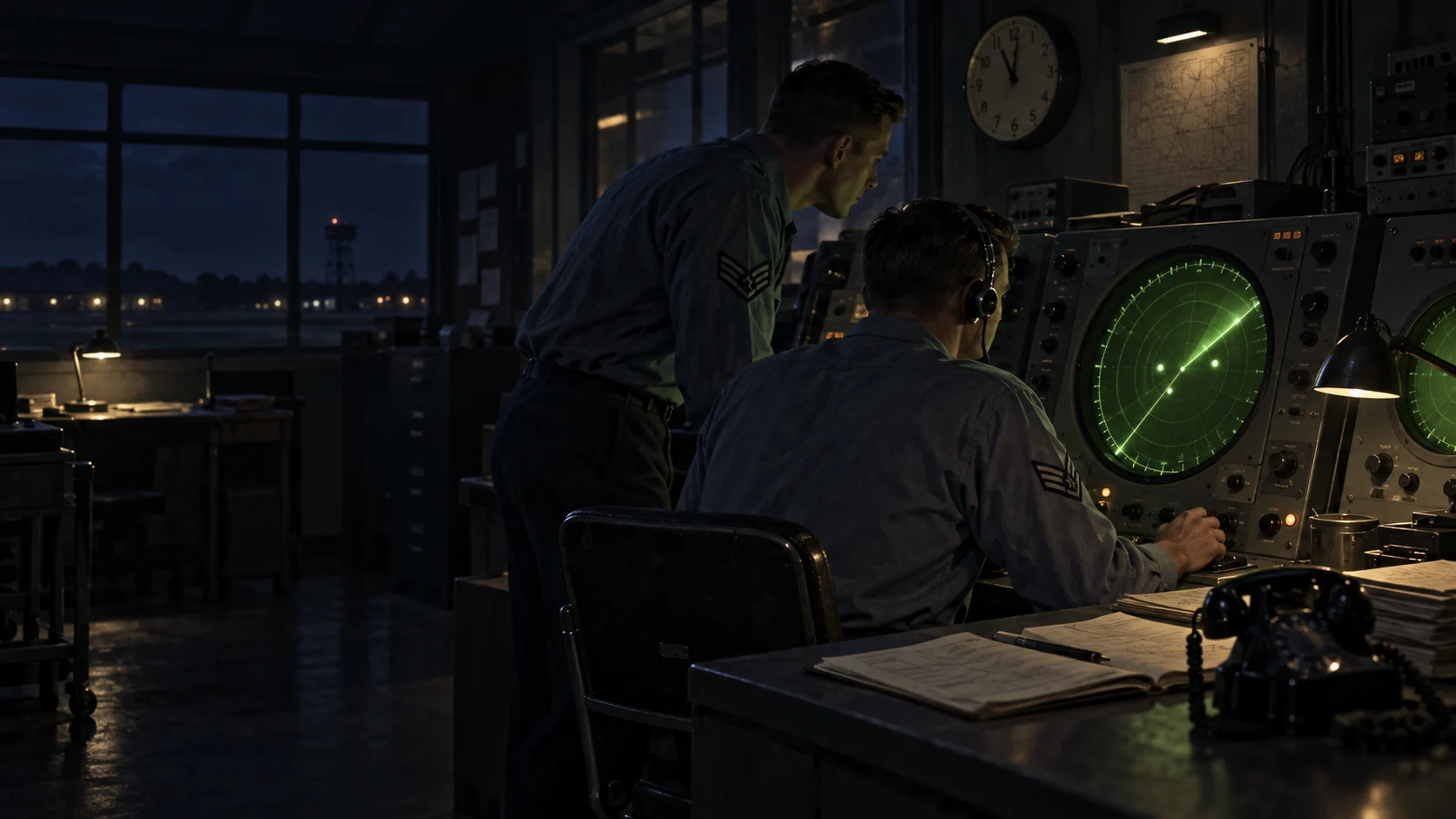
At RAF Bentwaters, Airman John Vaccare watched a target moving across his screen. He picked it up east-southeast of the airfield and followed it towards the west-northwest. Each new return appeared four or five miles farther along.
The blip had begun with the size of an ordinary aircraft target. Then it diminished, weakening towards the edge of the display. Vaccare had it in view for about thirty seconds.
In his account recorded in the August 1956 intelligence report, he estimated its speed at around four thousand miles an hour.
That night, other operators would watch groups of returns, telephone calls would pass between airfields, and RAF fighters would be directed towards an unfamiliar target. At Lakenheath, controllers would report a moment when the aircraft sent to investigate seemed to have become the aircraft being followed.
Beyond the tower
It was the evening of August 13, 1956.
Staff Sergeant Lawrence Wright, the shift chief in Bentwaters’ control tower, had seen a light to the southeast. He watched through binoculars as its amber colour changed to bluish-white. It disappeared and returned intermittently during an observation lasting roughly an hour.
Wright described a small point of light, without surface details or accompanying sound. He was aware that the ground-controlled approach operators were also tracking unidentified returns. His view from the tower and their instruments offered different ways of following what was happening around the airfield.
The report collected his statement on August 27. It preserves his recollection of the light’s changing position: initially low in the southeastern sky, later higher towards the south-southeast, in weather he described as clear.
Elsewhere at the station, the radar picture had become more complicated.
The scattered returns
Technical Sergeant Elmer Whenry reported a group of twelve to fifteen targets southwest of Bentwaters.
They moved towards the northeast, covering several miles of the display at once. Three returns led in a triangular arrangement, with the others scattered behind. Whenry estimated their movement at between eighty and 125 miles an hour, using the range markings on the scope.
He watched them grow fainter northeast of the airfield but continued tracking them farther out. At approximately forty miles, the individual returns appeared to draw together into one much larger echo. He compared its size on the screen with a return several times larger than that of a B-36 bomber.
The large echo seemed to remain stationary for ten to fifteen minutes. Then it moved a few miles northeast, stopped again and finally departed northwards beyond the display.
Whenry’s statement in IR-1-56 records checks of the equipment. The operators found no technical malfunction during those checks. The unfamiliar picture had unfolded on the system they normally used to follow aircraft approaching the station.
A search in the air
Two pilots returning to Bentwaters in a T-33 were asked to look.
First Lieutenants Charles Metz and Andrew Rowe flew through areas northeast, east and southeast of the airfield. Their search lasted about forty-five minutes, at heights between two thousand and five thousand feet.
They returned without finding the objects the operators were reporting. They did note a bright light on the eastern horizon and a beacon shining through haze near Orford. Their August statements preserved those observations alongside the radar operators’ accounts.
Whenry also described another fast return moving west across the scope. He tracked it for approximately sixteen seconds and estimated a speed above four thousand miles an hour. The final return weakened before disappearing.
Then an account reached Lakenheath that joined a radar track to a reported light over Bentwaters.
The warning passed west
The Lakenheath teletype sent on August 16 described a fast-moving target approaching Bentwaters from the east.
It disappeared from the scope shortly before reaching the station and reappeared west of it. Tower personnel reported a bright light passing over the airfield from east to west. A pilot above Bentwaters, at four thousand feet, reported a light streaking beneath his aircraft in the same direction.
The teletype placed these reports together in the warning transmitted to Lakenheath. Bentwaters asked whether unusual sightings were occurring there as well. Lakenheath alerted other personnel and the ground-controlled approach unit at Sculthorpe to watch for unfamiliar targets.
The search was spreading through the communications that connected the airfields. An unexpected return at one station had become a reason for people at another to look more closely at their screens.
A target that stopped
At Lakenheath, operators reported a track moving from west of the station towards the southwest.
About twenty miles out, it stopped. For five minutes, the return appeared stationary. Then it moved back towards the airfield and stopped again northwest of the station. Other targets were reported making similar movements nearby.
The radar air traffic control centre also described a target east of Lakenheath following a sharply rectangular course. Its turns appeared to form right angles. The operators estimated speeds of six hundred to eight hundred miles an hour, with rapid stops and starts.
The report recorded their use of the moving-target indicator, a setting intended to suppress stationary returns. They said the target remained on the scope when the setting was used.
Forrest Perkins, the watch supervisor, would describe the room in a letter received in February 1968. He remembered setting displays to different ranges and asking another radar unit whether it could see the return in the same location. He also recalled connecting commanders to a conference line and updating them on the target’s position.
His later account adds that perspective of a supervisor handling the calls while controllers followed the display. Bearings, distances and changes of position became information passed from the room to people elsewhere.
The fighter approaches
The August teletype describes an RAF Venom from Waterbeach entering the investigation.
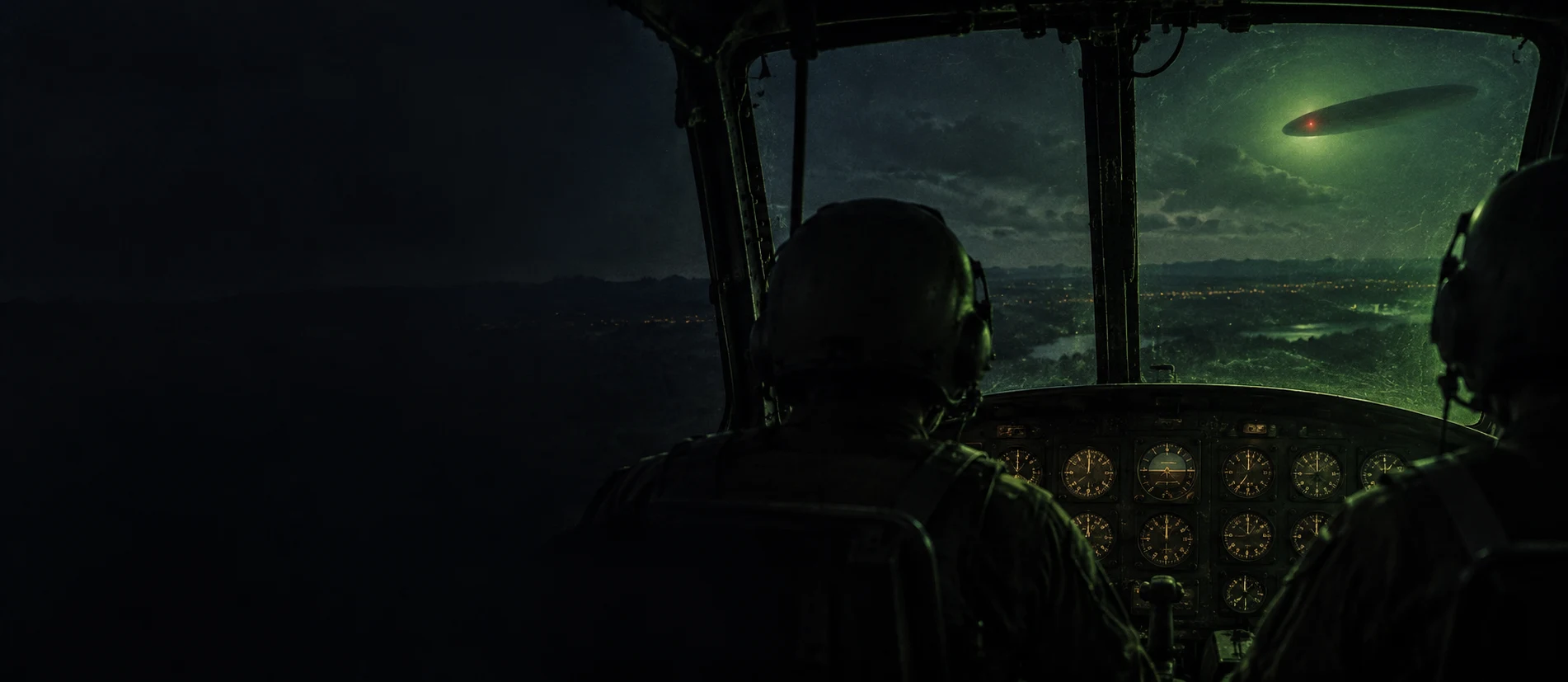
The first reported approach took it towards a radar target east of Lakenheath. The pilot was said to have a bright white light in view, then to have lost both the target and the light farther west.
Controllers directed the aircraft towards another reported target, ten miles east of Lakenheath. The pilot advised that it was on his airborne radar and that he was locking on.
Then he reported losing it.
On the ground, the radar air traffic control centre saw the aircraft pass the target’s position. According to BOI-485’s interception account, the target began following the fighter. Controllers asked the pilot to acknowledge the pursuit. He did, and said he would try circling to get behind it.
The relationship on the display had changed. The fighter had been approaching an unknown return. Now the report placed that return behind the aircraft, accompanying its manoeuvres.
Behind the Venom
The pilot reported being unable to shake the target and asked for assistance.
Another Venom was sent from Waterbeach. The original pilot was recorded as calling his contact the clearest target he had ever seen on radar. The statement survives as part of the intelligence message summarising the interception.
The first aircraft eventually returned to its station because its fuel was running low. The target disappeared, and the second aircraft did not establish contact with it. Controllers directed that fighter towards other returns, but it was unable to make contact and subsequently returned with a reported malfunction.
No further interceptions were undertaken. The teletype records the targets disappearing from the scopes at approximately 03:30 GMT on August 14.
The events had outlasted the first calls from Bentwaters and the initial aerial search. They ended with aircraft returning to their runways and controllers losing the returns they had been trying to identify.
Another view from the cockpit
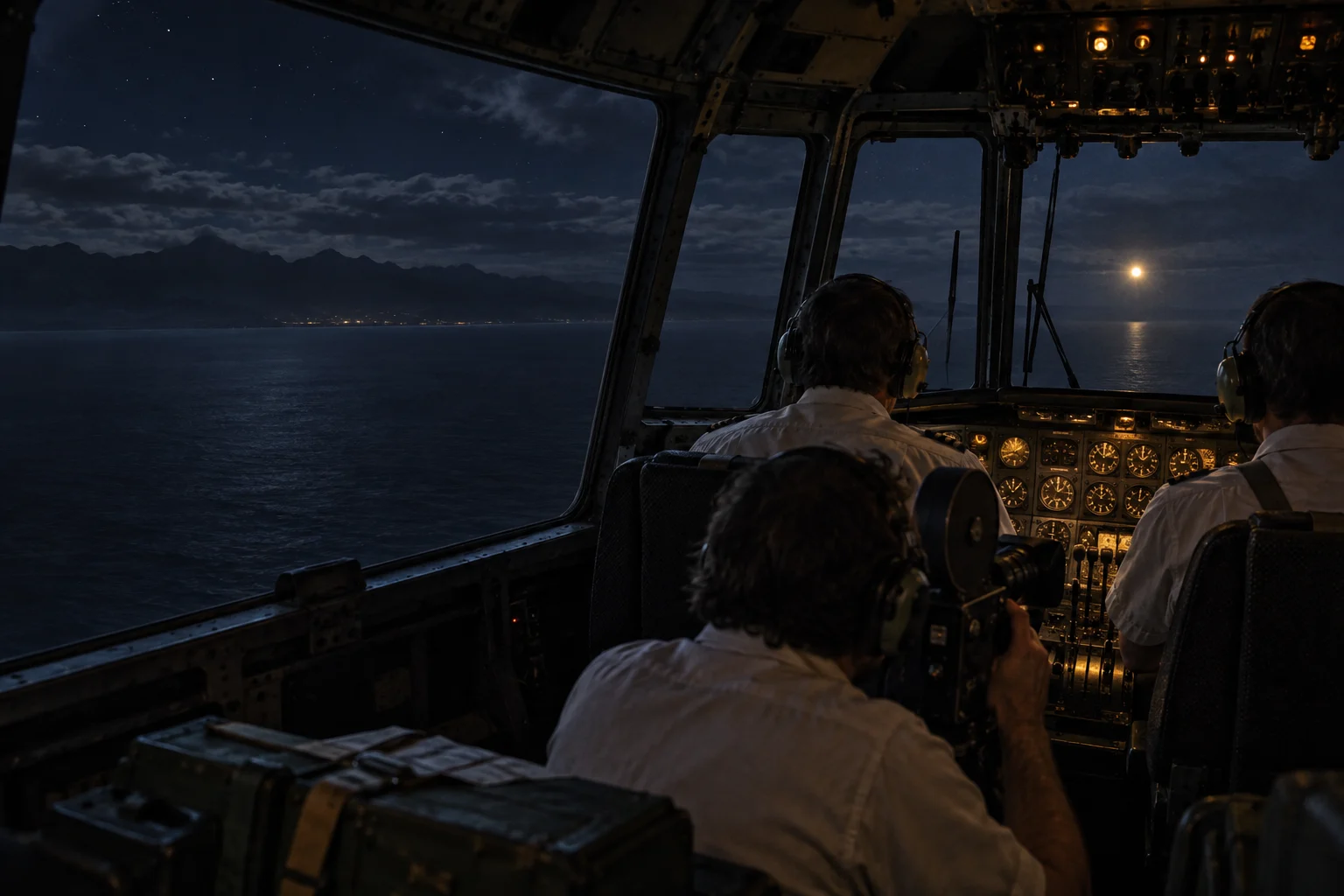
John Brady, a radar operator in a Waterbeach Venom, later described his own sortie with pilot Dave Chambers.
In a letter dated November 1, 2000, he recalled climbing to seven thousand feet and making several runs at a contact. After an initial unsuccessful pass, he obtained a firm but untidy return. It moved rapidly down his display as the aircraft approached, behaving, to him, like a stationary target.
Chambers looked outside on each run and saw nothing. After further passes, they returned to base. Brady remembered a flight lasting fifty-five minutes.
The 23 Squadron diary’s entry for August 13–14 also records attempts to intercept a stationary object reported by Lakenheath. It says neither crew saw it and gives the squadron’s eventual interpretation as a balloon.
Those records preserve an airborne experience with its own character: repeated approaches, a contact on the radar and a pilot looking into darkness. The American report preserves a different picture of the pursuit from the ground. Both perspectives became part of the night that later readers would try to follow.
What Is Known
Two substantial American reports anchor the case: Lakenheath’s BOI-485, transmitted on August 16, and Bentwaters’ IR-1-56, dated August 31. They document reported radar contacts, visual observations and interception activity. The figures for speed and size are observers’ estimates or comparisons with radar returns.
Their timings and descriptions differ in places. The earliest rapid tracks, the grouped returns and the later interception should therefore remain identifiable episodes, rather than being presented as the uninterrupted flight of one object.
The 1956 squadron diary and Brady’s 2000 recollection also deserve their own place. His letter describes a stationary contact and no visual identification; it does not recount the tail chase in BOI-485. Perkins’ detailed letter belongs to 1968, twelve years after the event.
Hynek’s October 17, 1956 memorandum treated the report as unusual and sought clearer connections between the visual and electronic observations. In the University of Colorado study completed in 1968, Gordon Thayer considered the case particularly puzzling while retaining uncertainty about its explanation. That analysis preceded the later aircrew correspondence used here.
These materials establish a documented episode of observations and military responses. They preserve the remarkable reported pursuit without settling the identity of every target or the relationship between every account.
The Bigger Picture
The night unfolded within a system built to turn radar information into action.
Historic England’s account of RAF Neatishead describes how ground-controlled interception developed to track aircraft inland and guide fighters towards them, especially at night. After the war, Britain’s radar defences were reorganised. During the early 1950s, the Rotor programme brought new protected installations and an underground operations block to Neatishead.
The RAF Air Defence Radar Museum’s history places that development within the transition from wartime defence to the Cold War. Fewer, more advanced radars were intended to meet a new threat from Soviet aircraft. Detecting, tracking and directing were practical tasks carried out by people working together across stations.
Lakenheath–Bentwaters draws its particular atmosphere from that working world. Its witnesses watched from a tower, followed returns on approach radar, relayed positions over telephone lines and searched from aircraft. An unfamiliar observation entered familiar procedures: another station was alerted, a target was checked, a fighter was directed towards it.
The resulting accounts let us follow how the same night reached people in different positions. A ground controller saw the changing relationship between two returns. An airborne radar operator saw a contact approaching his aircraft. A pilot looked outside and tried to find it.
The fascination remains in those separate views, each narrowing the distance to something that still resisted identification.
Sources
- USAF, Bentwaters IR-1-56, August 31, 1956. Archival transcription of the contemporary report, including statements collected in August; transcript prepared by G. David Thayer in 1987.
- USAF, Lakenheath BOI-485, August 16, 1956. Archival transcription of the contemporary teletype, presented in its reporting-questionnaire format.
- Forrest D. Perkins, letter received February 13, 1968. Later firsthand recollection, transcribed from his handwritten letter.
- John Brady, letter to David Clarke, November 1, 2000. Later firsthand account of his sortie.
- 23 Squadron diary, entry for August 13–14, 1956. Archival transcription of the squadron record.
- J. Allen Hynek, October 17, 1956. Contemporary Blue Book evaluation memorandum, reproduced in transcription.
- University of Colorado, Scientific Study of Unidentified Flying Objects, 1968. Reproduced analysis and case-study excerpts; retrospective investigation drawing on military records and Perkins’ letter.
- Historic England, R30 Operations Room, Neatishead. Independent historical context for ground-controlled interception and the station’s development; the preserved R30 interior is from the 1970s.
- RAF Air Defence Radar Museum. Independent station history covering the wartime and Cold War air-defence setting.