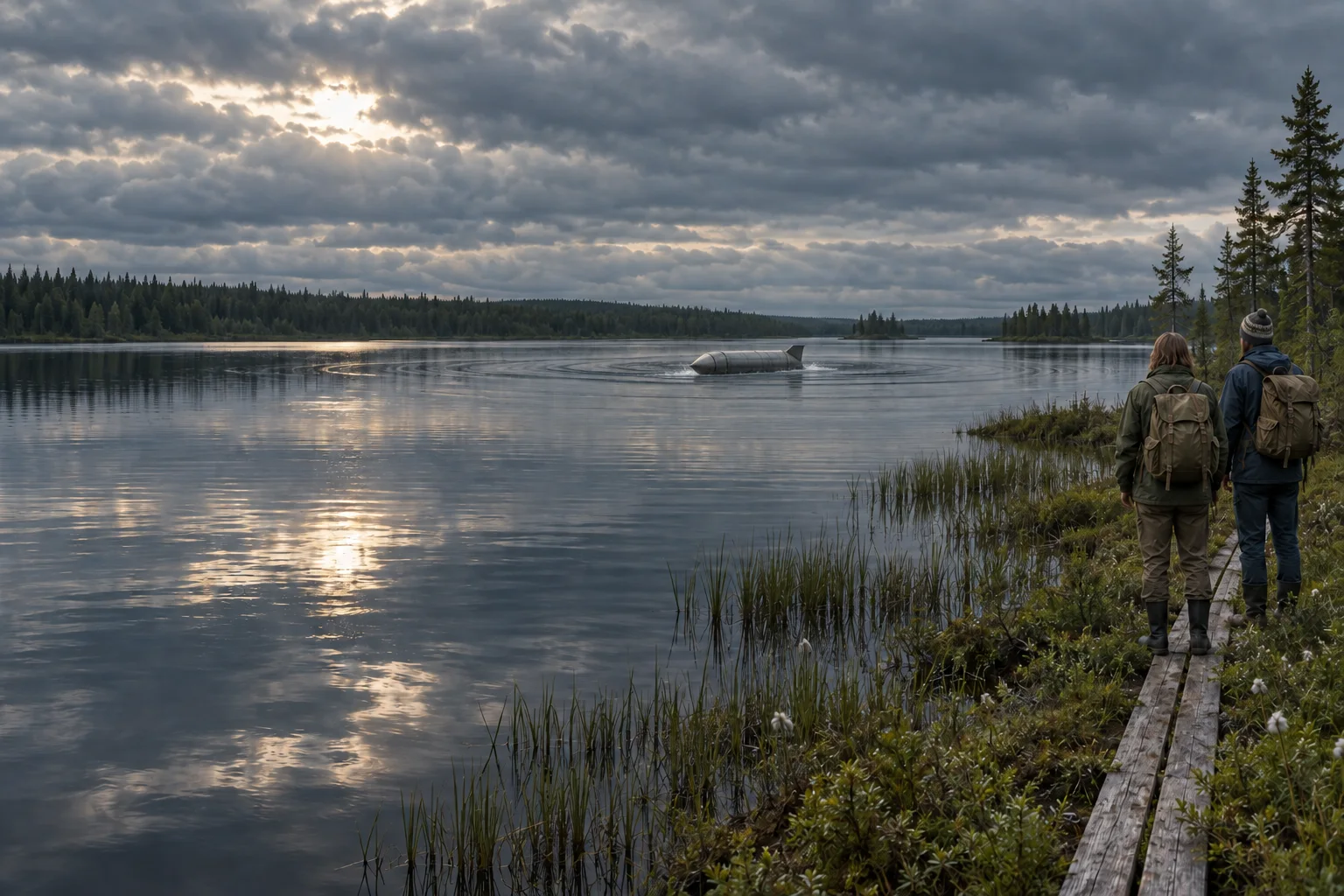
Howard Ball pulled off the highway to watch the light.
He was driving near Wanaque toward Paterson on the evening of January 11, 1966. It was about 6:20. Above the New Jersey landscape, something blue-white and exceptionally bright had caught his attention strongly enough to interrupt the journey.
Ball, an editor at the Paterson News, watched it stop, move westward and hover. Then it changed direction toward the north-northwest. In the account NICAP recorded soon afterward, the movement unfolded in separate stages: motion, a pause, another departure.
Within minutes, the reports were reaching the police.
The Calls Begin
At roughly 6:30, the first calls came in. They kept coming.
According to the contemporary newspaper report, police received about thirty calls that first evening. The names of places accumulated around the dispatcher: Oakland, Ringwood, Paterson, Totowa, Wayne and Butler. People described an unusually bright white light, larger than a star. Some called it a disk.
Those calls gave the evening a geography. A sight that might have remained with one driver was now being reported from several communities.
At Wanaque, the reservoir became a gathering point. The news reached the mayor, Harry T. Wolfe, and brought him out to look for himself. Police who ordinarily answered questions about events on the roads were now receiving questions about something above them.
A Car to the Dam
Wolfe had been at home preparing to attend a First Aid Squad dinner when Councilman Arthur Barton called. Reports of a strange object were flooding the police.
In the interview he later gave Lloyd Mallan, the mayor described asking for a police car to collect him and his son Billy. Sergeant Joe Cisco drove. They picked up two councilmen and went to view the light.
Wolfe remembered something just above the treetops, a little larger in appearance than a star. Its colors changed: green, red, white. In the car, the radio carried reports from other police departments.
The party watched for several minutes. The wind was strong enough that they turned the car to use it as a shield. When they looked back, the light had gone.
There was something quietly arresting about that departure. A mayor, his son and the councilmen had come out in a police car to watch a point of changing color. The radio was still connecting their position to people watching elsewhere. Then the place where they had been looking was empty.
Above the Ice
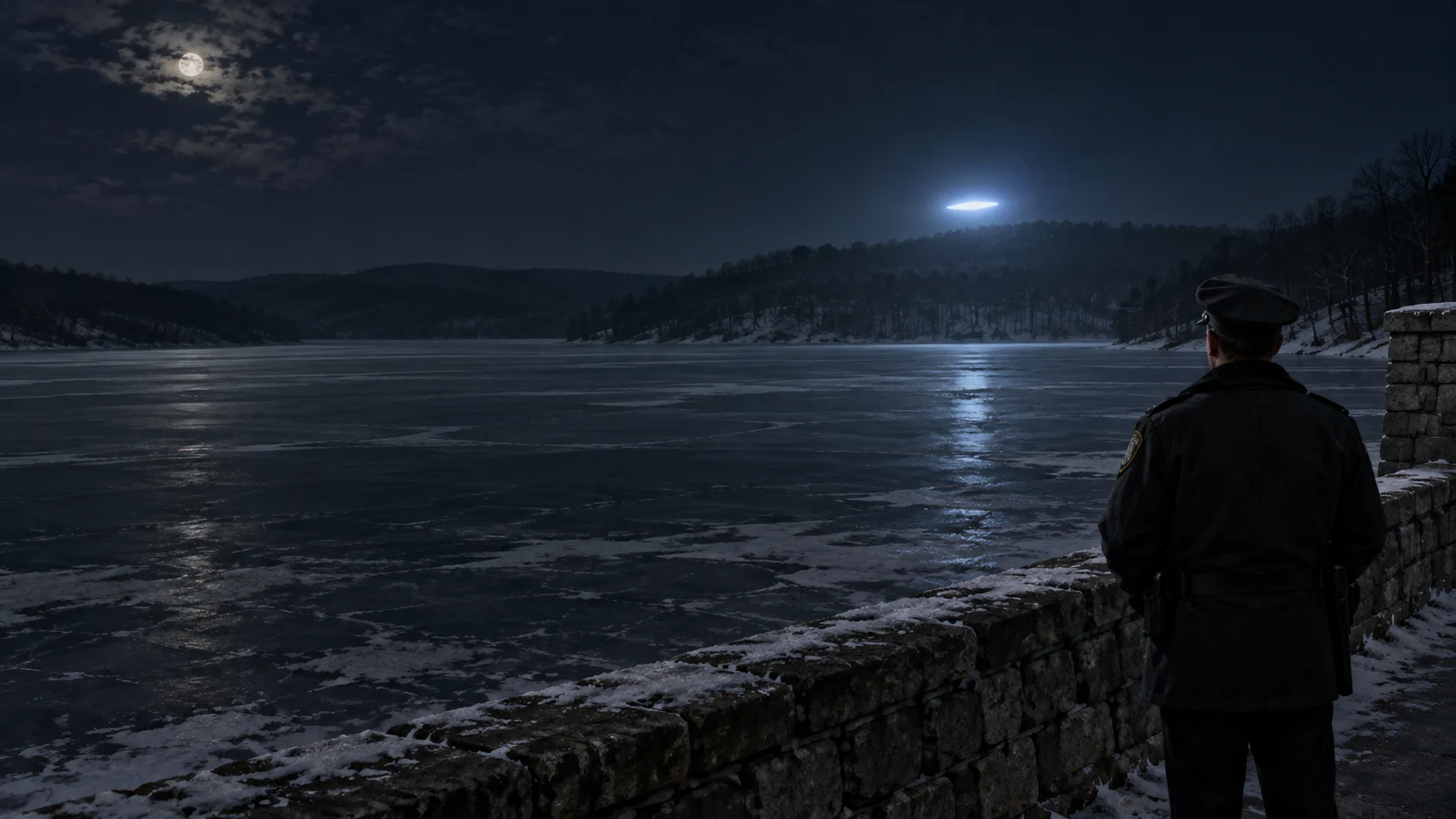
Near reservoir police headquarters, Officer George Dykman described a more active sight. His account placed it shortly after 7:30: a brilliant egg-shaped object that stopped suddenly, hovered, circled low and changed altitude quickly. He watched for nearly an hour and reported no sound. NICAP published his description in its January–February issue.
Civil defense officials were drawn into the evening too. Bentley Spencer and Richard Vrooman were among those alerted. People gathered at Raymond Dam, where the frozen reservoir offered a surface on which the light could show itself a second time, as a reflection. APRO’s early account describes crowds coming to the dam and being turned back at its approaches.
The reservoir had become a place to wait.
After Midnight
The waiting extended into January 12.
Around two in the morning, Patrolman Charles Theodora received word from Pompton Lakes police about a light heading toward the reservoir. The APRO report describes him watching it over the pumping station with other observers. It moved from side to side and blinked. The account carries their vigil into the hours before dawn, ending with a rapid rise and a departure to the north.
The pumping station gave this encounter a precise setting. The light was being described in relation to a building, the dam and the rim of the reservoir. An officer could receive a call from another department, go to a familiar piece of the waterworks and find himself watching the sky above it.
Later, historian Michael Swords reconstructed the January reports as a sequence of evening sightings, departures and early-morning returns. His reading of the newspaper accounts describes watchers staying out until midnight, before the next calls brought officers back into the story.
That rhythm runs through Wanaque: someone sees a light, someone telephones, someone else goes outside. An apparent ending becomes an interval. The next report starts the waiting again.
The Watchers Arrive
By daylight, the reservoir’s name was traveling well beyond the people who lived beside it.
The June issue of Saucer News reported that a police officer’s wife had been telling a friend about her husband’s experience when she saw a round white object herself. This encounter was in daylight. The object moved rapidly and silently, disappearing after roughly half a minute.
People also came equipped to keep watch. Two members of a citizens-band radio group known as the CB Rangers reported a different sight around 1:45 on the morning of January 14: a dark, thick cigar-shaped object near treetop height, with amber lights at its ends. They said their radio reception became disrupted while it was nearby.
The reports were acquiring new shapes and new witnesses. The same roads that brought residents home brought visitors toward the reservoir, looking for a vantage point and a reason to remain there.
Swords’s later reconstruction describes the congestion continuing for days. NICAP investigators arrived in mid-January. A public meeting followed later that month. What had begun with calls about a light had become a subject for a town to discuss together.
Nine Months Later
On October 10, the reservoir returned to the center of another report.
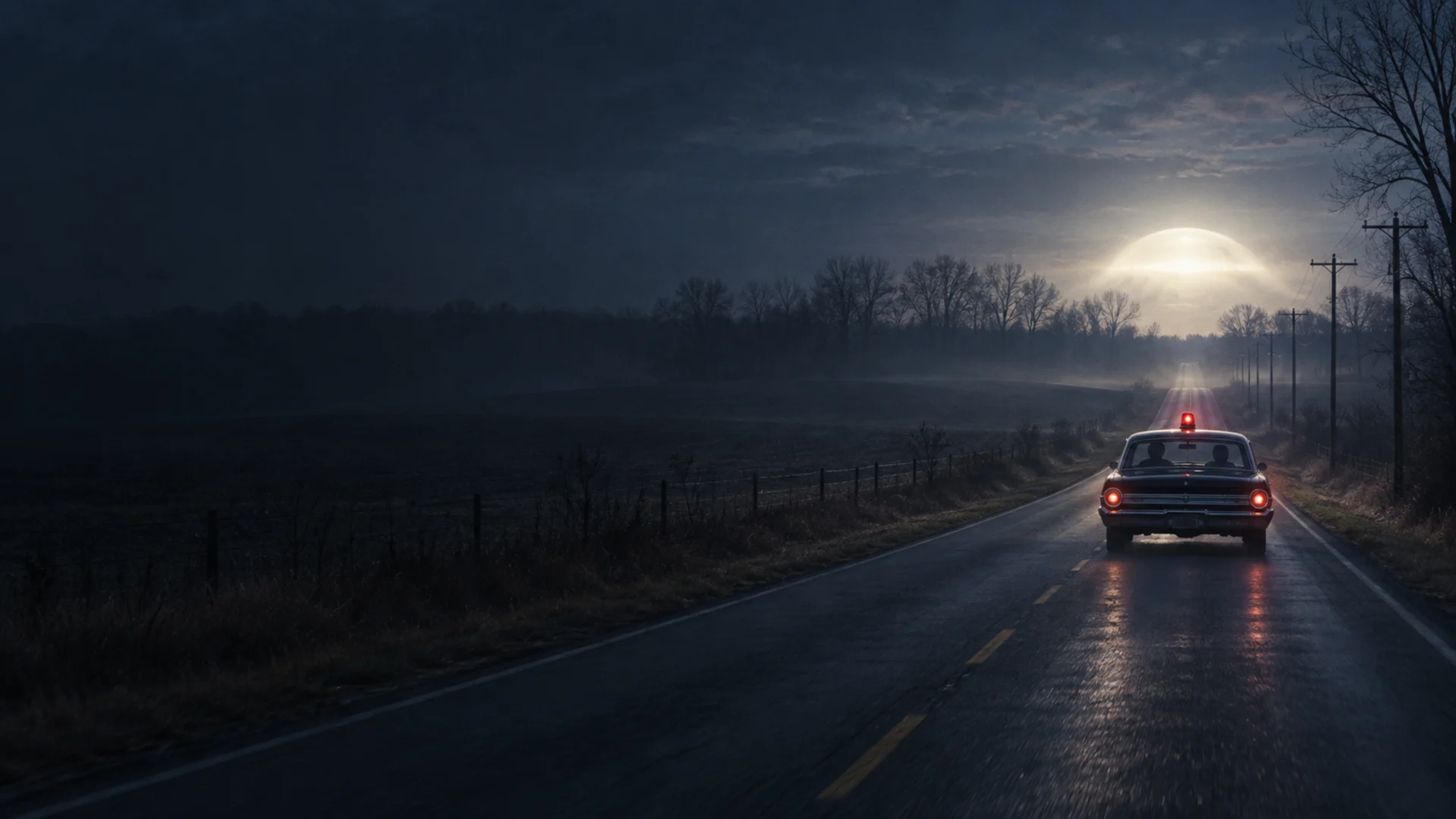
Sergeant Benjamin Thompson was alerted to a light coming north from Pompton Lakes. He parked his patrol vehicle and watched. In his recorded interview, preserved with the October correspondence, the scene includes traffic passing nearby and the flashing beacon on his vehicle.
The light moved left and right. Then it moved vertically, changing direction in sharp corners. Thompson described turns that seemed square, as though the motion traced angles in the air.
According to NICAP’s October–November report, the encounter occurred between about 9:15 and 9:30 that evening. Thompson estimated that the object was roughly the size of a car and around 150 feet above the lake. To convey its shape, he used an unusual comparison: a basketball with a football passing through its side.
Its brightness spread across the area. After it shot upward, moved left and vanished toward the mountains, Thompson said he could not immediately make out the flashing light on his own vehicle. His vision needed time to recover.
He also remembered a slight mist at places the object had occupied.
Through Binoculars
During October, groups of residents watched together.
Brad Olson’s account, published in 1967, describes Mary Ahearn and seven companions observing a light through binoculars. They saw red and green, and described a disk-like shape before it disappeared behind a mountain. Another watcher, Bernard Zick, described a rounded aluminum-colored upper portion, a flat bottom and a light beneath it.
People were coming to the water with binoculars, standing together and comparing what they could see. The mountains supplied a boundary beyond which the object could disappear.
The roads filled again. Olson reported the mayor’s estimate of roughly four hundred observers on October 16. The reservoir was drawing people who wanted their own encounter, and people who simply wanted to be present when someone else called attention to one.
Beyond the Junction
An account dated October 17 survives among the papers sent to NICAP.
Its writer had gone out with Dorothy Davenport and fifteen-year-old Dennis. Around nine, a woman directed their attention toward West Brook Road. They drove about half a mile and stopped behind another car, where two young women were watching.
With the engine and lights switched off, they looked up at something almost overhead: brilliant white around its edge, with red and green beneath. It moved slightly up and down, silently, and remained in view for about three minutes before passing behind cedars.
At the junction of Stonetown and West Brook roads, they found other cars and a guard. The account describes two women there as frightened.
The watchers had returned to a junction where others were still gathered. Beyond them lay the reservoir around which the reports kept drawing people.
Wanaque’s mystery rests partly in that repeated return. January gave the town one long night of calls and watching. October brought people back to the same water, looking above familiar landmarks for something that might appear again.
What Is Known
The documentary record contains two substantial clusters of reports, in January and October 1966. Contemporary newspapers named police officers and municipal officials; UFO organizations published accounts that same year. The October archive packet includes the transcript of Thompson’s interview on October 12. The October 17 letter is anonymous, as an annotation on the document explicitly records.
These are records of reported observations. Descriptions of size, height and shape remain witnesses’ estimates. The accounts should retain their individual dates and viewpoints: the reservoir’s name connects them, but does not establish that everyone watched the same object.
One familiar detail needs particular care. The story of a beam burning a hole through the ice circulated early. Swords’s comparison of the publications traces NICAP’s correction to an interview with the reservoir employee whose description concerned light reflected on the ice. Later publications repeated the more dramatic version. This article therefore describes the reflection without turning the hole story into an established event.
The source chronology matters as well. Mallan’s interviews were collected in a 1968 book; Olson’s article appeared in 1967. Swords’s two-part review dates to 2013. They offer different distances from the nights being described, rather than additional independent witnesses to every scene.
The Bigger Picture
Wanaque was already an important place before anyone reported a strange light above it.
The North Jersey District Water Supply Commission’s history describes a regional water project launched in 1920, with a reservoir capacity of 29.6 billion gallons. Its dedication took place on March 20, 1930. A twenty-one-mile aqueduct connected the works to the communities it served.
That practical landscape helps explain the distinctive human setting of the case. There were dams, pumping facilities, access roads and reservoir police. The people drawn into the reports included those connected to the waterworks and those responsible for the surrounding towns. The lights entered a place already organized around watching, maintaining and protecting something essential.
The reports also show how a shared location can hold attention across time. An evening sighting invites a telephone call. A named officer’s account attracts newspaper coverage. Visitors arrive, find somewhere to park and begin watching. When new reports appear months later, the place already carries a memory that makes people return.
That sequence is part of the documented story, whatever caused the individual lights. Wanaque became a mystery with roads leading to it, recognizable landmarks and people willing to spend another evening beside the water.
Its enduring image is the reservoir under a night sky, and someone at its edge waiting for a light to move.
Sources
- NICAP, The UFO Investigator, January–February 1966, p. 3. Contemporary investigation summary, including recorded witness accounts.
- “Bright Flying Disk Reported in Jersey,” The New York Times, January 14, 1966. Contemporary newspaper report, reproduced transcription.
- APRO Bulletin, May–June 1966, pp. 3–4. Early compilation of the January reports.
- “The Saucer Flap at Wanaque, New Jersey,” Saucer News, June 1966, pp. 26–27. Period reporting, including the daylight and CB Rangers accounts.
- NICAP, “UFOs Return to Wanaque Reservoir,” October–November 1966, p. 6. Contemporary account of Thompson’s October 10 encounter.
- CUFOS, October 1966 Wanaque NICAP documents. Original correspondence, interview transcripts and newspaper clippings; PDF p. 1 contains the anonymous October 17 account, and pp. 19–23 contain Thompson’s interview.
- Lloyd Mallan, The Official Guide to UFOs, 1968. Online transcription of the collection containing his period Wanaque interviews, including Mayor Wolfe’s account.
- Brad Olson, “The Many Weird Nights at Wanaque,” 1967. Period magazine article reproduced with scans at RR0.
- Michael Swords, Wanaque 1966, part one, February 26, 2013. Later reconstruction of the January chronology.
- Swords, part two, February 27, 2013. Later comparison of early reporting and investigation accounts.
- North Jersey District Water Supply Commission, “History of the Commission.” Official context for the reservoir and regional water system.