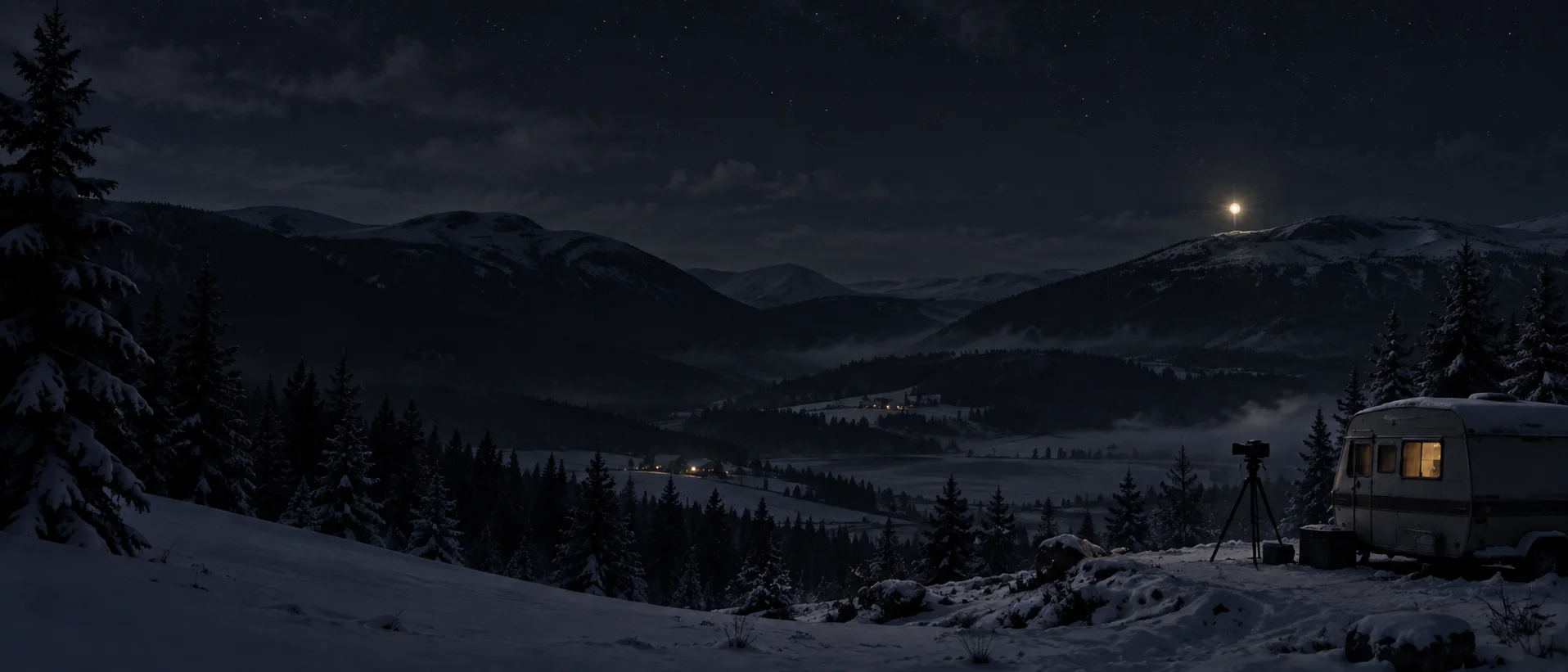
The observers were drinking coffee when the first flash appeared. At their southern field station in Hessdalen, it was ten degrees below freezing, with no wind and a little fog near the ground. The brightest stars were visible. Then, about twenty seconds later, another light appeared, stronger than the first.
It was 3:08 a.m. on February 26, 1984. Björn Lagesson went to the cameras. One observer wondered whether they were looking at a snowmobile spotlight. The light seemed to turn its beam downward, then back toward them, before going out. Developed film would contain two images of it. These details come from a next-morning note reproduced in Erling Strand’s later analysis of the photographic records.
The incident fell on the last day of a winter campaign to watch this Norwegian valley. It contains the problem that would follow Hessdalen for decades: something had been seen and recorded, but neither the photograph nor the witness’s uncertainty supplied its identity.
A valley becomes an observation site
Hessdalen lies near Røros in central Norway. According to the project’s technical report, the modern surge of unusual-light reports began in December 1981. Project Hessdalen formed in June 1983, with support from Norwegian and Swedish UFO research organizations and technical advice from scientists. Its first major watch ran from January 21 to February 26, 1984.
The headquarters was a caravan at Aspåskjølen. Cameras, marine radar and other instruments gave the volunteers several ways to investigate an observation. Staffing varied, however; parts of the campaign had only one or two observers. The final report counted 188 observation reports, including 86 aircraft, and classified 53 as unknown lights. Those were the investigators’ classifications, not 53 demonstrations of a new physical phenomenon.
This is an unusual starting point for a UFO case. An isolated encounter usually leaves a witness explaining what happened after the opportunity to measure it has passed. Here, the researchers could return to the same landscape and wait. They could record ordinary traffic as well as surprising lights. They could also make mistakes visible: a doubtful identification, an incomplete photograph, an instrument result that did not agree with what someone saw.
Repeated observation changes the question. Instead of asking only whether a person is credible, it becomes possible to ask what a camera was pointing at, how the timing was recorded, and whether another observer saw the same event from elsewhere. Each question requires a different piece of evidence. A convincing account does not automatically answer them all.
Entries against the mountains
The 1984 observation log records a succession of brief encounters. On January 21, observers reported a red light to the north. On January 25, another entry described a white and red object and noted radar contact. Later that evening, a yellow light was compared in brightness with Venus. Arne P. Thomassen took three photographs through a diffraction grating; the entry says the light eventually departed behind Fjellbekkhøgda.
The log used separate grades for how unusual an event seemed and how much information the report contained. That separation matters. A carefully documented ordinary aircraft can be an excellent report. A startling flash with no reliable distance can remain a poor basis for deciding what caused it. The February 26 incident was graded F5, at the threshold used for an unexplained observation, rather than placed among the strongest mysteries.
Read as a sequence, these entries make the watch tangible. A direction, a time and an apparent colour become a record that can be compared with the next entry. Yet the wording also shows how observation and interpretation sit beside each other. A light can disappear behind a ridge without its distance being known. An apparent departure can be judged rapid without a measured trajectory.
The mountains provide reference points, but they also create a temptation. Once a light appears close to a hillside, it is easy to imagine it occupying that hillside’s distance. It could be farther away, nearer, or seen along a line of sight that only appears to intersect the terrain. Without a second position or another means of determining range, the landscape supplies a bearing more securely than a location.
Two echoes, one extraordinary speed
The most dramatic calculation in the technical report concerns January 27 at 10:58 p.m. Two radar echoes appeared 2.4 seconds apart, separated by an interpreted distance of about twenty kilometres. Treating them as one moving target yielded a speed of roughly eight to nine kilometres per second. Observers also reported a fast light around that time.
The same report records 36 radar observations but only three considered probable matches with visible lights. The extraordinary speed therefore rests on a particular association between two echoes, rather than a continuous track proving that one object crossed the intervening space.
The arithmetic is straightforward. The identity of the target is the difficult part. If the first and second echoes belonged to different things, dividing their separation by the elapsed time would produce a speed that neither thing possessed. A complete track would help connect the positions; an independently synchronized optical track would help connect the radar return to the light.
That does not make the entry worthless. It tells a future investigator exactly where the claim needs testing. The useful question is whether a single target can be followed across successive returns while a second system records its movement. The larger the implied speed, the more consequential a mistaken association becomes.
What the film kept
At the February 26 station, the cameras offered a different kind of evidence. Strand’s 1997 spectrographic report describes paired cameras sharing a tripod and trigger: one used black-and-white film and a diffraction grating, the other colour film without the grating. Lagesson remembered making two or three exposures; the developed film showed two images containing the light.
A grating spreads incoming light into a spectrum. Across the campaign, the analysis counted 23 spectral photographs and five reference pictures, but only three spectral records were useful. The surviving spectra were continuous. They did not provide a distinctive set of lines that identified a substance or settled the cause. Film sensitivity and image quality limited what could be inferred.
That is a more interesting result than a photograph labelled simply “unexplained.” A spectral image can potentially constrain an explanation: it asks how the source emits light, rather than merely what shape the bright patch resembles. But it still requires calibration and enough signal. A faint or overexposed record may preserve an event while losing the information needed to identify it.
The snowmobile suggestion belongs in the account for the same reason as the pictures. It was a candidate offered by someone present, not an explanation imposed decades later. The reported beam movement made the event intriguing, but a photograph of a light alone cannot rule out a lamp. To do that, investigators would need to establish the light’s position and compare it with possible routes and artificial sources.
The watch continues
The first campaign did not end interest in the valley. In his 2004 survey, project participant Massimo Teodorani described an automatic measurement station operating from summer 1998 and Italian and Norwegian field missions in 2000, 2001 and 2002. The work extended the attempt to collect instrumental records and considered physical explanations for the reported lights. It did not produce a complete, quantitatively established explanation for the whole collection.
Automatic observation addresses a practical weakness of a volunteer watch. A camera can remain ready when people are asleep or looking elsewhere. It introduces another problem, however: a trigger detects a change in its image, not the cause of that change. Every alert still needs comparison with aircraft, celestial objects, weather and artificial lighting. Keeping the ordinary detections makes that comparison stronger.
More recent work has also looked beneath the valley. A 2024 paper in the Journal of Applied Geophysics, by G. N. Vargemezis and colleagues, reports VLF electromagnetic surveys across approximately one hundred kilometres of profiles. The researchers identified conductive zones associated mainly with mineral and sulphide deposits and explored their relevance to possible light-producing processes.
Geology offers a route toward a testable mechanism. A conductive deposit is not itself evidence that it produced an observed glow. The next step would be to show the required energy source, the process that releases it, and measurements tying that process to a particular luminous event. A map can tell investigators where to look; it cannot substitute for that connection.
What the record establishes
Hessdalen has a documented observation campaign, an accessible log, photographs and reported instrument detections. The central evidence is richer than a collection of anonymous sightings. It also has layers: the original field entries, a technical report completed after the campaign, a later analysis of the film, and subsequent research papers. Those layers should remain distinguishable when a striking number or image is retold.
The unresolved observations do not necessarily share one cause. “Hessdalen lights” is a geographical label applied to reports with different durations, colours and apparent movements. Before proposing a single explanation, researchers must establish which events genuinely belong together. A nearby lamp and a distant atmospheric glow could both enter an initial catalogue without being manifestations of the same process.
Three distinctions govern the strongest claims. An echo is a detection, while a trajectory requires a connected sequence. An image records light reaching a camera, while identifying its source requires more information. A plausible natural mechanism must account for measured conditions, rather than merely resemble a witness’s description. None of these distinctions dismisses the observations; each specifies the next piece needed to interpret them.
The most useful missing evidence for the celebrated radar event is a continuous, independently corroborated track. For the photographed beam, it is reliable range and location. For geological explanations, it is a demonstrated connection between the proposed process and a recorded light. The reviewed records leave those questions open. They do not establish an extraterrestrial vehicle or a single confirmed natural explanation for every remaining report.
The Bigger Picture
Hessdalen suggests a productive way to approach recurring UFO reports: go to the place, preserve the observations, and make the measurement problems explicit. Its importance lies partly in the chance to improve the next observation. An unresolved event can inform equipment placement and calibration even when it cannot support a confident conclusion itself.
NASA’s 2023 independent UAP study concerns the broader research problem, not an investigation of Hessdalen. It emphasizes calibrated instruments, sensor information, reliable metadata and data quality. Those principles explain why a spectacular-looking image may answer less than a modest image with a known time, location, exposure and independent distance measurement.
For a future valley watch, a persuasive record would bring several kinds of evidence together: synchronized cameras from separated positions, a continuous radar track where available, weather observations, and a checked catalogue of ordinary lights. Publishing the unsuccessful detections and known identifications would let other researchers assess how often the system produces something misleading.
The enduring question is precise. Can a light be recorded well enough to establish where it is, how it moves and how it emits energy, while known sources are checked independently? The winter observers began assembling that evidence. Their surviving records still show both the promise of the attempt and the distance between seeing a light and knowing what it was.
Sources
- Erling Strand, Project Hessdalen 1984: Final Technical Report, signed January 5, 1985. The campaign’s primary technical account, including equipment, observation totals and radar interpretation.
- Project Hessdalen, 1984 observation log. Published field entries with times, descriptions and the investigators’ grading system; hosted by the project that collected them.
- Erling Strand, Spectrographic records, September 1997. Retrospective analysis of campaign photographs, reproducing Lagesson’s next-morning note about February 26.
- Massimo Teodorani, A Long-Term Scientific Survey of the Hessdalen Phenomenon, 2004. Published research by a project participant; valuable for later fieldwork, rather than independent replication of every earlier claim.
- G. N. Vargemezis and colleagues, Contribution of VLF electromagnetic survey to the investigation of Hessdalen lights (Norway), 2024. Geophysical research; the abstract and publication record support the survey summary here, not a confirmed cause of individual sightings.
- NASA, UAP Independent Study Team Report, 2023. Independent methodological context; it does not identify the Hessdalen lights.