The sound reached them before the object did.
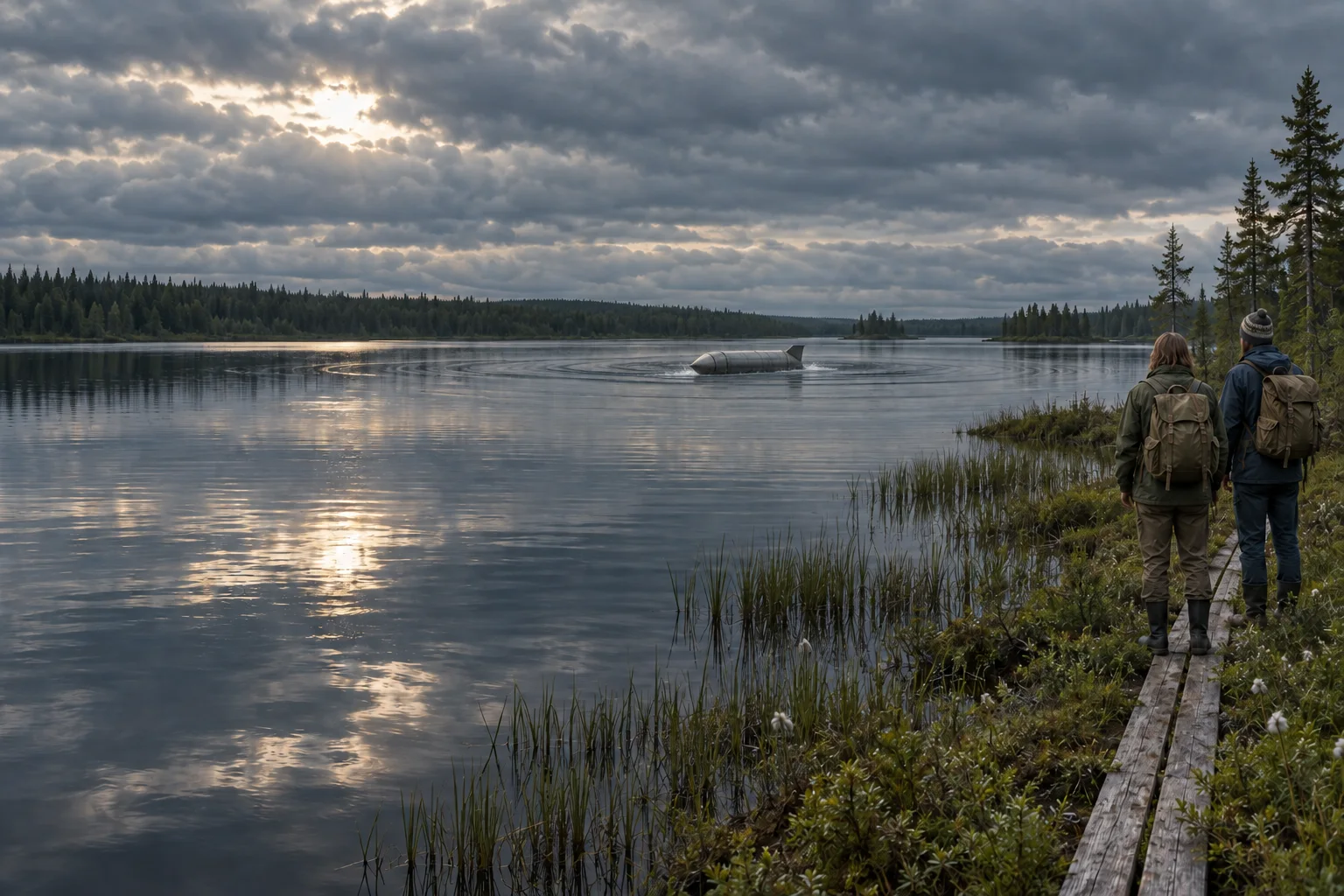
Bo Berg and Liz Hellström were resting beside Lake Nammajaure, deep inside Sweden’s Muddus National Park. It was July 31, 1980. Their first hiking trip together had brought them to a place where a wooden walkway crossed the wet ground beside the lake.
Then something came over their heads.
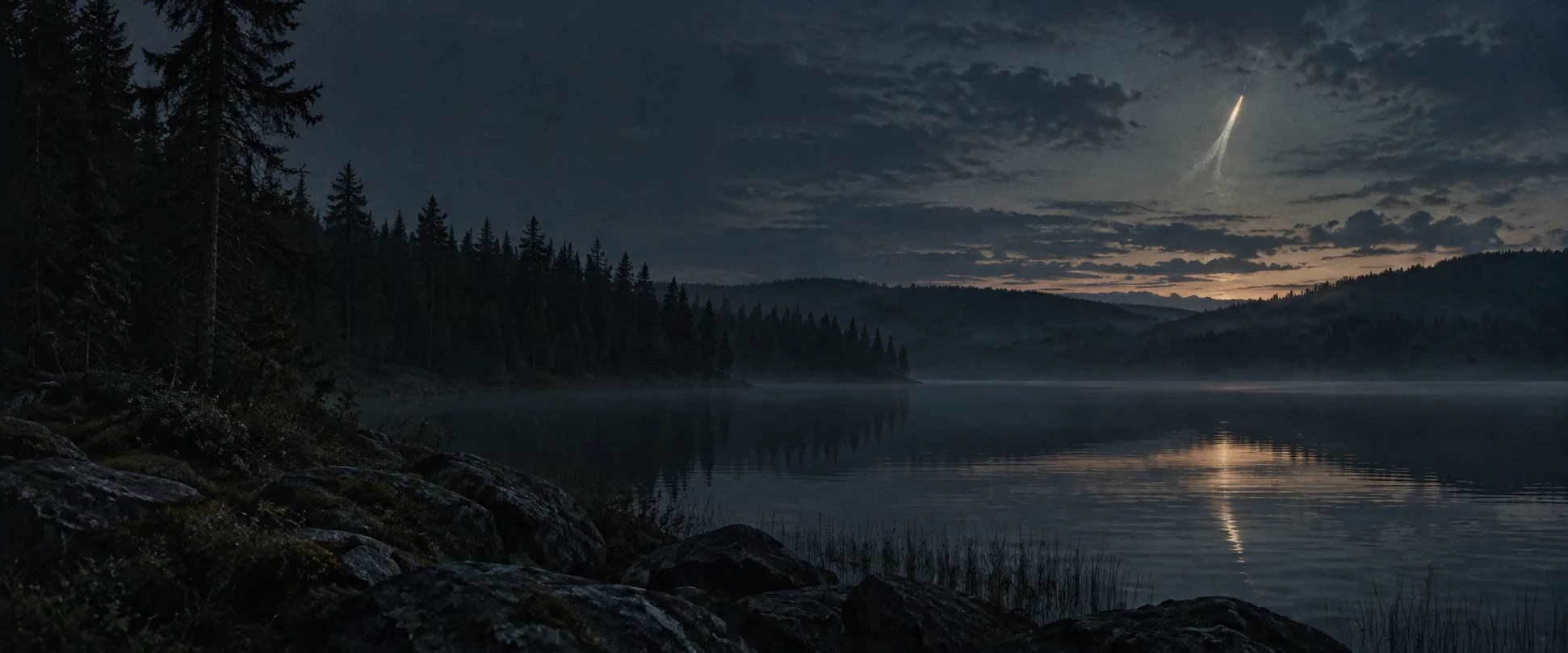
Liz would later describe a rushing, whining sound and a rocketlike body with small fins. It passed above them and continued out across the water. The two hikers had stopped to rest; suddenly, their attention was following something that belonged to neither the path nor the lake. In her interview with SVT before the 2012 search, Liz remembered the fear as clearly as the shape.
The object reached the lake, turned, and came down onto its surface.
Then it began to sink.
The turn over the lake
In Clas Svahn’s later account, the hikers watched the descending body through binoculars.
It seemed to settle deliberately onto the water. Bubbles rose as it disappeared, and the birds lifted from the lake.
Bo’s diary entry described a downward turn, a splash, and a body roughly three metres long. His impressions moved between an aircraft, a cruise missile and a UFO.
They left the area quickly, afraid that it might be a weapon that could explode. Back in Stockholm, Liz contacted defence researcher Sture Wickerts on August 5.
The flight had lasted seconds. The search for its destination would occupy decades.
A place to return to
Bo continued to think of a cruise missile. Liz, speaking to Sveriges Radio in 2012, remembered the Cold War setting in which they had first understood the encounter: a Soviet weapon, perhaps deliberately sent there, perhaps off course.
But their story also contained something unusually specific. It ended at a place on the water. They could return to the shore and indicate where they believed the object had gone down.
Thirty-two years after their walk, they did return. This time, they came with UFO-Sverige, divers, search instruments and a documentary crew. A lake that had been a stopping point on their first holiday together became the destination of an expedition.
Svahn explained the purpose to the radio reporter: the team would use sonar, divers and a metal detector to search for the reported object. Beyond the people on the shore lay the same water into which the witnesses had watched it disappear.
The years between the encounter and the expedition had changed almost everything about the search. The witnesses were older. The researchers could bring equipment that transformed the lake into a survey area. Yet the starting point remained the couple’s view from the walkway: a flight, a turn, a descent, and a location they could still point towards.
The marker on the water
On August 31, 2012, rain fell over the expedition. In Svahn’s diary written that day, tarpaulins and plastic bags protected the computers during a live broadcast from the shore. The divers arrived through the wet forest shortly after lunch.
Bo and Liz went back to their observation point. A boat waited out on the lake. With a walkie-talkie connecting the shore and the search team, the witnesses helped position it where they remembered the object sinking.
A buoy marked the spot.
There was now a visible point to work around, a small marker holding its position above the water. The divers began surveying the lake in sections. At the suspected location, the water was only about three metres deep.
As the day continued, sonar produced several places worth examining more closely. The divers returned with their recordings, and the next day’s work began to take shape around those targets.
From the walkway, the lake had offered a surface. On the computer, it was beginning to offer a bottom.
Beneath the buoy
The following morning brought a striking change. Svahn’s September 1 diary describes sunshine, blue sky and still water. The film crew worked both ashore and afloat, sometimes with three cameras recording at once.
Shortly after one o’clock, Svahn met divers Roine Norström and Simon Kenttä out on the lake. They had spent fifteen minutes underwater at the place the witnesses had identified. Their answer to his first question was mud.
Both men had pushed their arms into the sediment. Their hands continued downward without reaching a firm base. The shallow water concealed a much deeper layer of soft material.
Norström thought that an object sinking there could have carried on into it. The search was moving below the level that a diver could simply look across.
Back at the camp, the team discussed another visit with different instruments. Svahn contacted the helicopter company to arrange departure a day early. That evening, people gathered around the fire, ate, and talked through what the expedition had taught them.
The buoy had taken them to a location. The dive had taken them to the mud. Their next journey would have to reach farther beneath it.
Lines across Nammajaure
Two years later, the search returned to the water.
On August 31, 2014, Svahn spent six hours on the lake, steering while radar specialist Jaana Gustafsson operated the measuring equipment. Before they set out, he telephoned Liz for a final check on the area she and Bo had indicated during the previous expedition.
The boat worked across that remembered part of the lake. Batteries had to be recharged, equipment changed, and the survey continued through successive outings. A few echoes stood out in a lake that otherwise gave them relatively few returns.
Those points became the focus of the next stage. In Sveriges Radio’s report the following morning, Svahn described places where the radar suggested something lay within the sediment. Another instrument would be brought over them to look for a metallic response.
The strange flight had become a pattern of lines across the water, then a handful of places on a display. Each pass gave the team another way of approaching the destination Bo and Liz remembered. The work was slow enough to fill days; the event that had set it in motion had been over almost before the hikers could respond.
A second light above the lake
That evening in 2014, the camp had another spectacle overhead.
According to Svahn’s diary, the northern lights began appearing as the group gathered at the fire. Near midnight, he and his son Niklas stood beside the water to watch and photograph them. Broad curtains swept across the sky and reflected in Nammajaure. For about ten minutes the movement was particularly intense; the display then settled but remained bright.
It was a separate event, familiar in its identity and remarkable in its scale. The same lake that had drawn everyone there to search beneath its surface now held a reflection of the sky.
They stayed beside it until around one in the morning, then went to bed. The instruments and the search would occupy them again after dawn.
The boat without its engine
On September 1, the team took the magnetometer over the most interesting areas. Ludvig Vinka rowed while Gustafsson operated the instrument. Svahn and cameraman Janssen Herr followed in a support boat, helping with towing and recording the work.
The readings did not give a clear answer. The team finished the session, returned to shore, and began packing.
At two o’clock, the helicopter arrived to carry equipment out. Most of the group had already walked back towards the vehicles; two members remained to help attach the load and leave with the next lift. Batteries, instruments and the rest of the camp came out in stages. The search site returned to being a shore beside a forest lake.
The expedition drove south. Darkness fell on the road towards Skellefteå, and a half-moon rose during the journey.
At Nammajaure, the water remained above the places they had measured. The next return would begin there: with the locations on the survey, the sediment beneath them, and the brief turn over the lake that two hikers had carried with them since 1980.
What Is Known
Svahn reproduces Bo’s July 31, 1980 diary entry and dates his recorded witness interview to August 15, 1990. The diary and the interview preserve the encounter at different distances in time.
The expedition diaries document the fieldwork as it happened in 2012 and 2014. They record the witnesses helping mark a search location, sonar surveying, dives into deep sediment, radar work and the subsequent magnetometer session. Independent broadcasts place reporters alongside that work and preserve interviews with the participants.
The radar targets are survey observations. Their relationship to the reported 1980 object remains unestablished. SVT’s later follow-up, published in 2024 and updated in 2025, describes continuing plans to examine the lake with improved imaging.
In July 2026, Sveriges Radio reported a planned return during 2027, using new technology to investigate what might lie in the mud. That is a reported plan for further fieldwork, rather than a recovery or identification of the object.
The Bigger Picture
Nammajaure belongs to the long Swedish history of reported ghost rockets: elongated objects whose flights sometimes ended, according to witnesses, in lakes. In his 2016 radio talk, Svahn placed this encounter within a research history extending beyond the famous sightings of 1946. The name connects reports across decades; it does not establish a shared origin.
The Cold War also belongs to this story. In the 2012 radio coverage, FOI’s Eva Bernhardsdotter discussed how the technologies and concerns of a period influence the language people use for unfamiliar sights. Bo and Liz’s missile interpretation makes their account part of that historical setting. Their fear of a weapon was a documented part of the encounter itself.
The later searches gave the case another dimension. Filmmakers Kerstin Übelacker and Michael Cavanagh followed UFO-Sverige for years, recording both expeditions. Their production account of Ghost Rockets describes a seventy-minute film assembled from roughly 150 hours of footage. The story expanded from an extraordinary sight into the sustained human work of following it: fundraising, equipment, journeys and repeated returns.
There is a particular pull to a mystery with a geographical endpoint. A light can leave the sky. Something reported to have sunk invites people to come back to the same water and look below it.
At Nammajaure, that invitation has lasted longer than the hikers’ flight lasted by many orders of magnitude. The object crossed their view in seconds. The place where it disappeared has kept people returning for years.
Sources
- Clas Svahn, “Spökraketen i Nammajaure.” Later investigation history reproducing Bo’s contemporary diary and excerpts from the 1990 witness interview.
- Svahn, August 31, 2012 expedition diary. Firsthand field account of marking the location and surveying the lake.
- Svahn, September 1, 2012 expedition diary. Firsthand account of diving and the decision to return with other instruments.
- Svahn, August 31, 2014 expedition diary. Firsthand radar survey account and northern-lights observation.
- Svahn, September 1, 2014 expedition diary. Firsthand magnetometer survey and departure account.
- SVT, “UFO-Sverige på jakt,” August 30, 2012. Reporting with later witness interviews before the expedition.
- Sveriges Radio, “Sökandet efter Ufo har börjat,” August 31, 2012. Reporting from the search with witness and FOI interviews.
- Sveriges Radio, “Ufo-expedition: Intressanta saker i dyn,” September 1, 2014. Contemporary reporting on the radar targets; its approximate elapsed-year figure is erroneous, so the dated chronology is used here.
- UFO-Sverige, “Ghost Rockets.” Participant account of documentary production and expedition filming.
- SVT, “De vill lösa mysteriet med spökraketen i Nammajaure.” Independent follow-up, published September 28, 2024 and updated October 16, 2025.
- Sveriges Radio, “Clas ett steg närmare svaret på stora ufo-gåtan,” July 2026. Reporting on a planned 2027 expedition.
- Svahn, P4 Skaraborg radio talk, June 27, 2016, transcript. Later participant recollection and historical research context.