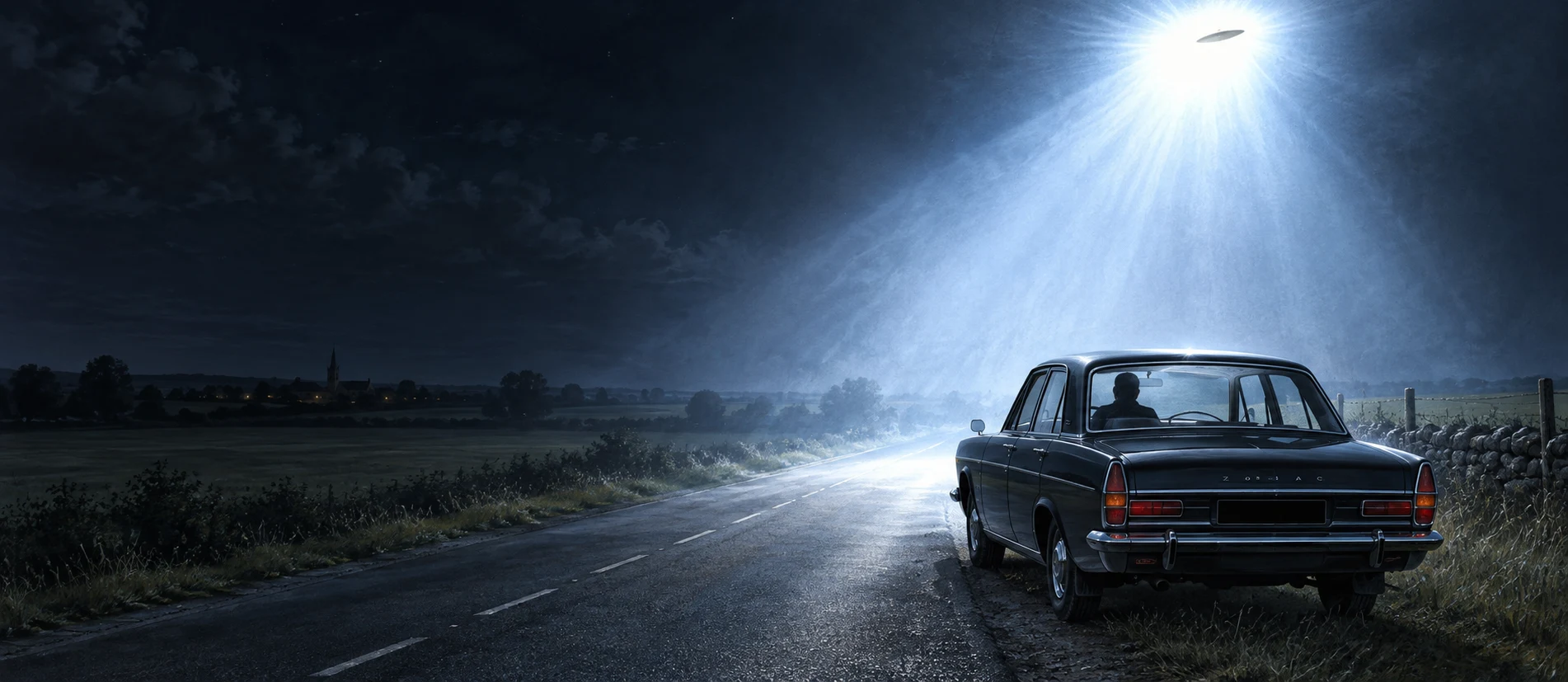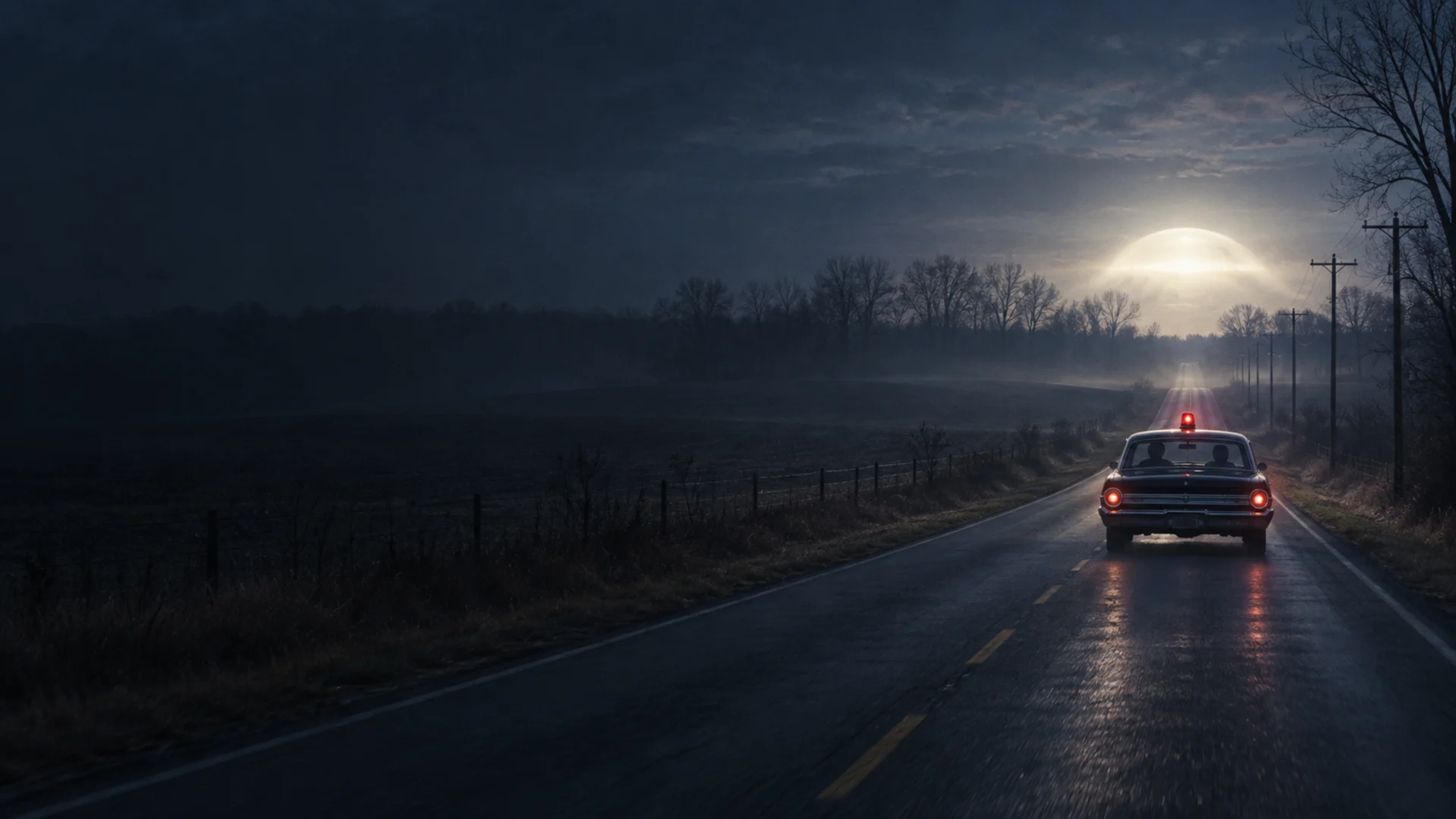
The light reached the cruiser before either man could leave the roadside.
Dale Spaur had noticed it above the trees on a hill beside the highway. He called his partner’s attention to it. As they watched, the light grew larger and came towards them, until something intensely bright was hovering directly overhead.
The ground lit up. So did their patrol car.
Spaur and Wilbur “Barney” Neff had stopped to check an abandoned vehicle. Now they were standing outside their own, looking up at a brightness that hurt their eyes.
They got back inside.
Across the radio, the men in cruiser P-13 reported what they were seeing. Then the object began moving away along the road, carrying its light with it.
The deputies followed.
The car on the berm
It was around five on Sunday morning, April 17, 1966. Spaur and Neff were patrolling southeastern Portage County, Ohio. Their radio had already carried traffic about a UFO in the vicinity, but the task that brought them out of the cruiser was ordinary police work.
An automobile stood on the berm of U.S. 224 between Atwater and Randolph. They stopped beside it and stepped out to investigate.
Their joint statement to NICAP begins with that parked car, then turns towards the hill. Spaur saw the light over the trees and drew Neff’s attention away from the vehicle they had come to examine.
At first there was a source somewhere beyond the roadside. As it approached, they described a large object giving off its own light. It crossed the remaining distance and stopped above them.
The cruiser was suddenly part of an illuminated patch of highway. Whatever lay beyond that patch, the two men were now directly beneath the thing they had been hearing about on the radio.
Under the white light
In the account preserved by NICAP’s Richard Hall, Spaur described checking his hands and clothing as the brightness enveloped them. A humming sound reminded him of an electrical transformer under load.
He remembered moving a foot, then making for the car. Neff went with him.
The object moved east and stopped again. Spaur used the microphone to describe it to the station. Hall’s account records that Sergeant Schoenfelt instructed them to follow and maintain observation while an attempt was made to bring a photographic unit into the encounter.
Inside P-13, the deputies could keep reporting. The radio gave the moving encounter a connection to people elsewhere: someone listening at a station could hear where the cruiser was going, and another patrol could position itself along that route.
Along 224
Spaur and Neff followed it eastward, along U.S. 224 and towards Route 14. Their signed account describes the illumination passing over the road and adjoining fields as the chase continued.
The object changed direction and altitude. They watched it move smoothly, sometimes lower, sometimes rising higher above their route. They initially placed it around 150 feet above the ground; later they estimated an altitude nearer a thousand feet.
Those estimates were being made from a moving police car. The measurements available to them were the road beneath the tyres, the speed of their own vehicle, and the changing position of the light beyond its windows.
They reported speeds of about 103 miles an hour at points during the pursuit.
A shape in the dawn
As the pursuit continued, the deputies described more than brightness.
Their joint statement gives the object a domed upper portion. Near the trailing edge, a projection appeared at times. Part of its upper rear surface looked metallic, with a satin appearance rather than a polished shine.
They estimated a width of thirty to forty-five feet and a height of eighteen to twenty-four. The light and the darker portion belonged, in their description, to the same moving shape.
The transition towards daylight changed their view. In the early darkness, illumination had dominated the encounter. As the sky brightened, a silhouette and an apparent surface became part of what they could describe.
Waiting on Route 14
Wayne Huston, an East Palestine patrolman, heard the reports over the police radio. Rather than trying to catch the cruiser from behind, he went to Route 14 and waited for it to reach him.
His written account places the object’s passage overhead at about half past five. He estimated it was roughly eight hundred feet up.
The comparison that came to him was an ice-cream cone, its point directed downwards. He was uncertain whether that lower portion was solid; it looked to him like light.
Then the Portage County cruiser came through.
Huston pulled out and followed. What had reached him first as radio traffic was now an object he had watched pass above his position, followed by the patrol car whose occupants had been describing it.
Two cars continued towards Pennsylvania.
Huston reported travelling at speeds between eighty-five and 105 miles an hour. The chase now included an officer from another department, with his own view of the shape and its position above the road.
Beyond the border
They crossed from Ohio into Pennsylvania, continuing onto Route 51 and towards Rochester.
Near Brady Run Park, Huston lost sight of it. Spaur and Neff also described a break in their observation while negotiating a bridge and underpass area near Rochester.
For a time, the light was beyond their view.
When they emerged, they saw it again. The deputies described it as lower than before, appearing to have waited for them. Then it moved off quickly ahead.
That impression gave the chase one of its most unsettling moments. The roadway had interrupted the officers’ view; once they were through, the encounter seemed to resume where it had paused.
By Conway, the fuel in Spaur’s cruiser was running low. He spotted another police car and stopped. The long pursuit was about to become a stationary observation again.
The officer on the hill
Frank Panzanella had been on duty in Conway. His statement dated May 18, 1966 begins with a cup of coffee at the Conway Hotel, followed by a drive along Second Avenue and up Eleventh Street.
Looking to his right, he noticed a shining object. He first thought he was seeing a reflection from an aircraft. At the top of the hill, near Mickey’s Lounge, he looked again.
It seemed to remain in place.
He turned his cruiser around and drove back down to a service station near Tenth Street and Route 65. There he got out to watch. He rubbed his eyes several times, keeping the observation to himself.
Two patrol cars arrived.
Their occupants stepped out and asked whether he had seen it. Panzanella initially asked what they meant. When they pointed, he told them he had been watching for about ten minutes.
The road had brought three pursuing men to a fourth who had already stopped beneath the same part of the sky.
Four men looking up
Panzanella compared the bright shape to half a football and estimated it was twenty-five to thirty-five feet across. It moved towards Harmony Township, stopped, then climbed rapidly.
He called his base station and asked the operator to notify Pittsburgh airport. The operator questioned whether he was ill. Panzanella responded by pointing to the other three officers watching with him.
The call continued through the dispatcher while the men remained outside.
A passenger aircraft passed to the left of the object, appearing below it. The officers relayed that observation too. Their pursuit had ended, but reporting continued through another police department’s radio and onwards to the airport.
The deputies’ statement describes two rapid climbs. Panzanella remembered the object continuing upwards, becoming smaller until its apparent size reminded him of a ballpoint pen.
The enormous brightness above the Ohio roadside had become something tiny in the Pennsylvania sky.
A telephone call in Rochester
A message asked the officers to make a telephone call. They went to the Rochester Police Department, where Spaur spoke to the person at the other end.
Afterwards, Panzanella supplied petrol for the Portage County cruiser to make its journey home.
The men could finally retrace the roads they had followed east. Their patrol had taken them approximately eighty-five miles from its beginning, across a state border and into a series of other departments’ reports.
By the next day, the chase was in the newspapers. In Douglas Bloomfield’s April 18 report, Spaur described the initial hum, the object’s outline and its manoeuvres. At Conway, he said, the officers had watched its ascent before going inside to telephone Air Force officials.
He had begun the morning by checking a car left beside the road. He ended it describing something that had brought him much farther than his patrol boundaries.
The next journey belonged to the account itself: out of the cruiser, through stations and telephone calls, into interviews, statements and print.
What Is Known
The case has a substantial contemporary documentary record. Spaur and Neff signed a joint statement; Huston supplied a written report; Panzanella recorded his observation in a statement dated May 18. The linked NICAP pages transcribe these documents from an archive credited to CUFOS and provide links to facsimiles. The observations and dimensions in this narrative are the officers’ reported perceptions and estimates.
William Weitzel’s May 4 letter to William Powers records his early investigation, interviews and portions of the radio-log sequence. His reconstruction places the state-line crossing at 5:35 and a report near Freedom at 5:50, using the log’s stated Eastern Standard Time. Published accounts differ in some timings; the route and sequence supply the narrative’s continuity.
Hall’s retrospective summary records the Air Force’s identification as a satellite followed by Venus, and the witnesses’ disagreement. That identification is an official interpretation of the reports. The statements preserve the encounter as the officers described it; they do not establish an extraterrestrial origin.
An Air Force letter of May 17, forwarding witness statements to Project Blue Book, also documents the human consequences already emerging. Information officer Eugene Rehrer reported that Panzanella wanted to assist without involvement in publicity, and that Huston had been harassed by calls, misquotation and unwanted attention. Huston had left the police force and taken employment elsewhere.
The Bigger Picture
The chase happened within a national system for collecting UFO reports. The National Archives’ Blue Book guide describes an Air Force programme that received 12,618 sightings between 1947 and 1969. Its case files eventually became historical records available to researchers.
At Portage County, police communications created another kind of record as the event unfolded. A report heard at one station reached a patrolman in another jurisdiction. He positioned himself beside the route and became a participant. Farther on, a fourth officer’s observation joined the pursuing men’s account.
Public attention followed the same paths much farther. By October, Associated Press reporter John De Groot described Spaur living apart from his family and working as a painter after leaving the sheriff’s department. His report recorded a broken marriage, an assault charge and the relentless attention surrounding the case. It also described Neff’s reluctance to speak and Huston’s frustration with ridicule. Those are reported circumstances and personal accounts, rather than proof that a single event caused every subsequent difficulty.
The National Archives’ history of the collection explains that public access followed a programme of removing personally identifying information, completed in 1976. The paperwork could then be studied at a distance from the lives that had produced it.
For the officers, that distance was harder to find. The pursuit finished at a service station, followed by petrol and a journey home. Being recognised as a witness continued long after the light had climbed away.
Sources
- Dale Spaur and W. L. Neff, joint statement to NICAP. Contemporary signed testimony, archival transcription with facsimile link.
- Wayne Huston, written report. Contemporary officer testimony, archival transcription with facsimile link.
- Frank Panzanella, statement, May 18, 1966. Contemporary signed testimony, archival transcription with facsimile link.
- Eugene F. Rehrer, “UFO Statements,” May 17, 1966. Air Force correspondence forwarding statements to Project Blue Book and recording witnesses’ concerns about publicity.
- William Weitzel to William Powers, May 4, 1966. Early investigator correspondence, archival transcription.
- Richard Hall, NICAP case report. Retrospective investigation summary incorporating excerpts of Spaur’s taped account.
- Douglas Bloomfield, “Ohio Deputies Chase, Lose Brilliant UFO,” Cleveland Plain Dealer, April 18, 1966. Contemporary newspaper report, archival transcription.
- John De Groot, “He Chased a Flying Saucer, Now His Life Is Shattered,” Cleveland Plain Dealer, October 9, 1966. Associated Press follow-up reporting, archival transcription.
- National Archives, Project Blue Book research guide. Independent institutional context.
- National Archives, “Public Interest in UFOs Persists 50 Years After Project Blue Book Termination”. Independent archival history and context for public access.