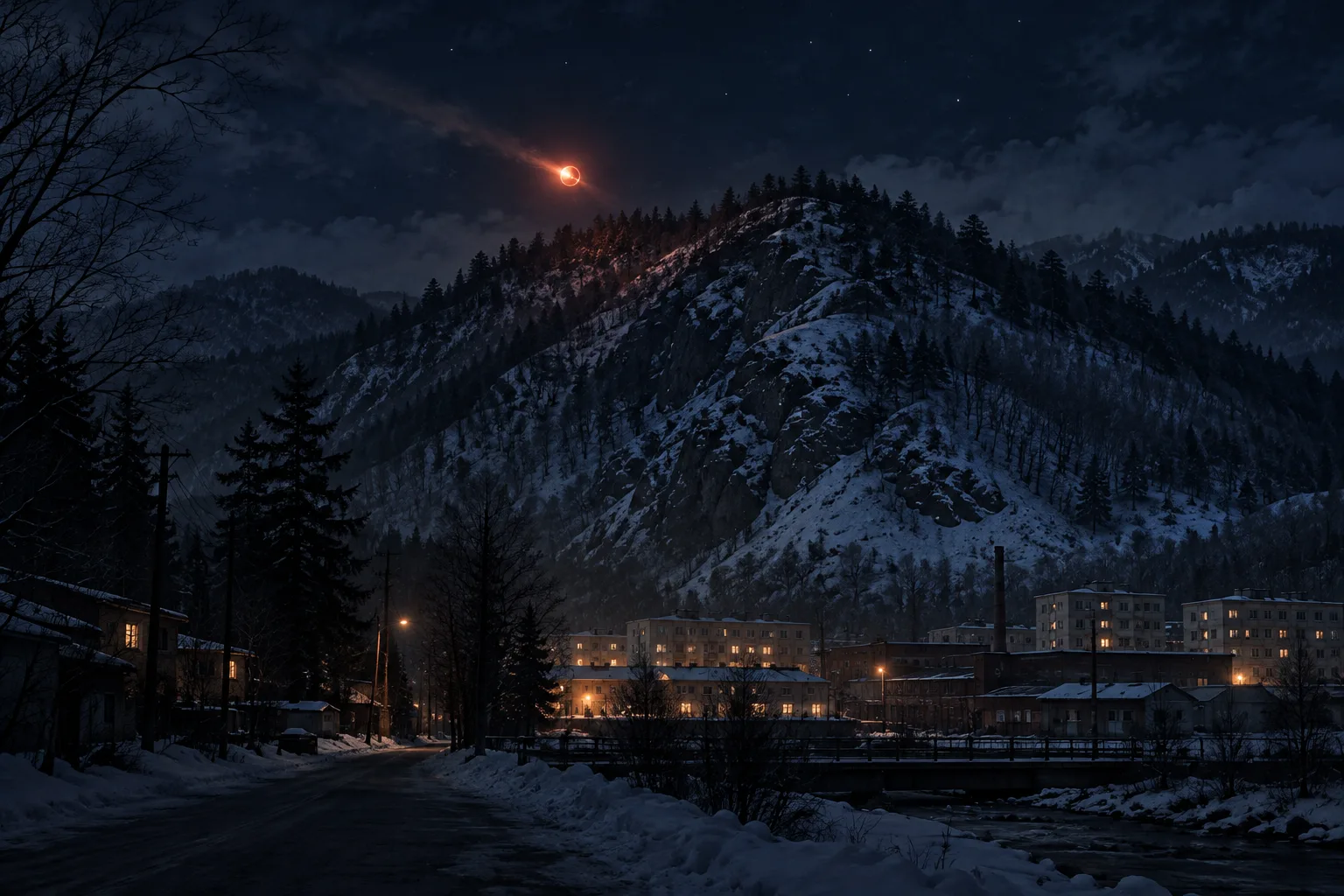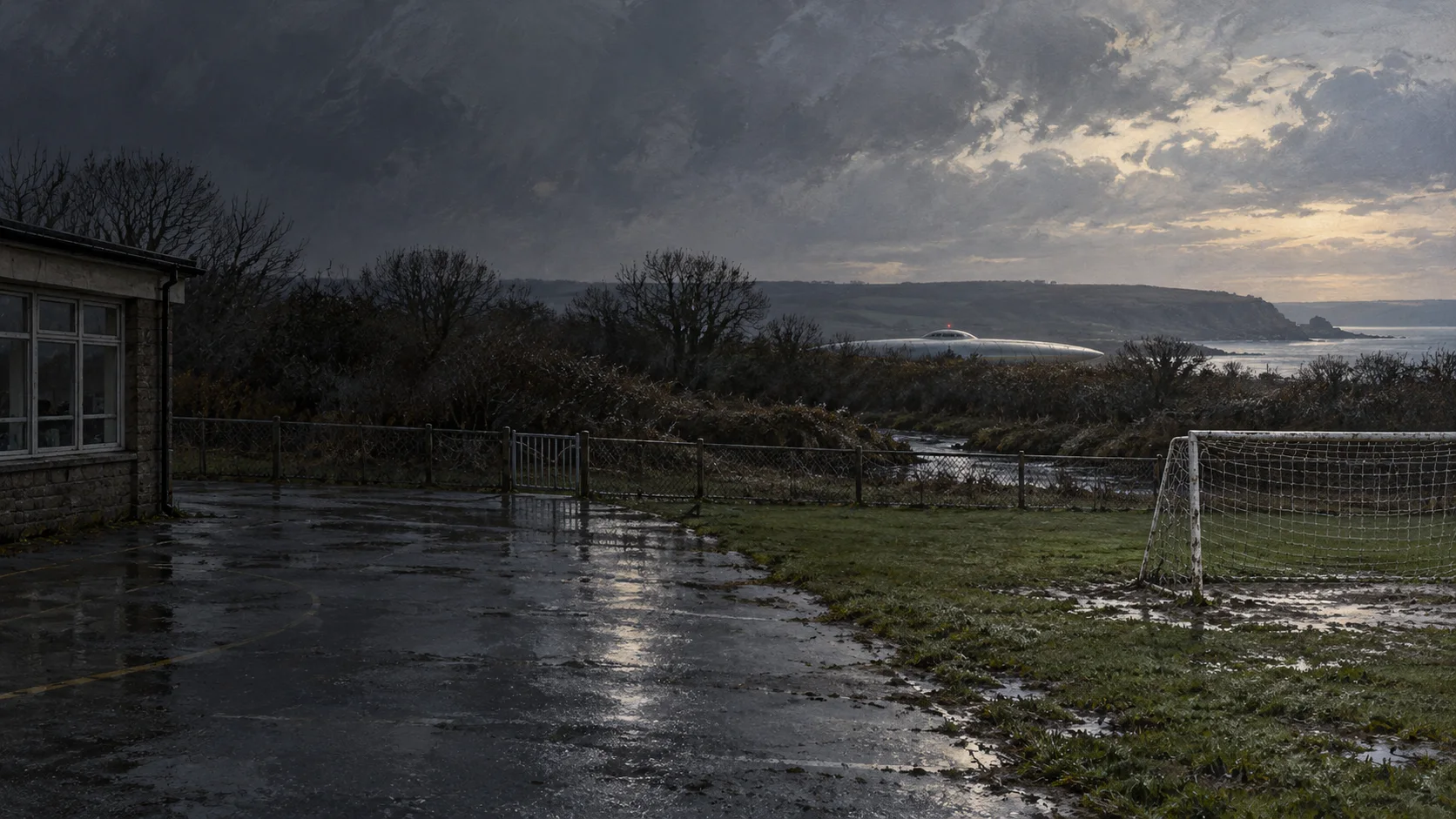
The football game ended with a pink light above the park.
On the evening of September 27, 1989, children in Voronezh, an industrial city south of Moscow, reported watching the light become a dark red sphere. It was about half past six. The object circled low over the grass, went away and returned a few minutes later.
In Jacques Vallée’s later reconstruction of the local reporting, the scene belonged to South Park. Two of the children were Vasya Surin and Zhenya Blinov, also rendered Genya in English accounts. Yuliya Sholokhova was another named witness.
Their story began with something overhead and grew stranger as it came closer. The sphere was described as roughly ten metres across. A hatch opened in its lower section.
Something appeared in the opening.
The figure in silver
The account carried by the Cincinnati Enquirer on October 11, drawing on the Soviet coverage, described a figure about three metres tall, dressed in silver-coloured overalls and bronze-coloured boots. A disc was visible on its chest. Its head had three eyes.
The sphere disappeared, then returned to land. A tall figure and a smaller companion, described as a robot, emerged.
The encounter had changed scale. The children had been watching a light above an ordinary place where they played. Now their account placed unfamiliar figures on the ground, close enough for clothing, eyes and a chest ornament to become part of the description.
The reported visitors were not addressing the children. What followed was a sequence of movements and reactions that the witnesses would later try to explain to adults.
The boy who vanished
A boy screamed.
According to the version in Sovetskaya Kultura, relayed by Associated Press reporter John-Thor Dahlburg, the figure turned its shining eyes towards him. He fell silent and could not move. Other onlookers began shouting, and the object and its occupants disappeared.
About five minutes later, the account continued, they were visible again.
This time the tall figure carried a tube, compared to a pistol. It pointed the device at an unidentified sixteen-year-old boy, who reportedly vanished. The figure went back inside the sphere. When the object departed, the boy reappeared.
The newspaper said police and journalists had questioned witnesses and that the children remained frightened afterwards.
That temporary disappearance became the most startling part of the story. The reported encounter had moved beyond an unfamiliar object or an unusual-looking visitor into an event in which another person apparently ceased to be visible, then returned as abruptly as he had gone.
Another view of the sky
Among the adults subsequently contacted was Lieutenant Sergei A. Matveyev of the district police.
In the telephone interview reproduced in the Enquirer, he described seeing a flying object on September 27. He had initially wondered whether tiredness was affecting his sight, but the object remained visible after he rubbed his eyes.
Matveyev said he had not seen the beings.
His recollection brought a police officer into the growing story, with a view of something airborne. The children’s account was meanwhile passing from the park into interviews, newspaper columns and the work of local investigators.
Four marks in the ground
At the site, investigators looked for something that might remain after the reported departure.
Genrikh Silanov, identified in the press as head of the Voronezh Geophysical Laboratory, became the principal scientific name attached to the case. The October 9 UPI dispatch relayed TASS’s description of a circle about twenty metres across, containing four small depressions. Each was reportedly fourteen to sixteen centimetres wide and four to five centimetres deep.
Two reddish pieces of rock also entered the account.
TASS attributed the identification of the site and the visitors’ route to a technique called biolocation. It said the route determined through that process agreed with the witnesses’ description. The agency presented the rocks as potentially extraordinary, while acknowledging that further testing was needed.
The investigation now had measurements, a named specialist and material to examine. These details gave editors something tangible to put beside the children’s descriptions: a place in the park, impressions in the earth and stones that might be analysed.
The message from TASS
On October 9, twelve days after the best-known reported encounter, TASS distributed the story internationally.
The Associated Press dispatch preserved in the following day’s Observer shows how emphatically it arrived. The Soviet agency said scientists had confirmed a landing and identified traces left by the visitors.
For foreign newsrooms, the source was part of the surprise. The Soviet Union’s official news agency was circulating an account of towering visitors and a robot taking a walk in a city park.
AP telephoned the agency. The duty officer stood by the dispatch, rejecting the suggestion of an April Fool’s joke.
The report crossed languages and borders with that institutional assurance attached. A local encounter involving schoolchildren had become international news, repeated by organizations whose readers might never otherwise have heard of the park.
The agency’s name travelled with the red sphere.
Questions on the telephone
The correspondent behind the dispatch was Vladimir Lebedev, a fifty-nine-year-old reporter with twenty years at TASS.
In UPI’s October 10 follow-up, he explained that he had not witnessed a landing. His reporting drew on interviews with about ten youngsters, whom he described as twelve or thirteen years old.
Asked whether he believed the story, he expressed a wish to believe. He continued to support his report while allowing that some imagination might have entered the account.
Soviet television was also following the case. UPI described the morning programme 120 Minutes devoting time to interviews in Voronezh.
Lebedev had become a witness to the reporting process: the person foreign correspondents could call to ask how the account had been gathered. The children had described an encounter. He had carried their description into a news system that was now asking him to account for it.
The story stays open
The investigators’ interest lasted beyond the first burst of headlines.
In a 2009 conference paper, writer Peter Robbins recalled corresponding with Voronezh investigator Yuri Lotosev during the early 1990s. Robbins described a local team examining the site, interviewing witnesses and continuing its work for more than a year. A book about the cases appeared in 1990.
Robbins also remembered the day the dispatch reached New York. He telephoned TASS’s Rockefeller Center office, introduced himself as a writer interested in UFO reports and was invited to visit. He left with copies of telexes and news reports.
The story had reached an office in Manhattan, then a writer’s files. Correspondence with a local investigator would later renew his interest.
The original evening had become a collection of accounts, drawings, clippings and competing descriptions. For the children, its remembered centre remained what they said had stepped out of the sphere.
What Is Known
The contemporary record establishes that children reported an encounter, local investigators examined a site and TASS published an emphatic account. Newspaper interviews preserve those claims; publication did not independently verify the beings or the alleged disappearance.
Silanov quickly challenged parts of the reporting. Paul Kurtz’s Spring 1990 review cites his AP interview identifying the supposedly extraterrestrial rock as ordinary iron oxide and objecting that TASS had attributed statements he had not supplied.
Kurtz also reproduced an October 28 AFP report: a commission’s radiometric, soil, microbiological and spectrochemical checks had found no anomaly establishing a landing. Elevated caesium was attributed by the commission’s chairman to the wider post-Chernobyl context. This is the commission’s conclusion as relayed through AFP and Kurtz, rather than its original laboratory files.
The same review identifies biolocation as dowsing. Its claimed results should not be equated with calibrated instrument measurements.
The later accounts preserve investigators’ perspectives, while the extraordinary claims remain unverified.
The Bigger Picture
Voronezh arrived during glasnost, when Soviet news organizations were publishing material that would previously have struggled to reach the public. Contemporary AP coverage placed the dispatch within that changing media environment.
The case exposes a particular problem of authority. A trusted institution can make an unfamiliar report seem stronger simply by carrying it. Readers encounter a polished dispatch, while the underlying story may still consist of interviews, provisional interpretations and disputed remarks.
That transformation can occur without settling what the witnesses experienced. A police officer’s aerial observation, a child’s description of a figure and a claim about a stone remain different kinds of statement, even when one article assembles them into a single event.
Treating the story only as a joke also obscured its human side. The children described fear; investigators tried to understand their reports. Taking those people seriously requires preserving what they said, including the disagreements that followed.
Voronezh endures partly because its images are so extraordinary: a crimson sphere, silver clothing, three eyes and a small mechanical companion. Its history asks a quieter question about what happens between a child’s account and a headline read around the world.
Sources
- Associated Press, in The Observer, October 10, 1989, page 6 — contemporary response to TASS’s October 9 dispatch.
- UPI, “Soviets report UFO landing,” October 9, 1989 — original international coverage of the claimed traces and testing.
- John-Thor Dahlburg, AP, in Arkansas Democrat, October 11, 1989 — contemporary report, preserved in UFO Newsclipping Service 243, page 9.
- Cincinnati Enquirer, October 11, 1989, page 7 — news-services report; consulted in an archival transcription.
- UPI, “Correspondent waffles on UFO report,” October 10, 1989 — Lebedev interview; also checked against the Arkansas Gazette reprint in the clipping archive, page 12.
- Jacques Vallée, UFO Chronicles of the Soviet Union, 1992, pages 40–59 — later reconstruction of Soviet reporting and discussions with investigators.
- Paul Kurtz, “Paranormal Pandemonium in the Soviet Union,” Spring 1990 — near-contemporary critical review, including the reported commission findings.
- Peter Robbins, “Voronezh: A Personal Reappraisal,” November 2009 — retrospective based partly on investigator correspondence and a visit to TASS’s New York office.