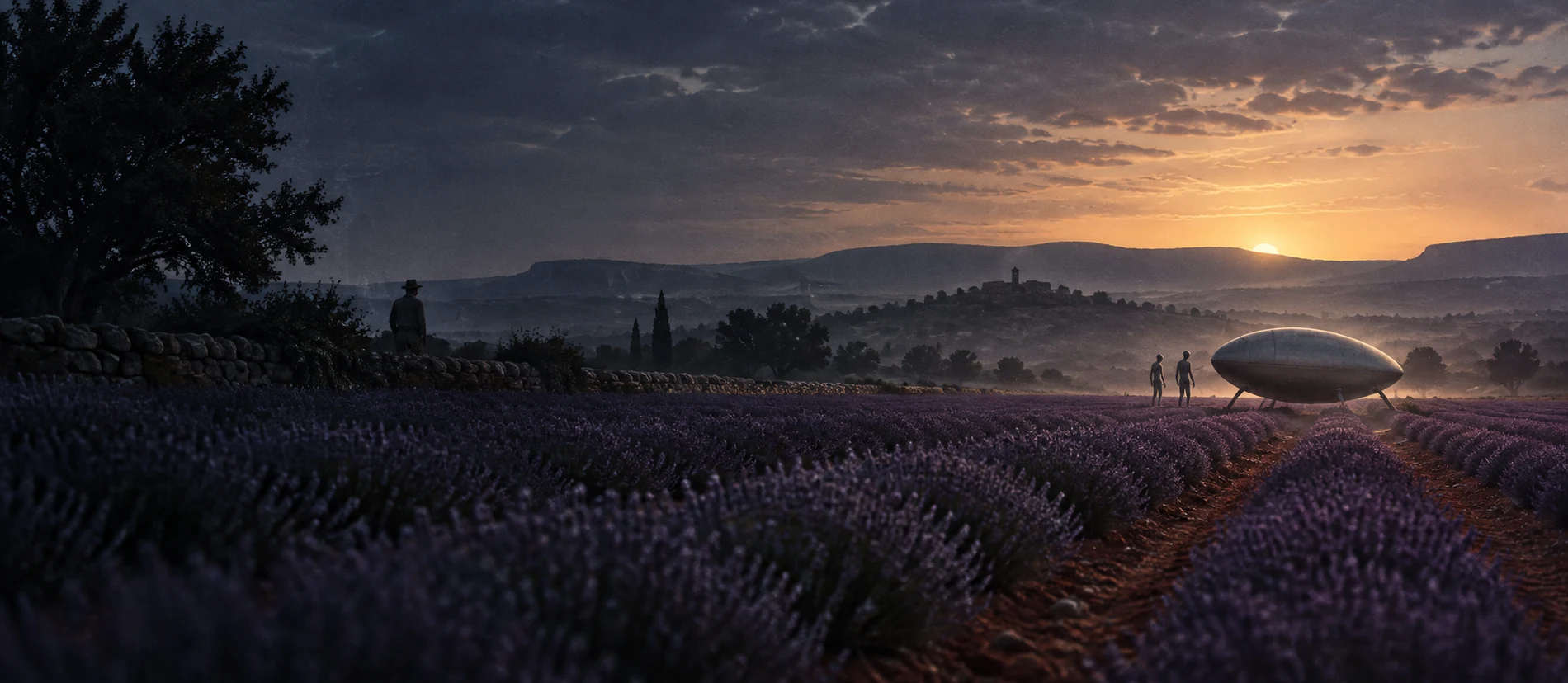
The two figures were crouching beside a lavender plant when Maurice Masse approached.
One had its back to him. The other faced his direction. Behind them stood an unfamiliar machine, low over the earth, its rounded body resting on supports.
Masse had crossed his own field to find the source of a whistle. Now he was close enough to see that the figures were very small, and that one of them had noticed him.
In the fuller account he gave the gendarmes that August, the figure turned towards its companion. Both stood. One raised an object in its right hand.
Masse stopped moving.
He could see the scene in front of him. He could hear. But, he said, he could no longer turn his head, lift an arm or take another step.
Before the whistle
The morning had begun with work.
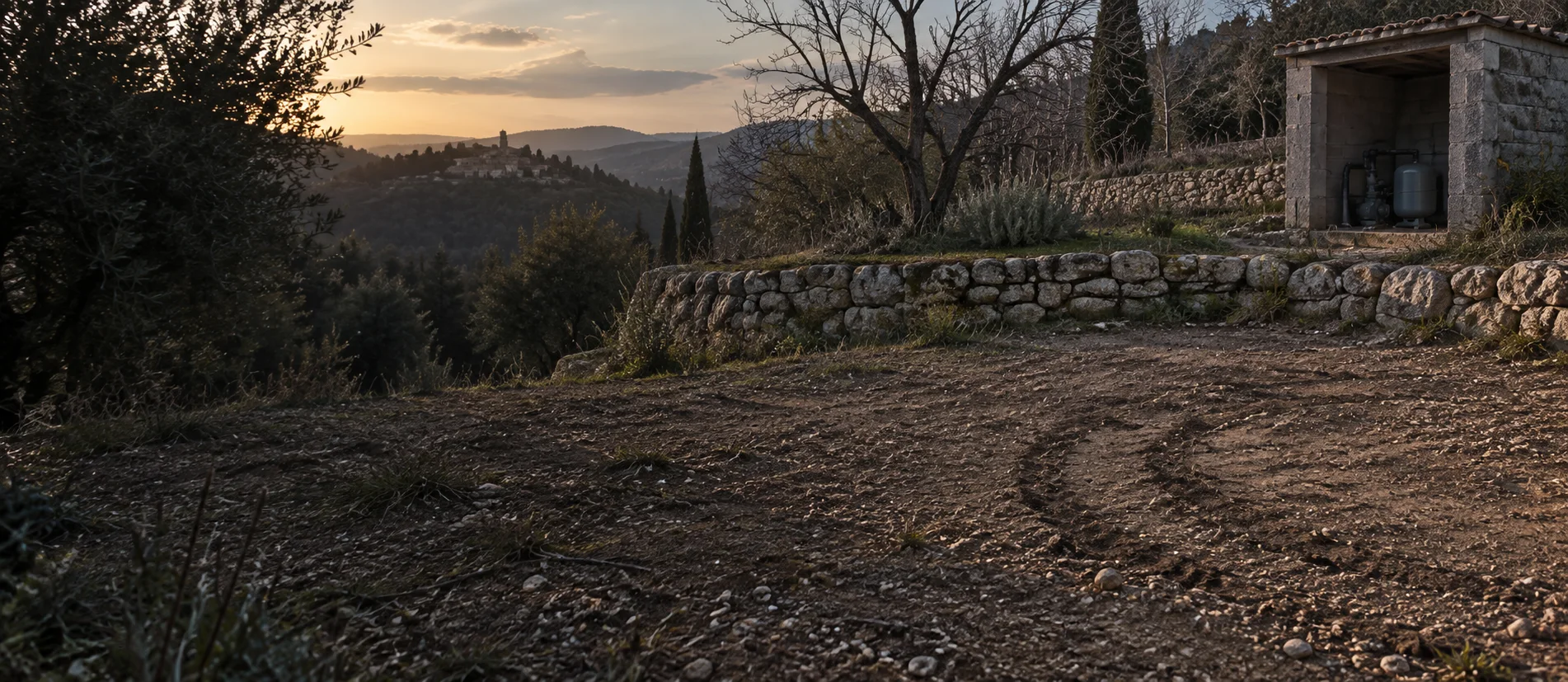
On July 1, 1965, Masse left his home in Valensole around half past five and travelled to L’Olivol, about two kilometres northwest of the village. The plateau was agricultural country: fields, tracks, vineyards and lavender. His destination was a place he knew through tending it.
His first police statement, taken the following evening, places him in the field around 5:40 a.m., hoeing the lavender. A few minutes later, he removed his jacket and sat down to smoke near a heap of stones.
Then came the sound.
He described a whistle nearby. The mound obscured its source. He got up and went around it, moving towards the noise.
At that point, the morning opened onto something unexpected. A machine was standing in the field, among the plants he had come to tend.
A machine among the plants
Masse reached for ordinary comparisons when describing the object.
Its bulk was about that of a Renault Dauphine, a small car. Its body reminded him of a rugby ball. The surface was matte, and the upper part appeared transparent. He could make out an opening on its side.
In the initial statement, he described looking towards it from some distance and seeing one figure outside and another within. The detailed statement of August 18 brought his approach much closer: he said he had followed the edge of the neighbouring vineyard, then turned towards the machine, stopping about seven metres away.
That later testimony is the source of the close encounter that follows.
From this position, he described the bottom of the craft as roughly half a metre above the ground. A transparent dome rose above the body. Beneath it were a central tube and supporting feet.
The figures by the lavender
At first, Masse had watched their activity as he approached.
Both were crouching. He thought the figure facing him was examining a lavender plant. Then it saw him and appeared to signal the other.
They rose and turned.
His August testimony, preserved with the July records, describes figures a little under a metre and a quarter tall, with heads disproportionately large for their bodies. Their clothing was close-fitting and grey-green. Their heads were bare, their skin smooth, their hands small.
He remembered large ears, eyes set at an angle, and an opening where he expected a mouth. The details came from the few minutes during which he said he was standing before them.
One held a small object; another, larger item was carried at the other side of its body. Masse described the raised object being directed towards him.
He did not report pain. The sensation he described was stranger: awareness remained, but movement had gone. He was standing there, looking at them, unable to make his body answer him.
Unable to turn away
The figures stayed near him for several minutes, according to his account.
He could see their mouths moving and heard a kind of murmuring. He associated the sound with them, though he understood no words. He said their attitude did not give him the impression that they intended harm.
Yet he could not move.
The restriction was complete enough that his view depended on what happened within the space ahead. He could not turn his head to follow something elsewhere. The field around him remained familiar, but his ability to act within it had changed.
The visitors then went back towards the opening in the craft.
Masse described them boarding with agility, using first one hand and then the other to help themselves inside. The doorway was slightly larger than their bodies. A man of his own size, he thought, would have had to turn sideways to pass through it.
Once inside, they were visible behind the transparent dome.
A sliding door closed. He remembered it moving downwards, without seeing a hand operate it. The figures were now enclosed in the machine that had brought them into the field.
The ground lets go
A low sound followed.
Masse estimated that it lasted two or three seconds. The craft lifted about half a metre to a metre. Beneath it, the central tube came out of the earth, and the feet began moving.
He compared their motion to the hands of a clock.
There was no cloud of dust in his description. The machine rose, then departed obliquely towards the west, in the direction of Manosque. Its movement carried it away across the same countryside through which he had travelled to work.
He followed it for a short distance before it disappeared from his sight.
For Masse, the encounter continued after the craft was gone. He said he remained immobilised for roughly another quarter of an hour. Eventually his hands began to move. Then movement returned to the rest of his body.
He went towards his tractor, lit a cigarette and resumed working. Around eight, he broke off and returned home.
The sequence he gave the police ends the morning with these ordinary actions. The departure had been abrupt. His own return to movement and work came in stages.
What remained in the earth
Later, he went to the place where the craft had stood.
In his July statement, he described an unusual pattern in the ground: a depression with a cylindrical hole at its centre. Around it were marks spreading outward. The earth in the depression seemed wet.
That evening, at about 8:30, he returned with his daughter.
He said the ground had changed. What had appeared soaked was now hard, with a consistency he compared to cement. The hole and surrounding marks remained in the field.
On July 2, around half past twelve, he noticed darkening along the northern edge of the hole. That detail entered his supplementary statement later that night.
By then, the story had begun travelling beyond the field.
Back to L’Olivol
Masse had told a friend the following morning. Word spread, and people came to look.
The gendarmes learned of the encounter on the evening of July 2. They called him to the brigade and recorded his statement at eight o’clock. Later that night, he accompanied them to L’Olivol.
The site report in the same police bundle describes the officers finding a shallow depression around 1.2 metres across. At its centre was a cylindrical hole about eighteen centimetres wide and forty centimetres deep. Four shallow furrows extended around it, forming a cross-like pattern.
They returned the next morning to photograph the site and draw its layout.
The resulting images show the open field, the mound, and closer views of the disturbed ground. The sketch places the trace relative to the neighbouring vineyard, paths and old lavender planting. Places Masse had moved between in his account now had measured positions on paper.
The field fills with people
On July 3, Le Provençal carried the encounter on its front page. Its correspondent, Victor Nathan, had spoken to Masse and visited the site with gendarmes. The report put the farmer’s account before readers far beyond Valensole.
The field was becoming a destination.
In its July 4 coverage, Le Dauphiné Libéré described arriving visitors and Masse’s concern for the lavender beneath their feet. The crop he had been hoeing was now being crossed by people coming to inspect the marks.
By July 6, Le Méridional described vehicles from several French departments and even Belgium crowding the approach. Its account placed golden wheat and blue lavender around the patch everyone had come to see.
The contrast was contained in that single place. Before dawn, one man had rounded a mound to investigate a sound. Within days, visitors were following the track to inspect the ground he had described.
In August, Masse returned to the gendarmes and gave his longer statement. He explained that the strangeness of the encounter had made him reluctant to describe everything initially. Now he put the close approach, the two figures and the immobilisation into the record.
The field had become a public story. The few minutes at its centre remained his own.
What Is Known
The original police bundle preserves several separate documents. Report 445 records Masse’s July 2 statement and supplementary interview. Report 105 documents the officers’ site visits on July 2 and 3, with measurements, a field sketch and captioned photographs; it was closed on July 5.
Report 145 preserves his fuller testimony given on August 18 and was closed on August 23. The close approach, detailed appearance of the figures and reported immobilisation come from this later statement, made seven weeks after the encounter. The article identifies that change in testimony before following its sequence.
The photographs and measurements document the ground the officers inspected. Masse’s statements document what he said he experienced there. Contemporary newspaper reports also preserve interviews and the public response in the first days.
GEIPAN’s case entry brings these materials into France’s national archive and classifies the case as D, unidentified. The institution’s predecessor, GEPAN, was created in 1977; the 1965 investigation was undertaken by the gendarmerie. The classification describes the archived case and does not establish an extraterrestrial identity for its reported visitors.
The Bigger Picture
Valensole’s landscape gives the encounter its distinctive character.
The Moustiers-Sainte-Marie tourist office’s account of the plateau describes a broad agricultural territory overlooking the Durance valley, with lavender flowering from mid-June into mid-July. Its cultivation is part of the region’s working heritage. Early July places Masse’s encounter within that seasonal landscape, among plants requiring attention before harvest.
For him, the field was a workplace. Its boundaries, neighbouring vineyard and mound were landmarks in a familiar routine. That familiarity makes the reported interruption especially vivid: the source of an unusual sound turns out to be something resting among his own plants.
The narrative then changes scale. A few minutes of private experience become a village rumour, a police visit, newspaper coverage and an archive. Each stage leaves a different kind of record, from a witness’s account of gestures to a photograph of a hole in the earth.
Reading those records brings the story back to a modest piece of ground. The claimed machine was small, the figures smaller still. Their presence lasted minutes. The field, the work and the man who described the encounter belonged to a much longer life around Valensole.
That is the lasting image: a grower approaching two figures beside a lavender plant, close enough to watch one turn towards him. Everything that followed began with the short walk around the mound.
Sources
- Gendarmerie records, July–August 1965, preserved by GEIPAN. Original scanned statements, site report, measurements, sketch and photographs; reports 445, 105 and 145.
- GEIPAN, Valensole case entry. Official archival summary and classification.
- Victor Nathan, Le Provençal, July 3, 1965. Contemporary interview and site reporting, reproduced with scans and translation.
- Le Dauphiné Libéré, July 4, 1965. Contemporary coverage, reproduced with scan and translation.
- Le Méridional, July 6, 1965. Contemporary reporting on visitors to the field, reproduced with scan and transcription.
- Moustiers-Sainte-Marie tourist office, lavender and the Valensole plateau. Independent geographic and agricultural context.