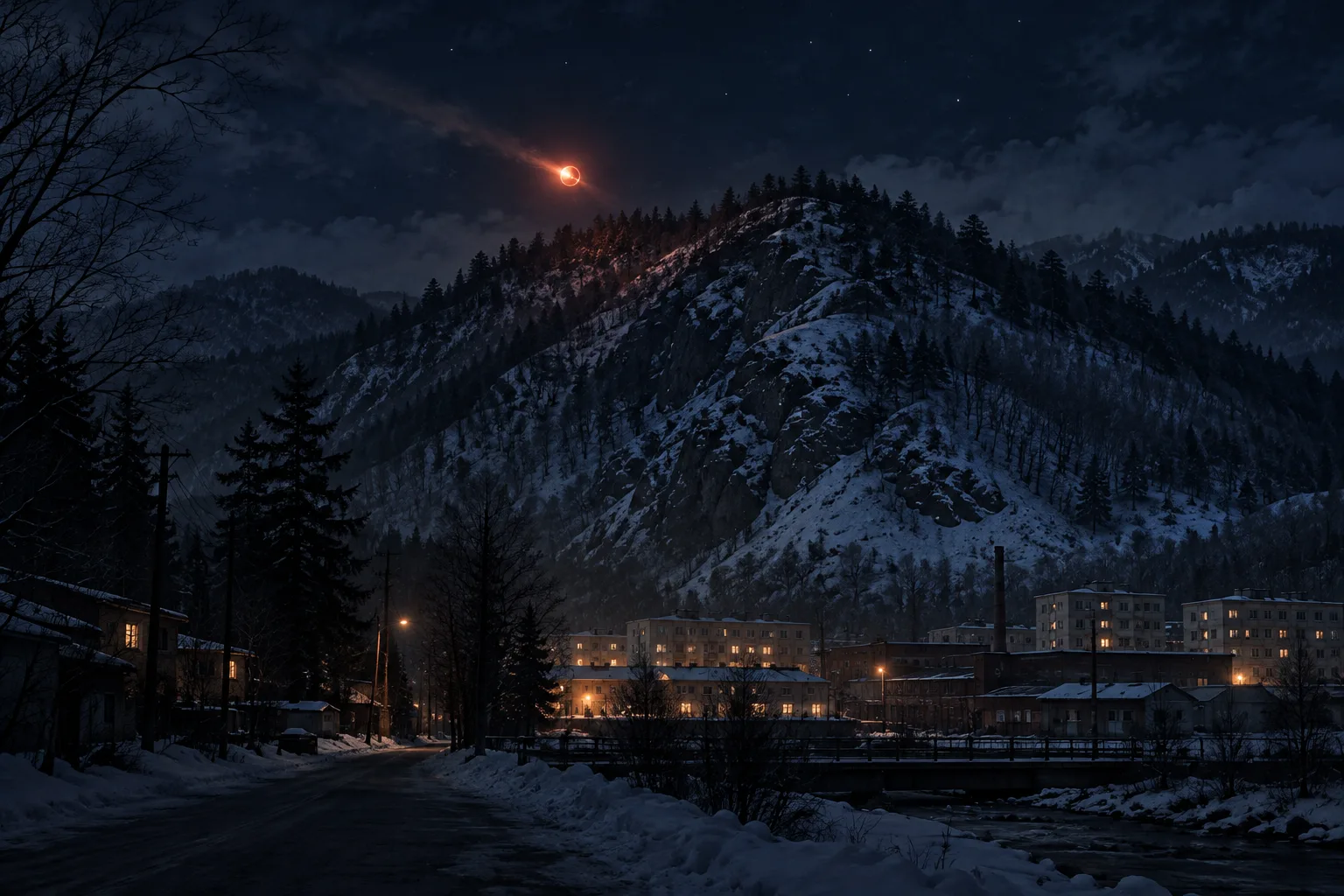
The red light was moving towards the bus station when it turned down towards the rocks.
Two schoolboys, Sergey Olkhov and Alyosha Maslov, had watched it cross the evening sky above Dalnegorsk. Behind it, they reported, came sparks and a pale trail. Its brightness changed as it travelled. On the ground, the shadows of trees moved.
Then the light descended sharply.
The boys’ account described a dull sound at the rock face, a flash, and the ball apparently bouncing upwards. There was another flash. It fell back among the rocks, where a fire began.
It was 7:55 p.m. on January 29, 1986. The hill would become famous under a number: 611.
Above the bus station
The schoolboys’ observations appeared in an article by local biology teacher Valery Dvuzhilny, published in Trudovoye Slovo on February 22. Decades later, journalist Sofya Koreneva reproduced the account while reporting from Dalnegorsk.
The town occupied a narrow valley in the Soviet Far East, with wooded hills rising above its buildings. Lead and zinc mining had brought a settlement here in the nineteenth century. The surrounding slopes belonged to the everyday landscape of an industrial community.
On this evening, people watching that landscape described something unfamiliar crossing it.
One of the more detailed witness accounts concerned Vladimir Kondakov, a mechanic standing near the bus station. In a retrospective narrative published under Alexander Rempel’s name, Kondakov watched a round object pass towards Height 611.
He placed it low against the familiar industrial skyline, near the height of a factory chimney. He described a surface resembling slightly heated stainless steel. There were no protrusions that he could make out, and he heard no sound accompanying its passage.
His first interpretation was a military projectile.
The object continued towards the hill. What had been a moving shape above the town became a light associated with one particular slope. Kondakov’s account ended with its fall and a fire at the destination.
The newspaper account and this later reconstruction preserved different viewing positions. From the street, witnesses had followed the object across familiar landmarks. Now their attention was fixed on a place above them.
The light on the slope
The hill was Izvestkovaya, also known as Height 611. Reports described a glow or fire continuing there for roughly an hour after the descent.
Some accounts made the sequence more complicated than a single impact. In investigator reports summarized by science writer J. Antonio Huneeus in 1990, some witnesses said the light rose and fell repeatedly at the hillside, brightening as it rose and weakening as it lowered. Six movements were reported.
This was the unsettling detail within the crash story: something appeared to remain active where it had come down.
The witnesses were looking towards the same hill, but they were describing an event that changed over time. A crossing light, an abrupt descent, flashes against the rocks and a prolonged glow became successive parts of the account.
Once the glow ended, the location remained. Whatever had happened in the sky, people could now climb towards the place where they believed it had reached the ground.
Into the snow
The search involved Dvuzhilny, who would spend years pursuing the case. Later descriptions differ over the precise date of the first organized ascent. They agree that investigators examined the slope in the days after January 29.
Rempel’s retrospective describes a steep climb through deep snow. At the reported site, the searchers found a small exposed patch, blackened rock fragments and scorched wood. The flight had taken witnesses across the town’s skyline; the investigation brought the search down to material that could be picked out of the ground.
The discoveries were small enough to collect by hand.
According to PrimaMedia’s later retrospective, early visitors had expected recognizable wreckage. Instead, the reported finds included metallic droplets, dark little spheres and fragments of an unusual mesh. Dvuzhilny inspected the area and interviewed people who had watched the event.
The scene offered two routes into the same mystery. Witnesses could describe where the light had travelled and what they had seen at the end. The searchers could gather the scattered particles and ask what they were made of.
Those routes would carry the case forward together: the trajectory across Dalnegorsk, and the tiny objects associated with its endpoint.
A patch beside the rock
By April 1988, Dvuzhilny and V. K. Zhuravlev had prepared a conference abstract on the Dalnegorsk phenomenon.
Their description located the affected ground close to the hilltop beside exposed bedrock. They gave its dimensions as approximately two metres by two metres. Rock fragments carried a dark coating and signs of heating. Black and grey ash covered the patch, with burnt wood among it.
They reported metallic droplets, glasslike black particles and loose, flaky pieces resembling a mesh. Analyses identified lead, silicon and iron among the principal elements, with other elements present in some samples.
The investigators also collected witness reports and drew a reconstruction of the flight path.
An evening’s observations had become a research subject with a mapped trajectory, a particular patch of hillside and several classes of material. Each small fragment could travel farther than the people who first watched the light. It could be sent to another investigator, examined under another instrument, and described in another paper.
Height 611 was beginning its second journey.
More lights over Dalnegorsk
The investigation did not remain confined to that January night.
In Huneeus’s June 14, 1990 article, Dvuzhilny’s reports described two yellow globes approaching the site on February 6, 1986. They allegedly circled above it before disappearing in a flash.
A much larger collection of reports followed on November 28, 1987. Dvuzhilny described observations across several districts and twelve settlements, with numerous lights reported over Dalnegorsk itself. Some witnesses initially thought they were watching aircraft in trouble.
Huneeus obtained the investigator’s accounts through retired Major Colman von Keviczky, whose UFO research group operated in Queens, New York.
The path from a local investigation to an English-language newspaper was becoming visible. Reports crossed institutional and national boundaries, reaching readers who had never heard of the mining town before its hillside fire.
Back in the investigators’ work, the later sightings became another set of paths to plot. The 1988 abstract recorded comparisons between the January event and subsequent regional observations. Its authors called for regular optical and photographic monitoring.
The hill had supplied a location to revisit. The sky above it had supplied a reason to keep looking.
Threads in the newspapers
By 1989, the small pieces described as mesh were attracting especially ambitious interpretations.
A U.S. government digest of Soviet press coverage, dated November 22, 1989, summarized articles about the continuing Dalnegorsk investigation. It relayed claims concerning fine threads, braided structures and extremely thin gold wires within the recovered material.
The digest attributed an extraordinary interpretation to V. Vysotskiy, a doctor of chemical sciences: he considered the material evidence of technology beyond terrestrial capabilities.
What had been lifted from a small burnt patch was now being presented in print as a possible technological signature. The scale had changed again. The object over the bus station had led to the hill; the hill had led to particles; the particles had led to microscopic structures and arguments about their manufacture.
These accounts gave distant readers something specific to imagine. A fine mesh could seem more tangible than a fleeting light. It suggested something to hold, magnify and examine, and it placed laboratory language beside the testimony from the town.
The fragments became the centre of the story’s international reputation.
Under the instruments
There was also laboratory work that can be followed through a surviving technical summary.
In 1989, samples attributed to Height 611 reached the E. O. Paton Electric Welding Institute, part of the Ukrainian SSR Academy of Sciences. Researchers O. D. Smiyan, L. M. Kapitanchuk and S. O. Antonov described their work in proceedings published in 1991, following a 1990 seminar.
Their paper identifies the Dalnegorsk specimens: tiny melted lead particles and four pieces of a charred stump. They examined the samples with several surface-analysis methods.
The lead particles were around a millimetre across. Their surfaces showed distinct layers, while the porous burnt wood made quantitative analysis difficult.
Here the journey reached an instrument bench. The hilltop objects had acquired dimensions, preparation procedures and measured compositions. Researchers were asking how the surfaces had formed and whether the materials differed from familiar substances.
The paper brought the reader close to the specimens themselves: small, dark, irregular remnants, separated into categories and examined one surface at a time.
Outside the laboratory, the larger image remained a luminous ball descending towards a Soviet hillside.
The hill people return to
The investigation gave Dalnegorsk a reputation that outlasted the Soviet Union.
The local museum’s account of Height 611 describes Dvuzhilny taking the subject to a symposium in California in 1995. The town’s story had travelled from its newspaper to an audience on the other side of the Pacific.
Visitors could make the journey in the opposite direction, arriving in Dalnegorsk to see the place itself. Museum staff organize accompaniment to the hill, which the museum places about a kilometre and a half from the bus station.
At the site stands an outdoor commemorative area with a model of an alien craft, made by specialists from the local industrial enterprise Dalpolimetall.
The model belongs to the story’s afterlife. The original observation remains harder to picture: a round light crossing the town, then a flare at the rocks. The walk returns visitors to that geography, from the buildings below towards the place where witnesses said the flight ended.
The name on the case file is still the name of a hill.
What Is Known
Dalnegorsk has an identifiable documentary history. There is a February 1986 newspaper account reproduced in later reporting, a 1988 abstract coauthored by the principal investigator, and a technical materials paper published in 1991. These are different records, serving different purposes. The online versions of the research abstracts are transcriptions rather than scans of the original proceedings.
The witness narratives describe a luminous object and a fire. Their estimates of apparent size, height and movement should remain attributed estimates. Later reconstructions also differ in details, including the first ascent’s date. They cannot be combined into a single perfectly synchronized observation.
The materials paper establishes that particular submitted specimens were examined. It does not independently establish how each specimen reached the hill or connect every particle to the observed light. Its title can also mislead a reader who overlooks the sample list: the iron sphere discussed alongside the Dalnegorsk lead came from the Kerch Peninsula, a separate location. Conclusions about that sphere cannot simply be transferred to Height 611.
The Paton researchers considered a possible technical process for producing the lead’s surface layers. Their paper does not establish alien manufacture, and it is not a laboratory authentication of the famous mesh claims.
Nor is the American press digest an independent American investigation of the hillside. It records what Soviet publications were saying. Its archival provenance gives those published claims a traceable history; it does not turn them into verified findings.
The Bigger Picture
The surviving records preserve disagreement as well as enthusiasm. The 1988 abstract considered meteor-related and atmospheric possibilities, including ball lightning. The 1989 press digest recorded competing interpretations, among them a failed rocket launch and an unusual plasma phenomenon. None becomes a demonstrated explanation merely through being proposed.
The case’s enduring appeal comes from the apparent meeting of an observation with a physical place. People saw a light; investigators climbed towards its reported endpoint; particles were collected and some were analyzed. Those steps made the story unusually concrete while leaving the connection between them open to examination.
Dalnegorsk also shows how a local mystery can acquire successive identities. It was an evening disturbance above a mining settlement, a research problem, an international UFO story and eventually a destination maintained within local historical memory. The museum’s commemorative site makes that final stage visible without resolving the first.
The most memorable moment still belongs to the people below the hill. They followed something across their own town until it descended out of the sky. Afterwards, they had a place to point to.
Sources
- Sofya Koreneva, Takie Dela, October 19, 2020 — independent local reporting; reproduces Dvuzhilny’s February 22, 1986 newspaper account.
- Alexander Rempel, retrospective Dalnegorsk account — later reconstruction, including Kondakov’s reported observations and the snowy ascent.
- V. V. Dvuzhilny and V. K. Zhuravlev, 1988 conference abstract — investigator-authored research summary; online transcription.
- J. Antonio Huneeus, Tribune, June 14, 1990 — near-period reporting based on investigator accounts; reprinted in UFO Newsclipping Service 253, page 11.
- USSR: Media Report Multitude of UFO Sightings, November 22, 1989 — government digest of Soviet press, preserved here through an archival mirror.
- O. D. Smiyan, L. M. Kapitanchuk and S. O. Antonov, materials-study abstract, 1991 proceedings — laboratory researchers’ report; online transcription.
- Dalnegorsk Museum and Exhibition Centre, Height 611 — institutional account of the site’s commemoration and visitor route.
- PrimaMedia, forty-year retrospective, January 28, 2026 — later regional retelling of the early search and reported discoveries.