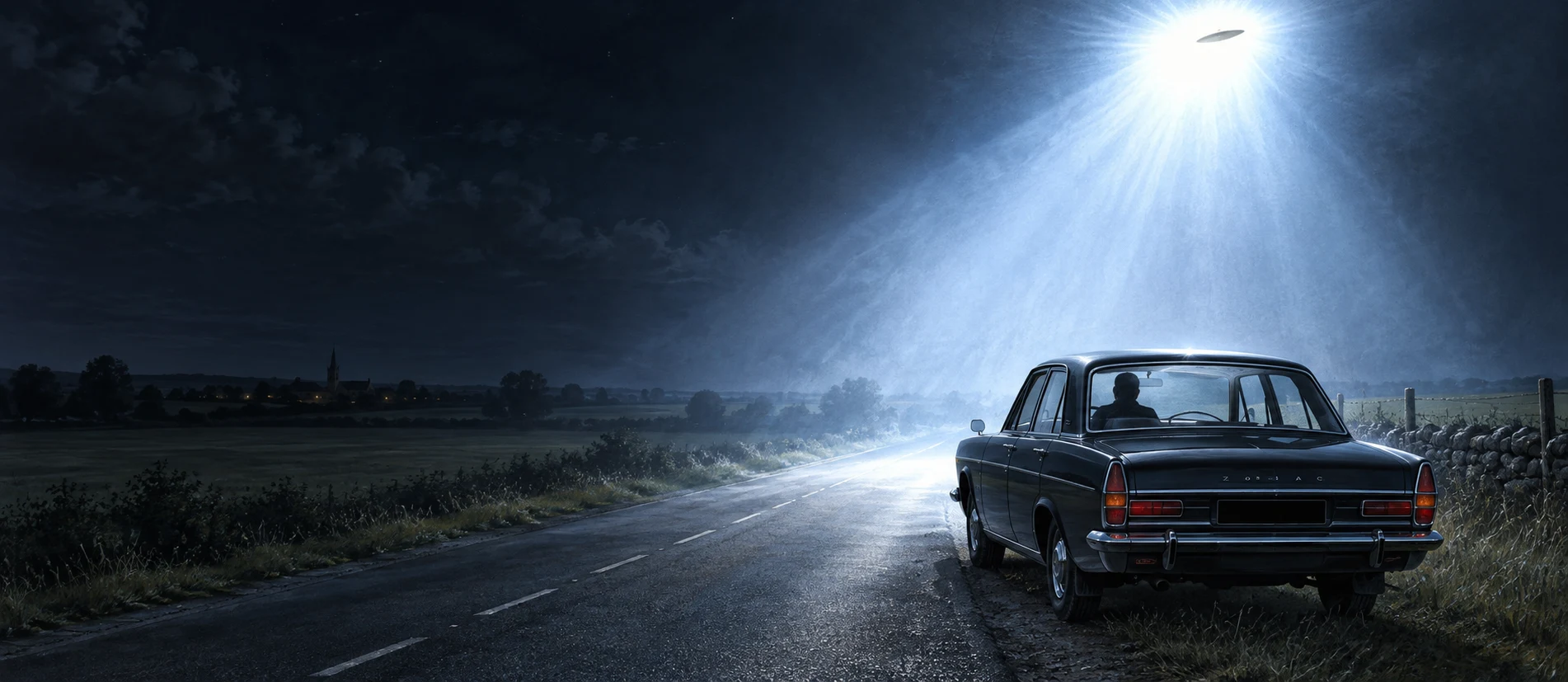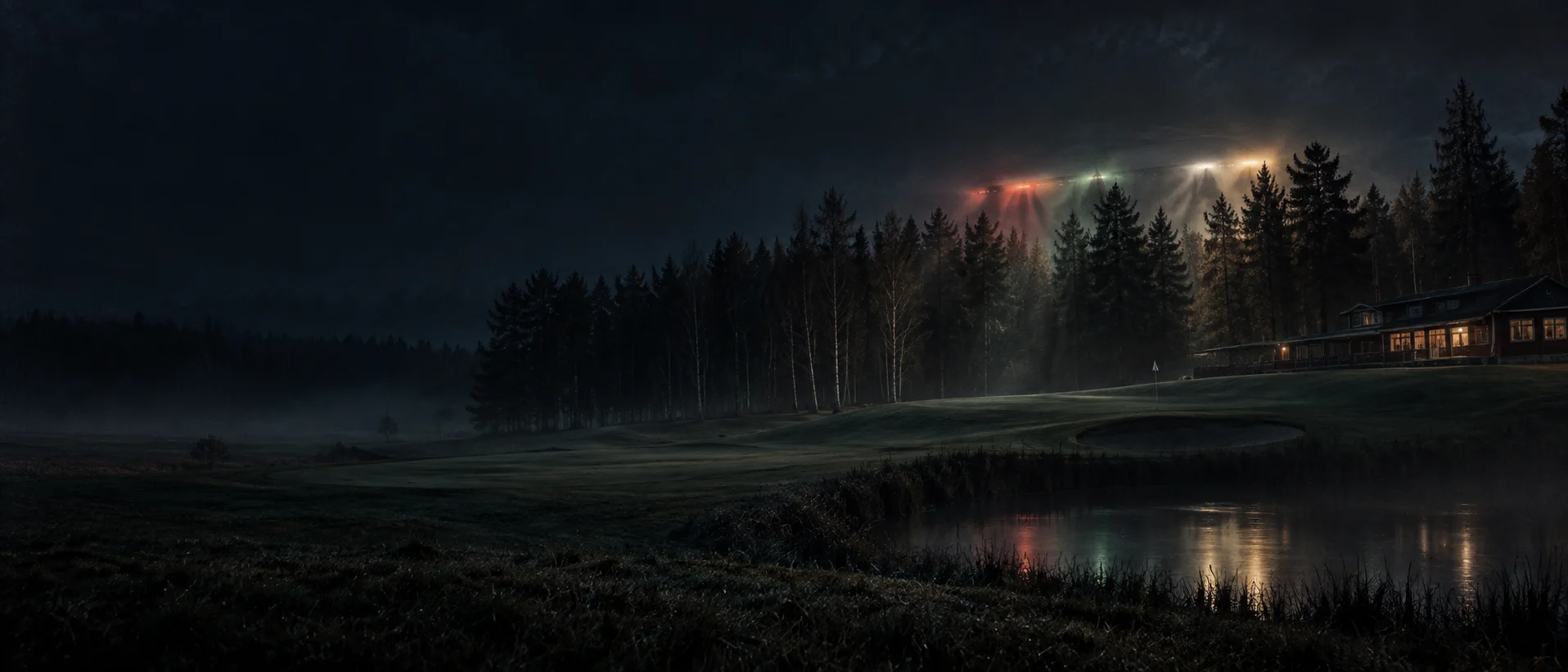
At about eleven on the night of November 6, 1988, Susanne and Mikael Olofsson drove past the Vittsjö golf club with their two children asleep in the car. A light near the clubhouse caught Mikael’s eye. He first took it for the lamps of a truck. Then the couple reached a lower stretch of road and, they said, saw a long shape above the ground beside the course.
Susanne later described a graphite-grey body, colored lights along it and a glow that reached into the trees. She estimated its length at 75 to 100 metres. Mikael kept driving. The encounter, as they told it, lasted roughly half a minute. They said the object rose, shifted and disappeared into the dark. They did not photograph it. When they returned with a video camera, there was nothing at the golf course to film.
That scene comes from Clas Svahn’s investigation for UFO-Sverige, which drew on interviews he began about a month after the event and on later conversations with the witnesses. It is compelling precisely because the couple’s claim has a location and a sequence that can be examined. It is also a scene with sharp evidentiary limits. The dimensions were estimates made at night, and the surviving public account does not contain a contemporaneous image, a measured altitude or a record of a flight directly above the course.
The report did not begin at the golf club. For several hours that evening, people in and around Vittsjö told of elongated lights moving low over the countryside. Some thought an aircraft was about to crash. Their reports gave investigators more than one vantage point—and raised the harder question of whether everyone was watching the same thing.
Before the drive
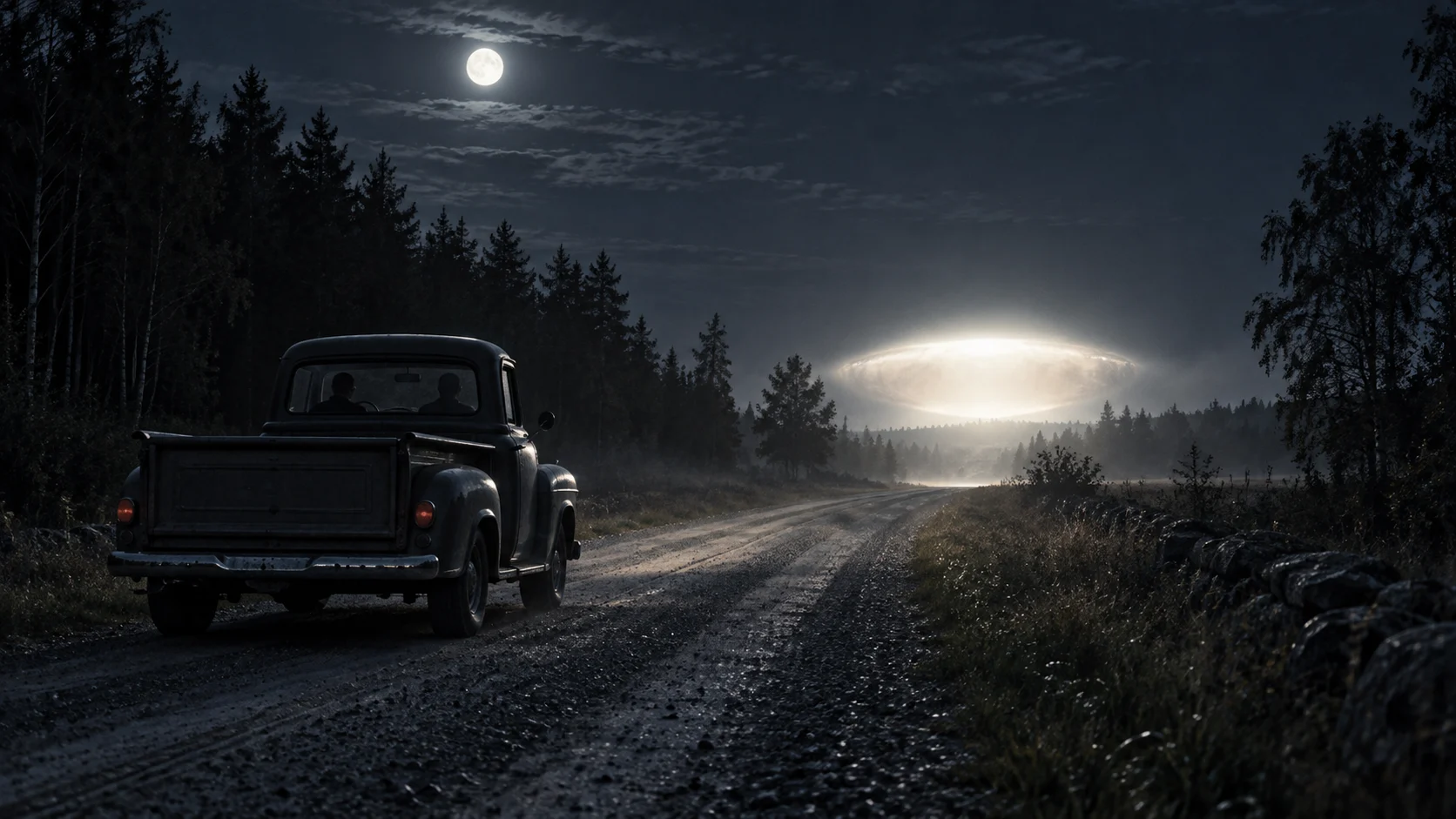
Earlier that Sunday evening, Susanne and Mikael were visiting Mikael’s parents on the southern edge of Vittsjö. According to the account assembled by Svahn, Susanne noticed a strong light moving outside as the television news was beginning. She thought it might be an aircraft descending toward an accident. Mikael and his father Gunnar came to the window; Mikael went into the yard. From there, he said, he saw a bright object move above the trees without hearing an engine. The sighting was brief. No crash followed.
The family returned indoors, still without a name for what they believed they had seen. Later, with their children in the car, Susanne and Mikael drove through the area. They described a separate, mushroom-like light near Kulleröd before heading back toward Vittsjö. The account does not establish that this smaller form was connected to the earlier bright object. It is one of several details that can make a retelling feel like a single continuous encounter, while the testimony actually contains different observations at different places and times.
Other residents had reported strange lights farther south. In Äljalt, Pia Jonasson said she saw a large grey form pass near her house, with red and green lights. Near Harastorp, Jan Sjöstrand and Erik Bengtsson stopped their car after seeing what they initially thought was a plane in trouble. Erik turned off the engine, and they got out to watch. Both said they heard no aircraft noise. They described lights spaced along an elongated body. A nearby resident, Niklas Willysson, used an everyday comparison that would become central to the investigation: he thought it looked like a zeppelin.
These accounts appear together in Svahn’s later case reconstruction. He spoke to witnesses separately, but the published narrative does not supply all their original signed statements or exact interview dates. The observers’ descriptions overlap in some ways: slow movement, an elongated form, lights and an apparent low height. They differ in other details, including direction and whether the body itself seemed illuminated. Similarity makes the reports worth comparing; it is not a demonstrated track from one village to the next.
The hollow beside the clubhouse
By the time Susanne and Mikael drove near the golf club, the hour was around eleven. Their later account places the bright shape in a hollow near a teeing area, with the clubhouse and trees nearby. Susanne described red, yellow and green lights, as well as intense white light. She said the shape appeared to be only a short distance above the ground. Neither of them reported seeing windows or occupants.
They were not on the golf course measuring an object. They were in a moving car, with two small children inside, looking through gaps in the view for perhaps thirty seconds. Susanne’s reported length of 75 to 100 metres came from the impression of how much of the hollow it filled. The following day, Mikael and his father walked the site and again estimated a similar length. They found no mark that would show where an object had touched down. Since they said it was hovering, a lack of marks does not contradict that part of their report; it does leave no physical trace to check against their size estimate.
Later interviews show why the distinction between experience and measurement matters. In a 2025 visit to the location with Fokus, Mikael recalled the object as about fifteen metres up. Svahn’s published account gives Susanne’s impression that it hovered perhaps a metre or a few metres above the ground. Those estimates cannot both be exact measurements of the same height. They may reflect different viewpoints, the passage of decades or the simple difficulty of judging a dark shape at night. None requires accusing either witness of inventing what they saw.
The couple said another mushroom-like light appeared after the large shape vanished and seemed to remain in view as they drove away. They went to Mikael’s parents’ house and, after trouble getting an answer at the door, used a public telephone to reach them. The household later reported that its telephone and television were not working when the couple returned. These details are part of the family’s account, not documented instrument readings tied to the lights near the course. No surviving repair record or power-company finding in the material reviewed establishes the cause of the interruption.
Mikael, Susanne and Gunnar set out again with Gunnar’s video camera. They saw no large object at the golf course. Mikael and Susanne said they encountered the smaller, mushroom-like form elsewhere, but Gunnar did not film it. The camera’s presence in the story can sound like the beginning of a piece of corroborating evidence. The investigator’s account is clear about the result: there was no recording.
Before midnight, Susanne and Mikael contacted the police in Hässleholm. They were referred to UFO-Sverige, whose report centre Susanne called the next day. Stig Aggestad, the man who took the call, later told Svahn that she was deeply upset. The call is an important early marker: it places a report close to the night in question. The article does not reproduce the call log or a recording, so the exact words she used that day cannot be separated from the investigation’s later account.
A town talks
The story soon moved beyond the family and the golf club. Svahn writes that Norra Skåne published an interview with Susanne and Mikael on November 8, two days after the sightings. Reporter Anna-Carin Darlin later recalled the paper’s phones ringing repeatedly after that story appeared. Those calls show how quickly the incident became public and how many people wanted to discuss it. A ringing newsroom, however, is not a count of independent sightings of the same object.
The UFO-Sverige account does not give a complete timeline of when each witness first reported or what they had heard from others. A scan of the original Norra Skåne story was not available for this article, so its exact wording could not be checked.
Svahn says police messages about the event were no longer retained by the time he revisited the case. He also reports that the local air base received calls, and that available radar film reportedly showed no unidentified return in the relevant area. Those statements are useful descriptions of inquiries made; the original police records and radar data were not available here for independent review. A lack of a reported radar trace can constrain some explanations, but without the equipment coverage and raw data it cannot establish that nothing passed over the area.
The airship in the same region
There is a mundane candidate with a shape, lighting and speed worth testing. Svahn asked about an illuminated airship called Panorama. Balloon designer Per Lindstrand told him it had flown in southern Sweden during autumn 1988 as pilots trained for night operation. He described a large hull lit from within, white lights at its ends and red and green navigation lights. Such a craft, seen against a dark, cloudy sky, could account for some witness descriptions better than a distant star or meteor could.
The possible match becomes more intriguing because the Olofssons placed their close sighting by a golf course. Lindstrand said golf courses were useful places for an airship to land during night training. That is a reason to check Panorama’s movements. It is not evidence that it actually used Vittsjö’s course on November 6.
The person who owned the craft, pilot Lars Karlqvist, gave Svahn a contrary recollection. He thought it was very likely Panorama was in the Gothenburg area that night and questioned whether witnesses’ descriptions fit its illuminated shape. In the 2019 Kristianstadsbladet interview, Svahn said he had reached the airship operators, who placed themselves near Gothenburg, but that no flight log was available. That leaves an unusual situation: a plausible class of object, a real example operating in the wider region that season, and no dated movement record that confirms or excludes it at Vittsjö.
Susanne rejected the airship explanation in the investigation. She said she knew what a zeppelin looked like and believed the shape near the golf course was different. Her objection deserves to be recorded alongside the airship lead. It does not substitute for a flight log, a photograph or a measured flight path, just as the airship’s general presence in southern Sweden does not identify every light reported that night.
What the record establishes
Several people reported unusual lights or shapes around Vittsjö on November 6, 1988. Susanne contacted UFO-Sverige the next day, and a local newspaper covered the couple shortly afterward. Svahn interviewed her about a month later and gathered other witness accounts. That is a meaningful reporting trail. It is still dominated by testimony, with parts of the early record known through Svahn’s later reconstruction rather than reproduced in their original form.
The physical record is thin. The visit to the golf course found no mark. A camera was taken on a return trip but produced no footage. The police messages did not survive, and the radar claim is reported without the original data in the public account reviewed. The weather information Svahn cites may help exclude some astronomical interpretations of low sights beneath the clouds, but it cannot fix how high an unidentified light actually was. Statements that it flew at treetop height depend on the witnesses’ perception of distance and scale.
The separate reports cannot confirm one vehicle without reliable times and bearings linking the locations. The published account does not supply that reconstruction.
Panorama remains the most concrete known candidate in the material reviewed. Its size, slow movement and colored lights make it a serious lead. Karlqvist’s recollection that it was probably near Gothenburg, combined with the missing log, keeps it from becoming a demonstrated solution. The evidence also does not justify treating the case as an extraterrestrial visit. What it establishes is a reported and promptly publicized sequence of unusual sightings that was investigated but not positively identified.
The Bigger Picture
Vittsjö shows why a detailed witness story can be valuable and still resist a confident conclusion. The early call and newspaper coverage help date the report. Multiple viewpoints give investigators something to compare. A real airship supplies a testable alternative. Yet the case turns on information that was not preserved in the accessible record: the airship’s flight log, original witness statements in order, measured positions, and any usable image or instrument data from that evening.
NASA’s UAP study makes the same point in modern terms. Apparent speed, size and unusual motion are difficult to assess when range, sensor conditions and timing are missing. More witnesses can help if their observations are independent and their positions are known. More repetition of a description after a story has spread cannot replace those measurements.
There is a human question here as well. Mikael returned with a reporter to the golf course in 2025 and still wanted to know what he had seen. An honest case history can take that persistence seriously while keeping the scale and identity of the reported object open. The next useful discovery would be prosaic: a dated Panorama route sheet, the November 1988 newspaper pages and the earliest separate witness notes. Together, they could turn the long shape over Vittsjö from a vivid story into a much better tested one.
Sources
- Clas Svahn, “Cigarren över Vittsjö,” UFO-Sverige. Investigator’s reconstruction from witness interviews and later follow-up; he says he first interviewed Susanne about a month after the event. The original interview notes, November 1988 report-center call and police messages were not available for direct review.
- Ingela Rutberg, Kristianstadsbladet interview with Clas Svahn, January 23, 2019. Independent reporting on the airship inquiry, preserved as a PDF copy by UFO-Sverige.
- Arvid Grange, Fokus, December 10, 2025. Direct later interview with Mikael Olofsson at the reported location; not a contemporary account of the event.
- Archives for the Unexplained, Swedish report-file holdings. Context for the preservation of Swedish UFO investigation files.
- NASA, UAP Independent Study Team Report, 2023. Context for assessing uncalibrated observations.