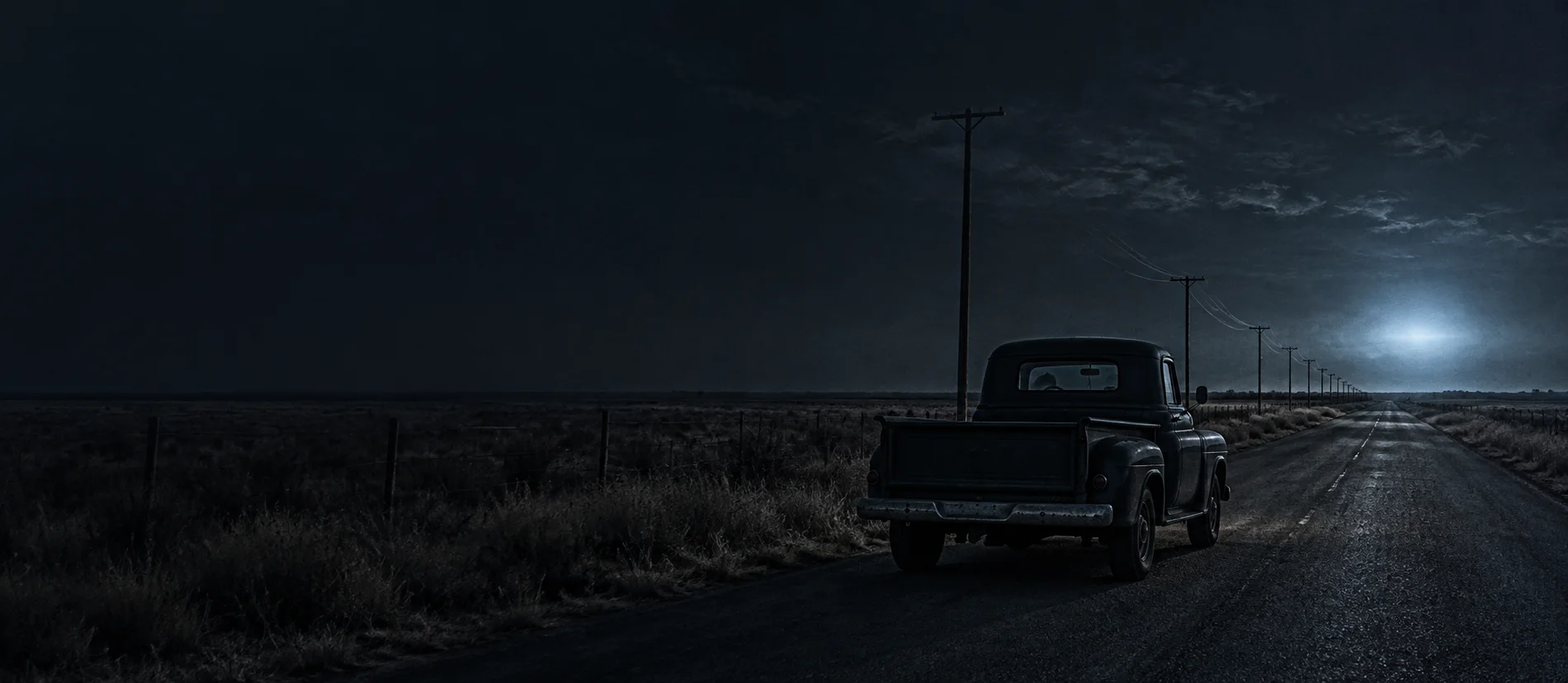
The engine stopped. Then the headlights went out.
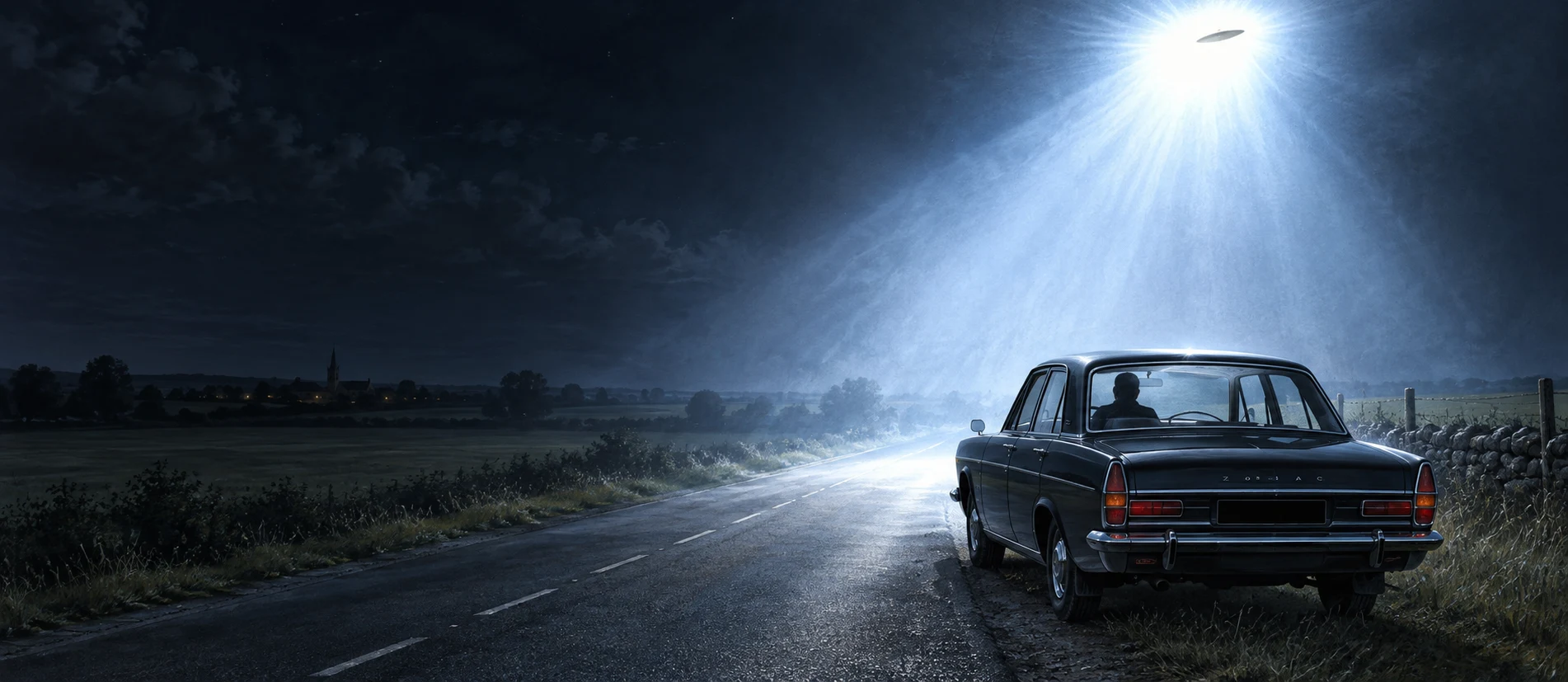
Stig Ekberg was behind the wheel, trying to start the truck again, when Harry Sjöberg drew his attention to something in the sky. A light was coming down towards them.
The two men had been travelling back to a building job on Väddö, north of Stockholm. Ahead lay the rest of their Sunday evening journey and the place where they would sleep before work. Now the truck was standing in the road, and the light was growing larger.
In the story they later told, it curved over the water beside the road, turned back, and settled across their route about a hundred metres ahead.
Its brightness spread into the surrounding countryside.
They stayed inside the cab and watched.
Back to the island
Ekberg and Sjöberg were carpenters, building a holiday house on Väddö. They had spent the weekend with their families in Stockholm and were returning on Sunday night so they could begin work on Monday morning. A small cottage at the site served as their accommodation.
Their vehicle was Ekberg’s nearly new Ford V8 light truck. The journey took them through Norrtälje towards Älmsta, across the bridge and north in the direction of Grisslehamn. It was around ten at night.
The interview published by Christer Nordin in 1980 follows the men from that familiar route into the encounter. Ekberg described the motor beginning to falter several kilometres beyond the bridge. It cut out completely, and the vehicle’s lights extinguished with it. His attempts to restart it brought no response.
Sjöberg was beside him in the passenger seat. While Ekberg attended to the truck, his companion noticed the moving light.
Their attention had been divided between the road and the failure of the engine. Now both men were looking out at the same approaching phenomenon. Whatever had happened to the Ford, there was something else to follow beyond its windshield.
Across the water
In the interview, the men remembered a clear sky. The luminous object moved nearer, taking a curved course over Väddöviken before returning towards the road.
That movement gave their observation a sequence. The light approached, swung out over the water to their left, then came back. It appeared to change direction as they watched from the stopped vehicle.
Their first conversation turned to things they knew. Ekberg recalled thinking of powerful military searchlights; Sjöberg considered ball lightning. The approaching object held their attention while they tried to find a familiar description for it.
Then it came down in front of them.
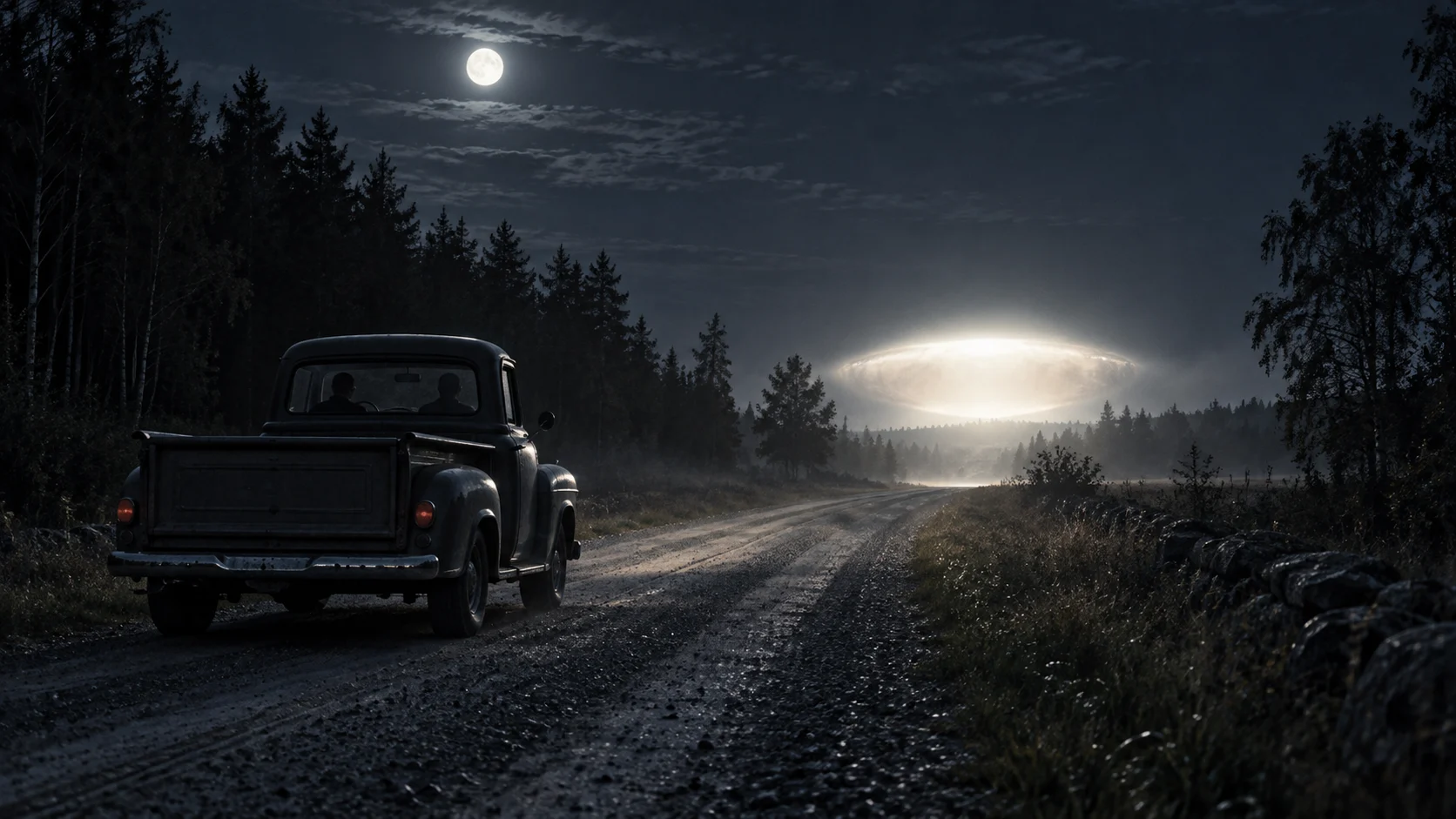
The road supplied a scale and a position. They placed it about a hundred metres from the truck, with its width extending across the roadway. What had caught Sjöberg’s eye in the sky was now low enough for them to watch against the ground.
Neither man had left the cab. Their view was still through the windshield, facing the place where their journey had stopped.
A brightness over the road
They compared the illumination to neon light. It reached beyond the object itself, making the surroundings visible. Sjöberg remembered seeing a building on higher ground hundreds of metres farther away, picked out by the glow.
The brightness was strong, but they said it did not prevent them from looking at the source. Within it they could distinguish a broad, rounded form, flattened rather than perfectly spherical, with indistinct edges.
Its lower surface seemed to remain clear of the road. Beneath it was a concentrated glow that gave the impression of something burning underneath. Around the main body, luminous veils appeared to move and shimmer.
The comparison they used was the wavering air seen above a road on a hot summer day. Here that appearance surrounded a bright object on an autumn night.
From the cab, the scene contained several things to watch at once: the broad shape ahead, the light beneath it, the changing appearance around its outline, and the countryside made visible beyond. The men continued looking while the truck remained where it had stopped.
Ten minutes in the cab
Sjöberg recalled that they were uncertain what to do. They watched for something approaching ten minutes.
The pause is central to their account. The approach had happened while Ekberg was dealing with a mechanical failure. Now the object appeared to have stopped as well, leaving the two men facing a luminous presence that occupied the route ahead.
Eventually they discussed getting out and going closer.
Up to that point, the truck had been their observation position. To approach the object meant opening the doors and walking along the road towards it. They had begun talking about that possibility when the scene changed again.
The object rose.
They described an initially slow ascent, lifting it some ten or twenty metres above the road. Then its speed increased. It swung to the left, came back across their line of travel and accelerated into the sky to the right.
Sjöberg associated its departure with the direction of the moon. The large luminous form diminished until they were watching a small point in the distance.
They had remained in the cab throughout. By the time they got out, the object had gone.
Under the bonnet
Their first task outside was to examine the Ford.
In the interview, they described the air as oppressive, with breathing feeling difficult. Ekberg opened the bonnet and used a torch to inspect the ignition components and wiring.
The situation had returned him to something practical. There was a stopped engine in front of him, and its electrical system could be checked. The torch gave him a smaller, directed source of light after the illumination they had watched over the road.
He asked Sjöberg to turn the key.
The engine started immediately.
The men got back into the vehicle to continue. Their destination was still the building site, and the Ford was working again. But Sjöberg wanted to stop at the place where the object had hovered.
They drove forward to it.
Beside the gravel
Sjöberg stepped out and examined the roadside. He noticed grass pressed down in a curved pattern and called Ekberg over to look.
Ekberg brought his torch. Together they walked around the area, studying the ground beside the road where they had just seen the light.
Their observation had moved through three positions: the stopped truck farther back, the open bonnet after the departure, and now the patch of roadside directly ahead. The distance between them and the hovering object had become ground they could cross on foot.
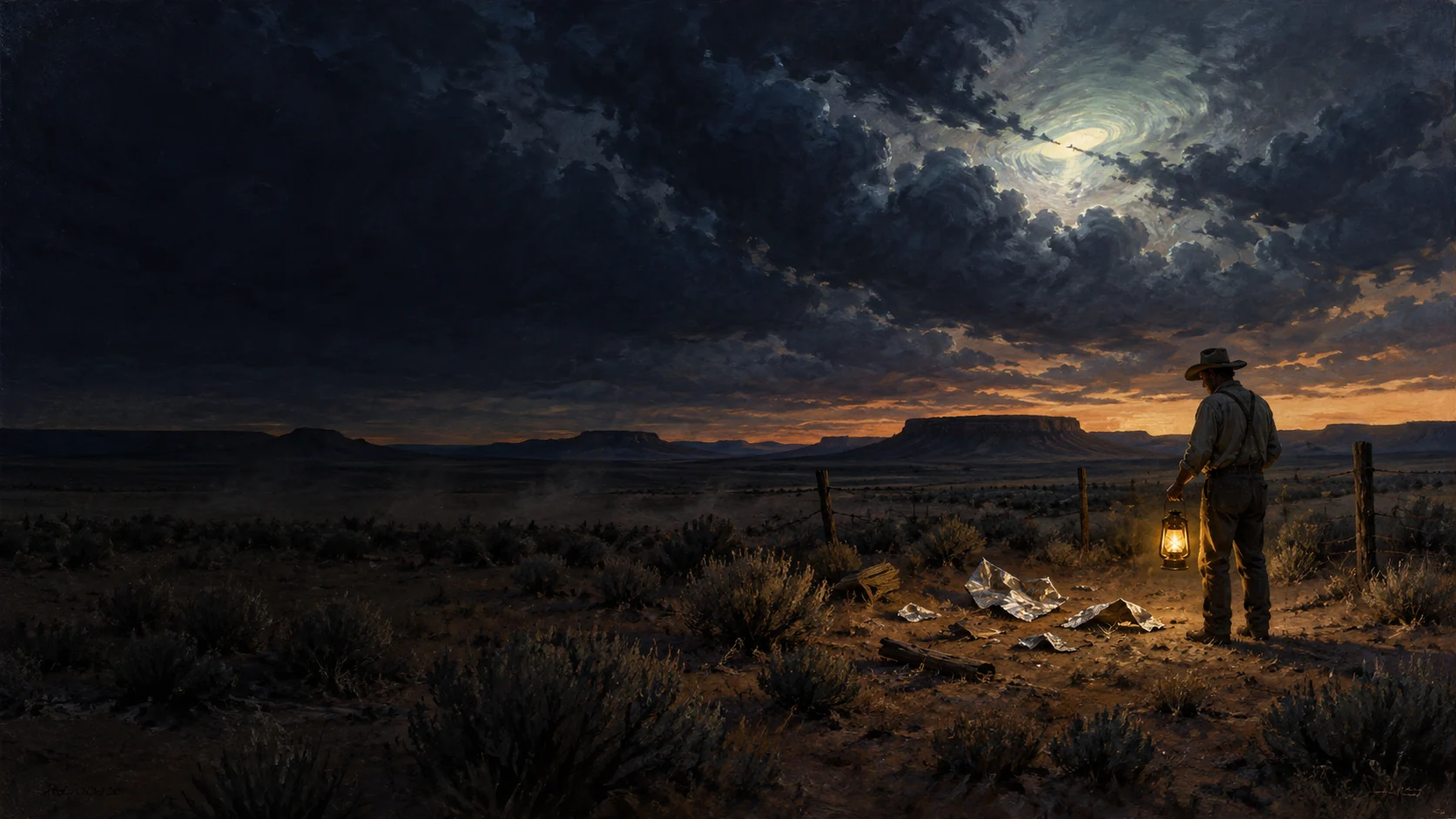
They found the metal while looking around that place.
Ekberg’s light caught a small reflective object on the ground. He picked it up. It was smooth, triangular and roughly the size of a matchbox.
It was also warm.
When Sjöberg handled it, he noticed the warmth too. Both men were struck by its weight in relation to its size. What Ekberg had seen shining under the torch had the heft of a much larger object.
He kept it. In his recollection, its smoothness and unexpected weight were the reasons he took it away.
Then they returned to the Ford and continued their journey. The light had disappeared into the sky, but something small enough to hold in one hand travelled with them.
The object on the table
Afterwards, Ekberg and Sjöberg passed the place again and talked about what they had experienced. They also described it to friends. Ekberg remembered people treating the story as a joke.
The fragment remained with them. Eventually an acquaintance with a background in metallurgy suggested somewhere in Stockholm that might identify it. The men took it for examination, beginning a succession of referrals and tests.
That process changed the object itself. At a laboratory in Helsingborg it was divided into three pieces, reportedly using ultrasound. Parts of the original find could now travel separately.
The story widened beyond the two carpenters. Researchers took an interest, and specimens were passed to people who could arrange further examinations. The small thing found beside the truck had begun a second journey, through workshops, correspondence and laboratories.
Years later, Nordin sat with both men at Ekberg’s home. There was coffee, and the fragment lay on the table in front of Sjöberg. The interview returned them to the route across the bridge, the dead engine, the descending light and the moment they walked onto the roadside.
By then, the encounter was far behind them. The metal could still be placed between interviewer and witnesses, a physical object around which the remembered night unfolded.
What Is Known
The roadside story is witness testimony. Nordin’s interview, translated into Norwegian in Internt UFO Forum 5/1980, preserves an account from both men, many years after the encounter. It dates the event to November 9, 1958; later research places it in 1956.
Clas Svahn’s 1998 investigation identifies a January 10, 1959 letter from Ekberg to engineer and UFO researcher Sven Schalin, accompanied by a specimen. The letter gives November 1954. Svahn reconstructed October 14, 1956 from the Sunday journeys, the vehicle’s history, the remembered moon position and weather records. The date used here reflects that reconstruction.
Svahn also traced a substantial laboratory record. Examinations arranged through Saab, Danish researchers and Sandvik identified cemented carbide. A further analysis by Sandvik’s Udo Fischer in February 1998 found tungsten carbide with cobalt, and a microstructure consistent with manufacture in the 1950s. Ekberg accepted the identification.
The recovered material is therefore identified industrial material. The encounter account records what the men reported seeing and finding; the analyses establish the specimen’s composition. They do not establish a flying object’s identity or a physical connection between it and the fragment.
The Bigger Picture
The Ford and the little triangle brought two forms of technology into this story: a vehicle familiar to its driver, and a manufactured material that felt unfamiliar in his hand.
Cemented carbide already had a history by 1956. Sandvik Coromant’s account of its development traces an early patent to 1923. The process binds hard carbide particles into a composite using a metal such as cobalt. It produced tools capable of cutting and wearing under demanding industrial conditions.
Sandvik’s company history places its first cemented-carbide metal-cutting tools in 1943 and a new production plant in Stockholm in 1953. The material belonged to the industrial world surrounding the witnesses, even if identifying a loose fragment required specialist knowledge.
Väddö’s lasting interest lies in the way an encounter became a material investigation. A luminous object could recede beyond sight; a recovered specimen could be weighed, divided and examined again. Those examinations produced an answer about the metal, while the men continued to describe the larger experience in which they had found it.
The case preserves both journeys: the Sunday drive interrupted by something over the road, and the much longer passage of a small triangular object through the hands of people trying to understand it.
Sources
- Christer Nordin, “Väddö-fallet,” Internt UFO Forum 5/1980, pp. 11–14. Norwegian translation of an interview published in UFO-Sverige Aktuellt 1/1980; later witness testimony.
- Clas Svahn, “Metallbiten från Väddö”. Investigation excerpted from UFO-mysteriet (1998), including correspondence, interviews, date reconstruction and material analyses.
- UFO-Sverige, Väddö case dictionary. Concise retrospective summary; related to Svahn’s investigation.
- Sandvik, company history. Independent industrial context.
- Sandvik Coromant, “Celebrating 100 years of cemented carbide”. Manufacturer’s account of the material’s development and production.