The ignition light had gone out with everything else.
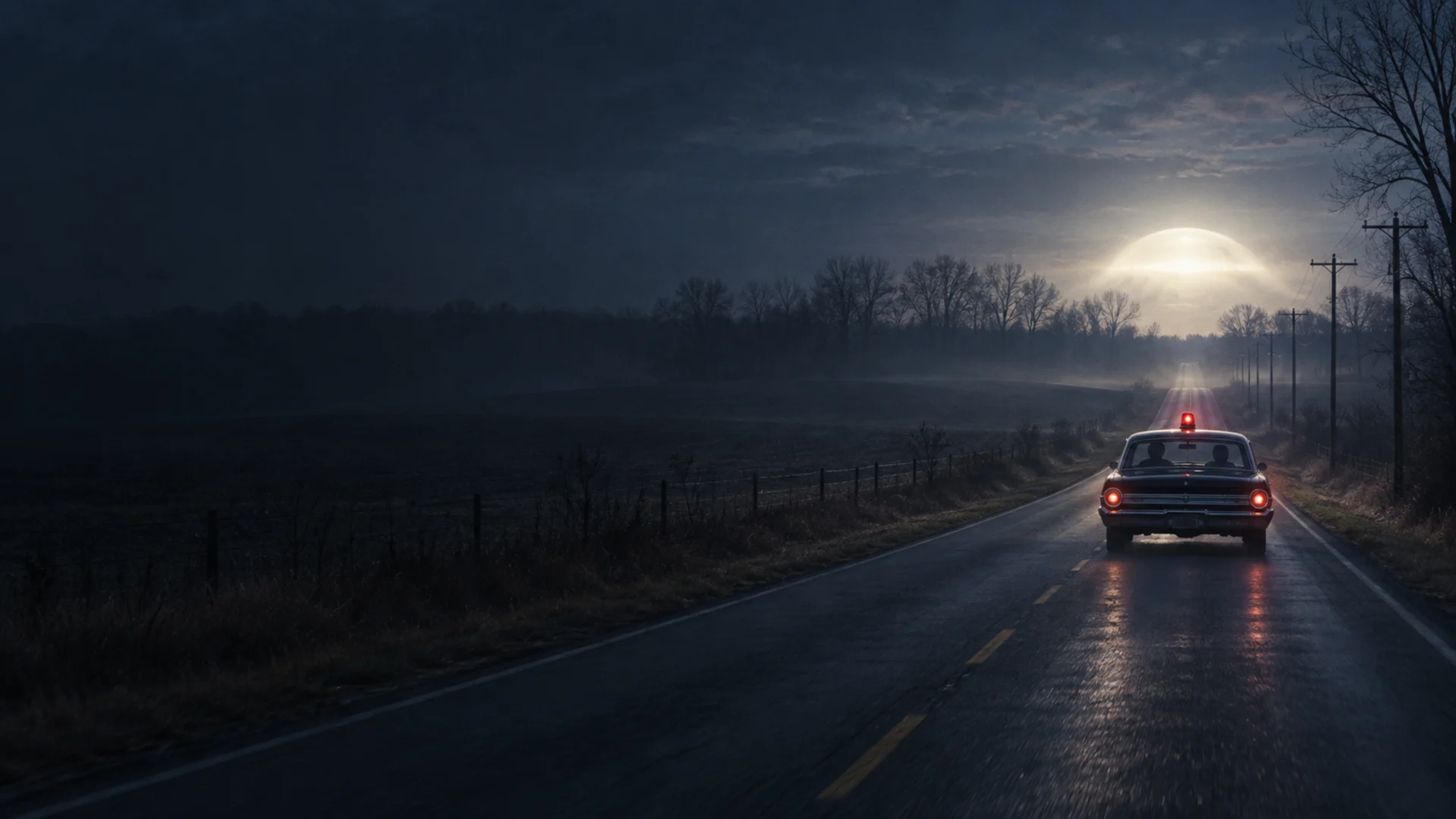
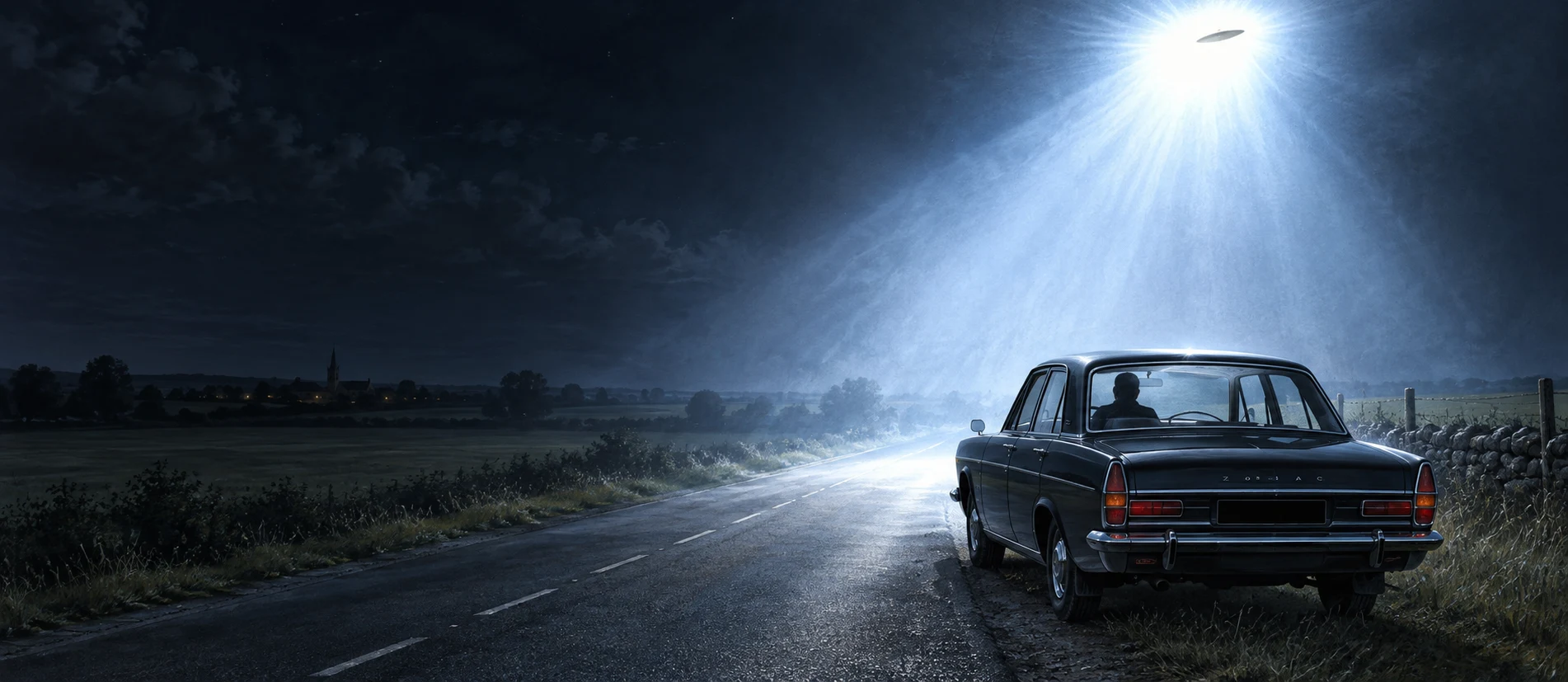
Evald Hansen Maarup was alone in the patrol car, surrounded by a blue-white brilliance so intense that he raised an arm to shield his eyes. The engine had stopped. He pulled towards the roadside and braked.
Somewhere beyond the glare was the Danish countryside. Inside the car were the controls he knew, the darkened dashboard and the radio microphone he was trying to reach.
He found the microphone and called his station.
The radio was silent.
In the account he gave afterwards, the light remained around him and the interior became warm. Then the illumination began moving upwards. When he leaned forward and looked through the windshield, he could see where it ended.
Above the car was a large grey object.
The road towards home
It was Thursday, August 13, 1970, around 10:50 p.m.
Maarup was travelling home to Knud in a police patrol car. His route took him between Kabdrup and Fjelstrup, eight to ten kilometres north of Haderslev. Ahead was a junction with the Haderslev–Fjelstrup road.
The account published by SUFOI that autumn places the beginning of the encounter as he descended towards a shallow dip in the road. The car was a nearly new six-cylinder Ford Zodiac. It carried a radio and a fixed camera, equipment that would become part of the night’s story.
He was still driving when the bright light appeared around the vehicle.
His description joins the changes in a single moment: light outside, darkness on the dashboard, the loss of the engine. He steered to the side and brought the car to a stop.
The journey had narrowed to the roadside. Whatever was producing the glare was close enough, in his perception, to surround the space he occupied.
Inside the brightness
Maarup compared the illumination to a harsh neon light.
At first it prevented him from seeing what lay beyond it. Holding his arm before his eyes, he felt for the radio and attempted to call the station. The familiar means of contacting other officers gave him no response.
Then he noticed the warmth.
He described it as pleasant rather than burning, like the heat felt when driving towards the sun on a summer day. The comparison was an ordinary one for a motorist: sunlight through glass, an enclosed cabin growing warm. Here, he was describing the sensation late at night, in a stopped patrol car beneath an unfamiliar light.
There was no temperature reading in his account. What he remembered was the feeling inside the vehicle, while the engine, dashboard lights and radio remained out of operation.
Then the view changed.
The lower boundary of the illumination began to rise. Darkness returned beneath it, giving him room to see upwards. The glare that had filled his immediate surroundings was taking on a shape.
Looking up through the windshield
He leaned forward.
The light formed a cone, broad at its lower end and narrowing towards the underside of the object above. Maarup estimated the width at the bottom at four or five metres. His eyes followed it upwards to the grey body.
He reported hearing no sound from it.
The object appeared round from his position below and to one side. He estimated its diameter at approximately ten metres and its distance, when viewed through the windshield, at about twenty metres. These were the dimensions he supplied from his roadside perspective.
On its underside, he described two raised, dome-like features. Between them was the opening from which the light appeared to emerge.
The scene had become more distinct as the illumination lifted. What began as brightness around the car now had a source, a surface and an underside. His view was still framed by the windshield, but he could describe more than the light itself.
The light withdraws
The movement that followed became the encounter’s most unusual detail.
Maarup described the cone being drawn upwards into the object. He made a point of explaining the manner of its disappearance: its bottom edge moved higher, leaving darkness underneath. He estimated that the withdrawal took about five seconds.
He got out of the car.
From outside, he watched the final part of the illumination disappear into an opening in the underside. He judged that opening to be a little over a metre across.
For those seconds, his attention followed the changing boundary between light and darkness. The road and car were emerging from the brightness as it contracted above him. He had gone from shielding his eyes in the driver’s seat to standing outside and watching the last remnant vanish.
Once the light had withdrawn, the object began moving.
Above the roadside
It rose vertically, according to his account, accelerating until it disappeared within a few seconds. He still heard no sound from it.
As it departed, the car’s electrical lights returned.
Maarup tried the engine. It started normally. The radio worked again, and he contacted the station to report what had happened.
The familiar parts of the vehicle were answering him once more. A microphone could carry his voice; the engine could take him onwards; the headlights could show the road ahead.
Before leaving, he stepped outside again. He rested a hand on the front wing of the car and found it still warm.
An oncoming vehicle passed afterwards. He did not stop it. The object had gone, and the roadside was again a place through which other people could drive without encountering what he had described.
He continued home. His wife, Anne-Lise, thought he looked pale, and he told her about the night.
Six frames of film
The encounter also travelled home inside the car’s camera.
Maarup said he had taken three photographs before getting out during the observation. After the power returned, he took three more, this time of the road illuminated by his headlights.
The camera was a Fujaxa, fixed in the patrol car. SUFOI described its automatic film advance and its ability to take roughly one frame per second. It was equipment already available to him within the vehicle, and he had used it during the interruption to his journey.
The film preserved two parts of the evening. The first three frames showed a bright spot; the later photographs showed the road, a barrier and reflective signs ahead.
The distinction gave the film its sequence. First came the light he photographed during the encounter. Then came the familiar roadside under the car’s own illumination.
In the days that followed, these frames would pass from the driver’s account into the work of people trying to understand it.
The following evening
Maarup’s film reached Skrydstrup air station on August 14.
The 1982 SUFOI investigation retrospective describes military personnel examining the photographs while press interest grew around the officer’s story. Maarup remembered an exhausting succession of questions, telephone calls and visits extending into the early hours.
The night on the road had lasted a brief interval. Explaining it occupied much longer.
The film became a focus of attention, with journalists wanting access to the images while the military held them. His name, occupation and description entered the newspapers. A report made over the patrol-car radio had become something people outside his station wanted to hear.
SUFOI interviewed him, photographed the location and published his account. The daylight pictures showed the junction and road from which the unfamiliar illumination had apparently come.
The setting was ordinary enough to visit and photograph. The moments Maarup placed above it remained extraordinary in his telling.
Three years later
Maarup would eventually describe another encounter in the same general area.
His written account of it reached SUFOI in a letter dated September 21, 1974. The event he described had occurred on August 14, 1973, again around 10:50 p.m. It forms the closing episode of his personal encounter history, preserved in the 1982 article.
He reported driving north from Haderslev, turning east near Skovbølling, and seeing a powerful light over a field. Cattle and horses were moving within its illumination. The light moved towards the road.
As he stopped, the beam reached the car and the engine and lights failed.
This time he described the object tilting, bringing its underside into view. He recalled three hemispherical projections and, during a change of angle, an upper structure with illuminated windows. He took four photographs while it moved across his view.
He then got out beside the left front wing and watched the final manoeuvre. In his account, the light withdrew again. The object rose eastwards and departed with a rushing sound, like a strong gust among trees.
For Maarup, the familiar road now held two reported encounters separated by three years and one day. The recurring elements were the ones he had already described: brightness around the vehicle, the loss of its electrical functions, and a light that seemed to retreat into something above.
What Is Known
The autumn 1970 issue of UFO-Nyt preserves a detailed account in Maarup’s own words, accompanied by photographs, an enlarged light image and views of the location. It identifies the vehicle, route and approximate time. These materials establish what he reported and photographed soon after the event.
Kim Møller Hansen’s 1982 article reproduces that testimony and adds the investigation history, correspondence and Maarup’s account of the 1973 encounter. The latter was communicated in writing in September 1974 and should be read as a later report of that evening.
SUFOI’s 2026 source register identifies the early military report dated August 15, 1970, its questionnaire and photographic attachments, Maarup’s signed SUFOI questionnaire, newspaper coverage and recorded broadcasts. The military references lead to holdings in Denmark’s Rigsarkiv; the source register is a guide to those documents rather than a substitute for reading them.
The account describes an encounter and changes in the car occurring together. That sequence is part of Maarup’s testimony; the article does not establish that an unknown craft caused the electrical interruption. The photographs preserve the recorded light, while the object’s shape and the withdrawing cone belong to his visual description.
The Bigger Picture
The patrol car gives this case its particular human setting.
Maarup was travelling in a vehicle equipped for police work. Its radio connected a lone officer to his station, and its mounted camera provided a way of recording something ahead. During the encounter he described, both the equipment and the act of using it became part of the story.
The Danish Police Historical Association’s account of emergency lighting records the change from earlier green and yellow emergency lights to blue under a 1964 regulation. It supplies a small piece of the period’s working environment: police vehicles already had their own familiar signals and lighting. Maarup’s blue-white illumination was something he described separately, arriving around the car while its own lights went out.
The history also extends beyond the officer. Haderslev’s local-history research, described by SUFOI, has returned to both encounters, while Danish reports and publications have been preserved at AFU in Sweden. A roadside experience in southern Jutland has become part of a wider Scandinavian archive.
That preservation allows the evening to be followed through concrete actions: pulling over, reaching for the microphone, leaning towards the windshield, pressing the camera release and restarting the engine.
At the centre remains the image Maarup described most carefully: darkness returning beneath a cone of light as its lower edge rose towards the object above. The road eventually lay in the headlights again. For him, the journey home had acquired a moment that ordinary illumination could never quite replace.
Sources
- “UFO’et ved Haderslev,” UFO-Nyt 5/1970, printed pages 211–213. Contemporary published testimony and photographs, preserved by AFU.
- Kim Møller Hansen, “Evald Hansen Maarup 1970 og 1973,” UFO-Nyt 6/1982, pages 4–10. Investigation retrospective and reproduced witness correspondence.
- SUFOI, UFO-Mail 312, 2020. Retrospective linking Maarup’s recorded testimony.
- SUFOI, source register for Politibetjentens oplevelse i mørket, 2026. Documentary references and archival locations.
- SUFOI, Maarup and Haderslev local-history research. Later research context and preservation history.
- Politihistorisk Forening, Motorcyklen i politiets tjeneste. Independent historical context for police emergency lighting.