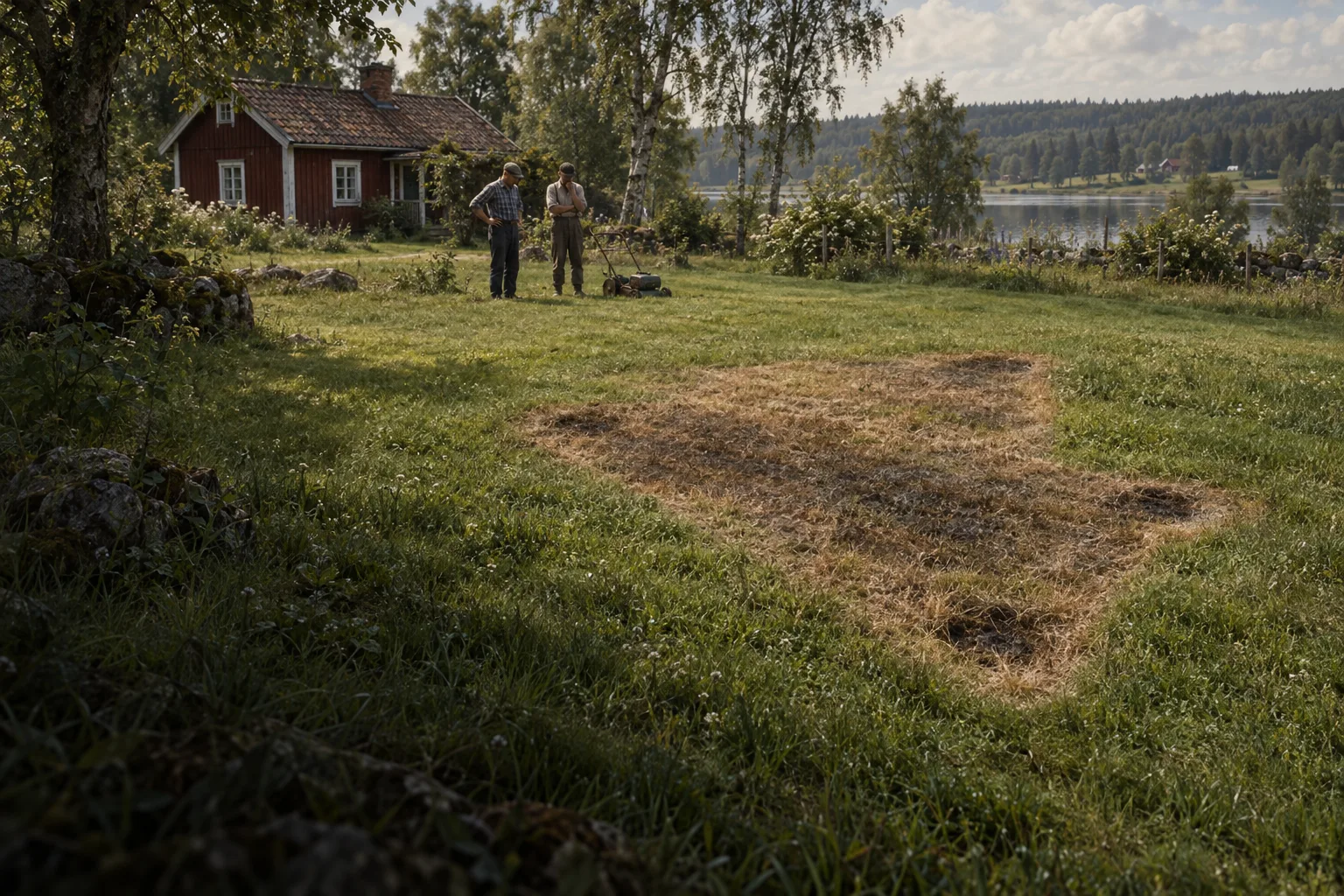
Åke Johansson was cutting the grass when he noticed the dark patch.
It was June 1, 1968, the Saturday before Pentecost, and he had come to his summer cottage at Vänga, near Borås in western Sweden. His daughter’s partner was with him. The grass had grown since their previous visit, so the two men had begun the familiar work of putting the place in order.
The mark looked oily. Johansson’s first thought was that somebody had brought a car onto the property and left something behind.
That was the beginning preserved in Norsk UFO Forum’s 1973 account, assembled from information supplied by Swedish UFO investigators. Nothing in that first discovery demanded an interruption to the day. The men had found a discoloured area while mowing, and an ordinary explanation suggested itself.
By the following morning, the patch had changed.
A shape in the grass
The grass inside the mark was withering. As it lost its colour, the outline became more distinct against the green around it.
There was also a strong smell, compared in the accounts to ammonia or a solvent. A dog reacted sharply and afterwards refused to approach the spot.
The later UFO-Sverige summary by Jörgen Granlie describes two overlapping triangular areas, with rounded corners. In the forward triangle were three circular impressions, each about fifteen centimetres across.
The lawn now presented something more particular than a dark stain: a pattern with edges and small, repeated marks. The early Norwegian report gives a triangular measurement of 170 centimetres to a side. Fred Andersson’s later archival retelling describes the combined mark as approximately 3.1 metres long and 1.6 metres wide.
Andersson identifies the cottage as Enebacken, formerly Johansson’s family home. This was a familiar property, with an unfamiliar alteration in its grass.
There was something to look at, something to smell and, apparently, something still affecting the vegetation. Whatever had made the mark had left Johansson a problem that remained in the garden after its maker had gone.
The visitors
Johansson then reported an uncomfortable itching in his hands and arms. His face became red and inflamed.
Friends came to the cottage a few hours later. According to the 1973 account, a woman among them developed similar symptoms, together with a swollen tongue. Several days afterwards, Johansson experienced irritation of his own tongue and a disturbance of taste, prompting a visit to a doctor.
These complaints became part of the account carried to investigators. The strange patch was no longer simply an unusual feature of the lawn: people visiting the property were reporting physical discomfort as well.
The sequence gave the discovery a growing reach. First came the oily appearance, then the clearer shape in the dying grass, the smell, the dog’s reaction and the symptoms described by Johansson and his visitor.
He still had no explanation for the mark. Neither, the early account says, did the people he knew.
A week to find an address
Johansson knew that a group called UFO-Göteborg had advertised its interest in reports of unidentified flying objects. He did not know its address.
The 1973 account says a whole week passed before he managed to contact the group. It also describes him as someone who did not himself believe in flying saucers. His reason for approaching the organization was the unexplained discovery at his cottage.
The resulting investigation brought a varied group of people to Vänga. The published list names Rune Rydebrandt, the group’s leader and a former pilot, alongside a telecommunications technician, engineers, a secretary and a photographer. One participant, Jan Timmerås, was identified as a rocket engineer at Saab.
For these visitors, the object of investigation was already on the ground. They could examine the affected area and arrange for samples to leave the property. Their inquiries also extended beyond the cottage to people living nearby.
The report describes the place as secluded, with little passing car traffic. Johansson had three summer properties to choose between, and his acquaintances had not known which one he would visit that weekend.
Those details entered the investigators’ account alongside the mark itself. They were trying to reconstruct what might have happened at a property before its owner arrived to mow the grass.
A window over the water
During their local inquiries, the group heard another story.
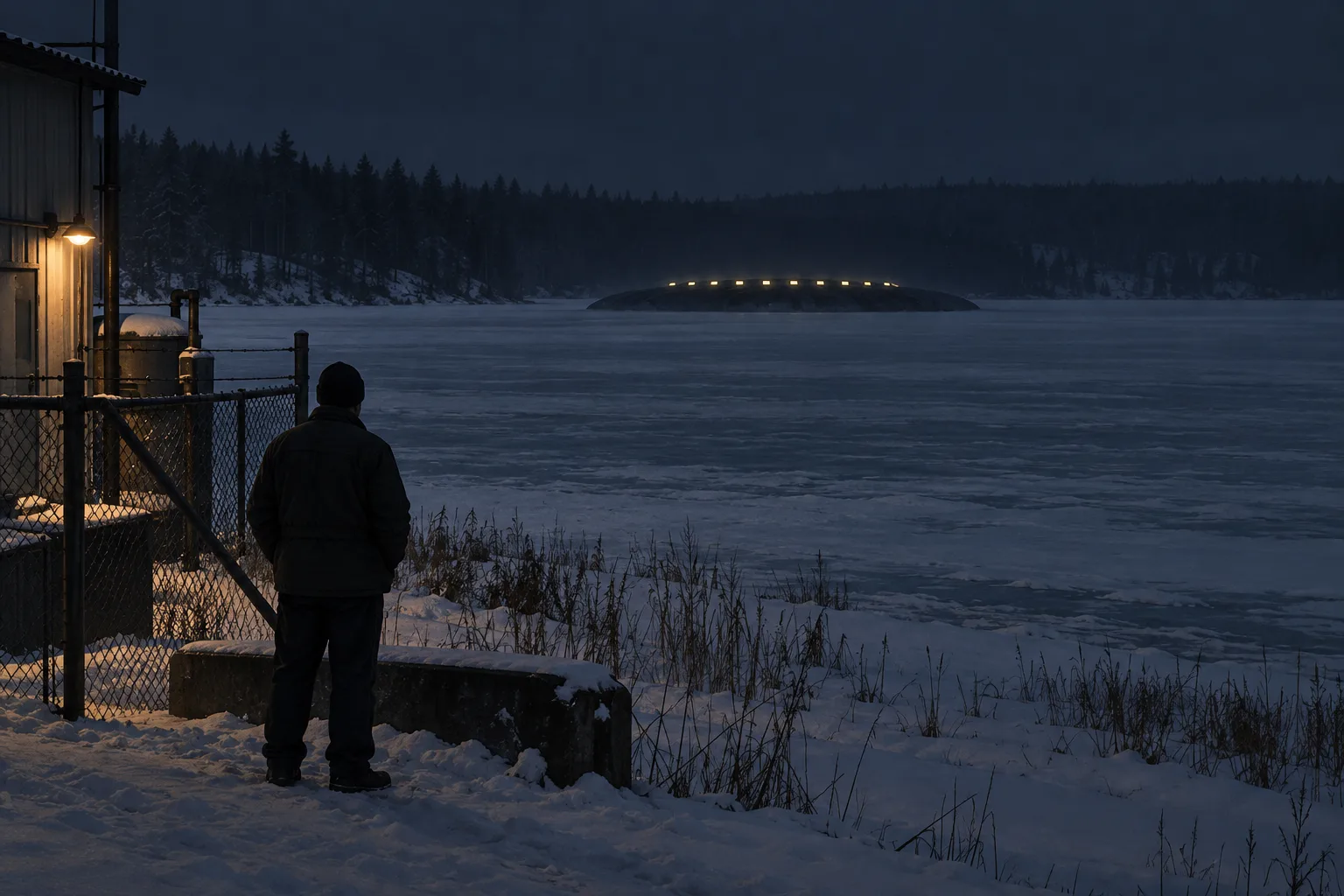
An elderly couple at Ebberad said that, on the evening before Pentecost Eve, they had watched a strongly luminous object through their window. It was moving at low height over a small lake near their home.
The object then rose above the forest and disappeared towards the north-northwest.
This recollection supplied the investigation with an event in the sky before the discovery on the ground. The men at the cottage had arrived to find a mark; the couple described watching something luminous depart.
UFO-Göteborg considered a connection probable. The 1973 magazine presented the lake observation as part of its account of Vänga, carrying the reader from the cottage lawn to the neighbouring landscape.
It gave the case two viewpoints: people looking down at a persistent trace, and people looking out through a window at a passing light. The investigators placed them together in the hope that each would help explain the other.
Samples from the garden
Soil and the oily material were sent for examination. The investigation moved from the lawn to laboratories, where the strange residue might acquire a name.
The Norwegian magazine reproduced a short summary of replies supplied by UFO-Göteborg and GICOFF, another Gothenburg UFO organization.
At Chalmers University of Technology, the nuclear chemistry department reported that the soil sample was not radioactive. The organic chemistry department had provided no clear answer.
The response attributed to Lantmännen’s research institute said the material was not a known fuel, lubricant or weedkiller. The entry for the National Institute of Public Health said that no clear reply had been received.
The published list was brief, but it preserved different outcomes from different inquiries. One test addressed radioactivity; another response concerned familiar agricultural and petroleum products. Other inquiries had not supplied a definite identification.
Back at the cottage, the mark was changing again. Granlie’s later account describes the liquid disappearing, the impressions fading and the grass recovering without substantial damage to its roots. The conspicuous shape gradually surrendered its outline to the surrounding lawn.
The samples and the written descriptions would have to carry the story onwards.
Beyond Enebacken
By the first issue of UFO Information in 1969, Vänga was already being described as one of the better-known cases of the preceding year. Its brief notice called it a UFO landing and mentioned the marks and unusual liquid.
Two years later, the case acquired a public afterlife that Johansson himself challenged.
In his history of UFO-Sverige, archivist Håkan Blomqvist recounts a television interview on April 10, 1971. Chairman Carl-Axel Jonzon speculated about predicting a third landing from a geographical pattern involving Vänga and another reported event. Both properties were called Enebacken, and both owners were named Johansson.
Blomqvist cites the following day’s Borås Tidning for Johansson’s response: the UFO enthusiasts were taking their theories too far, although the phenomena themselves deserved serious attention.
The man who had found the mark was drawing a boundary around his own experience. His lawn had become a point in somebody else’s larger pattern. He still wanted the original discovery taken seriously.
What Is Known
The surviving published record includes an early 1969 reference, the fuller 1973 investigator-supplied summary and later retellings. The Norwegian account dates the discovery to Pentecost Eve, consistent with UFO-Sverige’s June 1, 1968 date. Blomqvist’s retrospective instead gives June 8.
No landing at the cottage was witnessed in these accounts. The Ebberad observation became associated with the mark through the investigators’ interpretation; a shared cause was not established.
The laboratory summary reports an inconclusive identification, alongside a negative radioactivity result. It is a UFO publication’s account of replies, rather than the original laboratory documentation. It does not demonstrate an extraterrestrial substance. Likewise, the reported symptoms do not establish their cause.
Andersson says he located a historical photograph with AFU’s assistance, enlarging and editing it to protect a child’s privacy. That published image should therefore be understood as an altered presentation of an archival photograph.
The Bigger Picture
Vänga’s investigation began with a trace and worked outwards. A patch of affected grass led to questions about visitors, nearby observations and the nature of a residue. The suggestion of a landing emerged as the group assembled those separate reports.
That direction of inquiry makes the case distinctive. A trace can survive long enough to attract several observers and be sampled, yet its appearance alone cannot supply the event that produced it. A triangular outline describes geometry; calling its three smaller impressions landing supports adds a proposed history.
Blomqvist’s organizational history places Swedish UFO research amid competing traditions of critical inquiry and belief. Johansson’s objection shows that tension reaching a witness whose discovery had become famous.
His position leaves room for the enduring mystery without requiring agreement with every theory attached to it. He had found something unusual, sought help and watched the account grow beyond his property.
The grass recovered. The question of what had happened there remained.
Sources
- UFO Information, issue 1, 1969, PDF page 9 — early published notice; already interprets the mark as a landing.
- “Avtrykket i Vänga, Sverige,” Norsk UFO Forum, issue 1, 1973, printed pages 10–11 — detailed summary supplied by UFO-Göteborg and GICOFF; includes laboratory replies and participants.
- Jörgen Granlie, UFO-Sverige — later case narrative, geometry and recovery of the grass.
- Fred Andersson, “When a Flying Saucer Landed at Lake Anten and other UFO Touchdowns in Sweden,” 2023 — later archival retelling, property details and photograph provenance.
- Håkan Blomqvist, Riksorganisationen UFO-Sveriges historia, 1995, reproduced in 2006 — organizational history citing Borås Tidning, April 11, 1971; the newspaper original was not consulted directly.