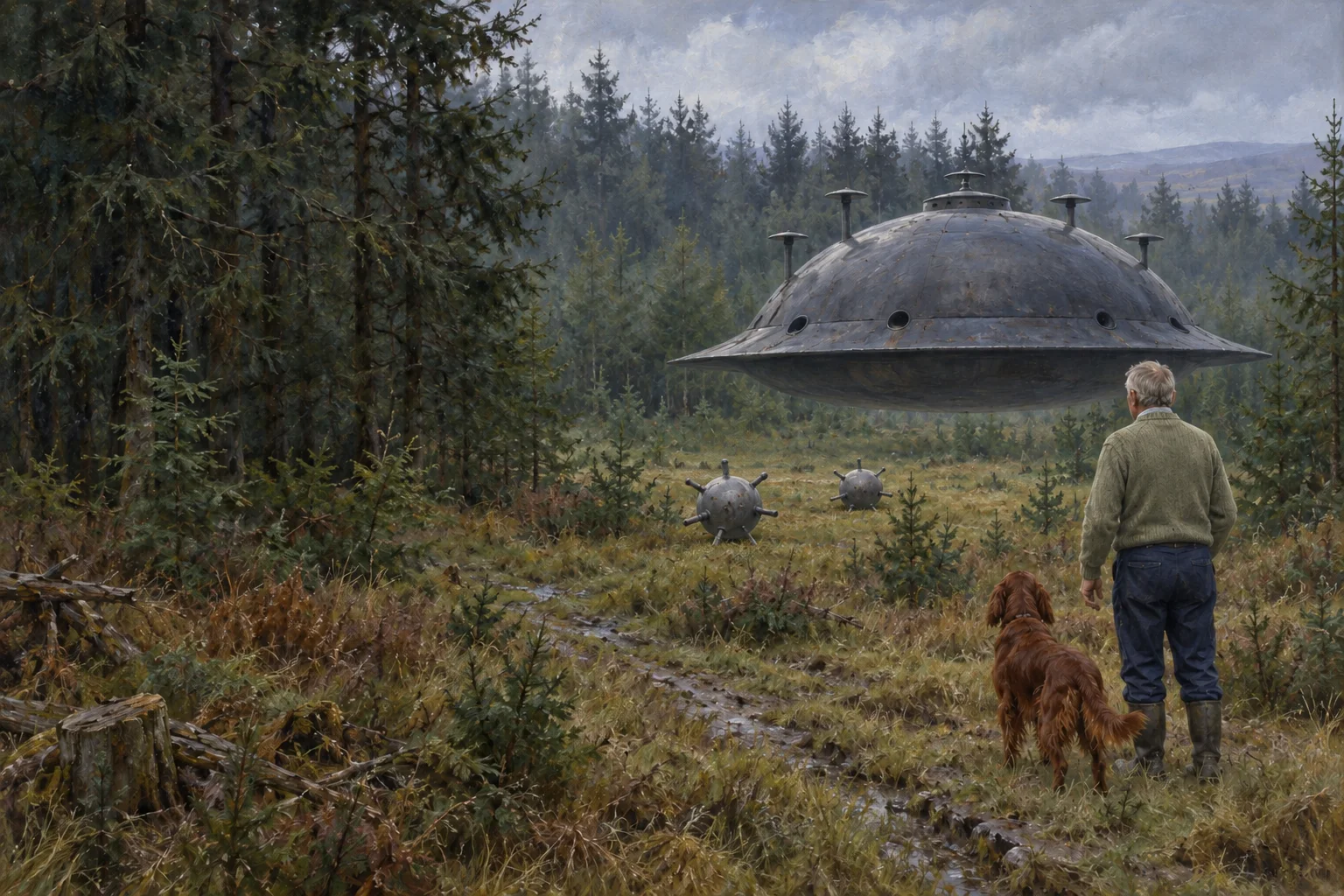
Robert Taylor stood at the edge of a clearing and watched two smaller objects come towards him.
It was the morning of November 9, 1979. He had been walking through Dechmont Woods, near Livingston in Scotland, with his red setter. Ahead, he said, stood a large grey object with a dome above a broad rim. The two shapes appeared from beneath it and crossed the grass rapidly, rolling on protrusions that reminded him of the legs of sea mines.
One reached each side of his body.
In the statement Taylor gave to police, an overpowering smell arrived with them. He felt himself caught high on the thighs, pressure beneath his chin, then the ground as he fell forwards. His recollection broke off.
The next part of the morning would unfold through other people: his wife at home, his manager returning to the woods, and police officers measuring marks in the clearing. By evening, a routine forestry inspection had become an investigation.
Before the clearing
Taylor was a foreman with the Livingston Development Corporation. His job that morning had begun at Rosebank Nurseries, taking a work party and a caravan to woodland near Bellsquarry. There were time sheets to complete and petrol to put in the Bedford pickup before he went home for breakfast.
The CID report, dated January 7, 1980, places his departure for the next inspection at about 10:10 a.m. He was going to check the woods and their surrounding fences and gates. He parked on the western side of Dechmont Woods and continued on foot with his dog.
That was the setting in which the encounter entered his account: a work vehicle left on a path, an inspection route through trees, and a clearing reached during the morning round. Taylor would describe what he saw to his family, his employer, the police and visiting investigators. Each would meet the story at a different point.
A shape above the grass
The object he described was motionless.
In Steuart Campbell’s later reconstruction, based on his investigation beginning that weekend, Taylor saw a dark grey dome hovering close to the ground. Its surface looked rough, like abrasive paper. A flange ran around it, giving it something of the shape of a hat with a broad brim.
Small upright stems stood around that rim, with what Taylor compared to propellers above them. He did not see them turn. Round dark features appeared above the flange, resembling portholes. Parts of the surface seemed to change appearance as he watched.
The details were strange in their particularity. Taylor reached for objects he knew—an abrasive surface, a hat brim, rotors—to describe something he could not identify. His size estimates varied between accounts, but the object consistently occupied the clearing as a substantial structure.
Then the two smaller forms moved into view. The stillness of the larger shape had lasted only briefly.
The smell and the break
Taylor described the smaller objects as round, with projecting limbs or spikes. Their movement across the grass was quick enough that the moment of their arrival and the sensation of being seized became closely joined in his account.
He remembered a choking smell. In an interview conducted by Malcolm Robinson two days after the encounter, later quoted in Mark Fox’s study of reported UFO odours, Taylor compared it to burning brake or clutch material. He described being pulled down, with his dog barking nearby.
The police statement was more cautious about the movement of his body: he remembered falling forwards but was not conscious of being dragged forwards. It also preserved his uncertainty about a rushing sound and the dog’s barking. He could not place those impressions securely before or after the loss of consciousness.
When he became aware of the clearing again, the objects were gone. The route home began with a struggle to get himself moving.
The truck on the track
He felt weak and unsteady. He made his way back to the pickup partly crawling, partly staggering.
The vehicle had a radio through which he could contact his workplace. Reaching it should have brought him back into the ordinary machinery of the day: the office, his colleagues, a voice at the other end. He tried to use it and found that he could not speak.
He also tried to drive. According to his statement, he could not coordinate his actions and got the pickup stuck. The CID account describes an attempt to reverse that carried it off the pathway into soft earth.
He left the vehicle and continued home on foot. A journey that had begun with a drive into the woods now ended with him approaching his own house, dazed and dirty, while the pickup remained behind.
At about 11:15 a.m., Mary Taylor looked out from the kitchen and saw her husband coming up the road.
At the kitchen window
Mary’s statement to police describes the change she saw. Earlier he had seemed normal and in good spirits. Now his face and clothes were dirty; he was pale and exhausted. His trousers were torn on both sides near the pockets.
She first thought there had been an accident. He told her that he had been attacked and tried to explain the object in the woods. He kept referring to a smell and wanted a bath. Mary did not detect an odour herself, but she could see the state he was in.
She ran the bath and telephoned his manager, Malcolm Drummond. Taylor described the large object to her as resembling a spinning top, with two round objects that had rolled towards him. When Drummond arrived, he heard the same extraordinary explanation from a man whose condition was plainly visible.
Drummond went to the woods. On that first visit he reported finding nothing. Taylor insisted that there should be marks and wanted to show him the place.
Back among the trees
Dr Gordon Adams examined Taylor at home. His medical statement records a complaint of headache, a graze on the left thigh and a faint graze beneath the chin. The examination did not reveal signs of head injury or brain compression. The doctor arranged further assessment at Bangour General Hospital.
Before going there, Taylor returned to the woods with Drummond, with the doctor’s permission. This time he could indicate the position himself. Both men saw marks in the clearing.
Taylor was subsequently taken to hospital, but left after waiting without being examined there. Later he and Mary travelled to visit their daughter in England, a visit he said had been arranged beforehand.
Back in Livingston, Drummond had notified the police. Officers were entering the clearing while the man at the centre of the account was beginning a very different afternoon.
The officers in the clearing
Police Constable William Douglas was instructed to attend at about 2 p.m. Drummond led him and other officers through the woods to the location Taylor had identified.
Douglas’s statement describes central impressions resembling the tracks of a caterpillar tractor. Around them were smaller holes, some extending under the turf. He searched the surrounding soft ground for traces of a mobile crane, but found none that explained the scene.
He took measurements and made a sketch. Detective Constable Wark photographed the area. The Development Corporation fenced it off.
At about six that evening, Douglas accompanied other officers to examine Taylor’s vehicle. It showed no indication of an accident, and they found nothing aboard it that appeared likely to produce fumes causing hallucinations.
The officers had practical tasks to carry out: examine the place, check the truck, record what they could see. The clearing offered marks that could be photographed even though the objects in Taylor’s account were no longer there.
Two tracks, many holes
In Wark’s statement, the two long tracks measured ten feet by one foot, with seven feet between them. He recorded twenty-one holes around each track, entering the ground at an angle, then prepared a plan at Bathgate Police Station.
Those measurements gave the reported scene an outline on paper. The long impressions and the smaller holes became separate features, with positions that another person could inspect.
The next day’s Scotsman report brought the encounter into public view. It described the fenced site, the marks and Drummond’s account of Taylor returning home. A police spokesman allowed for many possible explanations.
Within days, Taylor’s experience was being told far beyond the people who had first received it. The woodland site was becoming a destination, and the account a news story. Another piece of the morning, however, was about to enter a quieter setting: the forensic laboratory in Edinburgh.
The clothing in Edinburgh
The police received Taylor’s clothes for examination on November 12. The laboratory report dated November 22 records mud on the front of the trousers above the knees, as well as tears at both hips.
The examiners found the tears consistent with the fabric being pulled upwards while the trousers were worn. Beneath them, the long underwear had a corresponding tear at the left hip, consistent with damage occurring at the same time. The front of a pale green pullover was heavily smeared with mud.
These were clothes from a working morning, now itemised as evidence. Their damaged areas could be described and compared with the account of being caught near the thighs. The report gave the force a direction, while leaving its source unidentified.
Taylor’s story had travelled from a clearing to his home, back into the woods, and finally into statements, photographs and an examination of fabric. The morning could now be followed beyond his recollection, through the people who had seen what came afterwards.
What Is Known
The strongest accessible collection is Campbell’s Close Encounter at Livingston, published by BUFORA in 1982. It combines his investigation with reproductions of contemporary witness statements, police records, a medical statement, a forensic report, plans and photographs. Its interpretations belong to the author; the reproduced documents retain their separate evidential roles.
Taylor reported the object and the smaller spheres. Mary described his condition on returning home. Adams recorded minor injuries and arranged further examination. Douglas and Wark documented the scene. The forensic scientists recorded torn fabric consistent with an upward pull. These establish a reported encounter and an investigated aftermath; they do not identify an extraterrestrial cause.
Details differ within the record. Estimates of dimensions and timings vary. The January CID summary also notes water in the long tracks as a reason to doubt that those impressions had been made that morning. Such observations are part of the investigation, alongside the officers’ puzzlement.
The West Lothian Archives catalogue identifies a separate file containing 1979 press cuttings and 1991 plaque publicity. It explicitly says that file does not contain the Development Corporation’s internal investigation. The council’s present-day retelling and its archive catalogue therefore serve different purposes.
The Bigger Picture
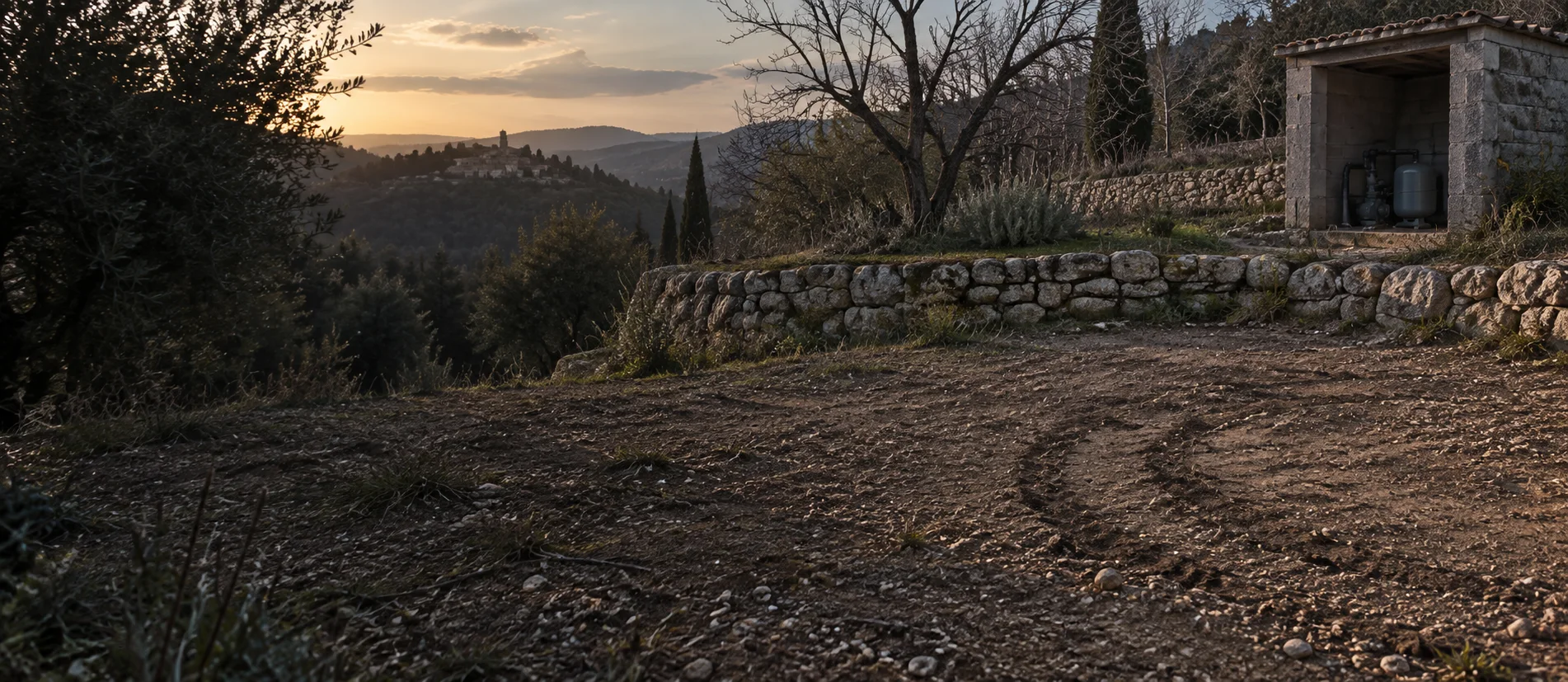
Dechmont is close to Livingston and the M8 motorway. In his 2023 visit for the research project UFO practice in Scotland, Gavin Miller described a soundscape of traffic, aircraft and people using the paths. The woodland can look remote in a photograph, but belongs to the everyday landscape of Lowland Scotland.
That setting matters to the story’s survival. Taylor was employed to inspect it. His manager could return to it. Police could walk through it, photograph it and check the equipment associated with the day’s work. The extraordinary account remained attached to an accessible place.
Today, West Lothian Council’s walking information includes the encounter among the site’s points of interest. A trail and memorial bring visitors back to the woodland where Taylor said his morning changed. Miller’s account treats this memorialisation as part of the case’s cultural history: the story has become something encountered on a walk.
The marks in the grass were temporary. The statements and photographs endured. A forester’s interrupted round left a route that later readers can still follow, from the edge of the clearing to the people waiting beyond the trees.
Sources
- Robert Taylor’s police statement, reproduced in Appendix 5. Contemporary firsthand account, published in BUFORA’s 1982 case history.
- Mary Taylor’s police statement, Appendix 8. Contemporary observations of her husband’s return.
- PC William Douglas’s statement, Appendix 3. Police attendance, scene search and subsequent inquiries.
- DC Wark’s statement, Appendix 4. Measurements, photographs and scene plan.
- Dr Gordon Adams’s statement, Appendix 7. Contemporary medical observations.
- Lothian and Borders Police, forensic report, November 22, 1979, Appendix 2. Examination of clothing, reproduced with supporting statements.
- Livingston CID report, January 7, 1980, Appendix 6. Police summary of the incident and inquiries.
- The Scotsman, November 10, 1979, transcribed in Appendix 10. Contemporary reporting; the transcription corrects minor spelling errors and omits illustrations.
- Steuart Campbell, Close Encounter at Livingston, BUFORA Case History No. 1, 1982. Investigator’s reconstruction, documentary compilation and interpretations.
- Mark Fox, Sulphur and Saucers: What Do UFOs Smell Like? Later comparative study quoting Taylor’s early interview as published in Malcolm Robinson’s 2019 book; used for the smell comparison.
- West Lothian Archives, LDC/CD/1/3/2/60. Official catalogue description of surviving press and publicity material.
- Gavin Miller, “Dechmont Woods,” December 10, 2023. Independent research context and firsthand observations of the site and memorials.
- West Lothian Council, Dechmont Law. Present-day landscape and walking context.