The light had gone beyond the shed. For a time, Ronald Johnson could hear it moving away, but he could no longer see the yard in front of him.
He was sixteen, standing near the sheep pen on his family’s Kansas farm. A few minutes earlier, his mother had called him in for supper. Now a sound he compared to a jet was fading into the distance, and the brightness had left his vision overwhelmed.
When his sight began to return, he looked up. The object was still in the sky.
He ran for the house.
The Supper Call
The Johnson farm stood near Delphos, in Ottawa County, among fields and scattered lines of trees. The encounter would be dated November 2, 1971, at approximately seven in the evening.
Ronald had been tending sheep with his dog nearby. His parents, Durel and Erma, were inside for the evening meal. In the account collected by investigator Ted Phillips, Erma called from the back door, and Ronald answered that he would finish shortly.
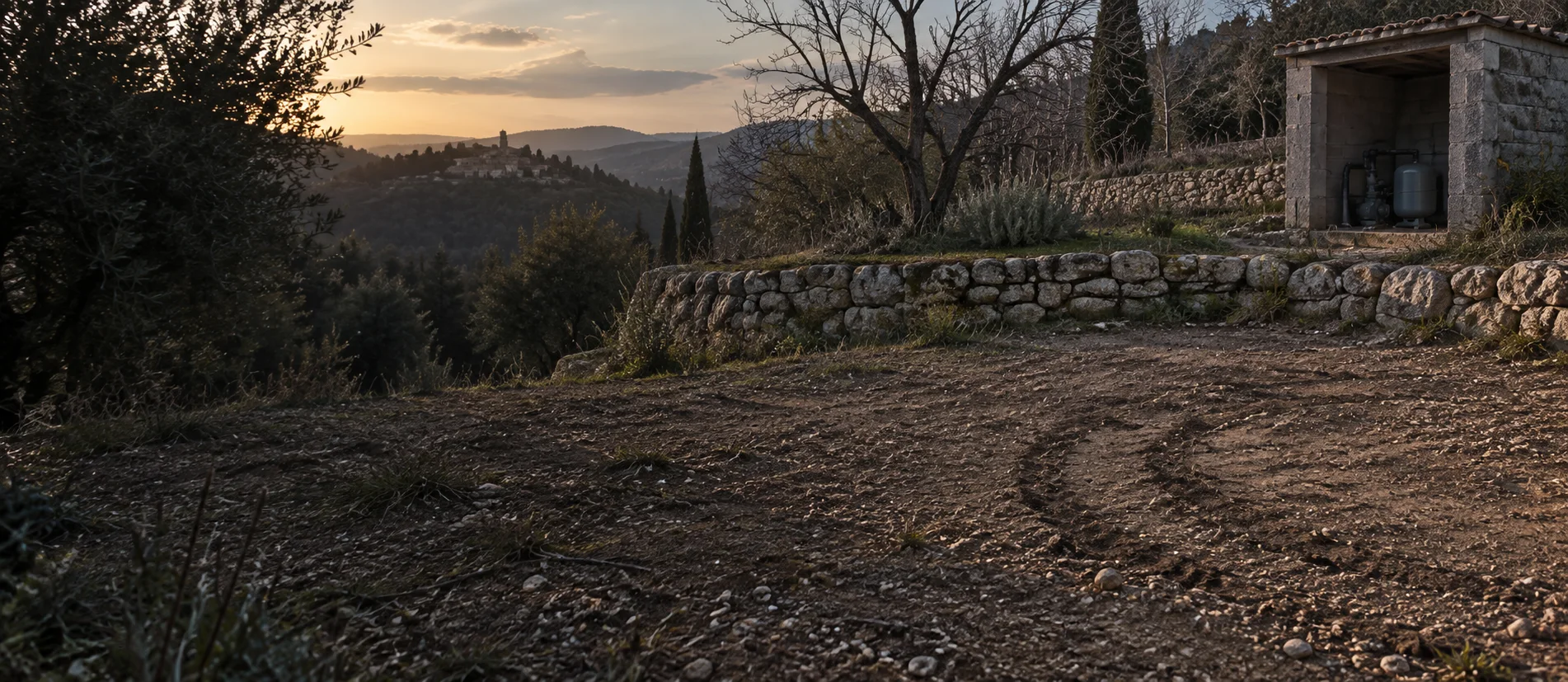
The farm buildings separated the house from the place where the evening changed. Beyond a low shed lay the trees and the patch of ground that would become the center of the story. Ronald was close enough to see that area from the sheep pen; his mother, at the house, had another view of the yard.
Then came the rumbling.
Ronald associated it with an old washing machine shaking as it ran. In front of him, roughly seventy-five feet away by his estimate, something became brilliantly illuminated. The familiar ground beyond the pen was suddenly occupied by a shape he could see through its own light.
He stood still. His dog, he later told Phillips, had become unusually quiet.
Beneath the Trees
The object appeared close to the earth, its base perhaps two feet above it. Ronald described a rounded form with a dome and a swelling through its middle, estimating it at about nine feet across and ten feet high.
Its whole outline was luminous. Blue, red and orange seemed spread across it, while a brighter glow filled the space beneath the base. The light reached the nearby trees and the ground.
From the sheep pen, the boy could make out the overall form. The brightness hurt when he looked directly toward it. His description placed the shape among the farm’s trees, with the low shed nearby: an object hovering in the space through which he ordinarily looked across the yard.
The sheep began making noise. Ronald remained where he was, watching.
In the later interview conducted for APRO by Clancy Tull, he described movement in the object’s upper portion while its base seemed steady. Tull also recorded the boy’s comparison between the illumination and the brilliant arc of an electric welder. Those details belonged to the same close, difficult brightness that dominated Ronald’s account. APRO published the additional interview in spring 1972.
The object stayed low for what Ronald remembered as several minutes.
Then the light beneath it grew stronger.
Over the Shed
The departure began at the base. As the glow expanded, the shape rose at an angle, moving toward and over the low shed.
Ronald estimated that it cleared the roof by only a few feet. The sound changed with the movement, rising from its earlier rumble into a high, powerful whine. The shed gave him a familiar measure against which to watch the ascent: the thing that had hovered by the trees was now passing over a building he knew.
At that point the light overwhelmed his sight.
In Phillips’s interview, Ronald described being unable to see for what felt like several minutes. During that interval, he could still hear the sound diminishing. When his vision recovered enough, he found the departing light above the farm and hurried inside to tell his parents.
His arrival brought the encounter into the house. Durel and Erma remembered him as frightened and excited. At first they did not accept what he was telling them. Ronald became more insistent.
Durel went outside.
There was a bright light in the southern sky.
Three People Looking South
Durel called out, and all three watched it. The parents’ account begins here, with the light already beyond the farm, moving away.
They described it as large and exceptionally bright. Phillips asked them to compare it with an automobile light seen from a hundred feet away. They remembered something larger and brighter, with the intense color of an arc welder.
As they watched, it grew smaller.
Their view was from the house, toward the southern sky. Ronald had come to bring them to the place behind the shed. Once they had watched the receding light for a short time, the three went around the building toward the trees.
There, the encounter acquired another center.
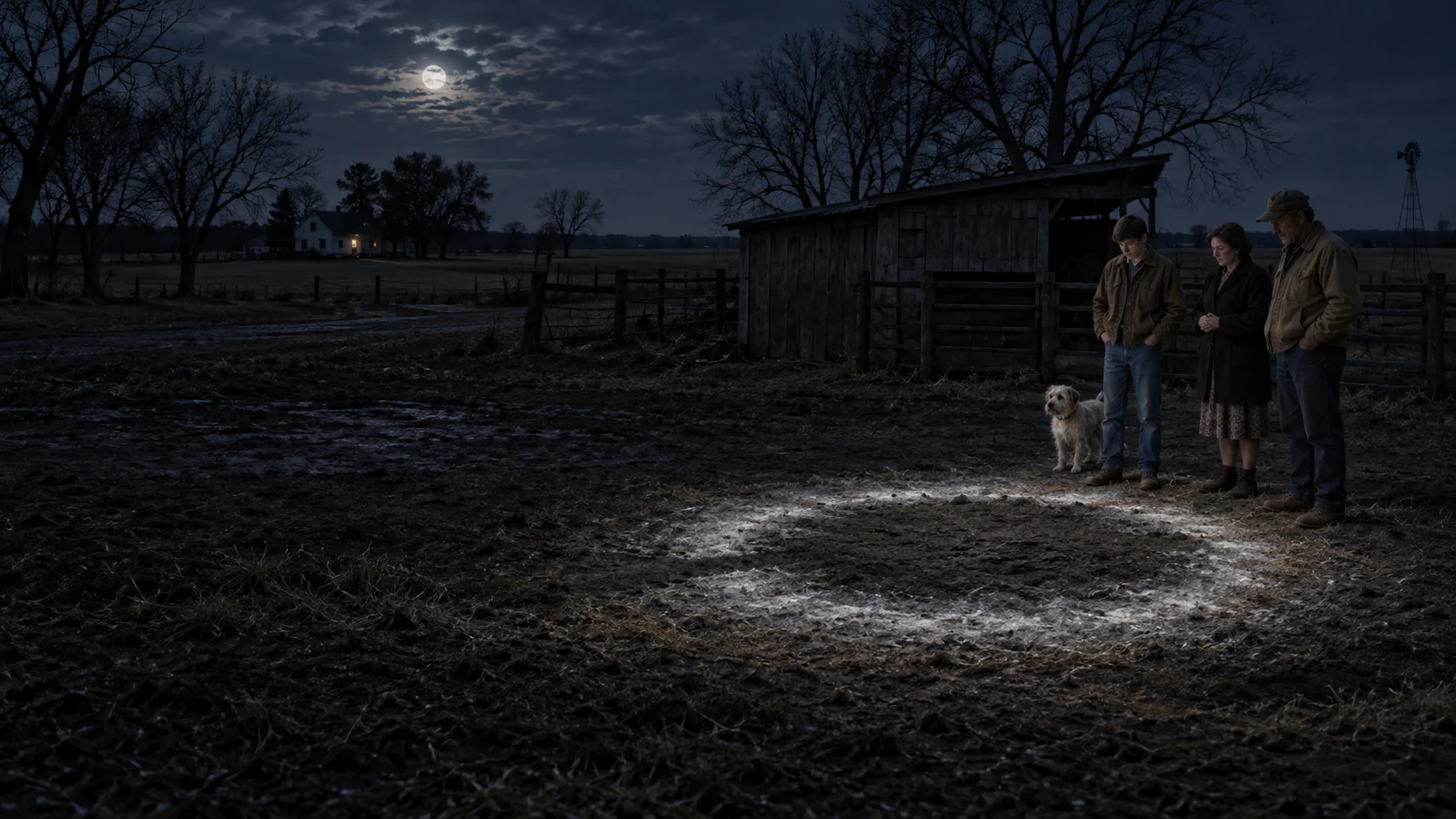
A circle on the ground appeared to be glowing gray-white.
The Pale Earth
According to the family’s account, the ring lay where Ronald had seen the object hovering. Parts of the nearby trees appeared luminous too.
Durel and Erma touched the ground. They said the surface was cool and had a peculiar crusted texture. Erma felt her fingertips become numb. Trying to wipe the soil away, she rubbed her hand against her leg and reported a similar loss of sensation there.
The effect stayed with her. She later told Phillips that for about two weeks she had trouble feeling with her fingertips, enough to interfere with taking patients’ pulses at the rest home where she worked. Durel also reported numb fingers, although his sensation returned sooner.
Erma went back to the house for the family’s Polaroid camera.
She returned to photograph the ring. The evening now had something the family could carry indoors: a picture of the place they had just visited, on the farm where the boy had been feeding sheep before supper.
Durel called Willard Critchfield, editor of the Delphos Republican. Critchfield later placed the call at about eight that evening.
By the next day, Ronald and his father were in Delphos, telling reporter Thaddia Smith what had happened. Her account survives inside Phillips’s early report.
The Reporter at the Farm
Smith went out with her husband, Lester, and their son-in-law, Kenneth McCullick. The ring was easy to find.
She described a light-colored band roughly eight feet across, its soil dry and crusted. Inside the circle and around its outer edge, the ground was muddy from recent rain. The band itself was approximately a foot wide.
The contrast continued through the scene: pale dry earth curving around a muddy center, among trees beside the farm buildings. Smith also examined a fallen dead tree and a broken limb nearby. These details entered her report along with the family’s description of the previous evening.
Back at the newspaper office, she made calls. The Concordia Weather Bureau and KSAL radio in Salina directed her toward the Ottawa County Sheriff’s Office.
At approximately half past one on November 3, the office received her report. About half an hour later, Sheriff Ralph Enlow, the undersheriff and Kansas Highway Patrol Trooper Kenneth Yager arrived at the farm.
Durel took them behind the shed.
The officers saw the pale ring and the muddy ground beside it. They photographed it and collected a soil sample. The undersheriff’s written account describes the sample as nearly white and very dry; the material and photographs went into the sheriff’s office vault. Phillips reproduced that report in 1972.
Smith returned that evening with her husband. In a signed statement later collected by Phillips, she recalled walking to the site with the Johnsons without lights and seeing the ring distinctly against the surrounding darkness.
The place could now be revisited. People arriving after the departure were following a story to a particular patch of earth.
Snow Around the Circle
On December 2, astronomer J. Allen Hynek telephoned Ted Phillips about Delphos. Phillips contacted the sheriff and arranged a visit for December 4.
Thirty-two days had passed since Ronald’s encounter.
Snow was melting when Phillips and Enlow reached the farm. The yard was wet and muddy, with standing water. They walked around the shed and through the trees to the site.
The ring remained visible. Snow still outlined it while the surrounding area was thawing. Phillips cleared a section and found light-colored, dry soil beneath, beside darker wet ground.
He poured water onto the exposed band. It stayed at the surface.
With Durel, he took samples from the ring and from outside it. White material was visible in the ring soil they opened. They also measured the positions of the shed, the trees and the place where Ronald had stood, turning the boy’s view across the yard into a plan of the site.
Phillips returned on January 11, 1972. This time the surrounding ground was dry, and the pale outline was faint. Several buckets of water brought the contrast back: the earth beside the band darkened as it absorbed the water, while water on the ring briefly stood, then ran toward a lower spot in its center.
The ring was irregular, with a section on the western edge that differed from the dry band. Phillips traced it, opened the soil and collected further samples. More than two months after the reported departure, the farmyard still gave visitors a place to stop, bend down and examine.
The light had taken minutes to leave. The ground would keep people returning for years.
What Is Known
The earliest detailed record used here is Phillips’s February 1972 report. It combines interviews with the Johnson family, Smith’s statements, the undersheriff’s account, photographs and Phillips’s December and January field visits. Ronald described the object at close range; his parents described the departing light and the ring afterward. The reported glow and physical sensations belong to their testimony. Subsequent visitors documented the pale band and its contrasting behavior when wetted.
APRO’s follow-up adds Tull’s interview and site observations. It is a further investigation of the same family account, rather than a second encounter.
Soil research continued much later. Erol A. Faruk’s 1989 paper describes tests on ring and comparison samples received in 1977, including their water repellency and extracted compounds. In her 1999 laboratory report, analytical scientist Phyllis Budinger examined preserved samples collected in January 1972. She identified a predominantly humic coating, with calcium oxalate and other constituents, and documented retained water repellency. Her proposed connections between chemistry, glow and physical effects are interpretations; the measured soil properties and the cause of the reported encounter are separate findings.
The Bigger Picture
Delphos became part of a wider effort to study encounters that appeared to leave something behind. A ground marking offered a different kind of continuing record: a location that could be mapped, photographed and sampled after a witness’s view of the object had ended.
That approach reached beyond specialist magazines. In The UFO Enigma, prepared for the Congressional Research Service in 1976, Marcia S. Smith included Delphos among ten selected case summaries. Her wider discussion identified Phillips’s physical-trace work as one strand of UFO research alongside photographic and radar studies. The report’s inclusion documents the case’s place in that research history.
The preserved samples gave Delphos an unusually long afterlife. Budinger recorded that ring and comparison soils had been kept by CUFOS’s John Timmerman and recovered in 1998. Material taken from a Kansas farmyard could be examined again with instruments developed decades after the first visits.
The story consequently moves at two speeds. Ronald’s evening unfolds through a supper call, a rumble, a brilliant ascent and a hurried return to the house. The ring’s history unfolds through photographs, snowmelt, buckets of water, sealed containers and laboratory work. At the point where those histories meet stands the family beside the shed, looking down at the pale earth after the light had gone.
Sources
- Ted Phillips, “Landing Report from Delphos,” Flying Saucer Review Case Histories 9, February 1972, pp. 4–10 — early field investigation, family interviews, site plans and photographs.
- Thaddia Smith’s report and signed statement, reproduced by Phillips — the reporter’s account of her November 3 visits; statement continues on scan page 11.
- Undersheriff Enlow’s November 3 site-visit report, reproduced by Phillips — official observations, photographs and sample collection; continues on scan page 9.
- “More On Kansas Case,” APRO Bulletin, March–April 1972, pp. 8–9 — follow-up investigation by Clancy D. Tull.
- Erol A. Faruk, “The Delphos Case: Soil Analysis and Appraisal of a CE-2 Report,” Journal of UFO Studies 1, 1989, pp. 41–65 — later chemical research and the author’s interpretations.
- Phyllis A. Budinger, Technical Service Response UT001, August 9, 1999 — laboratory analysis of preserved ring and comparison soils.
- Marcia S. Smith, The UFO Enigma, Congressional Research Service, March 9, 1976 — independent historical context; Delphos appears on printed pp. 111–112.