Allan Jansson first thought he was looking at the eyes of animals.
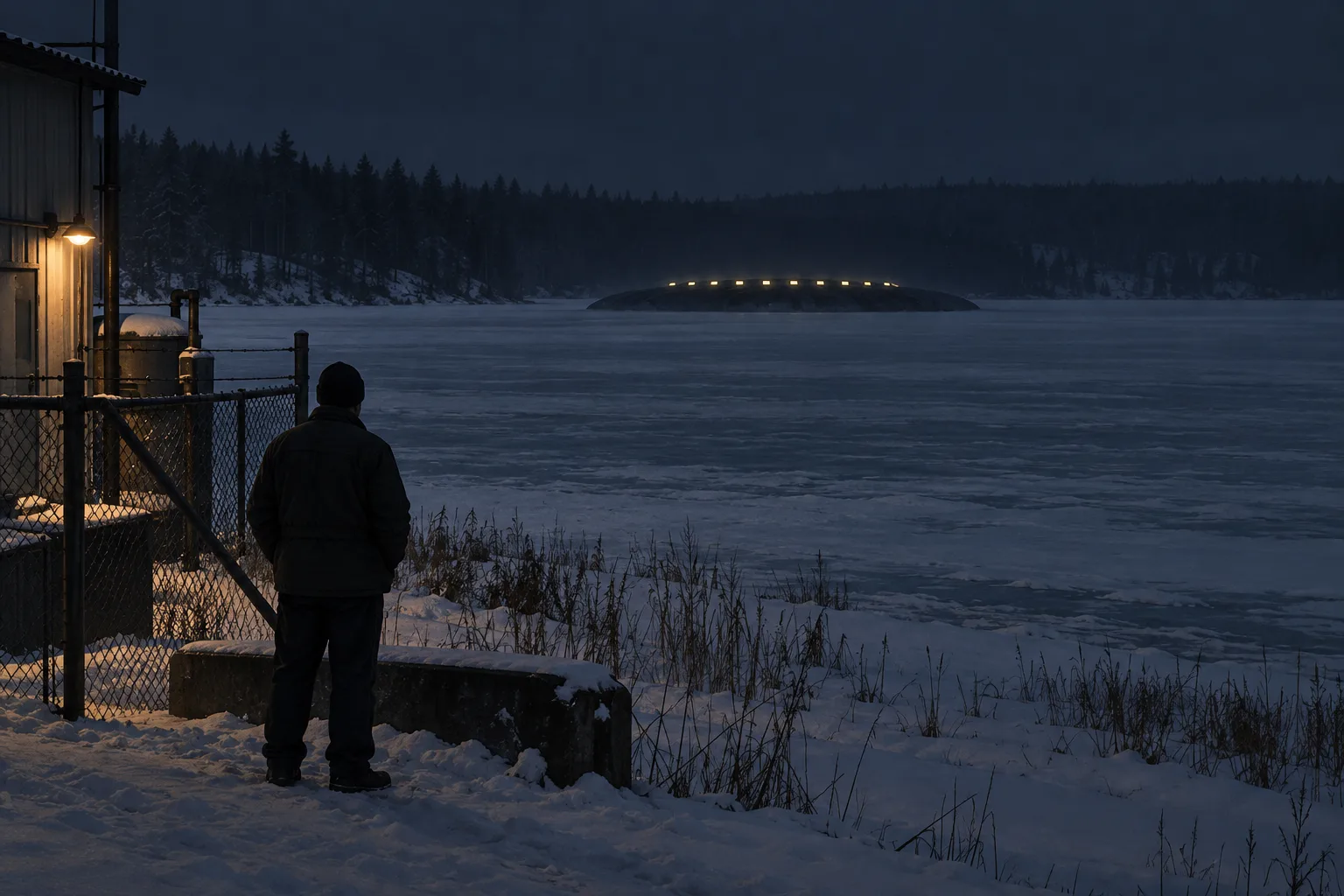
A row of lights stood out on the frozen lake beyond the factory fence. He was making an inspection round at Nitro Nobel in Gyttorp, where the buildings came close to Lake Vikern. It was 10:25 p.m. on January 21, 1976.
He moved nearer the fence and looked again.
As his eyes adjusted, he reported seeing a broad, dark form around the lights. The openings looked square. They ran along its upper part, shining over the otherwise dark ice.
Jansson would return to look several times during his shift. The lights stayed where they were. Hours passed, and the shape remained.
The factory beside the water
The lake was part of Jansson’s working landscape. In the account published soon afterwards, he described a job that took him outside on regular inspection rounds. He had started work at nine that evening and had already been out without noticing anything unusual.
Gyttorp’s association with explosives stretched back well before his employment. Sveriges Radio’s industrial history traces the factory to a powder works founded in 1858. Nitroglycerin AB bought the operation in 1915, and production moved here from Vinterviken, outside Stockholm, around 1920. The company used the name Nitro Nobel from 1965.
The setting combined industrial buildings with a substantial lake. The county administrative board’s description of Vikern places Gyttorp and its industry on the northeastern shore. Forest surrounds much of the water, with roads, railway and scattered homes close to its edges.
For Jansson, looking across the ice was something he could do during an ordinary night’s work. On this round, the familiar view contained a line of lights he could not place.
Nearer the fence
The 1976 investigation report in UFO-Information recorded his account in detail. Jansson knew the area and had seen illuminating projectiles from Bofors tests before. This looked different to him.
There was no moonlight, he said. Nor did he believe the lights came from the strong lamp near the fence. His first idea, a gathering of animals with shining eyes, gave way as he studied the view from his new position.
The shape he described was exceptionally low and wide. He compared it with a large round cheese or a snuffbox, with somewhat rounded edges. He estimated that it was roughly a hundred metres away.
Those comparisons belonged to the things he knew. They gave him words for an unfamiliar silhouette without supplying an explanation for it.
In the near-period account printed in Argus, the line resolved into an estimated twelve to fifteen openings. Jansson described a pale light and a feeling that he was being watched.
He considered calling someone.
He did not make the call. His explanation afterwards was that he feared being laughed at, particularly if he had misunderstood what was out there.
The hours between rounds
The observation unfolded around his work. He would go outside, look towards the lake, and then return to his duties. He estimated that he checked about three times an hour.
The shape did not appear to change position. The light remained steady.
The duration gave the account its peculiar character. Jansson was describing something he repeatedly found waiting in the same part of the view, across a succession of inspection rounds. Each return brought him back to the lights.
The UFO-Sverige case summary places his last observation shortly after three in the morning. The fuller early narrative says that when he looked again around four, the phenomenon had gone.
He had not watched it leave. There was an interval between the last time he saw it and the first time he found the lake dark again.
His shift continued towards morning. What remained with him was the experience of having looked repeatedly at something he could not identify, while the people around him still knew nothing about it.
A ring in daylight
On Monday, January 26, Jansson was returning for an afternoon shift when he noticed a ring on the ice.
The discovery gave the night a visible counterpart. He associated the mark with the place where he believed he had seen the dark object. Now he told people at the factory what had happened.
A March 16 report in Karlskoga-Kuriren, preserved with an English translation, records his uncertainty as well as his account. He wanted an ordinary explanation. He could describe what he had seen, but could not say what it was.
The newspaper also carried his size estimates: a little over a metre high and around thirty metres across, viewed from approximately a hundred metres away. He expressly recognized the difficulty of estimating dimensions at that distance.
The ring could be approached in daylight. Other people could look at it without relying on Jansson’s memory of the lights.
That changed the scale of the attention. A private observation during a night shift became a place people wanted to visit, with something unusual still visible when they arrived.
Ice standing on edge
Investigators from UFO-Sverige and Köpings UFO-förening examined the site and interviewed participants. Their published report gave the circle a diameter of 41 metres, with the ice measuring 26 centimetres thick at its centre and 42 centimetres towards its edges.
Within the circle, ice had formed into upright plates. The crystals became coarser towards the middle. In the central area, approximately five metres across, they resembled small sheets of ice standing on edge, around fifteen centimetres high.
The report included photographs and a close view of the crystals. It also located the circle approximately a hundred metres from the shore and fence. Investigators reported no sharply defined impressions from landing gear.
The mark was striking in its own right: a large round area, a change in ice thickness, and delicate structures rising from the surface. Looking at the formation was a different experience from following the light in darkness.
The first involved an object Jansson believed he could make out across the lake. The second brought people directly onto the ice to inspect the surface beneath their feet.
Those two experiences became joined in the public story of Gyttorp.
A witness in print
By March, the newspaper was asking what had landed on Vikern. It quoted Thorvald Berthelsen, chairman of the Köping group, on the interest of having both a witness and a formation in the ice. He also acknowledged that they had no proof.
The distinction mattered even as the story spread. The circle gave investigators measurements and photographs. Jansson gave them an account of a long night. The proposed connection between the two made the case compelling to readers.
The surviving publications preserve how quickly the language could become more definite. The title of the early UFO-Information article called the event a UFO landing. Its pages included an artist’s interpretation of what Jansson might have seen.
That illustration helped turn the description into a picture. The photographs showed the ice formation; the drawing showed a proposed appearance for the object. A reader could move from the witness to the imagined silhouette and then to the circle.
Meanwhile, investigators were gathering other reports from the same evening. A couple walking near the lake around 6:30 p.m. had described a steady red light which disappeared, returned, and later moved towards Nora. Their own first thought had been a helicopter.
The earlier red light entered the file beside Jansson’s later, much longer observation.
Back onto Vikern
Attention returned to the lake that spring when a new opening was discovered on March 30, farther south in Käppstaviken.
This time it was an area of open water rather than January’s crystal formation. The follow-up in UFO-Information 3/1976 described a roughly twenty-metre opening with three rectangular projections.
On April 10, investigators and members of Karlskoga Sportdykarklubb went to examine it. The report named Owe Lewitzki and Erik Pettersson as investigation leaders. Divers explored below the opening, and samples of a greyish substance were collected. They also examined reference locations away from the hole.
The work extended the winter investigation beneath the surface. People who had first studied lights and ice were now comparing material from separate points in the lake.
The report treated the new opening as another puzzle and said enquiries were continuing. Its publication preserves that stage of the investigation, before later accounts supplied a different interpretation.
January’s circle and March’s opening were distinct sites. Both, however, became part of what people meant when they spoke about the mystery on Vikern.
A letter thirty years later
In April 2006, investigator Clas Svahn received a letter from helicopter pilot Ingmar Schylström.
In Svahn’s later reconstruction, Schylström said his logbook placed him and a pupil over Vikern on January 21, 1976. They had practised landings and hovering after dark, sometimes using the aircraft’s lights and sometimes leaving them off. The exercises had lasted roughly fifteen minutes.
The letter brought another person’s activity on the lake into the record. It also returned the investigation to the clock: an evening flight, an earlier red light, and Jansson’s observations continuing well into the following morning.
Decades after visitors first walked out to the circle, the case was still acquiring information about what had happened over Vikern that night.
What Is Known
There are contemporary records of Jansson’s testimony and the investigation of the ice formation. UFO-Information 2/1976 contains an extended account, reported measurements and photographs. The March newspaper article provides an early interview. Argus later retold the case; it is evidence of its circulation, rather than another independent witness.
The shape, dimensions and openings belong to Jansson’s description. They were not measurements of a recovered vehicle. The circle was inspected separately, days after the reported observation. Its existence does not establish what produced it or demonstrate that the lights caused it.
An ordinary explanation was already being considered in 1976. The investigation article quoted ice specialist Arne Moberg, who reviewed photographs and thought natural crystallization under particular weather conditions was likely. He had not inspected the site himself. The early record therefore contains disagreement, rather than a unanimous scientific conclusion that the ice was inexplicable.
Svahn’s later assessment favours gas rising from the lakebed as an explanation for the January circle. He also reports that the March opening was interpreted as a hoax after evidence associated with a commercial explosive was found. That conclusion concerns the later opening; it does not make January’s formation the same event.
Schylström’s account offers a possible explanation for the earlier red light. A brief helicopter exercise does not account for Jansson’s reported observations over several hours. No demonstrated extraterrestrial explanation emerges from these records.
The Bigger Picture
Gyttorp is especially interesting because the association at its centre feels so immediate. Someone reports a shape on a frozen lake. A large circle is then found where he believes he saw it. The two observations seem to complete each other.
Yet they ask different questions. Identifying the light requires understanding the nighttime view and the timing of other activity. Explaining the circle requires understanding the ice, water and conditions at the site. One striking answer need not explain both.
The county’s lake survey supplies useful independent context. It describes Vikern as a regulated lake within the Arbogaån water system, with industrial activity along its shore and a documented history of environmental monitoring. This was a working landscape with processes above and below the surface. The survey is not a finding about the 1976 circle, and its later water-quality data cannot reconstruct that winter.
The archive allows something more valuable than choosing between a perfect spacecraft story and a perfect resolution. It preserves the witness’s uncertainty, investigators’ practical work and interpretations that changed as information arrived. Comparing those stages shows how a mystery can remain vivid while its proposed explanations become more specific.
At the heart of the account is still the inspection round: a worker leaving the building, looking across familiar ice and finding a row of lights he could not explain. The circle made other people stop and look. The records preserve what each of them brought back.
Sources
- UFO-Information 2/1976, pages 4–6 — contemporary investigation compiled by Thorvald Berthelsen; witness testimony, photographs, measurements and Moberg’s assessment. AFU scan.
- Karlskoga-Kuriren, March 16, 1976 — contemporary clipping and translation in UFO Newsclipping Service 84–85; PDF pages 27–29.
- Argus 1/1977, pages 9–10 — near-period retelling of Jansson’s account. AFU scan.
- UFO-Information 3/1976, pages 4–5 — contemporary follow-up on the separate March opening and April diving investigation. AFU scan.
- Clas Svahn, Kristallcirkeln i Gyttorp — later reconstruction, interviews and reassessment; includes Schylström’s 2006 account.
- UFO-Sverige, Elva fall — brief archival overview; the longer reassessment provides qualifications absent from this summary.
- Mats Carlsson Lennart, Sveriges Radio, December 30, 2016 — independent reporting on Gyttorp’s industrial history.
- Länsstyrelsen i Örebro län, Vikern, 2017 — official lake survey; geographical and environmental context, not a UFO investigation.