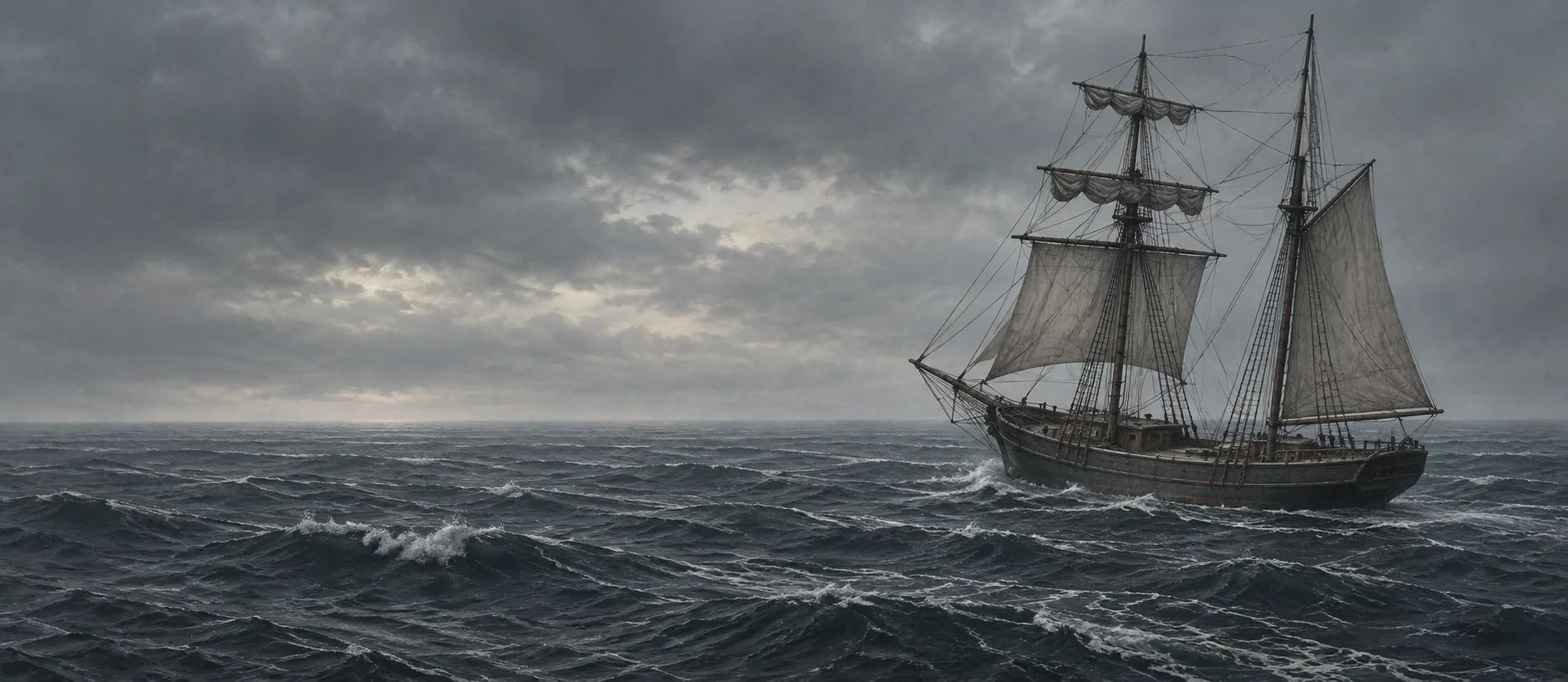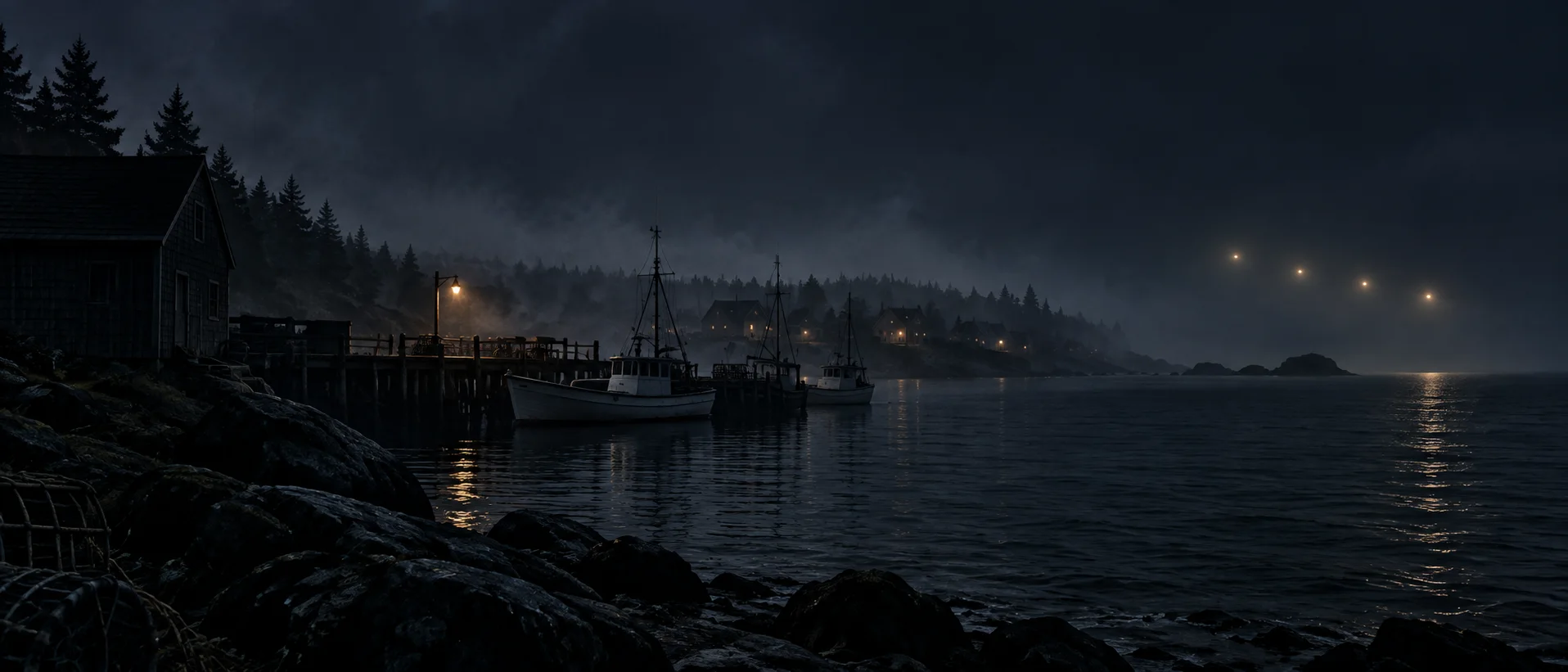
The last light stayed on the water. That is the detail in the Canadian defence record that makes the Shag Harbour report more than a brief flash in the sky. On the night of October 4, 1967, people near this fishing community on Nova Scotia’s southwest coast reported a large, illuminated shape descending toward the sea. After what they described as a bright contact with the water, one light remained visible. A Royal Canadian Mounted Police corporal tried to reach it by boat. Before he could, the light vanished.
The account appears in a contemporary Department of National Defence report and a later departmental summary. Those papers do not establish that a solid craft sank. They establish that an apparent accident was taken seriously enough to bring police, rescue officials, a Coast Guard cutter and naval divers to the harbour. The search found no aircraft and no object that could explain the report.
For the people watching from shore, the first question was immediate: had an aircraft gone down, and was anyone in the water? The second question—what they had actually seen—would outlast the search.
A row of lights
Laurie Wickens was travelling through Shag Harbour with friends when he noticed lights moving over the coast. In a 2017 interview with The Canadian Press, he recalled four lights blinking in a repeating sequence. He and his companions thought they were watching an aircraft descend. Wickens found a telephone and alerted the RCMP. That interview is a witness’s memory fifty years after the event, not a transcript of his 1967 call.
The early defence report gives a more compressed version. It places an RCMP corporal and six other witnesses near Lower Woods Harbour at about 11:45 p.m. on October 4. The report describes an object estimated at more than sixty feet across, with four white lights spaced along it. It says the lights moved east, descended rapidly, and that a bright flash appeared as the object reached the water. Over approximately five minutes, what observers took to be a floating object remained visible and then disappeared.
The distances and size in that message are reported estimates. A row of lights seen at night over open water does not provide a reliable scale by itself. The value of the document lies elsewhere: it shows what authorities understood very soon after the calls, before decades of documentaries and retellings had accumulated around the event. Its language also preserves the distinction between a description and an identification. “UFO report” was an administrative label for a reported flying object that had not been identified; it was not a finding about its origin.
Wickens later described an orange glow at the surface. The early defence reports describe a remaining white light. Those descriptions need not be forced into a precise colour match. The witnesses observed from different positions, and the later account was recorded decades afterward. Both versions support the narrower point that observers believed a light persisted on or near the water after the descent.
The harbour becomes a search area
The first response was a rescue effort. According to the defence report, the Rescue Co-ordination Centre checked whether the sighting could be attributed to an aircraft, flares, floats or another known object. Its preliminary inquiries found no match. That did not prove every ordinary explanation impossible. It meant the responders had no identified aircraft or routine maritime object to attach to a report that looked, initially, like a crash.
The RCMP corporal set out toward the light, but it was gone before he reached the reported position. Local boats also searched. A later account by Wickens describes people gathered at the water’s edge watching a glowing shape offshore. Some later retellings add a broad patch of yellow foam encountered by the boats. Historian Matthew Hayes notes that this striking foam detail comes from subsequent accounts and is absent from the official documentation he examined. No tested sample ties foam to the lights in the material reviewed for this article.
The distinction changes what can be concluded. A patrol or fishing boat looking for survivors shows the seriousness of the call. It does not, by itself, verify a submerged vehicle. A light disappearing before a boat reaches it could mean that something sank; it could also mean the light went out or that its position on the water had been misjudged. The available reports do not provide a measured range, a fixed bearing from each observer, or a recovered object to resolve those possibilities.
The police report moved quickly into military channels. The Department of National Defence message says Maritime Command was asked on October 5 to investigate. It describes an officer and a three-person diving team at the scene, aided by Coast Guard Cutter 101. Hayes, working from the archived telexes, recounts a helicopter carrying the divers and their equipment into the area and a local boat hired to assist them. The assignment was concrete: search the seabed for something that would explain the report.
That made Shag Harbour unusual among UFO cases. Most such reports end with an interview, a form, or a file. Here, the possibility of wreckage offered a near-term test. If an aircraft or other large vehicle had entered the water where the witnesses believed it had, searchers might find debris, a hull, or a trace on the bottom. The operation therefore had an outcome that could be compared with the story that prompted it.
What the divers found
They found no object. Hayes cites an October 8 defence message reporting two days of underwater searching in the likely area under good conditions with no results. A further message recorded continued negative results, and the search was ended on October 9. Those reports establish the failure of the search, though they do not provide a complete public map of every dive track or the sensitivity of the methods used.
Later that month, W. W. Turner of the Department of National Defence summarized the case in a memorandum preserved through Library and Archives Canada. The initial surface search and the underwater search had produced no material evidence by which the identity of the reported object could be established. Turner did not report a recovered craft. The memorandum records an unresolved inquiry after an unsuccessful search.
The paperwork matters because it can be checked against the legend that followed. The Library and Archives Canada catalogue identifies the relevant 1967 file on microfilm reel T-1744. Hayes cites specific DND messages and the October 25 memorandum from that archive. His study also notes a significant gap: despite the RCMP’s role, the officers’ own Shag Harbour files were not present in the surviving archival material he consulted. The public record is therefore strongest on the federal response and search result, thinner on separate, verbatim statements from every person at the shore.
News coverage brought the case to a wider audience while the search was still active. Hayes identifies October 1967 reporting in the Halifax Herald about the divers and official interest. A headline about a possible UFO naturally invited readers to imagine an extraordinary find. But the newsworthy possibility of recovering something and the documented result of the search are separate stages. The first explains the urgency; the second says what investigators could actually show.
What the record establishes
Several people reported unusual lights descending toward the water near Shag Harbour on October 4, 1967. The authorities treated the report as a possible aircraft accident. An early defence message describes four lights, an apparent impact or contact with the water, and a remaining light. Police and maritime responders searched the area. Naval divers searched below the surface. No wreckage or identified object was recovered. This sequence is supported by the contemporary defence paperwork and by Hayes’s archival study.
Other details have different evidentiary weight. Wickens’s 2017 account gives the sighting a human perspective, but it was recorded half a century later. The foam reported in later narratives has no documented sample analysis in the materials reviewed. Claims that a craft travelled underwater to a second site or was secretly recovered go beyond the known search reports; Hayes discusses those later suggestions without finding a recovered object in the archive.
The early report’s preliminary exclusion of aircraft, flares and floats deserves attention, but its scope should remain clear. Rescue staff checked known leads available to them at the time. Their failure to match the lights to a reported aircraft does not independently measure what the witnesses saw. Equally, the absence of wreckage does not erase the calls, the official response or the search. It leaves a real observation report without a demonstrated cause.
There is no basis in this record for saying an extraterrestrial vehicle crashed into the harbour. There is also no established, specific conventional explanation for the entire sequence. A misidentified light, a natural event, or a maritime object would have to account for the witnesses’ reported timing and apparent persistence at the surface. The surviving evidence does not let us test any candidate tightly enough to choose one with confidence.
The Bigger Picture
Shag Harbour illustrates the difference between documenting an investigation and identifying the thing investigated. Its defence file is unusually concrete for a UFO story: it names agencies, describes an immediate search and records a negative result. The search did not turn a report into a recovered craft. It did leave a dated account of how people responded when a light over water looked like an emergency.
Canada’s Sky Canada review places Shag Harbour among the country’s best-known reports and describes a broader problem: UAP records were collected by several agencies for different reasons, with uneven reporting and preservation. Shag Harbour began as a rescue call, passed through police and military channels, and survives mainly in the files those institutions kept. The gaps in that chain matter when later stories claim more than the records show.
The most useful future find would be a complete set of the original police statements, boat logs, dive positions and search notes, with the observers’ locations and times fixed independently. They could tell us whether the reported light truly occupied one point on the water and how thoroughly that point was searched. Until then, the case is best understood as a serious, unsuccessful search prompted by a vivid and still unidentified report—not a documented recovery from the sea.
Sources
- Department of National Defence, early “UFO Report” for Lower Woods Harbour, 1967. Contemporary report reproduced in transcription by the Shag Harbour Incident Society; the original is held in Canadian federal archival files.
- W. W. Turner, Department of National Defence follow-up memorandum, October 25, 1967. Scan and transcription reproduced from Library and Archives Canada; the hosting page gives an approximate date in its title, while Hayes identifies the memorandum as October 25.
- Library and Archives Canada, 1967 file description, RG77, volume 310, microfilm T-1744. Archival location and custody information.
- Matthew Hayes, A History of Canada’s UFO Investigation, 1950–1995, Trent University, 2019, pp. 179–183. Independent historical analysis citing the original DND and NRC files, search messages, and contemporary newspaper coverage.
- The Canadian Press, interview with Laurie Wickens, 2017. Direct witness recollection recorded fifty years after the incident.
- Office of the Chief Science Advisor of Canada, Sky Canada review, 2025. Official context on the case and Canadian UAP reporting practices.