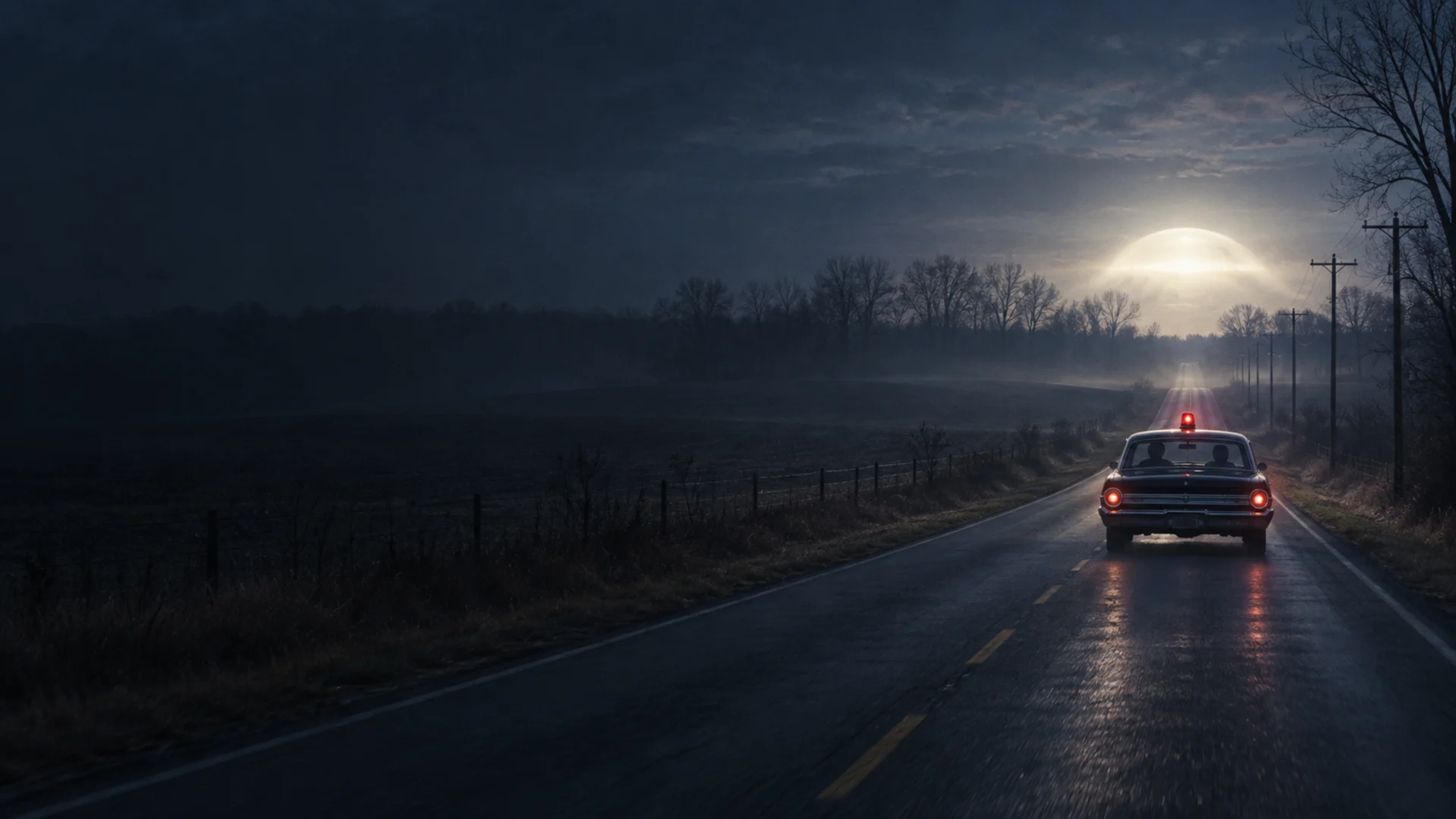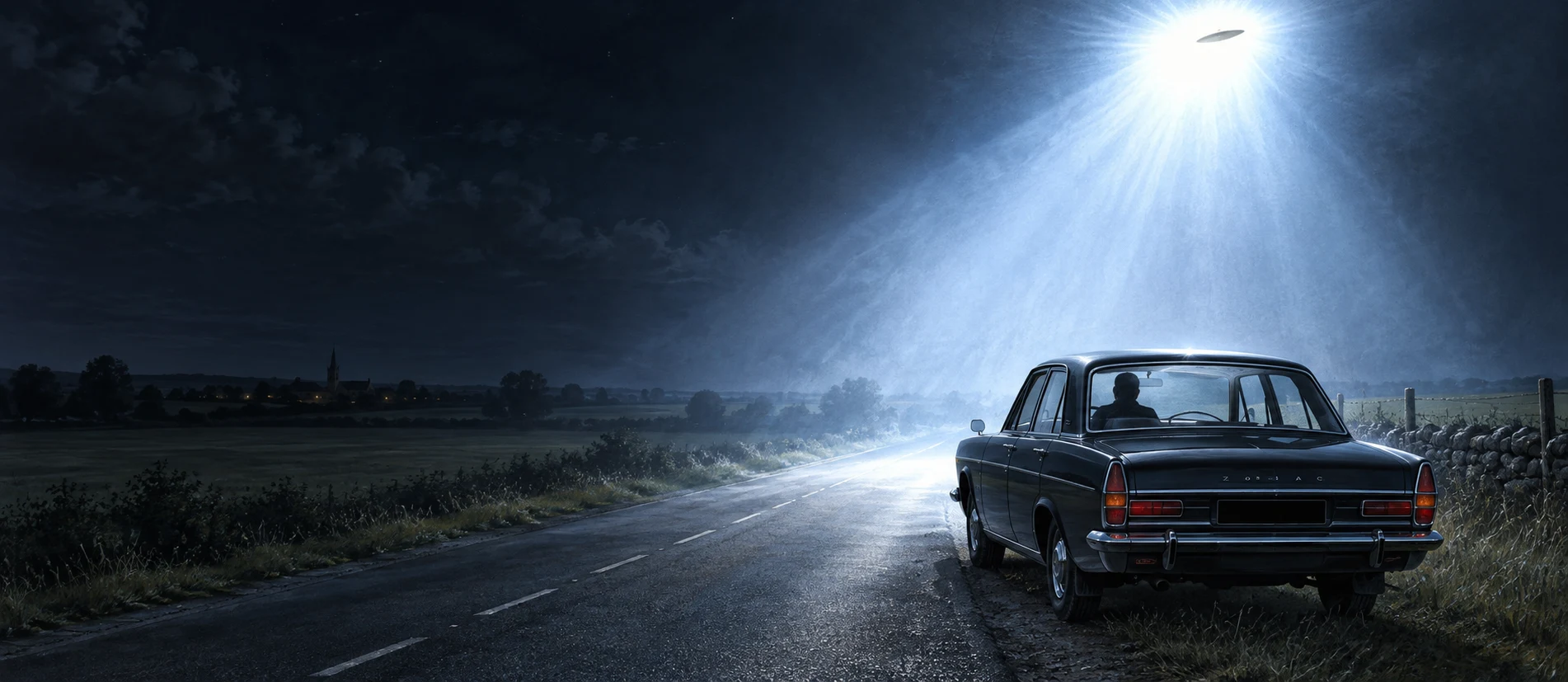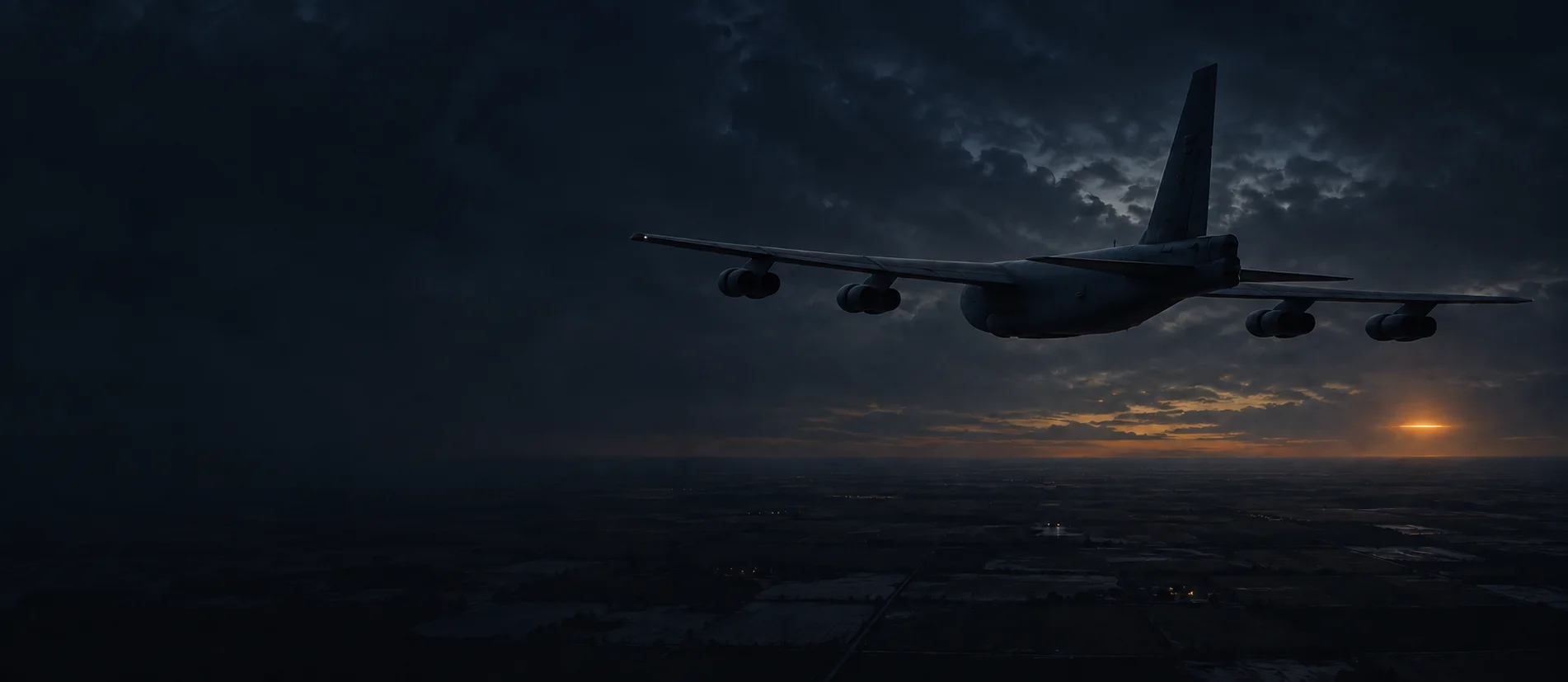
Captain Lawrence Coyne was taking the helicopter down. The red light kept coming.
It had appeared off their right side over Ohio, a distant point that became approaching traffic, then something close enough to threaten the aircraft. Coyne had taken the controls from his copilot. The helicopter descended. There was still ground beneath them, still room to get lower, but the light remained on a course towards their own.
The crew prepared for a collision.
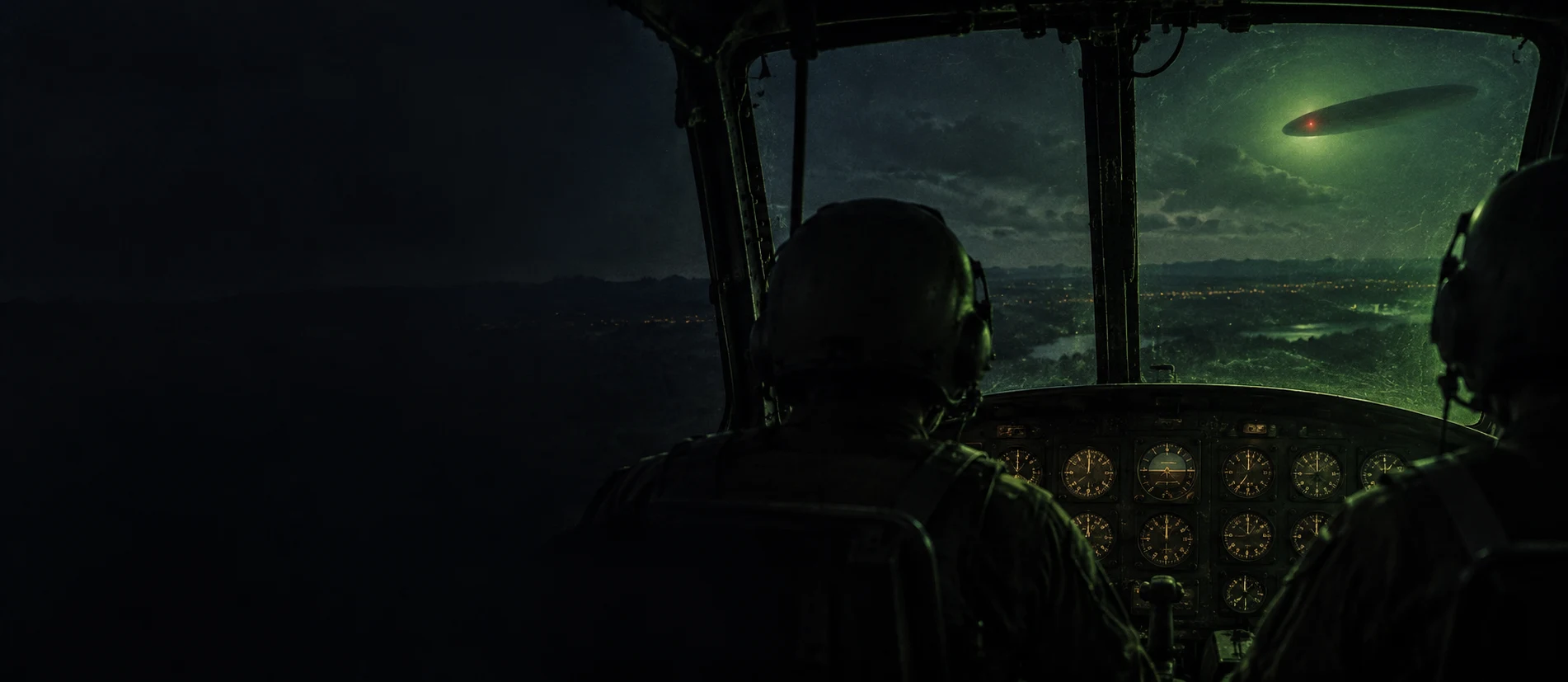
Then, in Coyne’s account, the approaching object stopped just ahead and above the helicopter. A green light swept through the windshield. The cabin changed colour.
And when Coyne looked back at his instruments, the altitude was increasing.
The flight home
The four men had flown to Columbus for their physical examinations. On the evening of October 18, 1973, they were returning to Cleveland in an Army Reserve Huey.
Coyne commanded the medical helicopter unit. Lieutenant Arrigo Jezzi was his copilot. Behind them were crew chief Robert Yanacsek and flight medic John Healey. Their aircraft belonged to a world of proficiency flights, medical duties and the procedures that brought a crew safely back to its base.
The first newspaper account, preserved in the case archive, described a captain with nineteen years of military flying behind him. This was a familiar journey for an experienced aviator: Columbus to Cleveland, with Mansfield along the way.
According to Coyne’s later testimony, they departed around 10:30 p.m. and travelled northeast at 2,500 feet above sea level. The air was clear. Jezzi was flying.
A companion to the east
Yanacsek was on the right side of the helicopter when he noticed the light.
In his 2018 interview with Kevin Randle, he remembered something to their east, apparently travelling north with them. Initially, he thought they were encountering another aircraft. His concern was practical: traffic crossing their course could strike the Huey.
Then the light began coming in.
Decades later, his recollection retained a small, startling detail. He and Coyne had crouched, as though ducking might protect them from what was approaching the rotor. Yanacsek remembered fearing a blade strike. The brightness made the object seem almost on top of them.
The danger was now close enough to shape their movements inside the aircraft.
Down towards the fields
The Army report signed by the crew places the encounter near Mansfield at 11:05 p.m. It records the red light to the east, then its convergence on their flight path.
Coyne took over and initiated a descent from 2,500 feet to 1,700 feet. The direction of escape was downwards. He called Mansfield Tower and asked about high-performance aircraft in the vicinity.
There was an acknowledgement. His question brought no reply.
Descending should have opened a separation. Instead, in the crew’s account, the encounter continued until they expected impact.
That expectation makes the next moment so arresting. The event they had prepared for never arrived. Something else happened in its place.
Across the windshield
Healey moved where he could look between the pilots’ seats and through the front windshield.
His recorded accounts, reproduced in Jennie Zeidman’s investigation, describe the approaching red light becoming larger and brighter. At close range, he could make out an elongated body. Light reflected from its surface. He described something solid, with a red light at the front, green beneath and white at the rear.
From his position, the object filled the view through the forward windows. The approaching point had acquired an outline and a surface.
Healey described a widening cone of green illumination coming from underneath it. The beam was visible ahead of him, opening outward. His attention followed that appearance through the windshield, then the white light as the object moved away.
There is a particular intimacy to this part of the encounter. A crew member changes position to see past the seats. The frame of the windshield becomes the boundary of his observation. Something that had occupied the distant sky now occupies that frame.
Everything turned green
In his 1978 statement before a United Nations committee, Coyne described a grey metallic object immediately ahead and above the Huey. He remembered the green beam swinging into the cockpit, illuminating the cabin and instrument panel.
The light reached the men and the instruments they were using to fly. The encounter had crossed from a sight outside into a condition inside their own aircraft.
Then Coyne checked the altitude.
He had been descending. Now the helicopter was climbing, although he maintained that he had kept the controls set for descent. His testimony described altitude readings passing 3,000 feet and continuing upwards.
The change gave the scene a second direction. Outside, the object was moving away. Inside, the instrument showed the helicopter rising. The pilot who had deliberately taken them towards the ground was now watching the opposite movement register on the panel.
The green illumination and the climb became the two moments around which the encounter would be remembered: something entering the cockpit as light, and something happening to the aircraft’s altitude.
The view from the left seat
Jezzi had occupied the other side of the cockpit. When the first alarm came from the right, his view was different from Coyne’s.
In his February 1974 interview with Hynek and Zeidman, reproduced in the monograph, he remembered Coyne taking the controls and the helicopter dropping. He heard the urgent conversation around him before he obtained his own view of the light.
His most vivid visual memory was an intense white light above and ahead, then moving away towards the horizon. He followed it as it departed. When he returned his attention to the instruments, the helicopter was above 3,000 feet.
His account preserves another angle on the same cockpit: the man who had been flying, the transfer of control, the sudden descent, voices describing something beyond his immediate view, and finally the bright departing light.
The two front seats were only a short distance apart. Yet each gave its occupant a different sequence of sights. Together with the men behind them, they would carry the flight home in four personal memories.
Over the lake country
The close encounter lasted only seconds.
In her 1977 investigation update, Zeidman placed the episode near Charles Mill Lake and described the object’s brief accompaniment of the helicopter. Her reconstruction followed several minutes of observation into that much shorter period of proximity.
She also interviewed a mother and four children who reported watching from the ground. They described a large object near a helicopter, comparing its appearance to a blimp or a school bus. Their vantage point put both shapes above them, within one scene.
The aircraft continued towards Cleveland. Zeidman’s reconstruction describes Coyne returning to his intended altitude and establishing radio contact with Akron-Canton. The remainder of the flight brought them home.
A room in Mansfield
Years later, another recollection would bring the green light into a very different interior.
In September 1988, Zeidman met Jeanne Elias at a UFO exhibition in Mansfield. Her subsequent article recorded what Elias believed she had experienced on the night of the helicopter encounter, fifteen years earlier.
Elias remembered watching the late news in bed. Her husband was asleep. A helicopter sounded so close that she feared it would strike the house, and she put her head beneath her pillow.
Her son John, then fourteen, called from his room. In the recollection given to Zeidman, the helicopter noise had awakened him and his bedroom had become illuminated green.
Elias associated the date with a birthday celebration for her younger son. She connected the experience to the reported flight after reading about it.
The remembered scene ends at a bedroom window, far from the instrument panel of a Huey. A familiar sound overhead, a sudden alarm, a child calling from another room: the account gave the reported light a place within an ordinary household.
The flight becomes a file
The men reached Cleveland, but the encounter continued into reports and interviews.
The Army form records that the flight plan was closed, the FAA Flight Service Station was notified, and the Army Reserve command was informed the following afternoon. All four crew members attested to the written account dated November 23.
Before that document, the story had already reached readers. The Cleveland Plain Dealer published its account on October 21, carrying Coyne’s description and a sketch of the object. The windshield view had become something that could be drawn on paper.
Years afterwards, Coyne would tell the story at the United Nations. The descent, the object ahead, the green cabin and the rising altitude travelled with him into that room.
The aircraft had completed its journey. The encounter had begun another one, passing from the men who experienced it to the people who would preserve and read their accounts.
What Is Known
The contemporary Army report is a signed crew statement about a near midair collision. It records evasive descent, an unanswered traffic enquiry, the object’s departure and a subsequent climb. It establishes what the men formally reported to their command.
The Plain Dealer clipping preserves an early public account. Zeidman’s 1979 CUFOS monograph brings together that reporting, individual crew interviews, drawings and ground-witness testimony. The interviews retain each participant’s position and perspective rather than giving every man an identical view.
The family on the ground was interviewed during the later investigation. The Elias account was recorded in 1988; Yanacsek’s interview with Randle dates to 2018. These are later recollections, identified here by their recording dates.
Coyne addressed the UN Special Political Committee on November 27, 1978, in a private capacity. The official meeting record preserves his testimony; his appearance was not an Army finding about the object’s identity.
The archive gives the encounter a documented history: a reported flight event, contemporary publication, a signed statement and successive firsthand accounts.
The Bigger Picture
The helicopter itself helps explain the human scale of this story.
The US Army’s history of the Huey describes an aircraft used for transport, medical evacuation and troop support. Its versatility made it a central part of military aviation. The Mansfield crew belonged to that practical world, flying an aircraft associated with carrying people and bringing them home.
Their story unfolds within the working spaces of that machine: front seats, a rear cabin, windows, radios and instruments. Each detail has a purpose before the encounter begins. During the encounter, those same details become the means through which something unfamiliar is experienced and remembered.
A side window provides the first warning. A pilot takes the controls. A crew member moves forward for a clearer view. An instrument records a change of altitude. Afterwards, the administrative machinery of flying gives the memory a date, an aircraft number and four names.
That progression is part of the case’s enduring appeal. Readers can follow the men from an ordinary return flight into the brief interval when the view ahead seemed to threaten them, then illuminated their cabin, then vanished towards the horizon.
The green light remains the image at its centre. It is remembered as something that reached beyond the sky outside and entered a place the crew knew intimately. For a few seconds, their familiar aircraft became the setting of an extraordinary story—one they would continue telling long after landing.
Sources
- Crew’s Army report, November 23, 1973, reproduced. Contemporary signed statement.
- Lawrence Coyne’s UN testimony, November 27, 1978. Official meeting record, printed pages 29–36.
- Jennie Zeidman, A Helicopter-UFO Encounter Over Ohio, CUFOS, 1979. Investigation; separate Healey and Jezzi interview records on printed pages 21–35; Plain Dealer clipping in Appendix B.
- Zeidman, “Helicopter Case Update,” November 1977. Investigator’s progress report, page 3.
- Zeidman, “Green light over Mansfield,” November–December 1988. Later household recollection, pages 13–14.
- Robert Yanacsek’s May 29, 2018 interview, published by Kevin Randle in 2025. Later firsthand testimony.
- US Army History Office, history of the Huey, 2024. Independent aviation context.