At first, Robert O’Connor thought a farmer had left a yard light on.
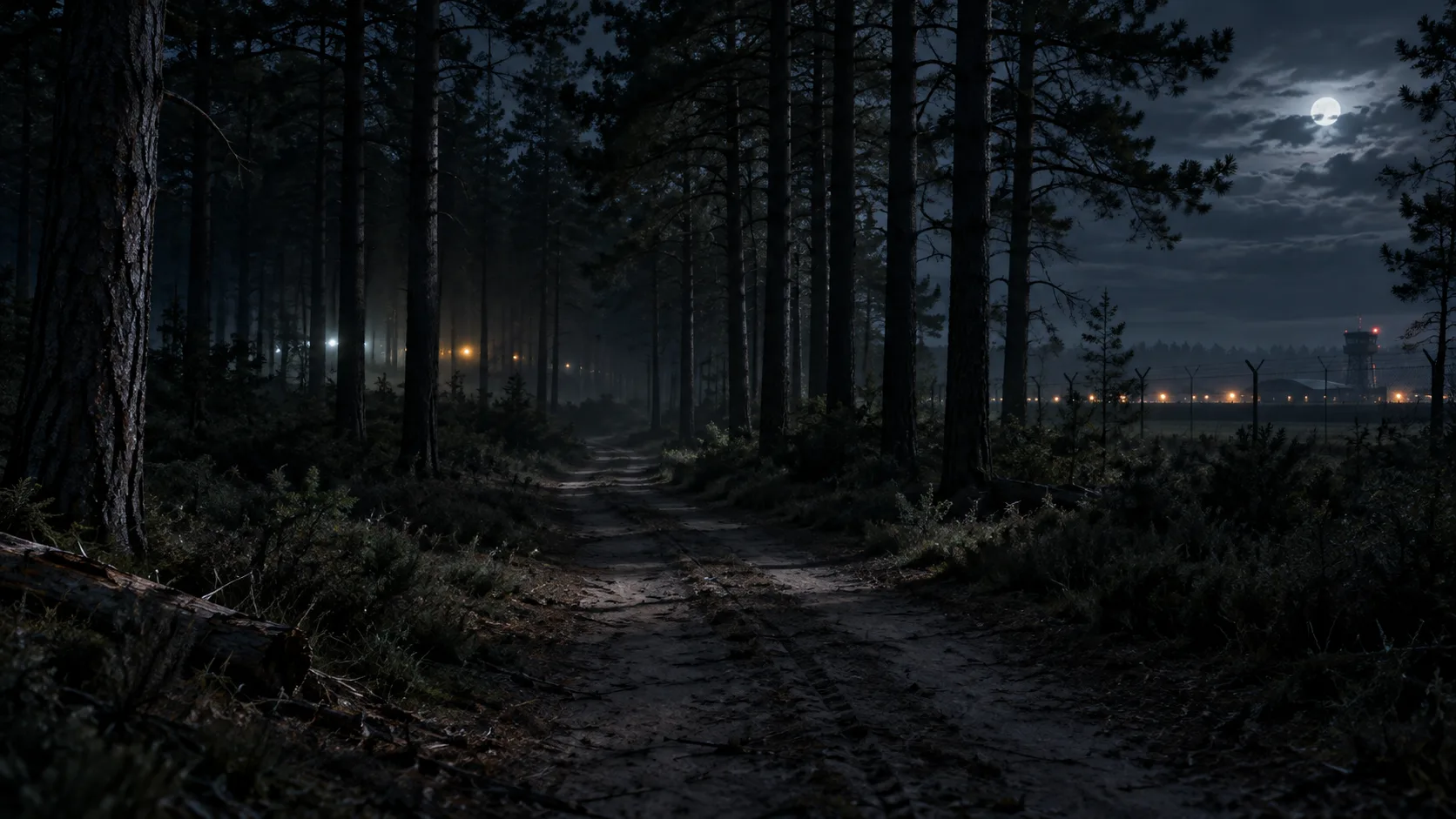
He and Lloyd Isley were travelling towards a missile site on a gravel road outside Minot, North Dakota. It was the early morning of October 24, 1968. Beyond their truck, a light stood out against the darkness.
Then, in O’Connor’s later recollection, the light rose and began moving alongside them.
The truck continued towards November-7. The light stayed with it.
Before the night was over, reports would travel from remote missile posts to the airbase, an unidentified echo would accompany a bomber’s descent, and two pilots would look towards an orange glow close to the ground. The encounter would move through several perspectives: a truck window, a security post, a radar display, and finally the cockpit of a B-52.
The light on the gravel road
O’Connor was an electrician. His work took him between scattered installations, maintaining the systems that kept the missile sites functioning. In his 2005 interview, he described carrying tools, spare parts and standby clothes, following maps between places separated by miles of countryside.
O’Connor remembered it illuminating the ground, then paralleling the vehicle. He took the radio microphone and asked whether any aircraft were operating nearby. The reply he recalled was that there were none in that area.
Isley, interviewed in 2001, described the same unsettling relationship between the truck and the light. It was off to their side, apparently holding their speed. A farmhouse light should have fallen behind as they drove. This one seemed to remain a companion on the road.
Isley maintained air-conditioning equipment; pairing his trade with an electrician was familiar practice. Keeping a missile installation ready involved machinery, power and environmental controls, with calls that could send technicians out late at night. The base wanted to speak to them directly. Their call was passed onwards, drawing the distant light into the communications network that connected the missile field.
Other men were looking south
Elsewhere, the night had already brought a report.
In Thomas Tulien’s reconstruction, a two-man security detachment at Oscar-6 contacted Staff Sergeant William Smith around 2:15 a.m. The men were guarding a site where a targeting team was working underground. They reported a strange light near their position.
Smith looked south from Oscar-1 and saw the phenomenon himself. His statement recorded two days later described burnt orange as its dominant colour, with a slight green tint. He watched it brighten, fade, move and reappear. The description placed him at his own post, looking across the field while other men reported from theirs.
At November-7, O’Connor and Isley stopped outside the gate. Their destination had become an observation point. The light was moving to the south, and Base Operations established an open line through which the men could describe it.
The dispatcher began keeping a timed log. Reports that started with an unexpected sight on a country road were now arriving as positions, movements and colours. Security personnel were sent to join the technicians. Each call added another location to the unfolding night.
Waiting at November-7
The men were accustomed to checking in. As Isley recalled, radio traffic was part of working in the field: people reporting their positions, their tasks, and their status. The strange observation passed through those same channels.
What they watched kept changing its appearance. In Isley’s contemporary questionnaire, preserved in an archival summary, he described lights resembling headlights or landing lights, with a green flashing light farther back. His drawing traced a broad circular course south of the site. At one point he reported two objects in the area.
O’Connor’s account conveyed how exposed the technicians felt. In Tulien’s reconstruction, he remembered Isley retrieving an axe from the truck. They had gone out to work on equipment, and the tools they carried belonged to that job. Watching something unfamiliar nearby gave an ordinary object in the truck a different purpose.
Above the field, another crew was nearing the end of its own working night.
JAG 31
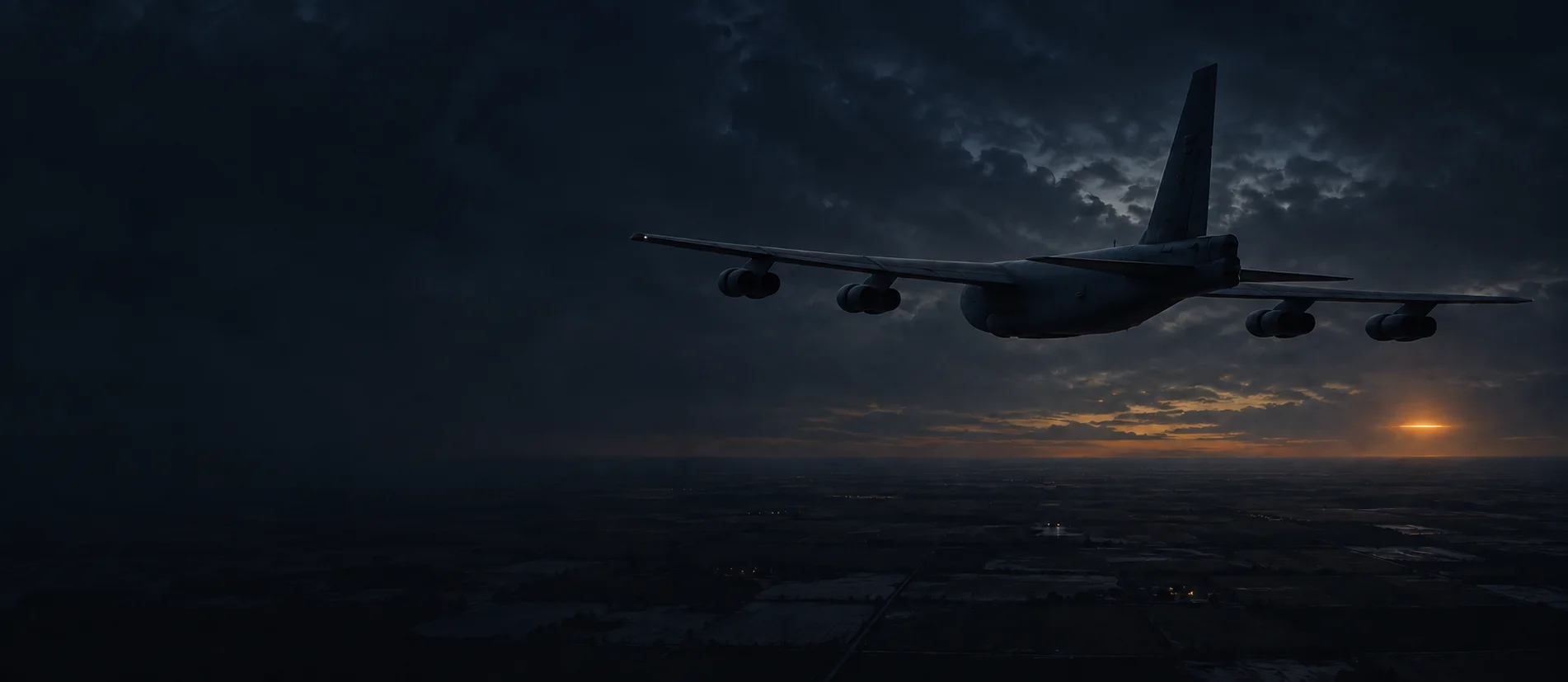
The B-52H had returned from a lengthy training mission. Its call sign was JAG 31.
According to the historical reconstruction, the crew was practising instrument procedures and approaches before landing at Minot. Controllers asked them to watch for orange glows. The bomber flew towards an approach fix northwest of the base at approximately 20,000 feet.
As the aircraft made its turnaround, the navigator observed an unidentified radar return about three miles away. The return maintained that separation through the manoeuvre. The bomber changed heading; the echo remained beside its course.
Then the distance contracted. The reconstruction describes a change from three miles to about one mile between radar sweeps. Captain Patrick McCaslin remembered the abruptness of that shift. The echo was suddenly close, then travelling with the aircraft as it descended towards home.
The unanswered transmissions
The Air Force’s reporting data describes what happened next: a transmission from the bomber was interrupted, and the aircraft could no longer transmit to approach control on either of the requested UHF frequencies.
The receivers still worked.
The crew could hear the controller. Their replies did not reach him. Requests to change frequency came through while the bomber continued descending with the radar echo nearby.
The report places that accompaniment over approximately twenty miles. During the encounter, radarscope photographs were taken, recording the return on the instrument display. The flight was producing a record even as its outgoing communications failed.
Then the echo disappeared. The transmitter became operational again.
The crew had regained contact with the people guiding their approach. Yet the flight was about to bring them back towards the strange light from another direction, at a much lower altitude.
The bomber comes into view
At November-7, the observers were told where and when to expect the approaching aircraft. In the account reconstructed from their reports, the B-52 appeared to the west-southwest while the unfamiliar light had been in the southeast.
Airman Joseph Jablonski described watching the bomber with its landing lights on. He could hear its engines. He also described the other light descending towards the horizon and becoming obstructed by trees before it left that part of their view.
Landing would have closed the flight. Instead, the aircraft went around again.
The orange glow below
In later crew recollections assembled by Tulien, a request was relayed for another circuit to look at the object. McCaslin remembered the pilots agreeing to one more pass before a full-stop landing.
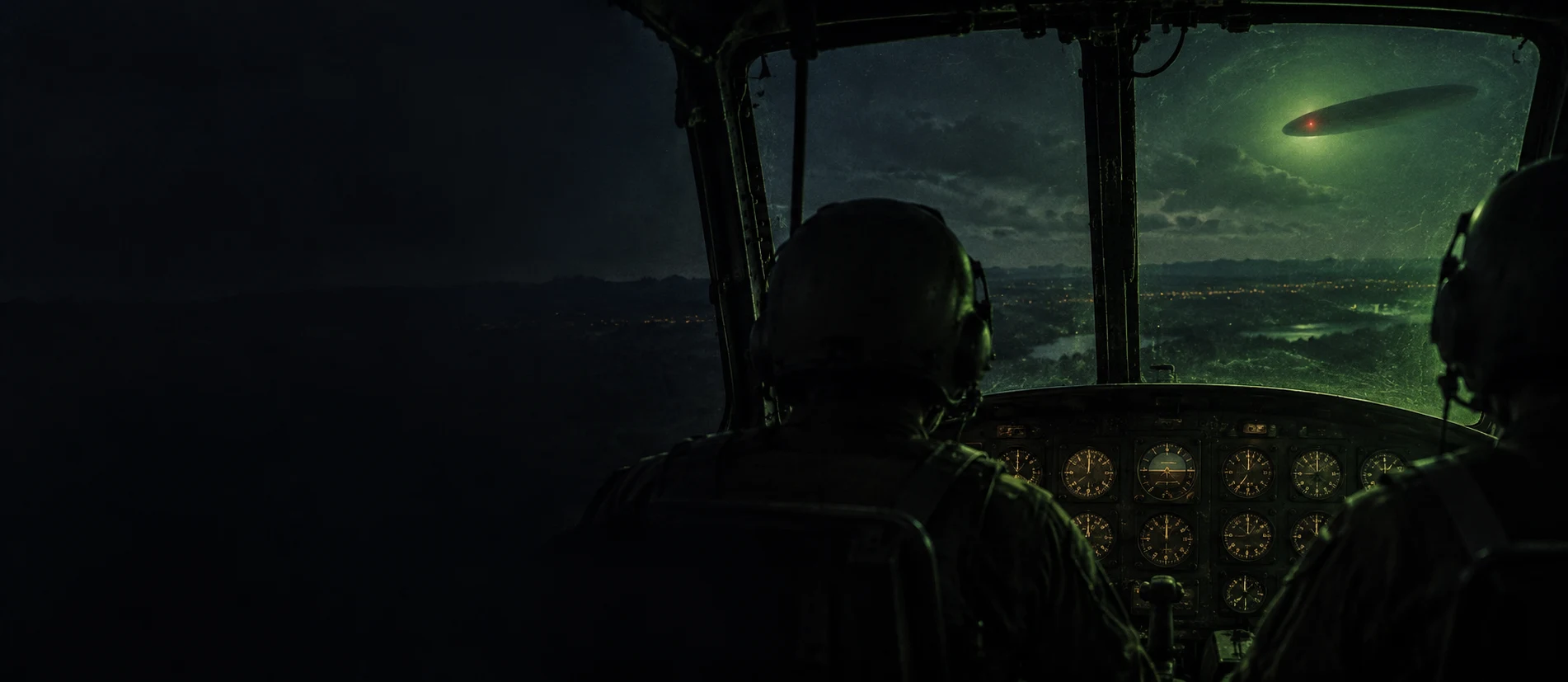
On the circuit, an orange light appeared ahead and below.
Major James Partin’s contemporary description compared it to a small sun on the ground. He reported that it remained stationary as the aircraft approached. The traffic pattern would take the bomber towards it, then bring the light alongside as the pilots turned.
Captain Bradford Runyon was also occupied with the procedures for landing: checklists, fuel settings, the practical demands of bringing the aircraft home. When he looked out, the distant glow had become something close to the side of the bomber.
His 2005 interview described the view in a sequence of details. First, his attention caught a dark rectangular area surrounded by dull red. Then, as they flew along it, he saw a metallic cylinder extending from the body.
Beyond the cylinder was a crescent-shaped section. Its light illuminated the connecting structure and the nearby ground. Runyon remembered distinct outlines, an appearance at once solid and almost translucent, and a glow bright enough to pick out features below.
The bomber began its turn over the end of the object. For several seconds, the aircraft’s motion carried his view along the structure and around it. The remembered scene was no longer simply an orange point ahead. It had surfaces, adjoining parts and light falling across them.
Runyon also recalled another interruption to his transmissions during the close pass. After turning back towards the runway, communications returned.
The night outlasts the flight
JAG 31 landed around 4:40 a.m.
In the final sequence reconstructed from the dispatch log and witness accounts, observers reported a light west of November-7. Orange became white, then green. It disappeared, returned, and remained stationary before another report placed it farther along.
Jablonski and Airman Gregory Adams were travelling back towards their control facility when their attention was caught again. They described the light in the west-southwest, changing colour until the green diminished from view. Staff Sergeant James Bond also reported a gradual fading.
The morning’s activity ended in stages: the bomber on the ground, the technicians returning to their tasks, the security team heading back, and a final light dwindling in the distance.
For more than three hours, the night had brought people at different posts into the same unfolding story. Its most arresting moments remained separate but connected by the communications that passed between them: a light keeping pace with a truck, an echo beside a descending bomber, and an orange glow becoming a strange structure beneath a cockpit window.
What Is Known
The Minot case has several distinct kinds of record. The October 1968 Air Force reporting data documents ground observations, an airborne radar return, interruptions to UHF transmission, and a later visual observation from the aircraft. Radarscope photographs preserve the instrument display during the encounter.
The ground witnesses completed sighting questionnaires. These record their descriptions and drawings in the days following the event. Their accounts locate the observations within the duties and positions of maintenance and security personnel.
The detailed passages about experiences inside the bomber also draw on later oral histories. The Sign Oral History Project began interviewing participants in 2000 and assembled testimony from aircrew, maintenance personnel, security staff and officers. The dates of those interviews identify when each recollection was recorded. Runyon’s detailed structural description belongs to this later testimony; Partin’s orange-light description appears in the contemporary record.
Taken together, these materials preserve a military encounter through both operational documentation and personal accounts. They give the story a sequence that can be followed from the field to the aircraft and back to the ground. They establish what was reported and recorded, while the identity of the phenomenon remains an open historical question.
The Bigger Picture
Minot’s setting gives the encounter an unusual character. Its witnesses were working within a landscape organised around readiness: remote sites, maintenance calls, security teams and aircraft following prescribed procedures.
The National Park Service’s account of the preserved Delta-01 installation in South Dakota explains the wider Minuteman system. Two missileers monitored ten missiles from an underground control centre. Above them, support personnel maintained the facility and coordinated security. That preserved site helps illustrate the working world in which a distant light could become a report passed from one duty station to another.
At Minot, those procedures also became the means of preserving an extraordinary night. Men called in what they saw. A dispatcher logged developments. Controllers spoke to an aircraft. A camera recorded a radar display. Years later, interviews added the participants’ perspectives to the written sequence.
The resulting case allows readers to move between the experience of an encounter and the records it generated. The fascination lies in that movement: each new viewpoint brings the phenomenon closer, from a light across the countryside to something beside the aircraft, then below it.
The B-52 reached its runway. The light entered the archive. Decades later, the night can still be followed, one report at a time.
Sources
- USAF, Basic Reporting Data, October 1968. Contemporary operational report, reproduced in the case archive.
- Robert O’Connor, interview, February 23, 2005. Later firsthand recollection.
- Lloyd Isley, interview, August 23, 2001. Later firsthand recollection.
- Bradford Runyon, interview, February 25, 2005. Later firsthand recollection.
- William Smith’s AF-117, archival summary. Summary of his October 26, 1968 statement.
- Lloyd Isley’s AF-117, archival summary. Summary of his October 28, 1968 statement.
- Thomas Tulien, introduction and flight sequence. Historical reconstruction with documentary references.
- Tulien, initial ground observations. Historical reconstruction.
- Tulien, ground observers and the bomber. Historical reconstruction drawing on witness reports.
- Tulien, air-visual observations. Contemporary descriptions and later crew testimony.
- Tulien, final ground observations. Dispatch-log sequence and witness accounts.
- Sign Oral History Project, interview collection. Research history and dated testimony index.
- National Park Service, Delta-01 Launch Control Facility. Independent historical context for Minuteman operations.