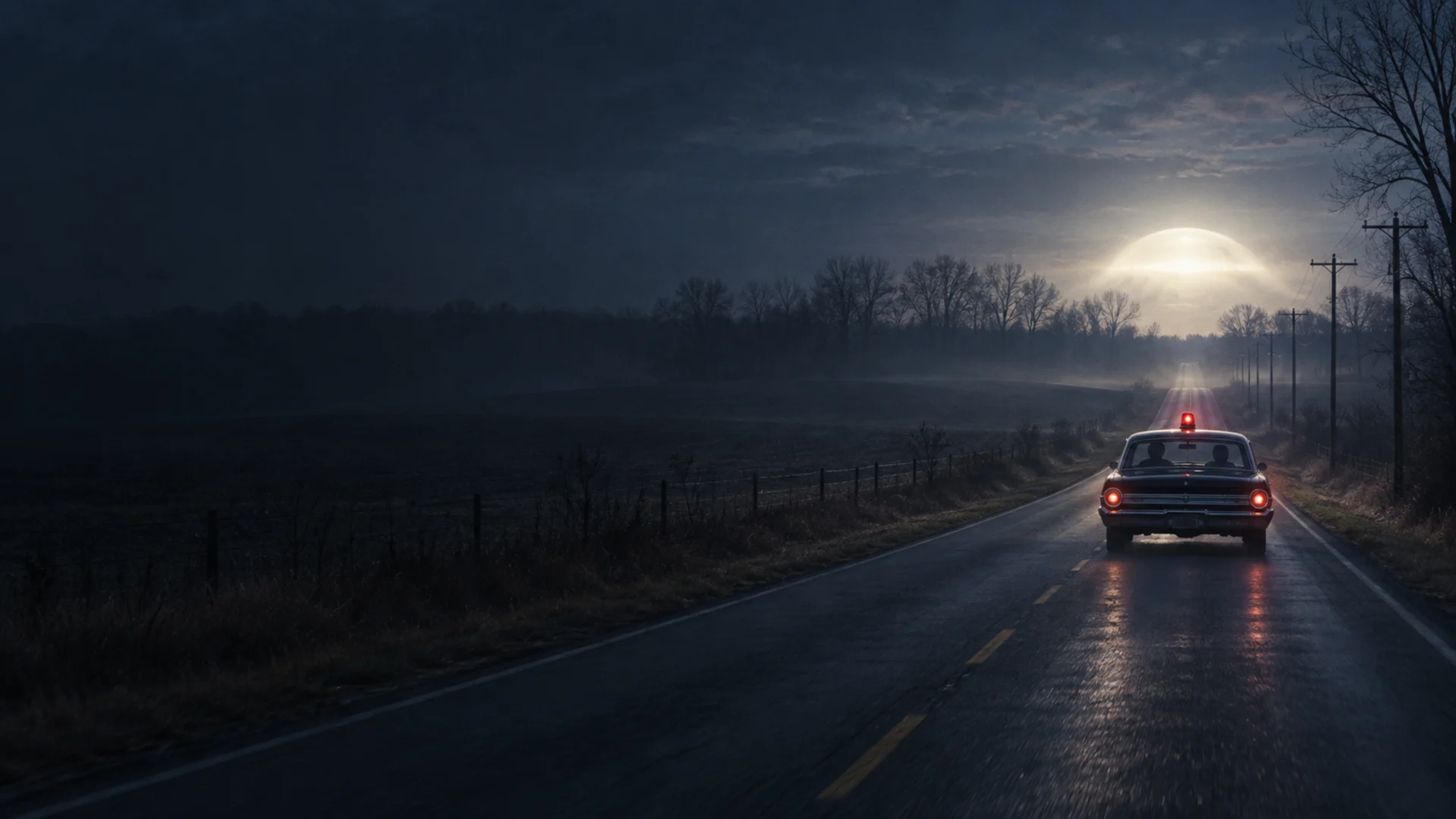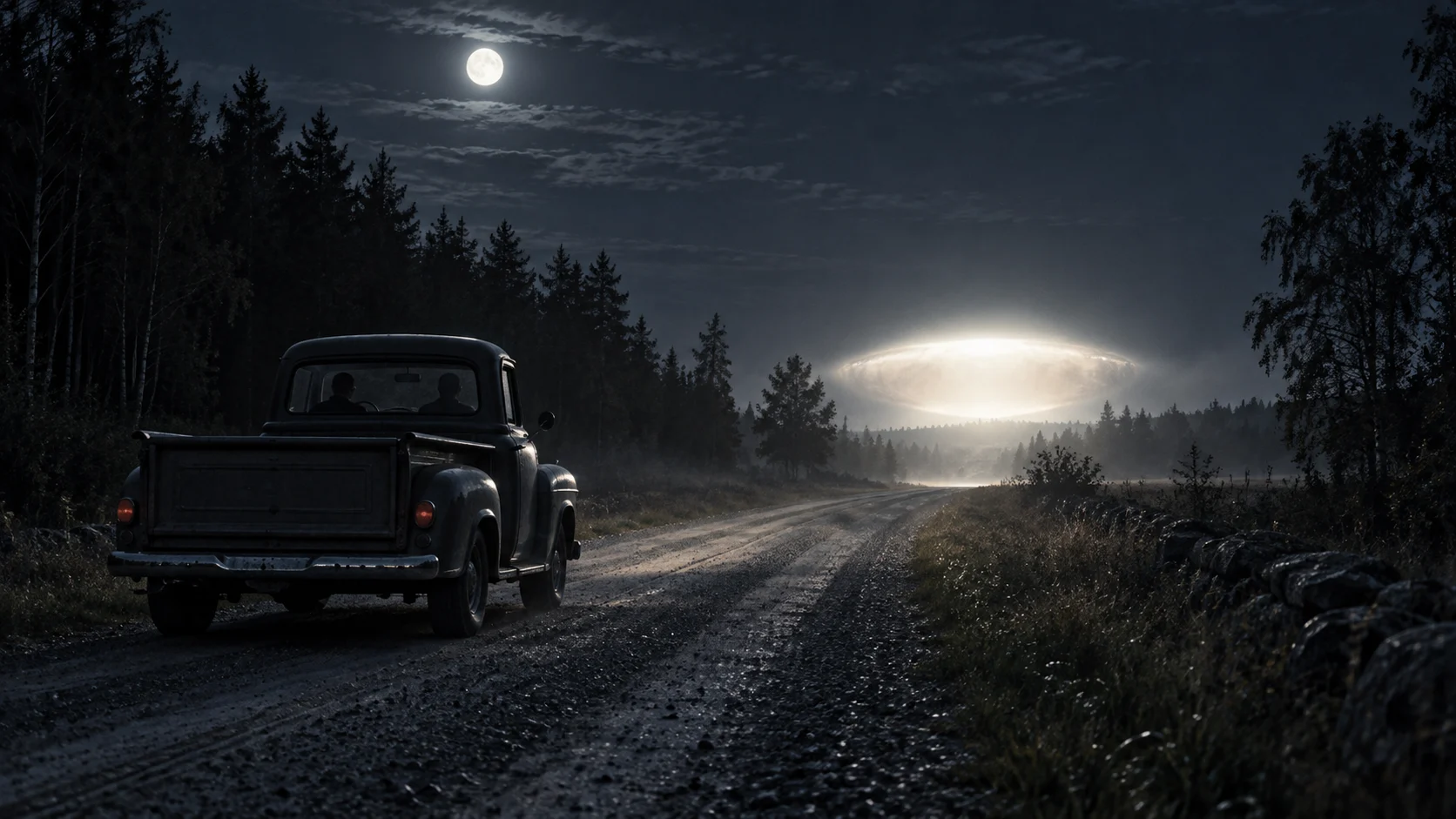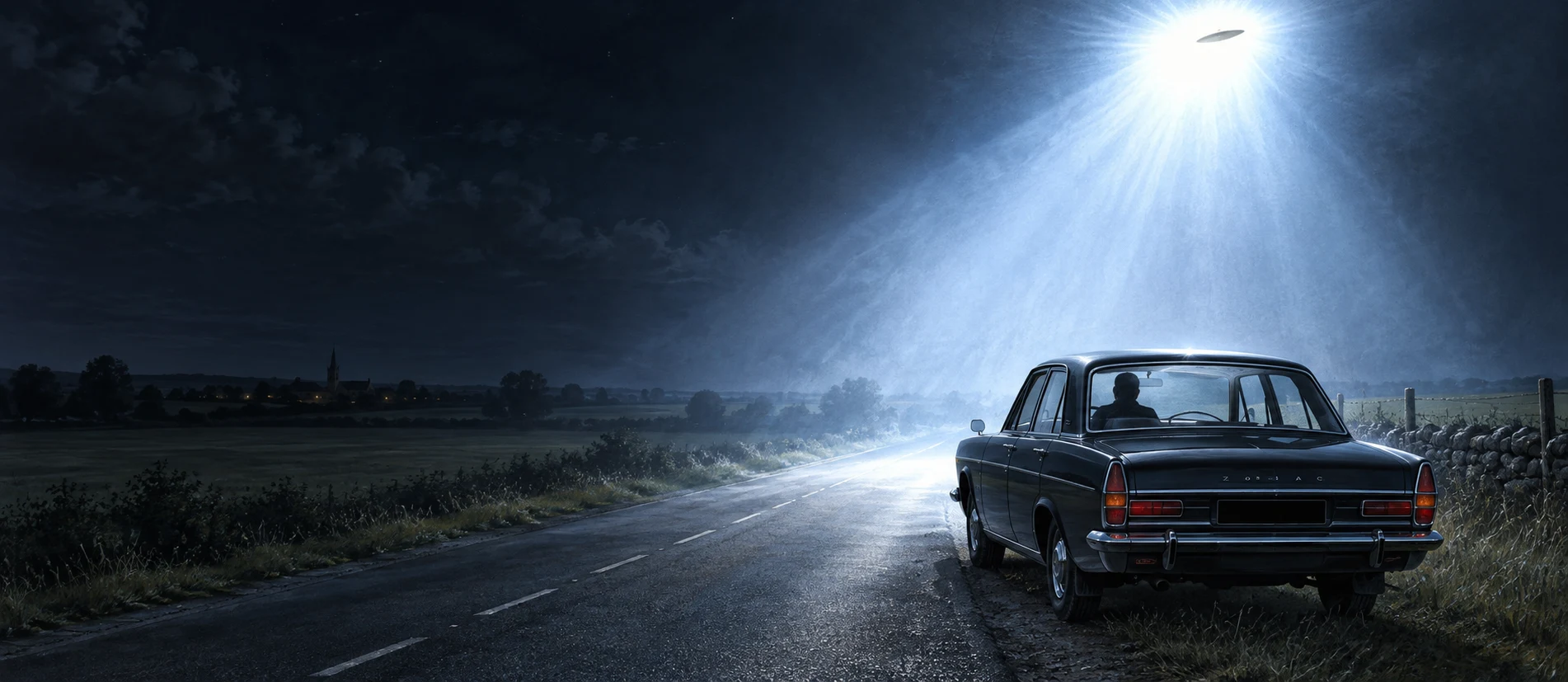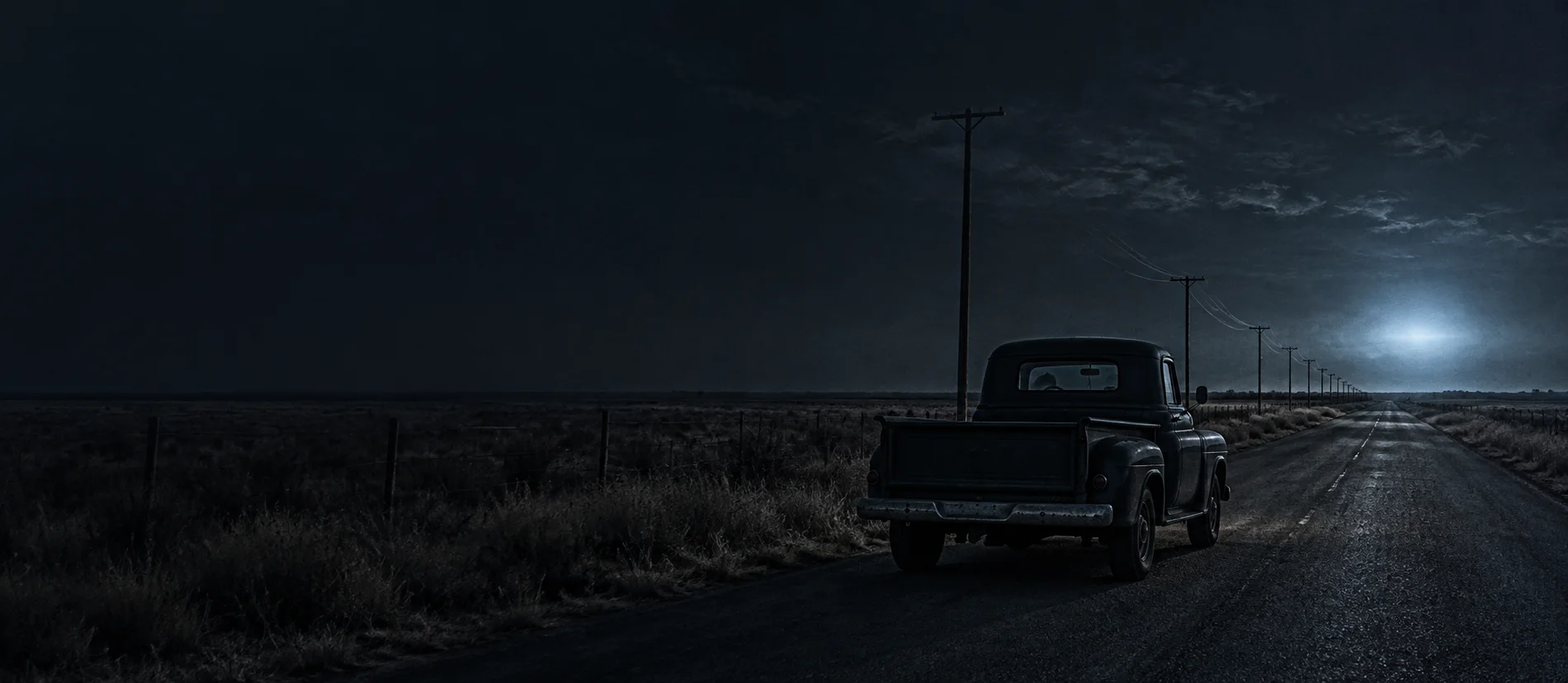
The strange part was what happened after the light went away.
Drivers around Levelland said their vehicles worked again. Headlights returned. Engines could be restarted. Whatever had interrupted their journeys appeared to have left with the object they had seen.
That sequence made the night of November 2–3, 1957, a lasting UFO case. A light alone could be misjudged. A stalled vehicle alone could be ordinary trouble. The reported connection between them demanded an explanation for both.
The accounts reached police from different roads around a small Texas town. They survive through official summaries, press reports and later compilations, with uneven detail and competing interpretations. The Air Force’s own briefing acknowledged the reported electrical disturbances. It gave them a terrestrial explanation that other investigators would spend years challenging.
The truck west of town
Pedro Saucedo and Joe Salaz were travelling west of Levelland when Saucedo reported a flash beside the road. In the retrospective NICAP case directory, the encounter is placed about four miles from town, at roughly 10:50 p.m.
The light became something much larger in his account: a blue, elongated object rising from a field and moving toward the truck. Saucedo described a torpedo shape, yellow flame and white smoke, then a passage overhead accompanied by noise, heat and a rush of air. His estimate of its length was about 200 feet.
During the encounter, he said, the engine died and the headlights went out. After the object disappeared toward Levelland, the lights returned and the engine could be started.
Those dimensions and sensations belong to the reported experience. They were not instrument readings. The directory assembles earlier published accounts; it is a route into the case, rather than an additional witness to the roadside event.
But the reported loss and recovery were concrete enough to convey the problem. Saucedo had reached a telephone. Back in Levelland, patrolman A. J. Fowler received a story that was about to become part of a much larger night.
More roads, more calls
Walter N. Webb’s chronology in NICAP’s 1964 The UFO Evidence describes Fowler’s initial skepticism, followed by further reports around midnight.
Jim Wheeler was said to have encountered a brilliantly illuminated, egg-shaped object on the road east of town. As he approached, his engine and lights failed. When he began to leave the car, the object rose; the lights returned. Jose Alvarez reportedly described a similar interruption north of Levelland.
At about 12:15 a.m., Frank Williams supplied a particularly unusual variation. His account associated a pulsating light with repeated changes in his own headlights: when the object’s light came on, his lights went out. After it departed, the car functioned normally.
Webb assembled ten similar sightings within less than three hours and a radius of about twenty miles. That is the scope of his compilation, not a count of ten independently measured electrical events.
The sequence nevertheless changed the shape of the problem. Fowler was receiving reports from motorists who described the road ahead of them becoming impassable, their transport failing, and movement becoming possible again only after the obstruction left.
Under the hood
One account began with the car rather than the sky.
In Hynek’s later discussion, Newell Wright’s statement describes checking beneath the hood before noticing a bluish-green object ahead. He said the car became operable after it departed.
Wright reported it the following day at his parents’ urging. The order of reported encounters therefore differs from the order in which police learned about them.
The account is unsettling because it moves through familiar actions. A motorist investigates a fault. The expected explanation is somewhere beneath the hood. Then, according to his statement, he looks toward the road and finds something for which the car offers no explanation.
An apparent recovery would leave an investigator with a difficult task. A permanently damaged component could be examined. A vehicle that worked normally afterward offered fewer opportunities to establish what had stopped it, or whether the nearby light had caused the failure.
A sheriff’s shorter glimpse
The press record carried a broader picture than any one driver’s statement. Contemporary newspaper extracts preserved by NICAP reported at least five instances of stalled engines and quoted Fowler describing excited callers and a large, illuminated, egg-like object.
Sheriff Weir Clem said he had seen a brilliant light, although he had not obtained a close view. His observation mattered because police had gone out in response to the reports. It also needed to retain its smaller scope.
Hynek’s account describes Clem and deputy Pat McCulloch seeing a brief light across the highway at about 1:30 a.m. Their patrol car did not suffer the failures described by motorists. That distinction appears in his reconstruction.
The sheriff could support the existence of an unusual visual observation without independently confirming a road-sized object or a mechanism that stopped engines. Merging his glimpse with the drivers’ closer encounters would make the evidence sound stronger and more uniform than the accounts allow.
By the end of the sequence, there was no single observer who could explain the whole night. The case had to be assembled from people who had seen different things, for different lengths of time, from different places.
The official answer
The Air Force’s briefing summary compressed the reports into a smaller set of witnesses. It described round or oval lights of varying colours and reported vehicle electrical disturbances. Its proposed cause was ball lightning.
Weather was central to that explanation. The summary described low cloud, reduced visibility, drizzle or light rain, and earlier thunderstorms. It suggested moisture affecting ignition equipment and electrical conditions associated with the luminous phenomenon.
This was an official assessment. It was not a recording of a luminous ball interacting with a truck, nor an experimental demonstration of the reported sequence.
Even so, it supplied an answer of a recognisable kind: unusual atmospheric conditions, a rare light phenomenon, and vulnerable vehicle equipment. The night could be closed administratively without an unknown aircraft being identified.
For critics, the difficult part was the recovery. If water had caused an ignition failure, why did the engine become restartable when the light departed? If the proposed phenomenon explained the light, what established its connection to the headlights? Those are questions about the fit of the explanation, separate from questions about an object’s origin.
The case returns to Washington
In his prepared statement for the 1968 congressional UFO symposium, atmospheric physicist James E. McDonald used Levelland as an example of reported vehicle interference.
He challenged the weather premise. He said his examination of weather data had found no nearby thunderstorms or rain sufficient to wet ignition systems, and that interviews with Clem and a local newspaperman supported that objection.
McDonald also stated that he had not located the drivers. His criticism therefore combined his own later inquiries with the inherited encounter record. It did not amount to a new round of interviews with every motorist.
Hynek, the Air Force’s astronomical adviser, subsequently reconsidered his concurrence with the explanation. In his 1972 book, he described having accepted the storm premise hastily while occupied with satellite tracking. His later position made Levelland an argument within the history of the investigation itself, as well as a story about Texas roads.
The two scientists questioned whether the official answer had been earned. Neither criticism, by itself, identified what the motorists had encountered.
What the record establishes
Levelland has a substantial record of reports, but the record is uneven. The press preserves what police said callers had told them. Later writers organise those reports into a coherent sequence. The Air Force summary establishes its own assessment and the premises used to reach it. McDonald’s statement establishes the scope of his later challenge.
These are different kinds of evidence. Repetition across reports warrants attention, especially where the same unusual sequence appears. It does not turn estimated lengths into surveyed dimensions, reported engine failures into recorded electrical measurements, or several glowing shapes into one tracked object.
The unresolved issue is causal. A driver may accurately report a stalled engine and an unusual light while still being unable to establish why the engine stalled. To demonstrate interference, an investigator would want the vehicle’s condition, exact timing, distance, environmental data and a measurable mechanism. The sources used here do not provide that combination.
The weather dispute should remain attributed. McDonald and Hynek challenged the storm account; this article has not independently reproduced their meteorological analysis. Accepting their objection would weaken a particular explanation. It would leave the identity of the lights open.
The National Archives’ Blue Book guide describes the surviving investigation records and the program’s overall conclusions. That collection provides a way to inspect how cases were handled. A file’s classification is one piece of its history; its supporting documents determine how much confidence the classification deserves.
The Bigger Picture
Ball lightning offers a useful comparison because it can be investigated with instruments. A 2014 Physical Review Letters paper by Jianyong Cen, Ping Yuan and Simin Xue reported an observation during a thunderstorm in China using spectrographs. The recorded luminous event lasted 1.64 seconds, and its spectrum included elements associated with soil.
That observation cannot settle a night in Texas decades earlier. It shows what becomes possible when an unusual light leaves timed, analysable data: researchers can ask about composition and development rather than relying entirely on remembered appearance.
For a future Levelland-like report, the most valuable evidence might be ordinary equipment working together: a dashboard recording, a precise location, weather observations, and a prompt mechanical examination. Agreement between those records could test whether light and vehicle failure shared a cause.
Levelland remains compelling because the claimed effect was temporary. The vehicles carried their drivers onward, while the interruption became a story. What would advance the case is a record of that interruption detailed enough to explain how it happened.
Sources
- U.S. Air Force, “Levelland, Texas ‘Blue Light’ Case.” Official briefing summary; records the atmospheric explanation.
- NICAP, Challenge of UFOs, Appendix E. Reproduced contemporary press extracts and vehicle-interference compilation.
- NICAP, Saucedo case directory. Retrospective synthesis and document index.
- Walter N. Webb, The UFO Evidence, Section XII, 1964. Civilian reconstruction of the night’s reports.
- J. Allen Hynek, The UFO Experience, 1972. Later account, reproduced statements and reconsideration of his assessment.
- James E. McDonald, 1968 congressional symposium statement. Direct account of his later inquiries and criticism.
- National Archives, Project Blue Book records guide. Archival and institutional context.
- Cen, Yuan and Xue, “Observation of the Optical and Spectral Characteristics of Ball Lightning,” 2014. Independent instrument-based research on a different event.