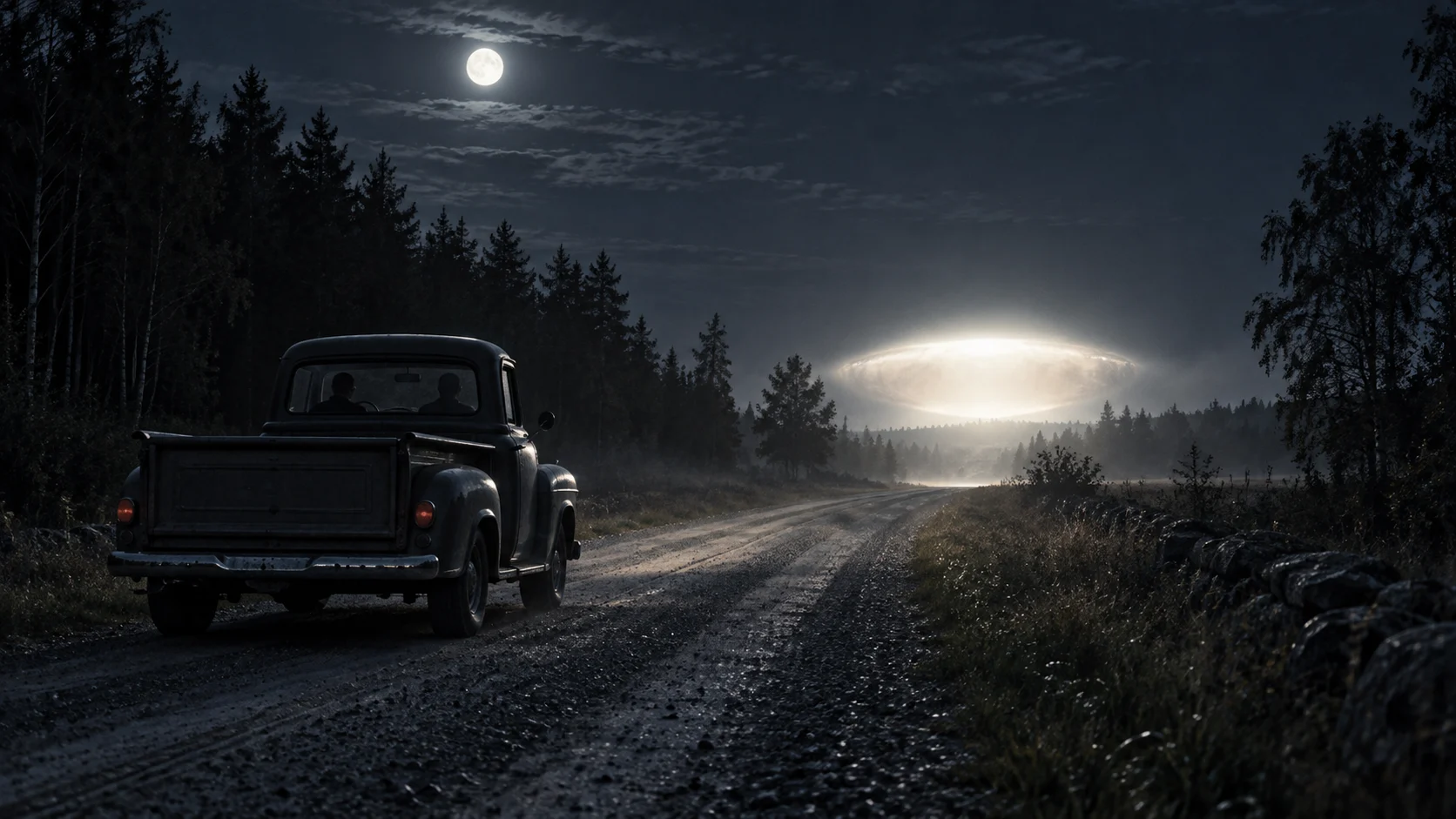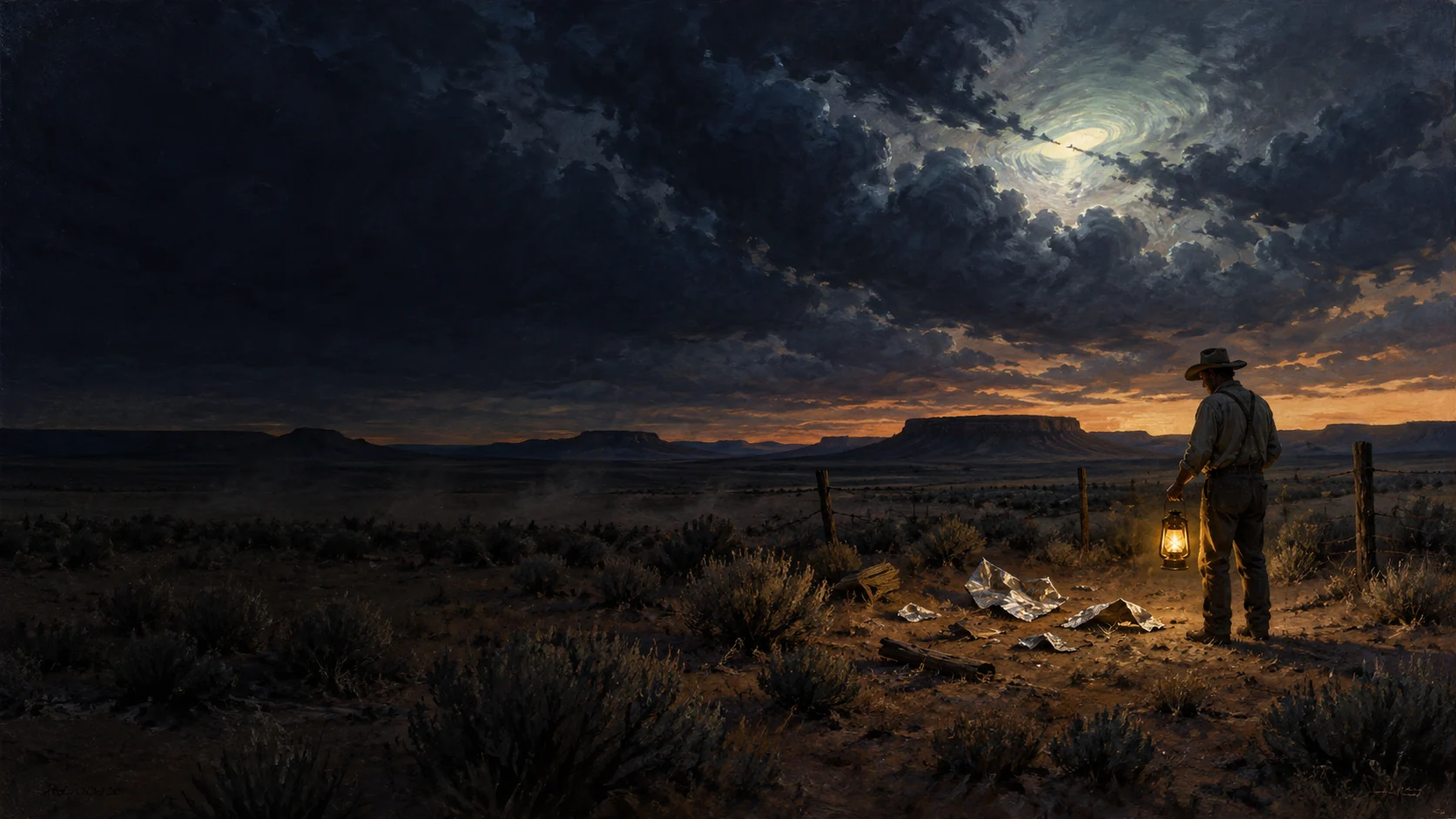
William “Mac” Brazel and his young son were out on the ranch when they came upon the wreckage.
Bright scraps lay across the ground: strips of rubber, foil, tough paper and slender sticks. Whatever had brought them there had come apart, leaving pieces spread over a patch of New Mexico ranch country.
Brazel would later tell a reporter that he first noticed the material on June 14, 1947. For a while, it remained where he had found it.
Then he returned and gathered some of the pieces.
Within days of carrying them into Roswell, Brazel’s discovery would pass through a sheriff’s office, an Army intelligence officer’s hands and a military airfield. An announcement would leave the base saying that the Army had obtained a flying disk.
For a few hours, a rancher’s find would become the country’s most extraordinary news.
The fragments near Corona
Brazel worked the Foster ranch in Lincoln County, near Corona, northwest of Roswell. In the July 9 newspaper account reproduced in the Air Force’s Roswell report, he described coming upon the debris with his eight-year-old son, Vernon, several miles from the ranch house.
He remembered a scattered area roughly two hundred yards across. The rubber was smoky grey. The bright material and sticks lay among it, parts of something that had reached the ground and broken into pieces.
On July 4, according to that account, Brazel returned with his wife and children to collect some of it. Gathered together, the fragments made small bundles. The foil, paper, tape and sticks could be packed into a narrow parcel a few feet long; the rubber formed another.
The family could pick up the pieces and carry them home. The whole collection, Brazel estimated, weighed only a few pounds.
At that stage, the material belonged to the small world of the ranch: a find on the land, collected by the people who lived and worked there. The name that would send it far beyond that world was already circulating elsewhere.
A word reaches the ranch
Flying disks were being reported across the country.
During the closing days of June and the beginning of July, newspaper stories brought accounts of strange objects to readers who had never seen one themselves. Reports travelled between towns and states, carrying descriptions, guesses and a new expression that seemed to fit something unfamiliar in the sky.
Brazel heard about the disks after collecting the wreckage. He began to consider whether the pieces he had found might belong to one of them.
That possibility gave him a reason to take the discovery beyond the ranch. On July 7, in the sequence he related to the newspaper, he went to Roswell and approached Sheriff George Wilcox.
The sheriff could bring someone else into the story. Wilcox contacted Roswell Army Air Field, where the intelligence office of the 509th Bombardment Group became involved.
The fragments were about to acquire a military escort.
The intelligence officer
Major Jesse Marcel went to the ranch.
Brazel’s contemporary account describes Marcel and a man in civilian clothes accompanying him to collect the remaining pieces. The Army had moved from hearing about the material to sending personnel out to the place where it lay.
For Marcel, the discovery became a task that took him away from the airfield and into the countryside. He would see the scattered material, gather it and bring it back through the military organisation in which he served.
Years afterwards, he remembered that journey in more detail. In Bob Pratt’s December 1979 interview, Marcel described going out with counterintelligence officer Sheridan Cavitt and spending the night at the ranch before examining the area.
He recalled lightweight fragments and small structural pieces with markings. He said the material had resisted attempts to burn or damage it, and that he had been unable to identify it. Those were the properties that remained central to his later account: pieces light enough to carry, yet behaving in ways he remembered as unfamiliar.
His son would remember some of the material reaching their home.
On the kitchen floor
His son remembered seeing it there.
Jesse Marcel Jr. was eleven in 1947. In a videotaped interview recorded on September 13, 1998, he described material his father had brought home from the ranch. Among it was a slender fragment with a cross-section resembling a capital I.
He remembered it as very light and metallic-looking, with unfamiliar symbols along one surface. As a boy who built model aircraft, he had handled balsa wood. The remembered piece looked different to him.
His account places a private moment inside the military recovery: a father bringing something home, a child looking at it on the kitchen floor, and one small piece retaining its shape and markings in memory long afterwards.
At the airfield, the collection would enter a different setting. It would be examined by officers, passed along the chain of command and described to the public in a statement that moved much faster than the material itself.
The airfield speaks
On July 8, Lieutenant Walter Haut, the base’s public information officer, issued the announcement.
The intelligence office of the 509th, it said, had obtained a disk through the cooperation of a local rancher and the Chaves County sheriff’s office. Personnel had collected the object, examined it at Roswell and sent it to higher headquarters.
The statement gave the recovery a beginning, a route and an institutional voice. It connected the ranch, the sheriff and the airfield in a few sentences. At the centre of those sentences was the word that readers had been encountering for days.
Now an Army base was saying it possessed one.
The contemporary press chronology assembled by the National Archives follows the announcement into newspaper coverage. In Roswell, the Daily Record put the recovery across its front page. Wire reports carried the claim outward.
The object had been found in remote ranch country. Its reported identity was now reaching people hundreds and thousands of miles away, attached to the name of a military unit.
A room in Fort Worth
The material went to Fort Worth, Texas, headquarters of the Eighth Air Force.
Brigadier General Roger Ramey became the officer presenting the next account. The setting changed from the ranch and the Roswell airfield to his office, where scraps of material were displayed and photographs were taken.
Marcel appears in those photographs, crouched beside fragments spread across the floor. Foil-like sheeting and thin broken members are visible around him. The intelligence officer who had gone out to the ranch was now part of the public image of the recovery.
Ramey described a weather balloon and radar target. The explanation reached the press on the same day as the flying-disk announcement.
The news had changed within hours. Roswell’s first statement and Fort Worth’s description were now travelling through the same newspaper system, one following the other. Readers who had encountered the extraordinary announcement would meet a new account of what the Army had recovered.
Back in New Mexico, the man who had found the pieces would have his own turn to speak.
Brazel tells his story
On July 9, the Roswell Daily Record published an interview with Brazel.
He described the June discovery, the return with his family and the trip to the sheriff. He gave the fragments their colours, sizes and approximate weight. He recalled tape and markings, and explained how the pieces had looked when gathered together.
He also said he had found weather balloons on the ranch before and did not consider this material the same as those earlier finds.
The interview brought the story back to a person who had handled the discovery before it became a military announcement. The distances were measured against ranch landmarks; the bundles against familiar objects. Brazel was describing something he and his family had picked up from the ground.
By then, his account was sharing newspaper space with the correction from Fort Worth. The rancher, the intelligence officer, the base spokesman and the general had each entered the sequence, giving the same recovery different points of view.
The night returns
The news cycle moved on. The announcement and the photographs remained.
Decades later, Marcel’s interviews brought the journey back into public discussion. He returned to the ranch in memory, describing the fragments he had collected and explaining why they had stayed with him. His son’s recollections added the kitchen-floor scene and the small marked piece.
Roswell grew around those remembered objects and moments. Books and further interviews brought the 1947 recovery to new readers, many encountering it long after the original headlines. The story widened to include claims of a crashed craft and recovered occupants.
At its centre remained the earlier passage of the debris: found on a ranch, taken to an airfield, moved to Fort Worth and announced to the country under two different descriptions.
The Army’s first statement carried the recovery far beyond the places where the material had been handled. That sentence would still be bringing people back to Roswell generations later.
What Is Known
The contemporary record documents a real debris recovery and the Army’s July 8 announcement. Newspaper reporting preserves Brazel’s description of the find and the rapid change to a balloon-and-radar-target account. Photographs record the material displayed in Ramey’s office.
The July 8 FBI teletype relays an Eighth Air Force description of a balloon with a hexagonal radar reflector. The GAO’s 1995 records search reproduced that message and a July 1947 unit history recording the recovery and its identification as a radar-tracking balloon.
The Marcel descriptions used above belong to later testimony. The father’s account was recorded in 1979; the son’s cited interview took place in 1998. Their remembered material properties and the kitchen-floor episode are recollections, rather than observations documented in the July 1947 reporting.
The Air Force’s 1994 investigation concluded that the most likely source was a Project Mogul balloon train. The classified programme carried acoustic instruments and radar reflectors in an effort to detect Soviet nuclear tests. That is the Air Force’s retrospective identification of the wreckage. The National Archives’ records guide reports that the investigation found no documentation establishing an extraterrestrial vehicle or recovered bodies.
The Bigger Picture
Roswell unfolded at the beginning of the atomic age, when recent experience had given military secrecy an enormous significance.
The 509th had a particular place in that history. As the National Park Service’s account of Tinian explains, the 509th Composite Group had operated the aircraft that carried the atomic bombs to Hiroshima and Nagasaki in August 1945. A unit associated with a technology that had transformed the world was now named in an announcement about another unfamiliar object.
That setting helps explain the force of the news. The public had already seen secret research become something of immense consequence. In the summer of 1947, strange aerial reports and the authority of a military airfield met in one short statement.
Roswell also travelled through two different kinds of communication. Press releases, wire stories and photographs made it a national event almost immediately. Interviews gathered decades later returned it to the experience of particular people: a rancher collecting scraps, an officer carrying them away, a boy examining a marked fragment at home.
The resulting history contains both scales. There is the enormous public story, with its announcements, investigations and place in popular culture. And there is the small beginning, on a patch of ranch land, where a father and son came upon bright fragments scattered across the ground.
Sources
- U.S. Air Force, The Roswell Report: Fact versus Fiction in the New Mexico Desert. Government investigation published in 1995, incorporating the 1994 research report and contemporary newspaper accounts.
- National Archives, 1947 press chronology. Archival reconstruction with references to the July 8–9 newspapers.
- Bob Pratt, interview with Jesse Marcel, December 8, 1979. Later firsthand testimony; transcription supplied by Pratt and reproduced in Patrick Gross’s witness archive.
- Robert A. Galganski, “A Conversation with Jesse Marcel Jr.” Highlights of a September 13, 1998 interview, published in International UFO Reporter, Fall 1999; later firsthand recollection.
- FBI Vault, July 8, 1947 Roswell teletype. Contemporary government communication.
- GAO, 1995 government records search. Federal archival review, reproducing the FBI message and unit-history extracts.
- National Archives, Roswell and Project Blue Book records guide. Official archival context.
- National Park Service, Tinian and the 509th Composite Group. Independent historical context for the unit’s atomic missions.