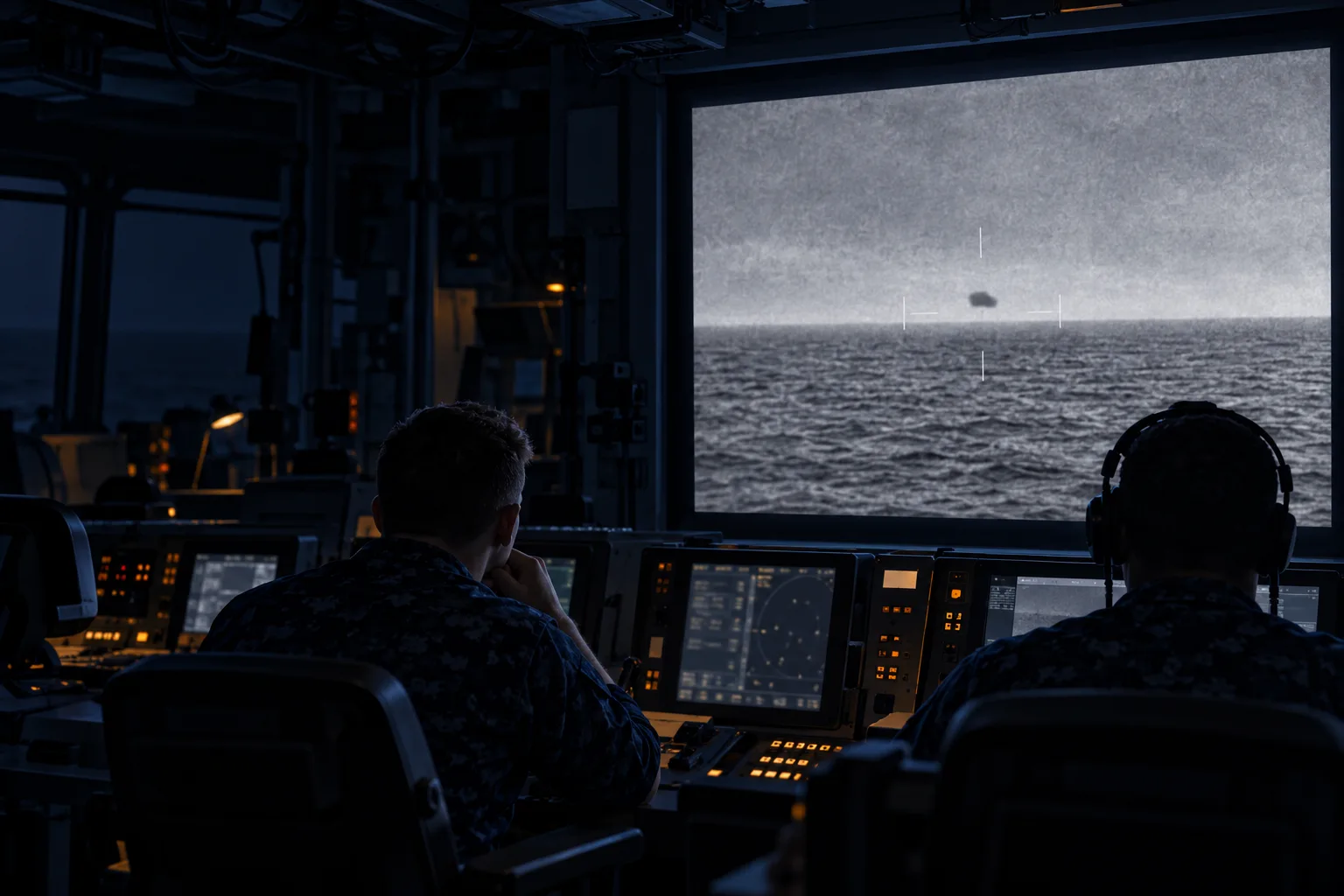
Before the object disappeared, someone aboard the ship was already preparing for a splash.
The instruction was practical: if it went into the water, record its bearing and range. Keep enough information to locate the place afterwards.
In the short infrared sequence attributed to USS Omaha, a rounded dark contact approaches the apparent sea surface. Voices discuss the conditions outside. Then comes an exclamation: “Whoa, it splashed!” Another voice repeats the assessment. The next instruction is to mark the position.
The publicly released recording lasts about a minute. It carries the viewer from an object being followed to a patch of ocean where that object can no longer be seen. The voices make the disappearance feel immediate: the people watching are trying to turn what has just happened into something they can act on.
The release account places the encounter off Southern California on July 15, 2019. Nearly two years would pass before this small part of the night’s activity became public.
A ship among the contacts
Omaha was an Independence-variant littoral combat ship, designated LCS 12. Commissioned in San Diego in February 2018, it belonged to the Navy’s distinctive trimaran family: a broad, three-hulled design with a large flight deck. The Navy’s description of the vessel emphasised speed and the ability to operate in coastal waters.
By the summer of 2019, the ship was operating in a region where Navy crews repeatedly reported unfamiliar aircraft near their vessels. The Omaha recording includes a call naming Omaha, Pinckney, Kidd and Rafael Peralta, raising the possibility of launching a helicopter quickly. The event was unfolding within a network of ships exchanging information.
Records from that same night place other crews at work identifying contacts. According to the deck logs reproduced in The War Zone’s reconstruction, Rafael Peralta activated its photographic intelligence team at 8:39 p.m. Kidd followed at about 9 p.m. Later, the passing cruise ship Carnival Imagination reported that the drones were not its own and that its crew could also see several nearby.
Those entries describe the surrounding night’s activity. Aboard Omaha, the released material would preserve a more particular problem: following a contact down towards the water.
The ocean on the display
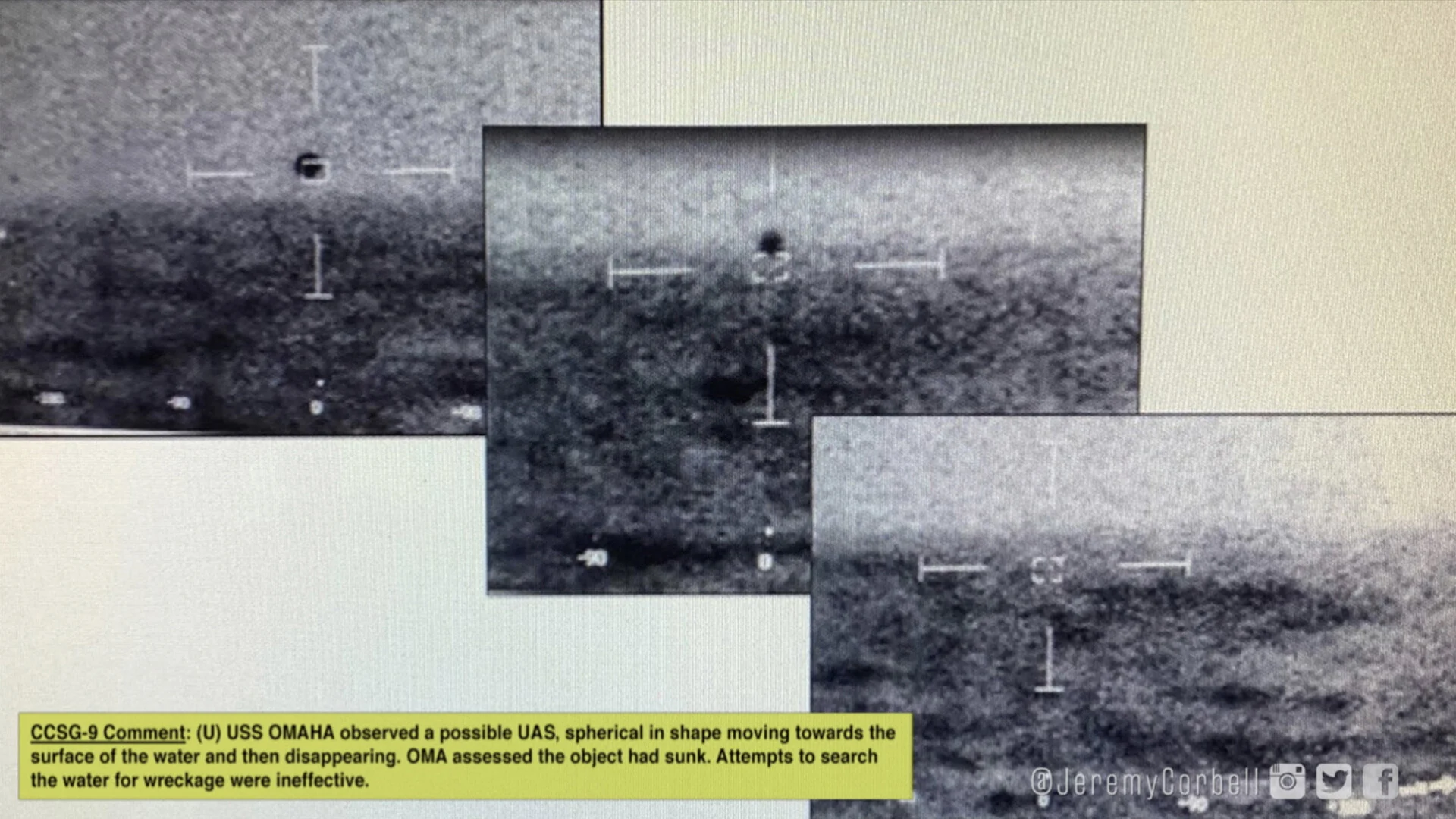
The published briefing image arranges three infrared views across a slide. In the first, a small dark shape sits above the uneven boundary between lighter sky and darker sea. In the next, the shape appears closer to that boundary. In the last, the targeting marks frame a scene in which the isolated dark contact is no longer apparent.
The pictures are visibly pictures of a display. The ocean has become a coarse pattern of light and dark; the object occupies a small part of the frame. The aiming marks provide a fixed reference while the feature of interest changes position within the view.
The accompanying audio adds a different perspective. Crew commentary describes white water and six-foot swells. A report gives sustained winds of 31 knots, with gusts reaching 40. These are the conditions the speakers describe while trying to keep the contact under observation.
The exchange moves between watching and recording. The potential helicopter launch, the instruction to obtain a bearing and range, and the final order to mark the position all point towards the same immediate task. If the object leaves the air, the crew wants to retain its location.
Where it had been
The caption beneath the infrared images gives the episode a brief official-sounding summary, attributed on the slide to Carrier Strike Group 9. It describes a possible unmanned aerial system, spherical in appearance, moving towards the surface and disappearing. Omaha assessed that it had sunk. Attempts to search the water for wreckage had been ineffective.
The sequence ends with a place to search, rather than an object recovered. Its movement has been observed, a position requested, and a conclusion reached aboard the ship about what happened at the surface. The account then passes from tracking to searching.
When filmmaker Jeremy Corbell released the footage, he supplied a broader account of the encounter. He described multiple targets, prolonged activity and observations on more than one radar system. He also said a submarine had participated in an unsuccessful search. These details formed part of his account from sources familiar with the incident.
His release placed the disappearance at approximately 11 p.m. Pacific local time. It also noted that the display’s Greenwich time had already advanced into the following day. The event’s familiar July 15 date refers to the night off California.
Another screen, earlier in the night
On May 27, 2021, Corbell published four clips of radar-display footage, also attributed to Omaha on July 15. His accompanying account placed this material earlier in the evening, around 10 p.m.
Here the voices are concerned with positions, courses, speeds and the number of contacts. Someone requests a general latitude and longitude. Another instruction asks for information about the contacts relative to the ship. A further voice directs the watch to maintain tracking as well as it can.
The released transcript includes a report of track 781 increasing to 46 and then 50 knots. Elsewhere, a speaker calls out 138 knots and remarks on a turn. These are the figures spoken in the clips, part of the watch’s attempt to describe changing tracks.
Corbell presented the radar material as another view of the same evening’s encounters. It brought the public into a second stream of activity aboard the ship: contacts reduced to positions and numbers, with sailors trying to maintain a usable picture as the situation developed.
The footage leaves the ship
The public story had begun in fragments. In April 2021, images associated with Omaha circulated alongside night-vision material attributed to USS Russell. The May 14 infrared release then gave the waterline sequence movement and sound.
For people who had seen the stills, the new clip supplied the voices between the images. A descending shape was now accompanied by a warning about what to record, an assessment of the sea conditions and the startled call at the end.
Micah Hanks of The Debrief asked the Pentagon about its provenance. Spokesperson Susan Gough confirmed that Navy personnel had recorded the video and that the UAP Task Force had included it in its ongoing examinations. She did not provide the further identification or classification of the object that the publication requested.
Meanwhile, researchers were following the incident through less dramatic records. In his account of the document search, filmmaker Dave Beaty described obtaining hundreds of pages of Kidd logs in May 2020. Entries about drones and photographic teams led him towards other vessels and further requests. The event was reaching the public through two routes: leaked imagery and the slow reconstruction of ships’ records.
Together they carried the story far beyond the final instruction aboard Omaha. What had been a contact to locate became a disappearance watched and replayed around the world.
What Is Known
The Pentagon’s confirmation establishes that Navy personnel recorded the infrared video and that it entered the task force’s examination process. It authenticates the recording’s military provenance. It does not establish the object’s identity or demonstrate that it continued operating underwater.
The released imagery shows an unresolved contact approaching the apparent waterline and disappearing from view. The crew’s splash commentary and the briefing slide preserve an assessment that it entered the sea and sank. The published sequence does not follow a submerged object. Corbell’s additional claims about performance and a submarine search should remain attributed to his release account.
Later records also changed the context. In June 2022, The War Zone published Navy documents describing multiple 2019 encounters as drone activity, including assessments of possible surveillance from civilian vessels. Those findings materially narrow the wider mystery. They are not a demonstrated identification of the particular dark contact in the Omaha sequence.
At the May 2022 congressional hearing, naval intelligence official Scott Bray explained how the triangular appearance in separate night-vision imagery could result from the recording optics, with additional observations supporting a drone identification. That explanation concerned the triangle footage, rather than proving what happened to Omaha’s contact at the waterline.
The Bigger Picture
The later Navy records place these encounters within a serious operational problem: small aircraft approaching warships where crews train and use sensitive systems. An object can demand attention even when its operator, purpose or precise type is uncertain. Recording, sharing and preserving observations matters to that problem.
Omaha also illustrates why the boundary between air and water is so compelling in UFO reporting. A visible contact reaches the sea, and the viewer is left to imagine what happened beyond the last usable image. “Transmedium” supplies one possible continuation, but the recording ends before that continuation can be observed.
The most grounded thread is the crew’s effort to preserve a position. Their final instruction reaches beyond the spectacle of disappearance towards something concrete: a bearing, a range, and a place in the Pacific where the contact had been.
Sources
- Jeremy Corbell, infrared release and transcript, May 14, 2021 — footage attribution and source claims; published briefing slide.
- Corbell, radar release and transcript, May 27, 2021 — related clips attributed to the same evening.
- Micah Hanks, The Debrief, May 14, 2021 — reporting with the Pentagon’s direct response.
- U.S. Navy, Omaha delivery announcement and ship history — vessel context.
- Adam Kehoe and Marc Cecotti, initial reconstruction and June 2022 follow-up, The War Zone — reporting and reproduced Navy records.
- Dave Beaty, Mystery Drones of the SOCAL, The Black Vault — document-research account and archive.
- U.S. House of Representatives, May 17, 2022 hearing transcript, pp. 16–17 — official explanation of separate triangle imagery.