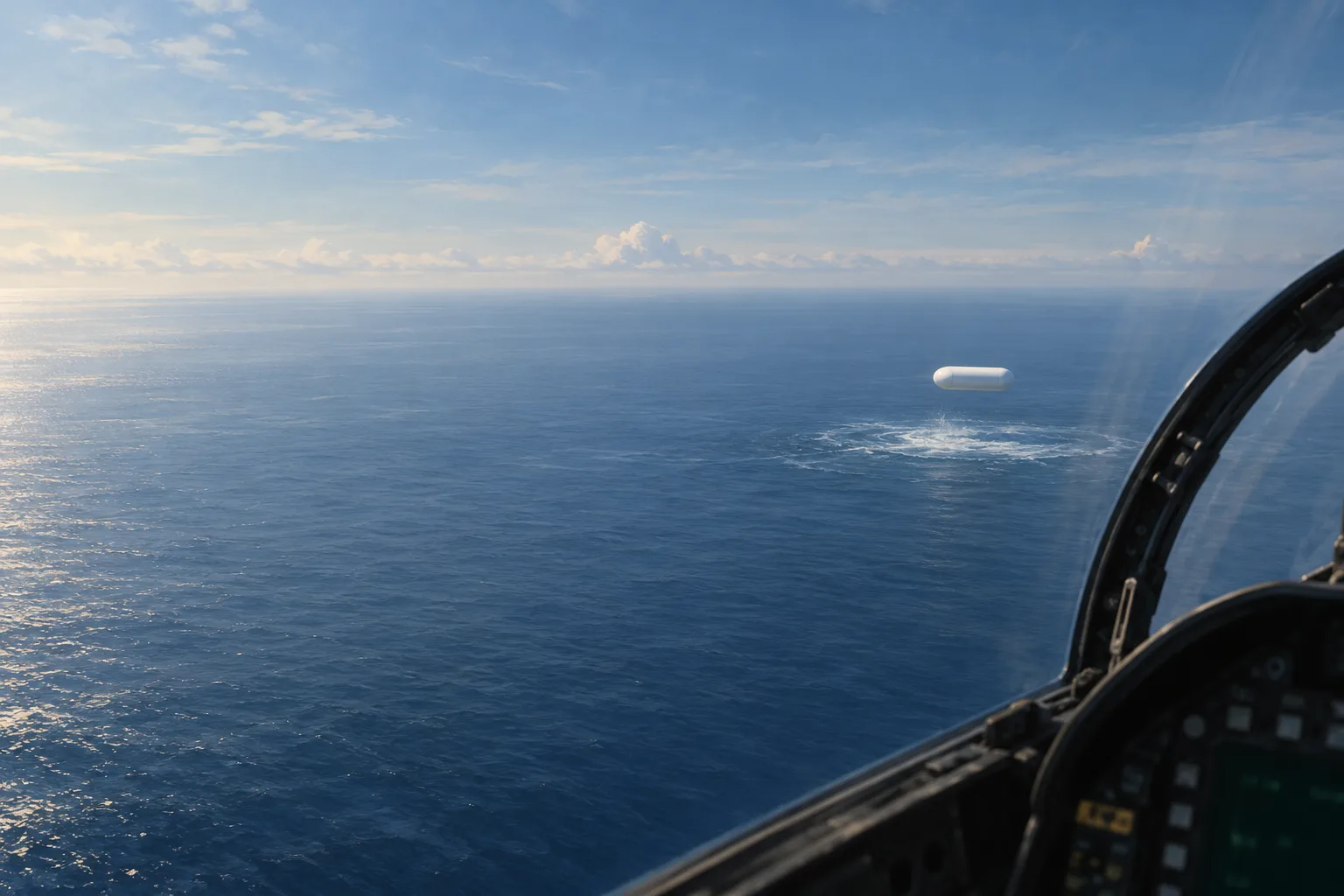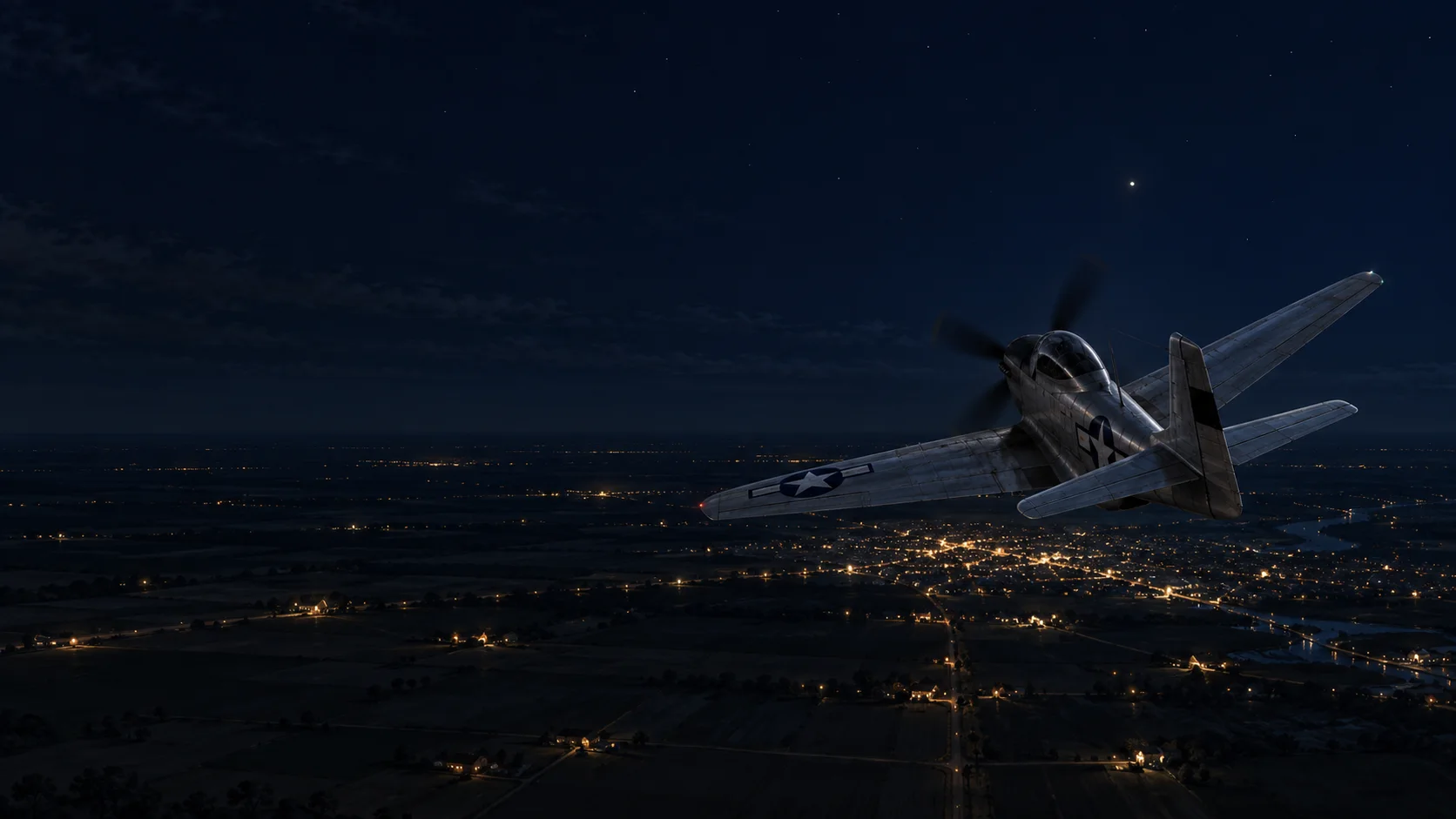
The Meteor was descending towards the airfield when Flight Lieutenant Paris noticed something behind it.
Five Shackleton aircrew were standing at RAF Topcliffe in North Yorkshire, watching the fighter approach from the east. It was September 19, 1952. The aircraft was familiar. The white object farther back was not.
It seemed to be travelling on a similar course, higher than the Meteor and much more slowly. Then it began to fall, swinging from side to side.
For a moment, the men thought they might be watching a parachute or a piece of aircraft cowling.
The fighter turned towards Dishforth. The object appeared to turn with it.
Within seconds, the movement changed again. The falling stopped. The swinging stopped. The silver shape seemed to rotate, accelerated westwards, turned southeast and disappeared.
The entire sequence occupied fifteen to twenty seconds.
Beyond Yorkshire, a multinational fleet was testing its ability to fight together. Before the exercise was over, another unfamiliar object would be photographed from an American carrier, and reports associated with Mainbrace would begin travelling through military intelligence channels on both sides of the Atlantic.
Above Topcliffe
Flight Lieutenant John Kilburn of 269 Squadron put the observation into a report to his commanding officer. His statement survives in the account reproduced by historian David Clarke, while a contemporary RAF signal summarising the incident is reproduced in The National Archives’ book extract.
Kilburn placed the Meteor at approximately 5,000 feet. The unfamiliar object appeared considerably higher: between 10,000 and 20,000 feet, perhaps five miles behind the aircraft.
Those were the positions as the men judged them from the ground. What made the observation memorable was the sequence that followed.
The object looked circular and silver. Its initial progress was slow enough for the observers to notice it maintaining a course before the descent began. Kilburn compared the swinging movement to a sycamore leaf falling through the air.
The comparison captured something apparently unsteady: a shape moving forward while rocking from side to side, coming down without following the clean line of an aircraft’s approach.
When the Meteor changed direction, the object seemed to follow. Then the rocking gave way to rotation around its own axis. The final departure looked astonishingly fast to Kilburn, who compared its apparent acceleration with that of a shooting star.
He could not match the movements to anything he had previously seen airborne.
The report carried that short observation beyond the airfield. A signal received on September 20 circulated the description to the Air Ministry. The men had watched for seconds; the account would remain in official files for decades.
The fleet at sea
Mainbrace brought together ships and aircraft for a practical test of NATO’s northern defence.
In a statement to Parliament the following month, the British government placed the exercise between September 13 and 23 and counted roughly 220 participating ships. Admiral Sir Patrick Brind commanded it. Its purpose included sustained tactical coordination between the allied naval and air forces.
Among the ships was USS Franklin D. Roosevelt. Wallace Litwin, a photographer covering the manoeuvres for an American newspaper organisation, was aboard.
The next important observation would begin on its flight deck.
Three exposures
A letter dated October 2, preserved in the American investigation file, forwarded three colour transparencies to Air Force intelligence officer Major Dewey Fournet. It included Litwin’s description of taking them.
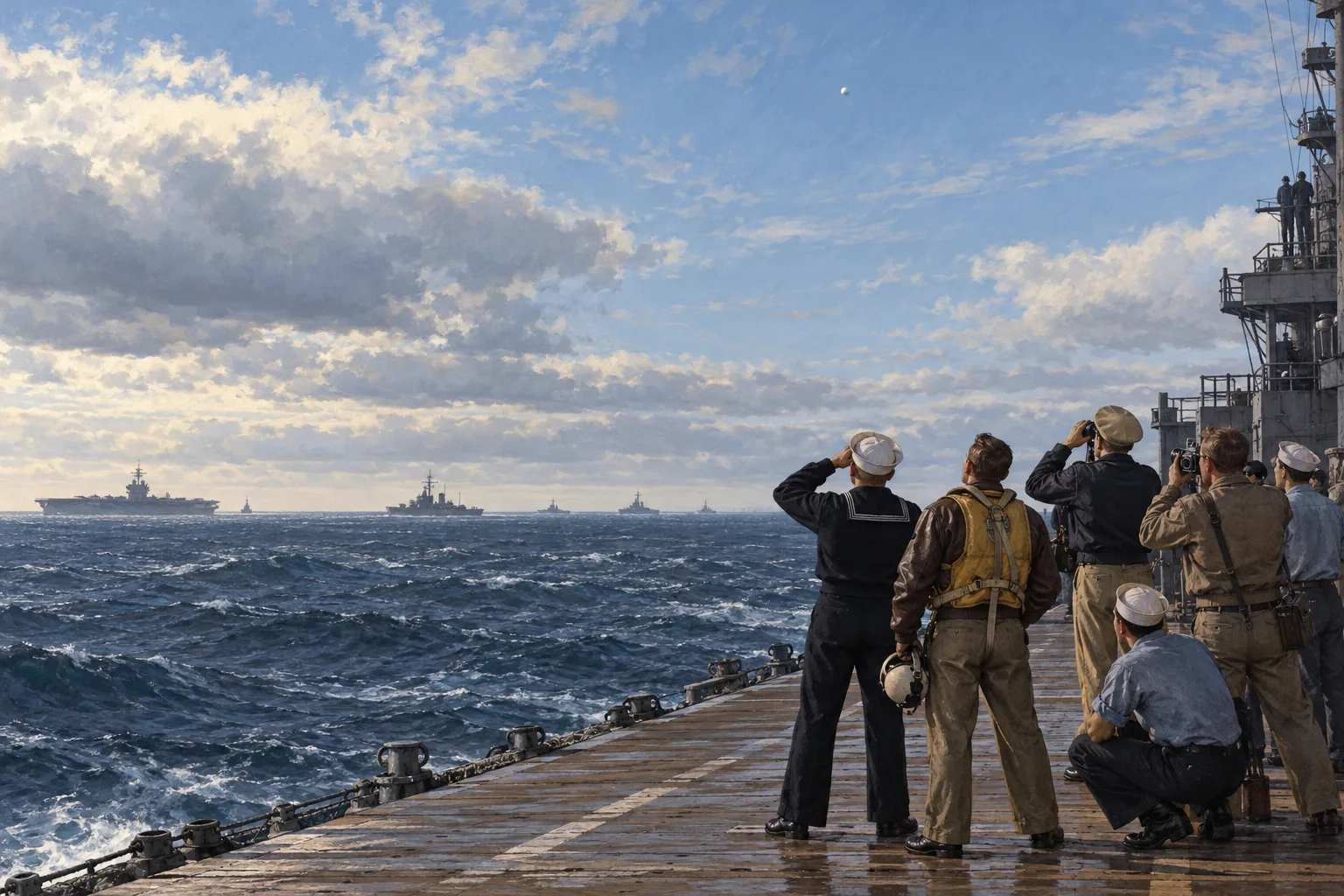
Shortly after four in the afternoon on September 20, Litwin was on the forward flight deck with helicopter pilot Lieutenant Robert M. Greer. He described a bright day with scattered clouds.
Litwin noticed a round object above the ship’s after end. He alerted Greer and moved aft, framing part of the carrier’s island with the object. He took a light-meter reading and made three exposures before it rose out of sight.
His estimated height was only 500–1,000 feet. The pictures were in colour, and the ship provided a recognisable reference in the frame.
Soon, the images would leave the photographer’s possession and become material for an Air Force inquiry.
Looking back down the deck
Captain Edward Ruppelt, who led Project Blue Book, later described the carrier incident in his memoir.
His telling opens with the reporter photographing an aircraft’s take-off. Looking back along the deck, the man notices pilots and crew watching the sky. He goes to see what has caught their attention and finds a silver sphere moving behind the fleet.
Ruppelt remembered the photographs as unusually useful because they included the carrier’s superstructure. He believed differences between successive images indicated rapid movement.
In that account, the pictures were developed promptly and examined by the ship’s intelligence officers. The object looked balloon-like, prompting enquiries among nearby ships.
The witnesses did not all reach the same conclusion. Some thought they had seen a balloon. Others felt that its speed and appearance differed from the familiar balloons released by the ship’s weather personnel.
For Ruppelt, the photographs became part of a larger problem. Other observations associated with the exercise kept his team asking the Navy for a definite answer.
The unexpected sight had now passed through several hands: people looking up from a working flight deck, a photographer making exposures, officers examining the results, and investigators seeking information from the fleet.
Over the North Sea
Ruppelt’s next episode took the story away from the carrier and into the air.
He placed it on the day after the photographs, September 21. Six RAF pilots were flying jets in formation over the North Sea when they noticed a shiny spherical object coming from the direction of the Mainbrace ships.
They could not recognise it as friendly aircraft and turned to pursue it.
The pursuit lasted only a minute or two before they lost sight of the object. The formation continued towards its base.
Then one pilot looked back.
According to Ruppelt, the sphere was now following him. He turned towards it; it turned as well. Once again, the unfamiliar object drew away from the Meteor, disappearing from the pursuit within minutes.
The account contains two reversals. First, the pilots move towards something they cannot identify. Later, with the first chase apparently over, one of them sees it behind his aircraft. A journey home becomes a second attempt to close the distance.
Ruppelt supplied neither the pilots’ names nor a detailed flight log in this passage. What his book preserves is the reported sequence as it reached the American investigation: formation, pursuit, loss of contact, reappearance and another unsuccessful chase.
The enquiry continues
The carrier’s paperwork shows investigators still working after Mainbrace had ended.
An October message addressed to Ruppelt and Fournet referred to enquiries about balloons released by other ships in the formation. The photographs were moving through official channels while investigators sought the operational information that might explain them.
The October 2 covering letter also asked for the transparencies to be returned quickly and requested whatever statement the Air Force would provide for publication. The photographer’s work had two destinations: an intelligence investigation and a newspaper audience.
At Topcliffe, the account had already entered the press. A September 20 Yorkshire Evening Press headline, reproduced beside the RAF signal in Clarke’s book, announced the airmen’s sighting.
Ruppelt would later recount the Mainbrace episodes during a discussion with American air-defence officers. Their interest was in what the investigation had learned. He described the photographs and pursuits, then returned to the need for firmer proof before assigning an extraordinary meaning to an unidentified report.
The exercise had ended. The questions raised by those brief observations were still being passed from one desk to another.
What Is Known
Mainbrace’s existence, purpose and scale are documented independently in the contemporary parliamentary record. The Topcliffe observation is preserved in RAF reporting; the carrier sighting generated correspondence and photographic submissions in the American file. These are distinct incidents associated with the same exercise.
The records also correct a familiar version of the story. Ruppelt placed Topcliffe after the carrier photographs and described a scrambled Meteor approaching the object. The RAF account instead dates the observation to September 19 and places the witnesses on the ground, watching a Meteor. This article follows that contemporary chronology.
For the carrier incident, the surviving Blue Book record card gives the conclusion “BALLOON.” Litwin’s near-contemporary account acknowledged a balloon launch aboard the carrier at 3:30 p.m., while maintaining that the object he photographed was different. Ruppelt’s later statement that enquiries found no balloon launch should therefore remain attributed to his memoir, rather than presented as an established result.
The six-pilot pursuit is described here from Ruppelt’s later account. It does not supply the same documentary detail as the surviving carrier correspondence or RAF signal. None of these records establishes that all the observers encountered a single object, or that an extraterrestrial craft was involved.
The Bigger Picture
Mainbrace was an exercise in getting separate organisations to operate together. The parliamentary statement emphasised communications, coordination and lessons for future equipment and training. Bad weather affected parts of the operation; a closing conference aboard HMS Eagle at Oslo brought senior allied commanders together to compare results.
The UFO reports travelled through that same international military environment. A Yorkshire observation became an RAF signal. A photographer’s transparencies reached American intelligence. A later memoir gathered several episodes under the exercise’s name.
That shared setting helps explain Mainbrace’s lasting appeal. Naval crews, aircrew and investigators appear in a connected story, each looking from a different position. Yet the connections between their organisations are better documented than a connection between the things they saw.
The enduring scene is small against the exercise’s scale: a few airmen watching a fighter descend, a photographer turning his camera upwards, and a moment in the sky becoming a question carried home from the fleet.
Sources
- Project Blue Book, USS Franklin D. Roosevelt sighting file, September–October 1952. Contemporary record card, correspondence forwarding Litwin’s account and transparencies, and military messages; digitised compilation hosted by NICAP.
- RAF Topcliffe signal, AIR 20/7390, reproduced on printed page 49 of David Clarke’s The UFO Files. Contemporary September 1952 message reproduced by The National Archives; the extract also includes the contemporary newspaper headline.
- Edward J. Ruppelt, The Report on Unidentified Flying Objects, chapter 13. Later memoir by Blue Book’s former director, originally published in 1956; source for his carrier narrative and the reported six-pilot pursuit.
- David Clarke, “The Topcliffe Incident”. Later archival history quoting Kilburn’s statement, reference AIR 16/1199; distinguished here from the original signal.
- UK Parliament, “Exercise Mainbrace,” October 15, 1952. Contemporary official account of the exercise’s dates, purpose, participating forces and closing conference.