The patrol ships were supposed to be training.
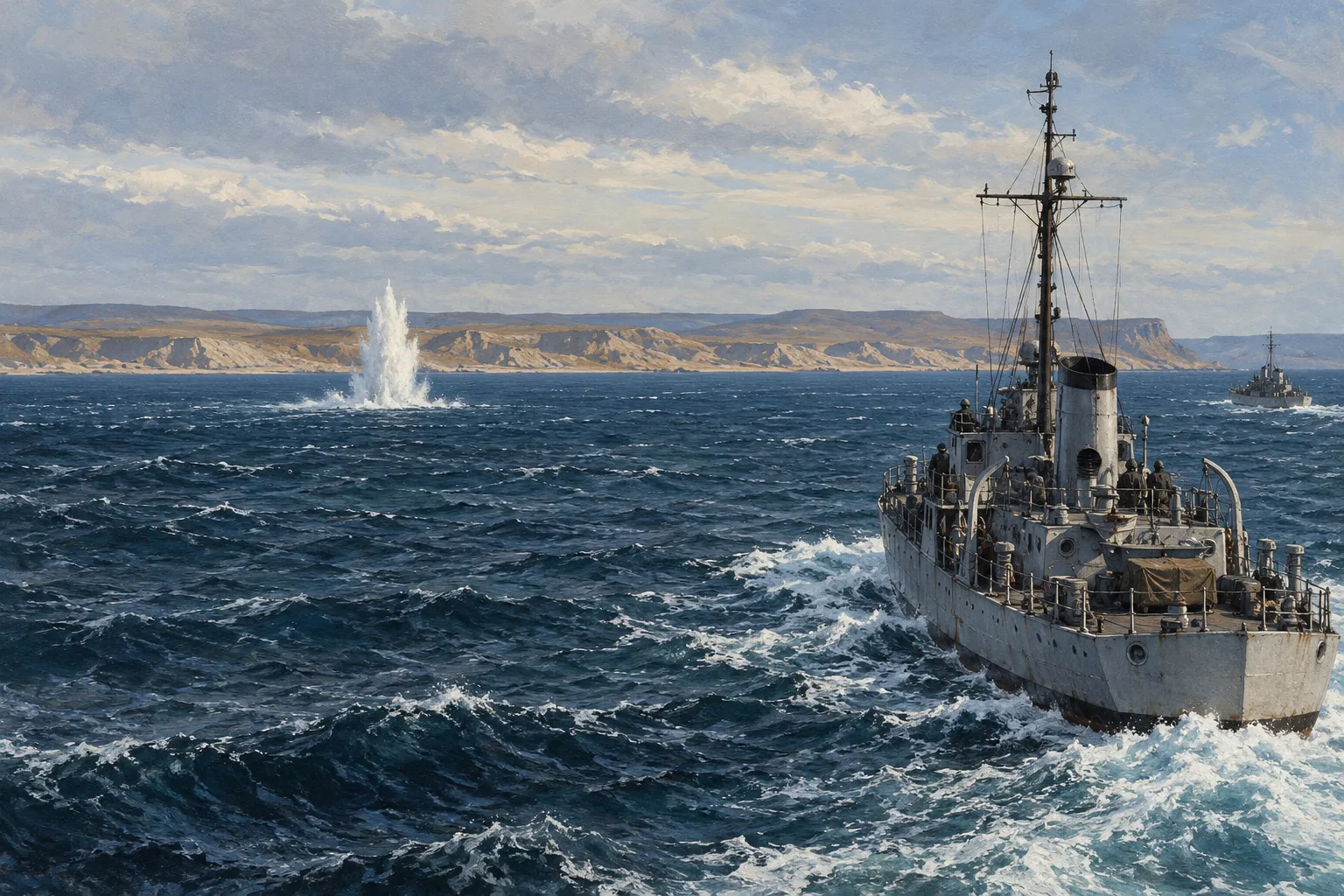
Near the entrance to Golfo Nuevo, on Argentina’s Patagonian coast, they detected something underwater. It did not identify itself. When the ships pursued it, the contact appeared to move towards the open sea.
In the account later given by naval officer Benjamín Cosentino, the morning was January 30, 1960. The patrol vessels ARA Murature and ARA King followed the suspected submarine beyond the gulf and were eventually ordered back. Their pursuit had carried them outside the territorial limit being applied to the operation.
Then, that night, they obtained another contact inside the gulf.
The ships had followed one target out. Now there seemed to be something behind them, in the water they had just left. Before the hunt was over, Argentina would mobilize aircraft and additional warships, American naval specialists would come south, and the question of what was beneath the gulf would reach a conversation between two presidents.
Back inside the gulf
Cosentino’s later account, quoted in a naval-history reconstruction by Mariano Pablo Sciaroni and Pablo A. Castro, describes the first pursuit beginning at 9:10 a.m. Attempts to communicate with the unidentified contact brought no answer. The patrol ships attacked, but the target seemed able to manoeuvre and move faster than its pursuers.
The return to the gulf changed the situation. A fresh contact inside its waters suggested that the ships might be dealing with more than one intruder. A Neptune patrol aircraft joined the attacks. After contact was lost again, the ships watched the entrance with support from a Mariner flying boat.
The operation now had two demands: find the target within the gulf and watch the way out. An underwater contact could disappear while a ship changed position, then be acquired again elsewhere. Every new detection required the searchers to decide whether they had recovered the same quarry or found another one.
In Cosentino’s retrospective description, commanders came to interpret the movements as the work of two submarines. One seemed damaged and intent on breaking contact; the other appeared to create distractions, relieving pressure on its companion. He described brief contacts and occasions when part of a suspected submarine appeared above water.
That interpretation gave the pursuit a larger shape. The navy might have caught a boat that could not safely leave, while another was trying to help it. Keeping the entrance under observation became part of a possible trap.
The later reconstruction also reproduces drawings associated with the patrol ships’ reported observations. They show what the men were trying to recognize: a low hull, a raised sail and small projections above the water. The encounter could present itself as an acoustic contact on one occasion and as a fragment of a vessel on another.
One drawing attributed to Murature concerns a periscope or radar antenna seen at night. Its accompanying description gives the distance as one hundred yards and says that the projection was seen turning. Another, associated with King, depicts a submarine on the surface near Punta Conscriptos.
Those glimpses formed part of the searchers’ developing picture of the intruder. A mast or a section of exposed hull offered something to watch and sketch, then could vanish with the next dive. The drawings preserve the reported forms that naval personnel associated with their quarry, without supplying the name or flag that the hunt was meant to obtain.
The gulf closes
By February, the search was becoming a public confrontation. The government faced an unidentified vessel believed to be within Argentine waters, refusing to declare its nationality or purpose. The patrol exercise had become a problem of sovereignty.
On February 11, a United Press International dispatch reported that civilian aircraft had been barred from the gulf area. Private shipping had already been excluded. Navy Secretary Gastón Clement told reporters that the navy could use force against the suspected submarine if it would not leave.
The restriction on ordinary traffic gave the search force space to operate. Anyone travelling through the gulf now risked entering an area reserved for a hunt in which weapons might be used. The water around Puerto Madryn had become the centre of a military emergency.
Naval sources were also offering a timetable. The February 11 dispatch said they thought the submarine would probably have to surface within seventy-two hours. They believed their existing equipment was poorly suited to attacking it in the gulf’s deeper water.
There was an apparent opportunity in that limitation. If the boat could stay beneath the searchers, perhaps it could still be forced into sight by the demands of its own machinery and crew. The watch would continue until the quarry exposed itself.
The following day’s news appeared to bring just such a moment.
A brief appearance
The February 12 UPI report carried unofficial accounts from Puerto Madryn of a submarine surfacing early that morning. Ships and aircraft attacked it with gunfire and bombs. It reportedly dived again, and destroyers moved towards its last position to drop depth charges.
The sequence was urgent and frustrating: an object appeared, weapons were brought to bear, and the sea concealed it again. The dispatch did not describe a successful capture. It reported no wreckage or oil slick indicating that the attack had destroyed the target.
Frondizi had meanwhile ordered action against unauthorized warships in territorial waters, according to the same report. There was also talk of breaking diplomatic relations with the country responsible. Identifying the vessel had become politically consequential as well as militarily necessary.
Yet the country remained unnamed. Reports of a second submarine outside the gulf added to the sense that the first might have support. In Buenos Aires, speculation increasingly pointed towards the Communist bloc, following reported Western denials of ownership.
At sea, the searchers still needed something more immediate than a diplomatic theory: another contact they could follow long enough to bring the vessel to the surface.
Watching from shore
The hunt extended beyond the ships. TIME’s contemporary coverage described troops along the Patagonian shoreline and security restrictions at Puerto Madryn. The search occupied the water, the air above it and the coast beside it.
On February 15, a UPI dispatch from Puerto Madryn introduced a different possibility. Naval sources feared that the submarine might already have escaped. It had gone undetected for twenty-four hours.
Preparations for another major attack were continuing. Officers’ leave had been cancelled in southern Argentina. The operation was gathering effort at the very moment its participants were confronting the possibility that their target had slipped away.
Reporters watching from the shoreline described dead fish and penguins around the presumed search area. The bombardment had left visible consequences on the surface, while the sought-after vessel remained out of reach.
The same dispatch carried a report that two warships had fired unsuccessfully at a submarine said to have surfaced on Sunday night. Public accounts moved between sightings and absence, renewed attacks and fears of escape. From shore, the hunt was still happening. Beneath the water, its ending was harder to recognize.
Help arrives from the north
American assistance brought a new group into the story. On February 16, the Observer’s UPI report announced that thirteen U.S. Navy specialists were due to arrive: four officers and nine enlisted men travelling in two aircraft.
One aircraft was carrying antisubmarine equipment. The Americans were authorized to board Argentine warships if requested, serving as advisers. They were joining an existing operation, bringing additional knowledge and equipment to a force already watching the gulf.
But the contacts were fading. The dispatch described a blockade maintained by roughly a dozen warships and a score of aircraft, while officials reported more than twenty-four hours without sonar contact with either suspected submarine.
The arrival therefore came at an awkward moment. The search was being strengthened, but there was less certainty about where the quarry remained. The report could not yet establish whether the newly purchased American depth charges had been used.
In Cosentino’s later account, the operation eventually passed from an apparent escape phase into a period of few contacts, doubtful detections and a thorough search. The navy came to assess the gulf as empty of submarines. Weeks of pursuit ended without an identified boat being brought home.
The question aboard the aircraft
On February 27, the story travelled inland aboard the American presidential aircraft, Columbine. Eisenhower and Frondizi were flying from Mar del Plata to Bariloche. Their conversation turned from other business to the submarine hunt.
The surviving U.S. diplomatic memorandum records Eisenhower asking whether submarines had really been there.
Frondizi said they had. He believed there had been two, possibly three. He suggested they were investigating the route around Cape Horn, which Western shipping might need if a major war closed the Panama Canal. In his view, Soviet crews could acquire long-distance experience while facing relatively little danger from Argentina’s ageing equipment.
The Argentine naval chief of staff then joined the conversation and described the contacts and attacks. The memorandum records that briefing without reproducing its operational detail.
The president who had authorized the hunt was still convinced. The gulf, however, had yielded no submarine that could settle the identity of the intruders. The operation’s final question had followed him out of Patagonia and onto the aircraft.
What Is Known
Golfo Nuevo was the scene of a sustained Argentine naval search during January–February 1960. Contemporary dispatches document restrictions on civilian traffic, attacks attributed to naval sources, concern about lost contacts, and American assistance. They also show how quickly unofficial sightings and judgments about nationality entered the public story.
The State Department’s historical edition preserves the February 27 presidential conversation and notes that no submarines were found despite a three-week search. Frondizi’s conviction is part of that record; his suggested Soviet explanation is explicitly his belief.
Cosentino’s account provides a later participant’s interpretation of the operation. Here it is accessed through Sciaroni and Castro’s reproduction, rather than the original operational logs. Its detailed opening date and sequence belong to that retrospective account. The contemporary February 12 dispatch also placed the first sighting on January 30.
These records establish a serious military response to contacts interpreted as submarines. They do not identify a captured vessel or establish an extraordinary underwater craft. Calling the case a USO encounter describes its later place in unexplained-object literature; it does not resolve what the navy was pursuing.
The Bigger Picture
The hunt unfolded within a navy facing a difficult practical problem. Writing in Proceedings in July 1960, Argentine Lieutenant Carlos E. Zartmann described a force responsible for protecting a long coast and vital seaborne trade with largely ageing ships and aircraft. Its destroyers were at least twenty years old, and modern submarines were lacking for realistic antisubmarine training.
His article also identified the southern shipping route as strategically important if the Panama Canal were disabled. That concern helps explain why a contact far down the Patagonian coast could draw presidential attention. An intruder there might belong to a conflict whose main powers and expected battlefields lay thousands of miles away.
Golfo Nuevo retains its hold because the response was so tangible. Ships sailed, aircraft searched, restrictions were imposed and advisers arrived. Those actions are part of the historical record even though the target’s identity remains unresolved.
For weeks, the searchers tried to turn a contact into a vessel they could identify. The enduring image of the case is the water between those two things: something the navy believed it had followed, and something it never made surface for the world to see.
Sources
- U.S. Department of State, Foreign Relations of the United States, document 205 — original February 27, 1960 diplomatic memorandum, with editorial context.
- UPI, La Grande Observer, February 11, 1960, page 1 — contemporary traffic restrictions and Clement’s statement.
- UPI, La Grande Observer, February 12, 1960, page 1 — contemporary reporting, including explicitly unofficial attack accounts.
- UPI, La Grande Observer, February 15, 1960, page 1 — contemporary fears of escape and shoreline observations.
- UPI, La Grande Observer, February 16, 1960, page 1 — contemporary announcement of American advisers and equipment.
- Sciaroni and Castro, “Submarinos extranjeros en la Patagonia argentina,” elSnorkel, 2013 — later reconstruction reproducing passages from Cosentino’s memoir; its proposed submarine identification remains a hypothesis.
- TIME, “The Ping in Golfo Nuevo,” February 22, 1960 — contemporary magazine coverage.
- Lt. Carlos E. Zartmann, “The Argentine Navy,” Proceedings, July 1960 — contemporary naval officer’s account of the fleet and its strategic responsibilities.