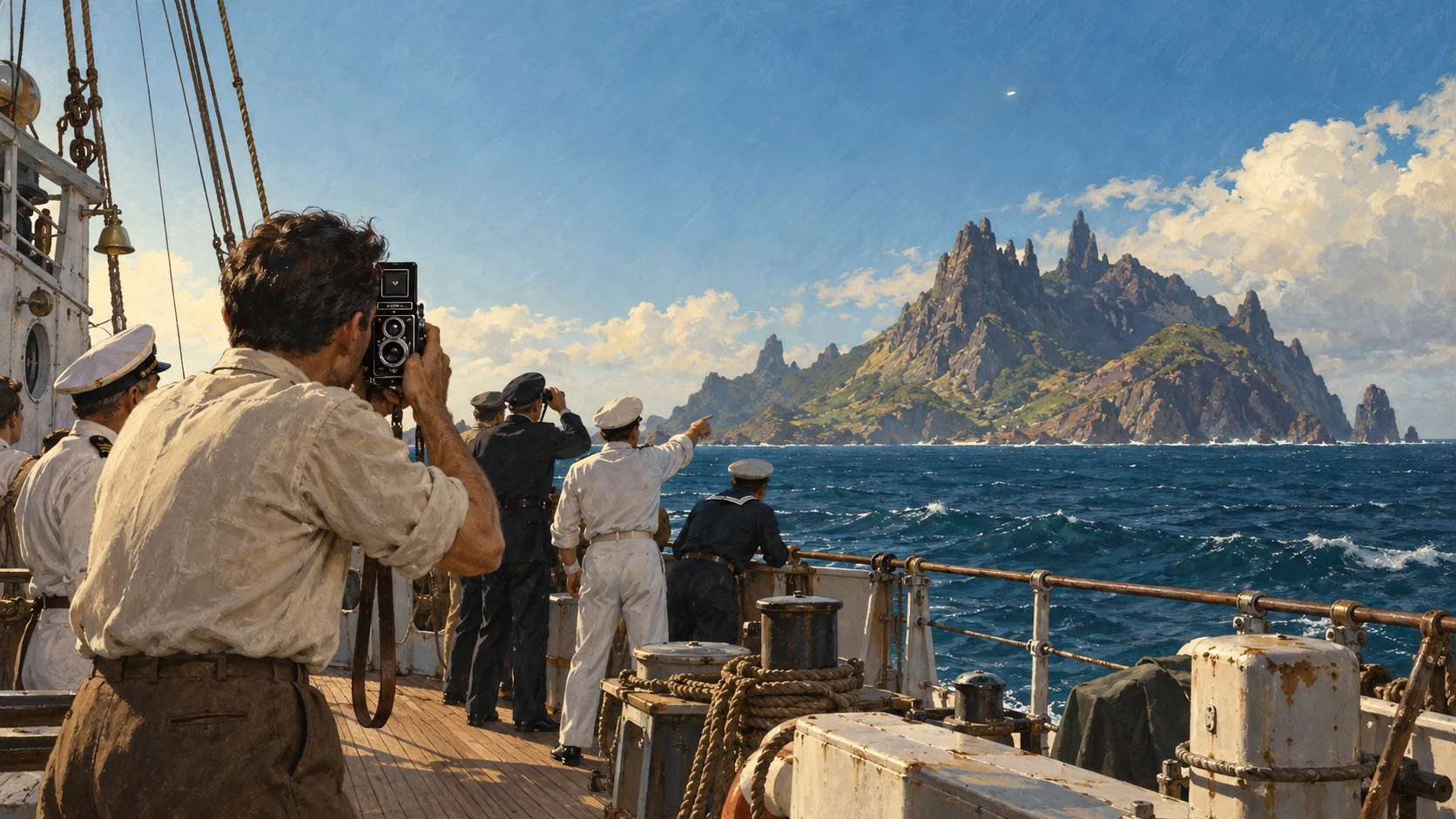
Someone at the stern of the Almirante Saldanha called attention to the sky. Almiro Baraúna turned towards Trindade Island with a camera in his hands. What he said he photographed during the next few seconds would travel much farther than the Brazilian Navy ship that carried him there.
The island stood apart in the South Atlantic, its peaks rising beyond the ship. Baraúna was a professional photographer accompanying a group of underwater hunters, not a sailor assigned to watch the horizon. The vessel was finishing a visit to the Navy’s new oceanographic post. On January 16, 1958, the ordinary business of getting people and equipment aboard was interrupted by a report of something moving above the island.
Who first called out matters because it is one of the few ways to reconstruct such a brief encounter. Baraúna told the contemporary press that José Teobaldo Viegas, a retired Brazilian Air Force captain, shouted from the stern. Amilar Vieira Filho, who led the diving group, recalled in a 2003 interview that Viegas had probably seen it first and summoned the photographer. Vieira himself looked up only after the object had reached the vicinity of Pico Desejado. His memory was recorded forty-five years after the voyage, but it places a useful limit on his view: he did not claim to have watched the entire passage.
Seconds above the water
Viegas’s description was the more detailed. In the period assessment assembled by the American UFO organisation NICAP, he described a bright, flattened shape with a band or ring around its middle. Baraúna’s photographs, as published, show a dark form against the sea and island. Vieira’s much later account was plainer than either image or Viegas’s description. He said he saw a luminous object near Pico Desejado, grey when it paused and without visible surface detail. As it moved above the island, he recalled, it brightened and disappeared towards the sea.
Baraúna had the camera. He later described taking six exposures, with four images of the alleged object becoming the celebrated sequence. The action on deck was fast enough that his first concern was whether anything had registered on the film at all. The next person in the story did not arrive in time to answer what had flown past. He arrived in time to watch what happened to the negatives.
Carlos Alberto Ferreira Bacellar had commanded the Navy post on Trindade. In his end-of-commission report, written soon afterwards, he placed himself in a cabin when word came that an unidentified aerial object had been seen from the ship. He went to the aft deck and found several people excited, Baraúna among them. The photographer, Bacellar wrote, was uncertain that his shots had succeeded.
Bacellar stayed near him. On deck he watched Baraúna remove the roll from the camera. He followed him to the improvised darkroom, then remained outside because the room was hot. Roughly ten minutes later, Baraúna emerged carrying the freshly developed film in a tray. Bacellar described him as disappointed, believing he had missed the object.
The commander took a closer look. On three negatives he saw a strange mark in different positions, later identified with the photographed object. The detail is modest but central. Bacellar witnessed the film handling and the wet negatives; he did not witness the object in the sky. Nor did his account say that the fully familiar saucer shape was already plain on four frames aboard ship.
The film leaves the ship
The negatives remained with Baraúna after that first examination. Bacellar said he urged the photographer to make himself available to the Navy staff in Rio de Janeiro. Once the ship returned, Bacellar gave an account to naval intelligence officer José Geraldo Brandão. Other interviews and photographic examinations followed.
The sequence soon acquired two forms: uncertain marks inspected on the ship, and enlarged photographs studied later. Brandão’s subsequent report, quoted in a later presentation of the case, described Bacellar seeing the object on the processed film and witnesses identifying it in photographs. Bacellar’s own report was narrower: three marks noticed while the film was wet. The later account may compress the first inspection with what enlargements revealed afterwards.
Bacellar’s report had already recorded aerial sightings from Trindade, including one reported by the post’s doctor and other men on December 31. Of a New Year’s Day sighting, he wrote that he suspected a gull. He preserved doubt alongside the reports.
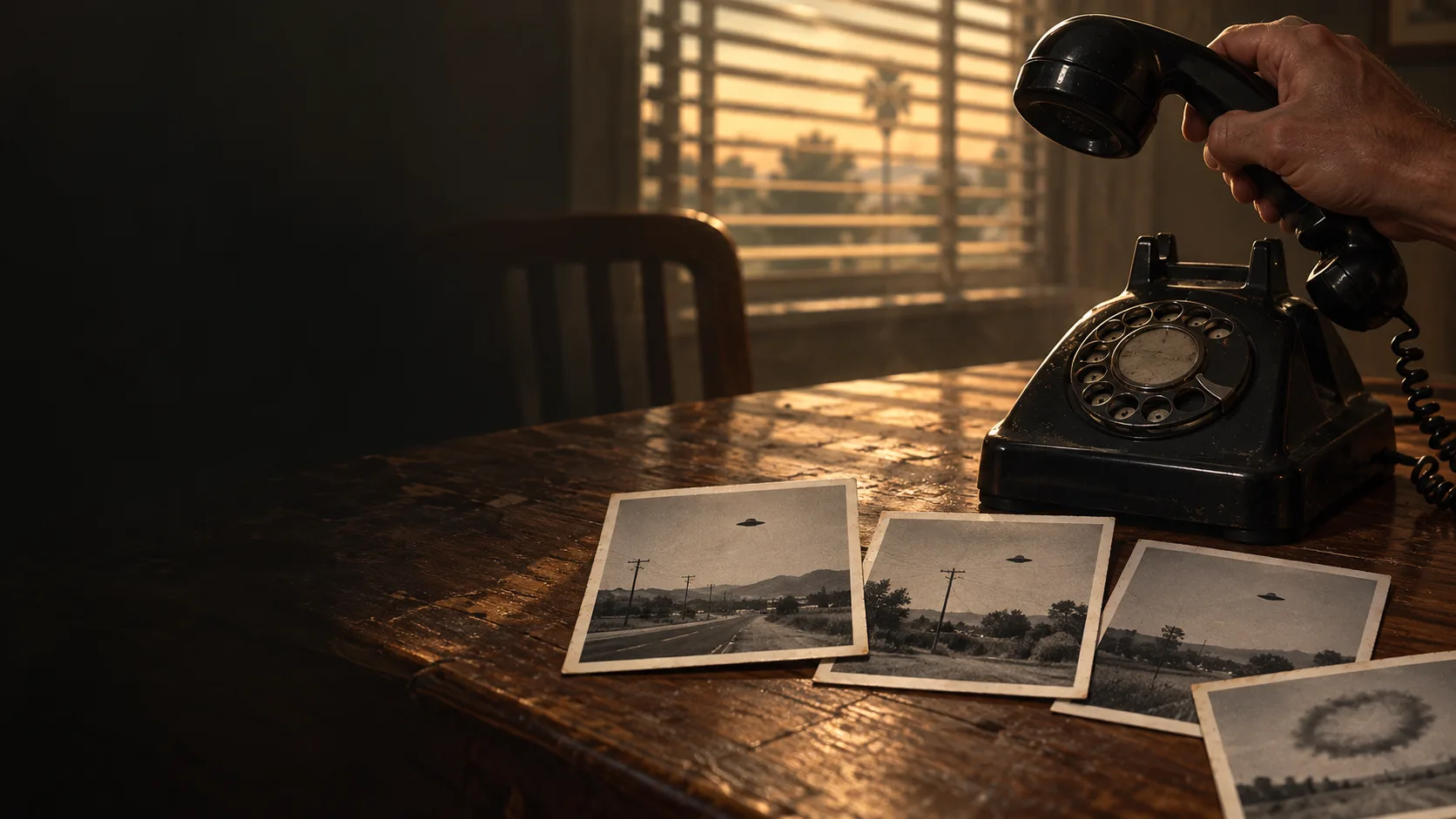
The public saw a sharper story. Brazilian newspapers began publishing the pictures in February. Headlines treated the Navy’s involvement as a seal of authenticity. For readers far from Trindade, the photographs carried a potent setting: a remote island, a naval ship, a professional photographer, and film examined by an officer before the vessel returned to port. Those circumstances made the case harder to dismiss casually, but they also invited a stronger conclusion than the examination itself could support.
The inquiry and the headlines
NICAP’s 1958 assessment found the images persuasive. Its analysts studied prints, compared the sequence and reported that photographic specialists had found no evident trickery in the negatives. The organisation considered the case exceptionally strong. Its published review also made clear that it had not inspected the original negatives itself and wanted the full technical reports. Its conclusion was an advocate’s evaluation of the material available to it, not a second Navy laboratory finding.
The Navy’s reported technical conclusion was more guarded. In the surviving account of Brandão’s inquiry, a Navy technician considered the negatives natural. A civilian aerophotography service, Cruzeiro do Sul, reportedly found no sign of a montage applied after the sighting. But its finding did not rule out a montage prepared before the film was examined. The inquiry therefore stopped short of proving that the object in the published images had passed through the sky above Trindade. The underlying civilian laboratory document has not been located in the archival research cited here, so its methods reach us through the Navy inquiry’s summary.
The pictures circulated internationally. Critics pointed to Baraúna’s skill with photographic tricks, already a subject of Brazilian press coverage in 1958. That ability raised a fair question without proving this sequence was fabricated. Supporters pointed to Bacellar and the other reported witnesses. Their presence could not, by itself, settle what appeared on the film.
Vieira’s 2003 interview shows how far even a witness’s perspective could differ from the legend. He rejected any knowledge of the often repeated figure of forty-eight eyewitnesses. He said Bacellar and the ship’s captain had not seen the object. He also said that although he saw something luminous above the island, he was not beside the darkroom and could not tell the interviewer what he had seen on the wet negatives. Those limits do not erase his reported sighting. They give it a more exact place in the sequence.
Decades later, the dispute acquired an apparent ending that was no ending at all. In 2010, Emília Bittencourt, described as a family friend, said Baraúna had told her he had fabricated the images with a small model and photographic work. Baraúna had died in 2000. There is no recorded confession from him concerning the Trindade photographs in the sources used here. Bittencourt’s allegation is a later, secondhand claim, substantial enough to report but incapable on its own of demonstrating the alleged method.
The moment on the ship remains divided between what people said they saw, what the camera appears to show, and what Bacellar inspected. Baraúna emerged from a hot darkroom disappointed; Bacellar noticed marks on the film. What made them was the question that followed the ship home.
What Is Known
Bacellar’s February 1958 report is a near-contemporary Navy record of the aftermath. It establishes that he saw Baraúna remove the film and noticed marks on three wet negatives. He did not see the aerial event or remain inside the darkroom. Alexandre de Carvalho Borges’s archival study reproduced the passage and the report scan; the Brazilian Navy archive lists the post’s records.
The published four-image sequence and named witnesses form the other positive record. Viegas, Vieira and Baraúna did not describe identical views; Vieira’s detailed interview came in 2003. NICAP supported authenticity after studying prints, without inspecting the negatives. Brandão’s inquiry reported no detected later montage but could not exclude a prior one. The original Cruzeiro do Sul technical report has not been located in the cited archival search. The Navy investigated the photographs; it did not prove an extraordinary object was photographed.
The 2010 fabrication allegation came from Bittencourt’s account of a private conversation. It is neither a recorded statement by Baraúna nor a demonstrated reconstruction of the four photographs. Authenticity remains disputed.
The Bigger Picture
The Navy archive’s description of the Trindade post explains the permanent Brazilian presence there. The post began during the International Geophysical Year for meteorological and other observations as well as maintaining a national foothold. The Almirante Saldanha was part of its supply and research work. Baraúna’s reported sighting became an institutional matter because it happened aboard that ship.
Trindade is also a case about the distance between a negative and a headline. The Navy recorded film handling and commissioned technical opinions, while the public saw enlargements and declarations about examinations. Investigators worked with different materials and access. As the images moved through newspapers and UFO collections, the alleged witness count and the supposed strength of authentication became less stable than the date and place of Baraúna’s exposures.
The photographs endure because they put an apparently solid shape into a recognisable landscape. The documentary record endures for a different reason: it lets the viewer step back from that shape and follow the people who saw, developed, examined and argued over it. Their accounts establish a remarkable controversy aboard and after a Navy voyage. They leave the object above Trindade unresolved.
Sources
- Carlos Alberto Ferreira Bacellar, Relatório de fim de comissão, Posto Oceanográfico da Ilha da Trindade, February 1958. Contemporary Navy record of the outpost and Bacellar’s observations after the January 16 sighting; digitised by the Brazilian Navy archive.
- NICAP, “The Trindade Island Photographs” (1958 period assessment). Advocacy organisation’s review of prints and witness accounts; its investigators did not inspect the original negatives.
- Amilar Vieira Filho, interview conducted in 2003 and published by Alexandre de Carvalho Borges in 2008. Later eyewitness account, useful for its explicit limits and corrections to the claimed witness count.
- Alexandre de Carvalho Borges, “Caso Ilha da Trindade: documentos sigilosos são revelados” (2011). Archival research reproducing Bacellar’s report, tracing period press coverage and quoting Brandão’s inquiry.
- UFOs at Close Sight, Trindade case compilation and Pocantico presentation. Later review quoting a Navy-report translation and Baraúna’s accounts; used as a source trail, not an independent examination of the negatives.
- Brazilian Navy archive, Posto Oceanográfico da Ilha da Trindade collection. Institutional context for the Navy post and its scientific work.
- Alexandre de Carvalho Borges, report on Emília Bittencourt’s allegation (2010). Reporting of the later secondhand fabrication claim; no recorded confession by Baraúna is supplied.