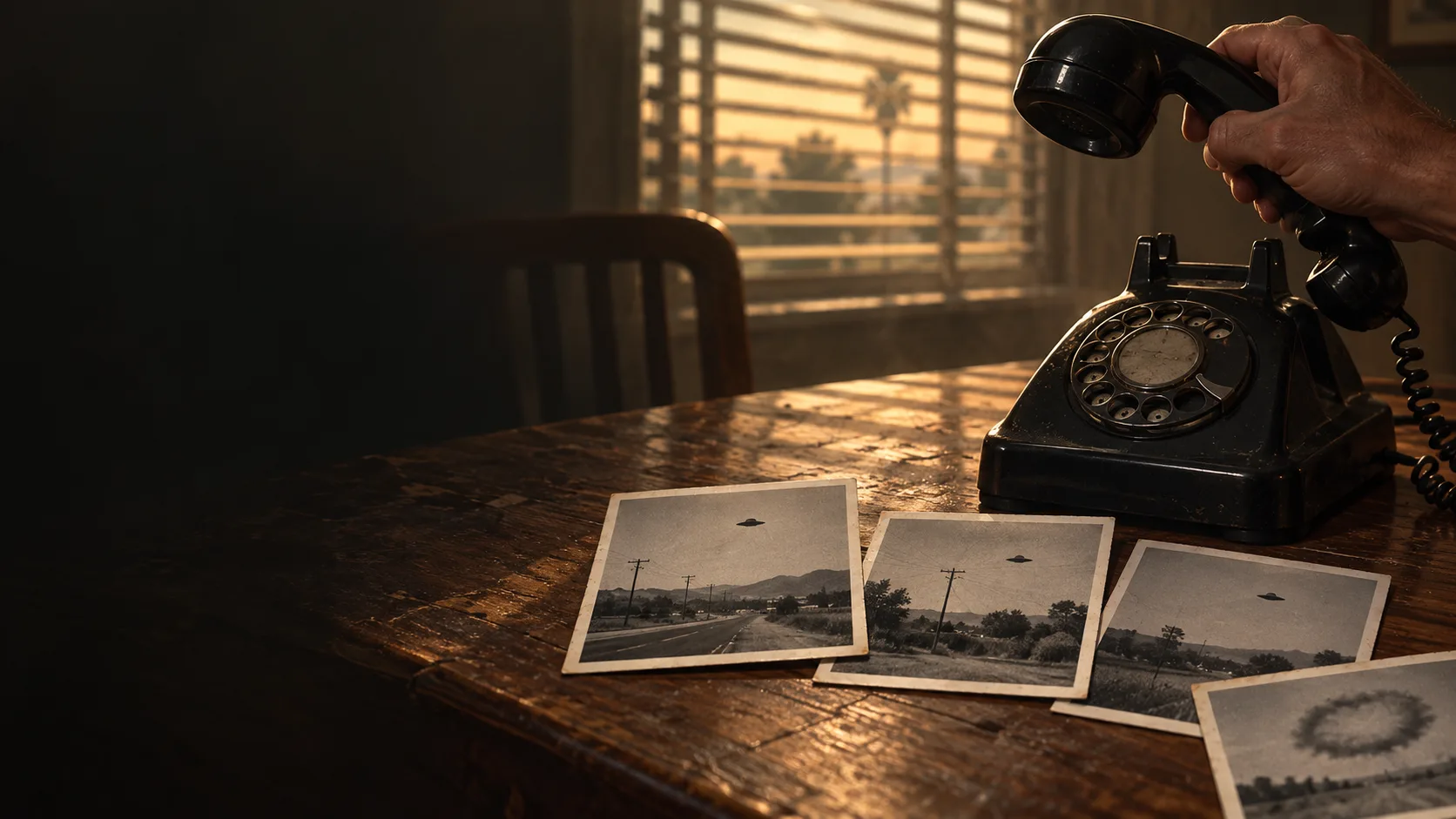
The man on the telephone identified himself as a colonel from NORAD.
According to the NICAP chronology preserved in Ann Druffel’s papers, he wanted Rex Heflin to stop commenting on his photographs until they could discuss them. A tentative meeting was set for September 22, 1965.
The caller did not follow up.
By then, Heflin’s pictures were moving far beyond the California road where he said he had taken them. Newspaper readers could examine a dark, hat-shaped object suspended above an ordinary landscape. Military investigators wanted the prints. Strangers wanted to speak to the photographer.
That unanswered appointment would become one strand of a much larger story. Another concerned visitors who, Heflin said, appeared at his house and left with the originals.
Beside Myford Road
Seven weeks earlier, Heflin had been driving a county vehicle near Santa Ana. His job involved traffic investigation, and a Polaroid camera was part of his working equipment.
It was August 3, around midday. Myford Road ran through a landscape of fields, utility poles and nearby military aviation. In the Air Force investigator’s account, Heflin first caught something at the edge of his vision. He initially took it for a helicopter.
Then it moved into the view ahead of his vehicle.
Its shape made him stop. He reached for the camera on the front seat and photographed it through the windscreen. Two more pictures followed through the side window.
The prints showed a low dome above a broader rim. The road, mirror and window frame supplied an everyday foreground: a working man’s view from a vehicle, interrupted by something unfamiliar above the fields.
In Richard Hall’s later summary, Heflin described a rotating strip of light beneath the object. He also reported that his two-way radio had failed around the encounter and worked afterwards.
The object departed. Heflin produced a fourth photograph showing a dark smoke ring, which he associated with its disappearance.
Three pictures of an apparent object, and one of what he said it left behind: the sequence would occupy investigators for decades.
Prints passed from hand to hand
At the end of the working day, Heflin showed the photographs to coworkers.
Their circulation began with people close to him. Copies were made. Friends and relatives saw them. The small prints could be borrowed, taken elsewhere and shown to another interested person.
The Air Force’s September investigation traced a submission to Life magazine, followed by the photographs’ return. The magazine declined to use them. Meanwhile, more copies were circulating locally.
Ann Druffel, who participated in the civilian investigation, later described how the pictures reached the Santa Ana Register. In her 2006 retrospective, relatives and local acquaintances formed the route between Heflin and the newspaper. Chief photographer Clay T. Miller made copies from the originals.
The Register published the story on September 20. Newswire distribution carried it farther.
Heflin had photographed something during his working day. Now people who had never met him were studying the result. The camera had given the episode a life beyond its witness: anyone holding a newspaper could look at the strange shape for themselves.
Calls to an unlisted number
The attention soon reached his telephone.
Captain Charles F. Reichmuth’s contemporary report records Heflin describing apparent prank calls and bomb threats. Heflin was concerned that callers had found an unlisted number. His name had appeared in the papers; his home telephone number had not.
There were also calls carrying claims of professional authority. One man said he represented Boeing. Another invoked NORAD. Requests that Heflin stop speaking about the photographs entered the story alongside newspaper enquiries and legitimate military interest.
At work, the telephone traffic was becoming disruptive too. The Road Department was receiving enquiries from across the country. Officials arranged for callers to contact Heflin at home after working hours, and for some evening appointments to be made there.
The county investigator’s house became another place where the photographs could be discussed. There was no single, orderly inquiry. Reporters, military personnel, civilian researchers and people whose identities Heflin could not establish were all seeking access to him.
Returned at noon
The Marines at El Toro had borrowed the original prints.
On September 22, they returned them. The NICAP chronology records a signed receipt. Reichmuth’s report places their return at noon.
That was a completed transaction: identifiable military investigators had obtained the photographs, copied them and brought them back.
What followed survives as Heflin’s account.
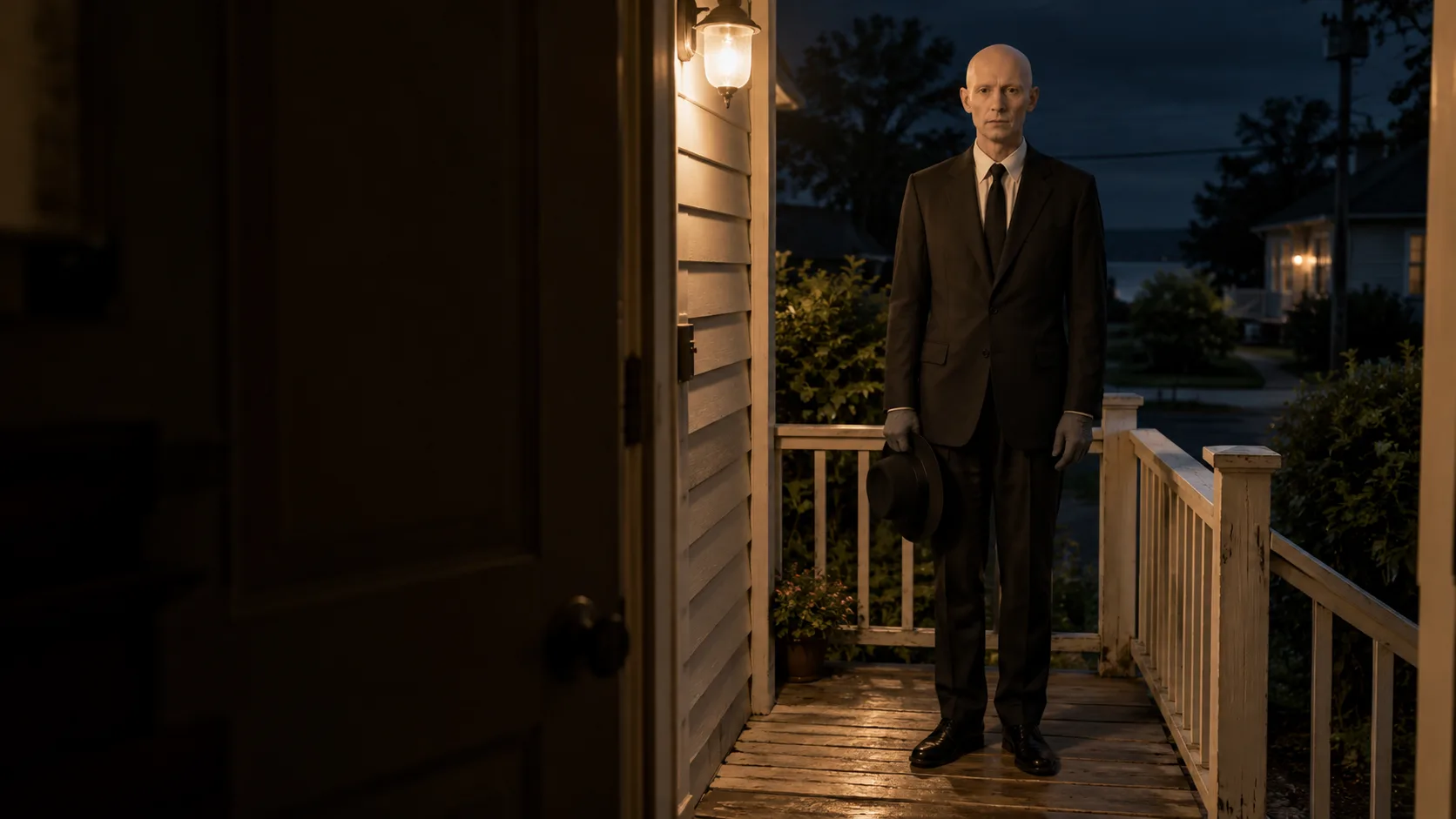
The chronology’s next entry says that two men claiming to represent NORAD arrived a few hours later. They showed identification and asked to borrow the three original photographs of the object. Heflin handed them over. The entry says they had not been returned.
Reichmuth recorded a different detail when he interviewed Heflin the following day: a single man in civilian clothes, arriving during the evening. Heflin remembered a card with differently coloured sections, shown in the porch light. He had not examined it closely. He expected the prints to come back and had obtained no receipt.
The supposed NORAD connection had moved from a voice on a telephone to a claimed visit at the door.
An investigator at the office
On September 23, Reichmuth went to the Road Department looking for Heflin.
He spoke with supervisors while the traffic investigator was still in the field. When Heflin returned, the captain questioned him for more than three hours.
The resulting report preserves a surprisingly patient exchange. Reichmuth suggested that the photographed object might have been only about three feet across. Heflin remained convinced it had been much larger. He did not respond with anger; he discussed the estimate.
The captain wanted the originals examined by qualified photographic interpreters. Heflin agreed to send them when they came back from the alleged NORAD representative.
There was also a practical instruction for any further contact: obtain a name, an office address and information establishing official status. Heflin agreed that he would do so, or decline to speak to the person.
The photographs had already passed through several hands without difficulty. This time, the expected return was becoming part of the investigation itself.
The search continues
Civilian investigators kept working with the available copies. Engineers returned to Myford Road; photographic specialists examined the images; correspondence accumulated around Heflin’s account.
Years later, William K. Hartmann revisited the episode for the University of Colorado’s UFO study. In a January 1968 interview, Heflin insisted that two men had come: one had remained behind the other, while the nearer man displayed identification.
NORAD denied responsibility for the contact. Hartmann treated the visitors’ identity as unresolved. He also preserved the distinction between the telephone caller who never followed up and the separately reported visit.
The three missing prints remained at the centre of that second story. Copies could keep the images in circulation, but they could not bring back the people Heflin said had borrowed the originals.
Another telephone call
The next reported turn came in 1993.
According to Druffel, Robert M. Wood and Eric Kelson’s 2000 reanalysis, Heflin received a call from an unidentified woman asking whether he had checked his mailbox. He looked and found it empty. About half an hour later, she called again.
This time, he reported finding an unmarked manila envelope containing the three lost photographs.
He recognised the blue-ink numbers he had written on them. There were additional markings that he said were not his. The prints appeared well preserved. He later entrusted all four originals to Druffel, allowing the team to resume analysis using the actual photographic material.
The pictures had returned, in his telling, without the people who could explain their absence. A telephone call had announced authority in 1965. Another, twenty-eight years later, directed him to an envelope.
What Is Known
The surviving record includes photographs, military reports, civilian correspondence and Epperson’s chronology. The alleged visit appears in both that chronology and Reichmuth’s September 1965 report; it was not simply added decades later. The accounts differ over the number of visitors and their arrival time. Neither establishes their identity.
The collection guide describes the unfulfilled telephone appointment but overlooks the chronology’s separate visit entry. Reading page two of the scan changes that impression. The document challenges a tidy Men in Black legend, but does not erase Heflin’s allegation that someone borrowed the prints.
Photographic interpretations also differed. Blue Book classified the case as a hoax. Hartmann’s later assessment was inconclusive. The 2000 team argued that its reanalysis supported Heflin. Those are investigators’ conclusions, rather than a demonstrated identification of the photographed object. The reported mailbox episode comes from the later account.
The Bigger Picture
NORAD’s name carried particular weight in 1965. As its official history of the agreement explains, the joint American–Canadian command had been created to coordinate continental air defence against Soviet bombers. A caller invoking it borrowed the authority of an organisation concerned with threats arriving through the sky.
The Air Force itself acknowledged receiving allegations of impersonation. A March 1, 1967 memorandum signed by Lieutenant General Hewitt T. Wheless mentioned an individual claiming NORAD affiliation who reportedly obtained a citizen’s photographs. The memorandum explicitly described the information as unverified, named no witness and instructed personnel to notify local Office of Special Investigations offices about such reports. It documents official concern, without identifying Heflin’s alleged visitor.
Heflin’s story occupies that uneasy space between recognisable institutions and people claiming to speak for them. The verified investigators left reports, correspondence and receipts. The disputed callers and visitors left accounts of conversations and a gap in the photographs’ custody.
The lasting mystery is therefore more particular than an arrival of anonymous men in black. A photographer said he trusted someone with his prints. The organisation invoked denied sending that person. The photographs eventually reappeared, according to a later account; the identity behind the claim of authority did not.
Sources
- Idabel Epperson, “Rex Heflin Case: Chronology of Events.” Scanned NICAP chronology and attachments, covering developments into 1966; page two records both the caller and alleged visitors.
- Project Blue Book Heflin documents. Contemporary Air Force and Marine Corps material reproduced by NICAP, including Reichmuth’s report forwarded September 30, 1965.
- Richard Hall, “Heflin UFO Photos.” Later NICAP summary and favourable interpretation.
- Ann Druffel, “Goodbye, Rex Heflin,” August 2006. Retrospective by a participating civilian investigator.
- William K. Hartmann, Condon Report, Case 52. Later investigation incorporating contemporary records and a 1968 interview.
- Druffel, Wood and Kelson, “Reanalysis of the 1965 Heflin UFO Photos,” 2000. Later technical paper and account of the reported 1993 return.
- Expanding Frontiers Research, Ann Druffel Special Collection. Archival guide; its Heflin summary should be compared with the scan.
- Hewitt T. Wheless, “Impersonations of Air Force Officers,” March 1, 1967. Official memorandum, reproduced as a scan; allegations expressly unverified.
- NORAD, “NORAD Agreement.” Independent institutional context for the command’s creation and original mission.