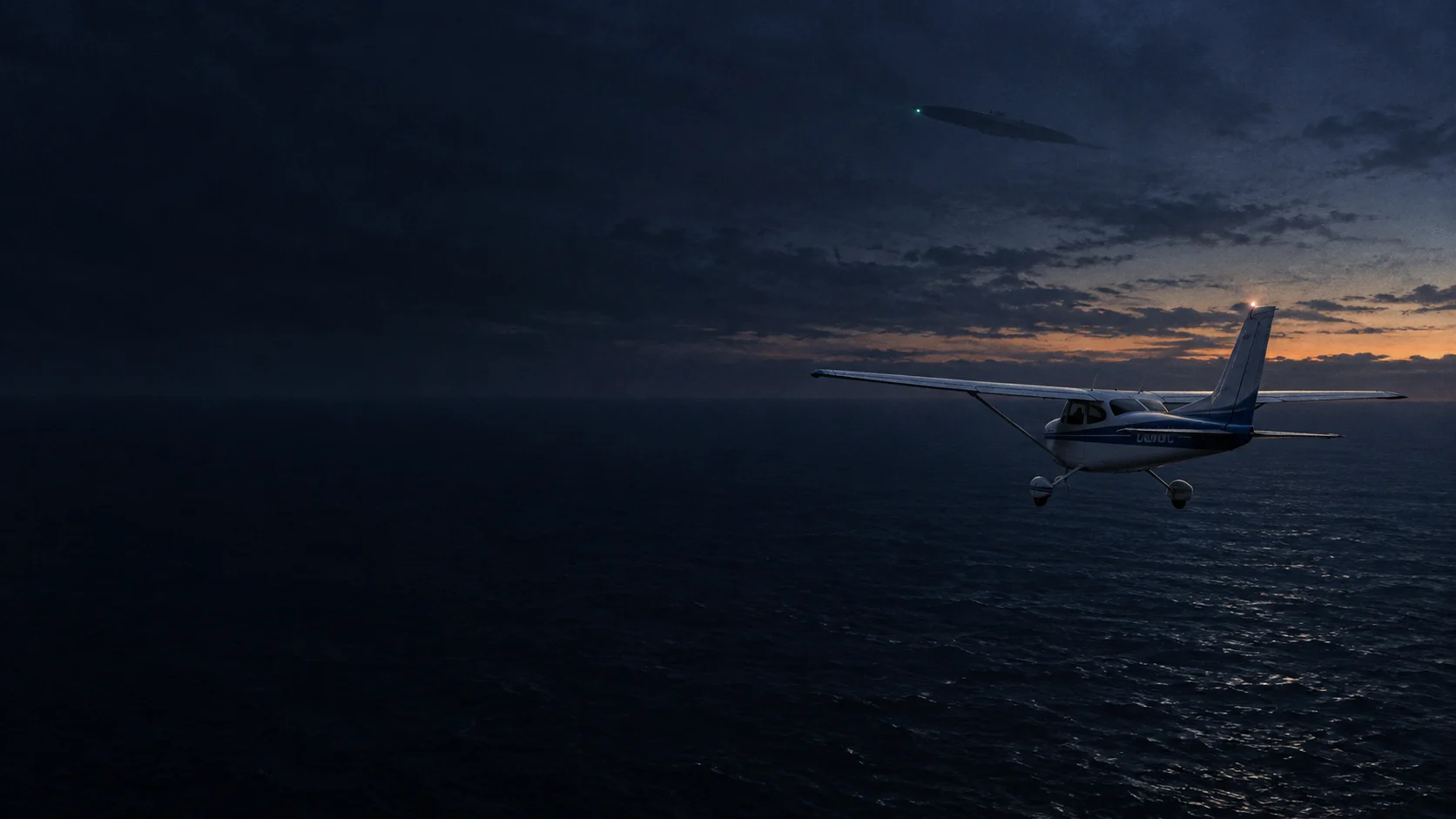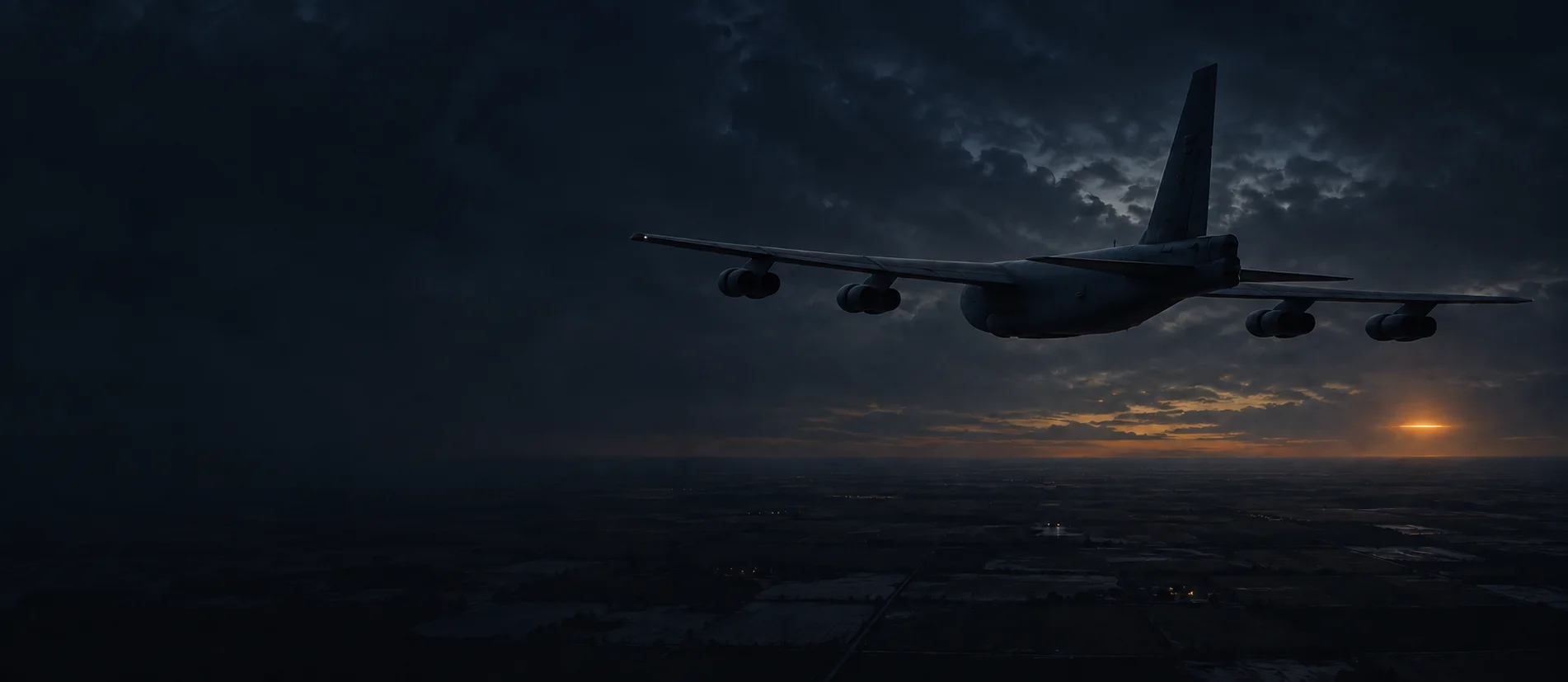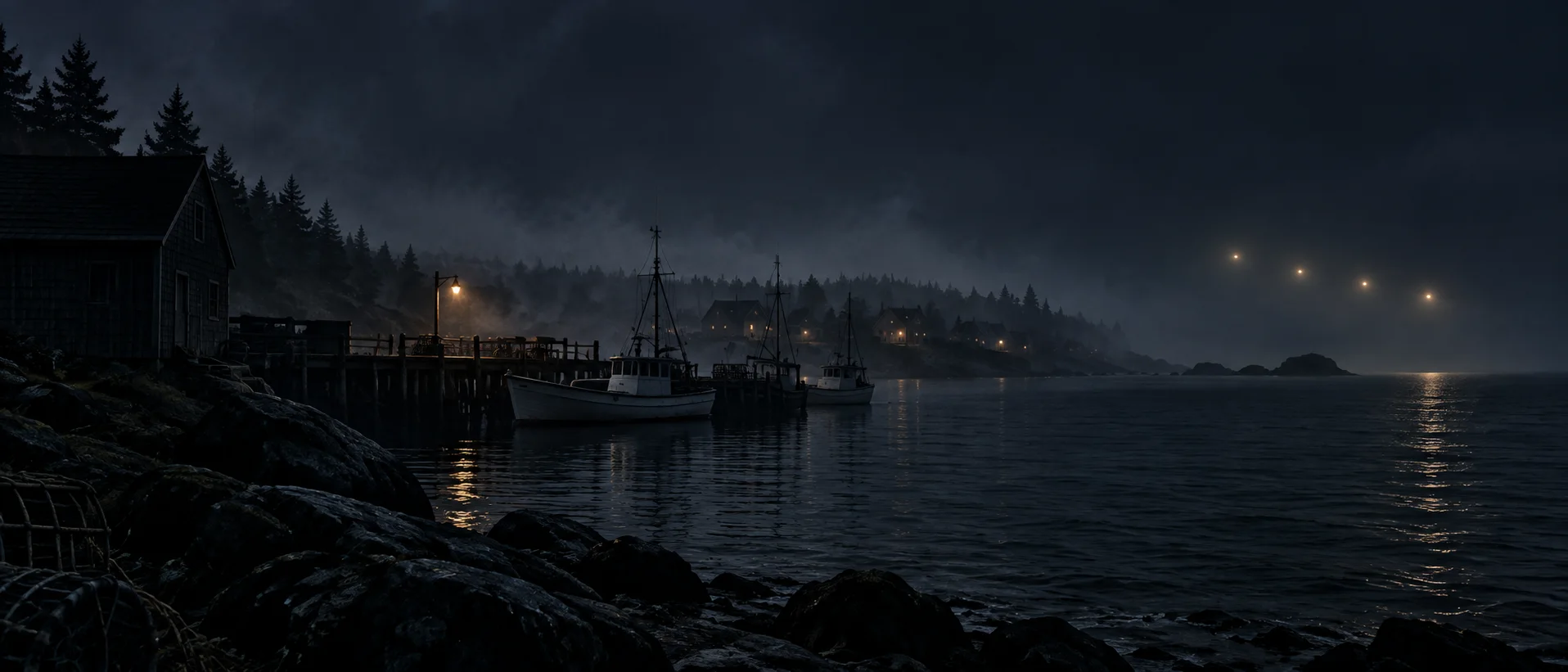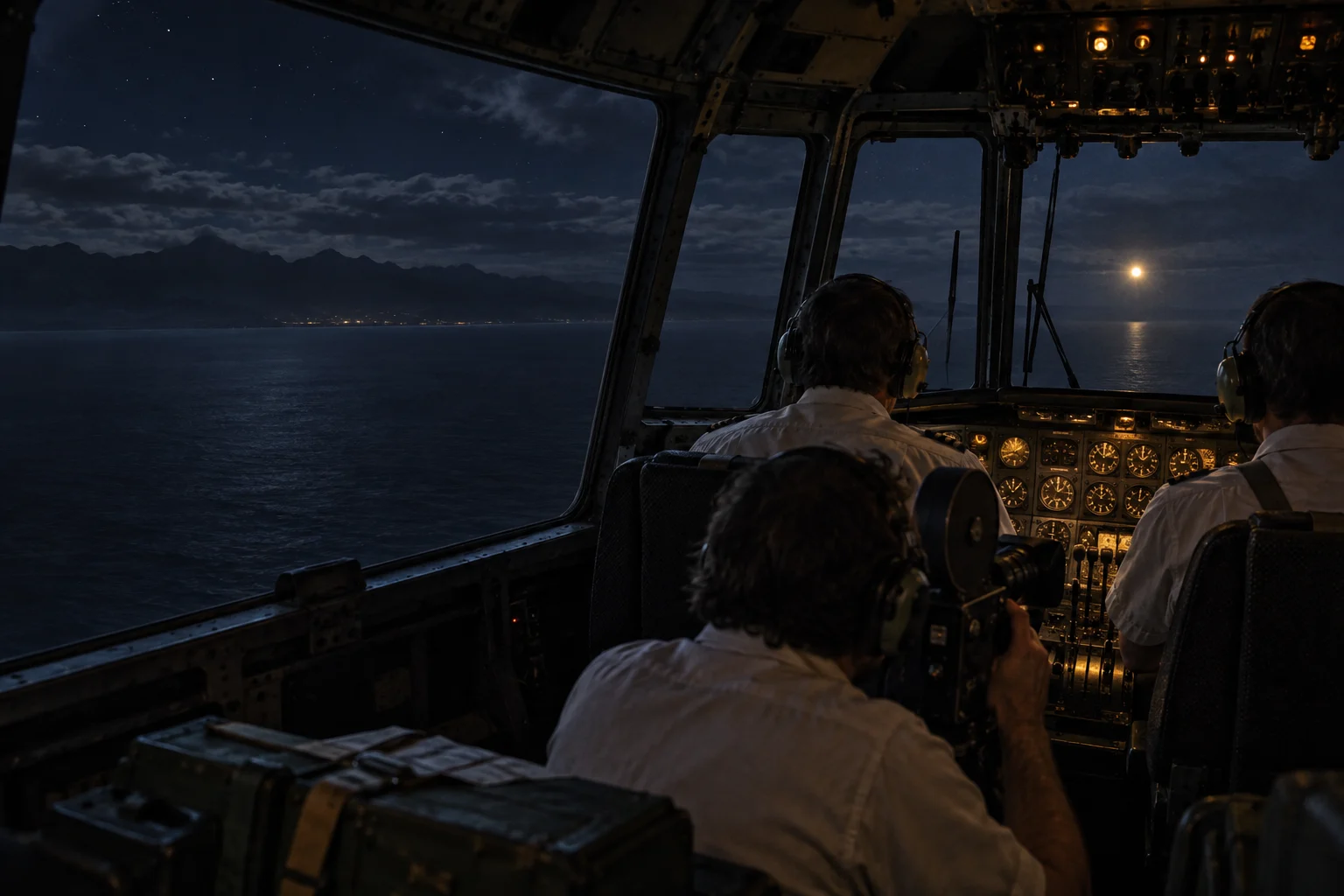
The light was off to the right, below the aircraft, and seemed to be keeping pace.
Dennis Grant checked his watch. It was 2:18 in the morning. First Officer Bob Guard had pointed it out to him after the journalists came forward to the flight deck.
From where Grant stood, the light looked circular, whitish yellow, changing in intensity. At one point, he reported seeing its reflection on the ocean beneath it.
Ahead of him were two pilots. Beside him was Quentin Fogarty, an Australian television reporter. Between and behind the front seats, cameraman David Crockett was working with a film camera.
The Argosy had left Christchurch in the early hours of December 31, 1978. It was carrying a television crew back north after a flight on which they had already watched strange lights along the coast. Now there was another light outside, and the camera was recording again.
The Newspaper Run
Hours earlier, the aircraft’s journey had begun as scheduled work.
Safe Air’s four-engine freighter was flying a newspaper delivery route linking Blenheim, Wellington and Christchurch before returning to Blenheim. Captain Bill Startup and First Officer Robert Guard—usually called Bob—were the crew. The aircraft was ZK-SAE, Merchant Enterprise.
The extra passengers had a different assignment. Fogarty was reporting for Melbourne’s Channel 0. David Crockett would operate the 16mm camera; his wife, Ngaire, would handle the tape recorder. They had come to obtain material about lights reported on an earlier flight.
On December 21, Captain Vern Powell had described an unusual bright light while flying from Blenheim toward Christchurch. The account drew attention to the stretch of coast the news team was about to cross. The catalogue for Crockett’s 1979 documentary preserves that earlier flight as the beginning of the film’s story.
At 11:46 p.m. on December 30, the Argosy departed Wellington.
Lights Beyond Cape Campbell
The route took the freighter toward Cape Campbell and down the eastern side of the South Island. Beyond the flight deck lay the coast, the sea and the lights of settlements.
At about 12:13, while climbing toward fourteen thousand feet, the pilots noticed four or five lights near the coast, with Kaikōura’s town lights behind them. Startup’s interview summary describes one as white and pulsing, resembling a searchlight sweeping toward the beach north of the peninsula.
The crew asked Wellington whether radar showed anything in that area. The controller reported contacts ahead of the aircraft.
David began filming. Fogarty and Ngaire’s recording captured descriptions as the flight continued. The unfamiliar lights were now part of several tasks happening together: the pilots following their route, the reporter describing the view, the cameraman trying to hold a light in frame, the controller watching a screen elsewhere.
The lights appeared in the forward and right-hand part of the view. Their positions were described relative to the aircraft and the coast. At times, a light would be visible; at others, attention returned to something Wellington was reporting.
The freighter continued south. What had brought the news team aboard was unfolding outside their own windows.
Wellington Calls Back
The radio kept bringing the ground into the flight deck.
Around 12:18, Wellington advised the crew of a return behind them. Startup made an orbit to look. Later in the southbound journey, another report prompted a further turn.
As the freighter approached the part of the route known as Kaikōura East, the exchanges became more involved. The aircraft changed to Christchurch’s frequency. Wellington then reported a target behind it, and Christchurch asked the pilots to return to the Wellington channel.
In Bruce Maccabee’s reconstruction from the recordings and interviews, Wellington first placed a target behind the aircraft, then reported another to its right. A subsequent call described a target apparently flying alongside it.
The controller was following positions on a screen. Aboard the aircraft, people were looking out into the night. The radio passed one view into the other, giving the crew directions in which to look while Fogarty repeated information into his own recording.
As the Argosy neared the coast at Woodend, Startup and Guard saw a white light on the starboard side. Startup’s interview summary records a reported target at three o’clock to the aircraft. The light remained part of their account of the approach, until close to touchdown.
At 1:01 a.m., the freighter landed at Christchurch.
On the Ground
The newspapers were unloaded. The pilots and television team discussed the flight with radar personnel at the airport.
Fogarty contacted his friend Dennis Grant, a senior journalist with Television One in Christchurch. Grant came to the airport and found the group discussing the sightings.
Ngaire Crockett had decided that she would not make the return flight. Grant’s statement records that she was upset by what she had witnessed. He asked Fogarty whether he could go to Blenheim in her place, then obtained Startup’s agreement.
David and Fogarty would continue north with the pilots. Grant would join them.
A fresh roll of film was loaded for the return journey.
At 2:16, the Argosy took off again.
A Second Flight
Grant and Fogarty initially sat farther back in the aircraft. When they could move forward, they joined the pilots and cameraman on the flight deck.
Grant’s statement preserved in the investigation file places Startup in the left seat, attending to the radar, and Guard in the right seat with the aircraft on autopilot. Crockett sat behind them. Fogarty was to the cameraman’s right; Grant stood to his left.
A bright light had appeared during the climb. Guard described an orange shape seen through cloud. When it became more clearly visible, the witnesses used descriptions of white, yellow and orange for its changing appearance.
Grant recorded the moment Guard pointed it out: 2:18 by his watch. He watched it below and to the right of the Argosy. The pilots had a radar return on the aircraft’s own equipment, which they were now using in mapping mode.
Startup changed the range scale to examine the return. The crew’s attention moved between the glow outside and its possible position on the screen.
Crockett continued filming through the window. The light’s appearance on his camera changed with framing, focus and lens choice, while the other observers described what they were seeing directly. Fogarty’s running account followed the experience as it happened.
Grant made notes. Alongside the camera and the spoken descriptions, the second flight acquired a record in pencil.
Turning Toward It
The Argosy reached thirteen thousand feet. By the time it was some thirty-five to forty miles from Christchurch, the crew had watched the light for a sustained part of the climb and onward flight.
Startup decided to turn toward it.
The maneuver brought the aircraft away from its northbound track. The pilot’s interview summary describes a right turn of approximately ninety degrees. Grant remembered Guard taking the aircraft off autopilot and directing it toward the light.
For the passengers, the sight was now being approached. The pilots were changing the freighter’s course while Crockett tried to keep recording from within the flight deck.
The radar return closed to about ten nautical miles. For a few minutes, the pilots described it as holding a similar relative position even as the aircraft continued moving.
Grant reported that the light moved farther to their right and eventually passed out of his view and off the screen. Startup’s account follows the changing view as the aircraft turned left to regain its route: the light seemed to pass above, behind and below the freighter.
Then the freighter was heading toward its destination again.
Back to Blenheim
Grant still had more to record.
On the approach to Blenheim, he described a smaller light ahead, then another appearing at a similar height several minutes later. As the Argosy turned for landing, both passed out of his view.
At 3:15 a.m., the aircraft landed.
Grant arranged for a film crew to come to Blenheim. Later that morning, he recorded his own account and interviewed Startup and Guard. The night’s observations were already moving into the next stage of their journey, from an airborne experience to a story told on the ground.
The freight route was complete. The film and recordings would travel much farther.
What Is Known
The released RNZAF file AIR 1080/6/897, Volume 1 contains witness material, interview summaries, charts, technical reports and correspondence from 1978–1981. The scan’s release cover identifies it as a copied and redacted public file. The witness and pilot pages used here were checked visually against that scan.
The principal narrative follows Startup’s interview summary on scan pages 172–173 and Grant’s statement on pages 130–133. These are accounts recorded after the flight. Grant also made notes during it, as described in Maccabee’s provisional 1979 report included in the same file.
Maccabee’s reconstruction draws on the Wellington air-traffic recording, Fogarty’s onboard recording, Grant’s notes, interviews and the 16mm film. It is an independent investigator’s work preserved within the official collection. Its presence there does not make its conclusions an RNZAF finding.
The southbound radar reports came from Wellington; Startup’s summary says the aircraft radar was not used for those observations. On the northbound leg, the crew described returns on their own radar. The article keeps these separate and presents the relationship between lights and returns as something reported by the observers.
Ngā Taonga’s catalogue preserves UFO: A True Story, Crockett’s 1979 documentary, reference F1910. Fogarty’s 1982 BUFORA article records his later response to the ensuing debate. The film, testimony and documents establish a recorded encounter and investigation; they do not establish an extraterrestrial origin.
The Bigger Picture
The aircraft had a history before it carried the cameras.
The Argosy Trust’s account of Safe Air describes a freight airline built around connections between New Zealand’s islands and transport networks. Its aircraft moved goods across Cook Strait, helping join places separated by water. The newspaper run belonged to that practical world: aircraft traveling at night so that cargo could arrive for the next morning.
On this journey, the freight aircraft also carried people whose work was to make an experience visible to others. Crockett worked with moving images; Fogarty with spoken description; Grant with notes and subsequent interviews. Controllers and pilots added their own professional ways of following a position and reporting what they saw.
The resulting story has several viewpoints. A light framed through a camera is one of them. A pilot changing course toward it is another. So is a controller reporting a target to people who are looking out into a different stretch of darkness.
The Argosy Trust identifies ZK-SAE with the encounter, and the aircraft remains preserved at Woodbourne. That gives the case a tangible connection to the ordinary machine at its center: the freighter that completed its route while carrying a story none of its passengers had planned to bring back in that form.
The encounter’s lasting image is the light outside. Its human center remains inside the aircraft—people looking through windows, comparing what they could see, and keeping the camera running as the coast passed beneath them.
Sources
- RNZAF, AIR 1080/6/897, Volume 1, Investigations of Unidentified & Radar Sightings East Coast South Island, 1978–1981. Released public scan mirrored by UFO Transparency; pilot interview summary on scan pp. 172–173 and associated papers. Original pages visually checked rather than relying solely on the mirror’s automated transcription.
- Dennis Grant, witness statement, scan pp. 130–133. First-person account within the same released file, used for the passenger change, flight-deck positions and return flight.
- Bruce S. Maccabee, What Really Happened in New Zealand, provisional 1979 report. Independent reconstruction included in the file and forwarded to the Ministry of Defence in June 1979; used for the route, recordings and southbound exchanges.
- Quentin Fogarty, “The New Zealand Sighting — December 1978 — And Its Aftermath,” BUFORA Bulletin, 1982. Participant’s later account of the public debate, beginning on scan p. 9.
- Ngā Taonga Sound & Vision, UFO: A True Story, 1979, F1910. Archival catalogue and synopsis of David Crockett’s documentary; the synopsis is distinguished from directly viewing the film.
- Argosy Trust, Kaikōura encounter account. Aircraft identification and heritage context; later summary, not an additional independent witness account.
- Argosy Trust, Safe Air history. Historical context for the airline’s freight operations.
- Argosy Trust, preserved aircraft at Woodbourne. Present-day preservation context for the closing section.