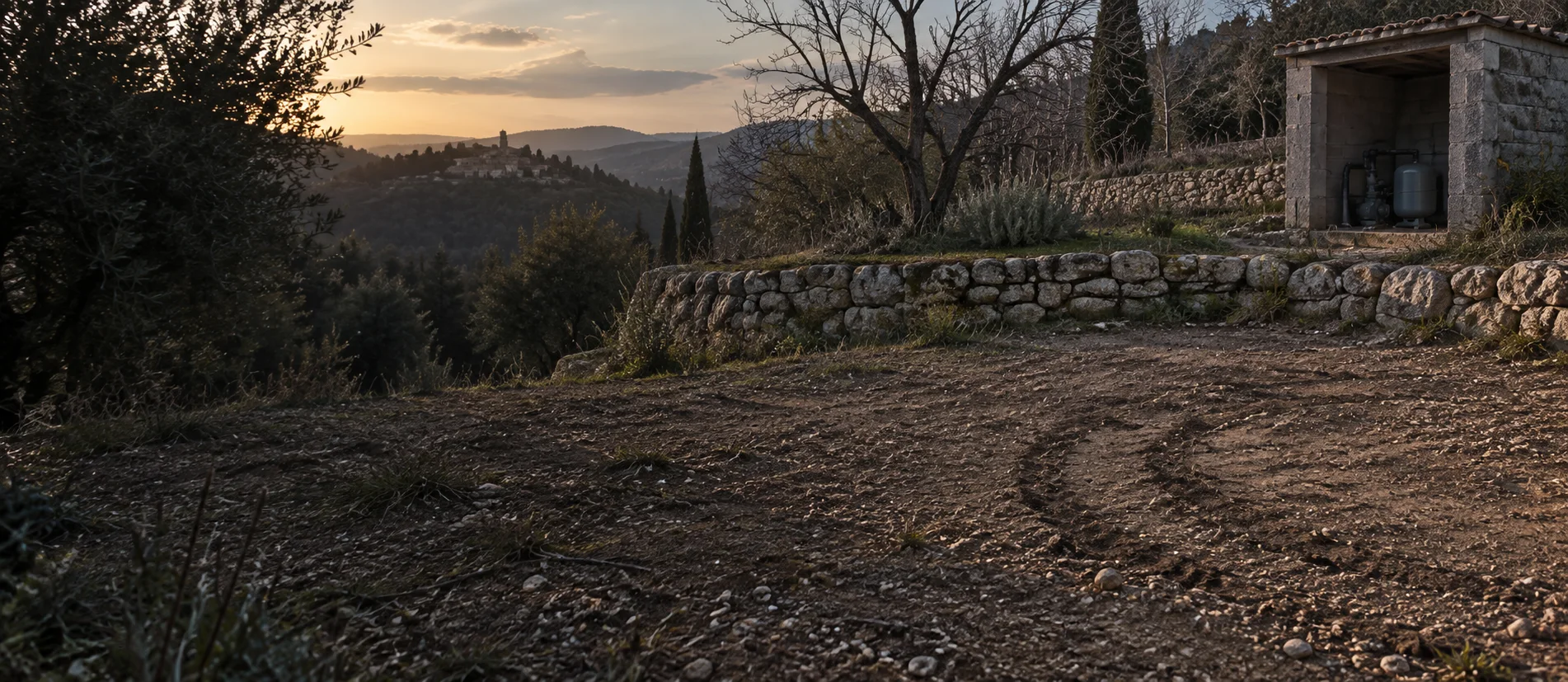
The object was gone by the time anyone else came to look. What remained, according to the man who had watched it, was a mark in the earth.
On January 8, 1981, Renato Nicolai was working on a small masonry shelter for a pump at his property in Trans-en-Provence, in southeastern France. He reported hearing a whistling sound and seeing a grey object descend onto a lower terrace. It stayed briefly, rose and disappeared rapidly. The whole observation lasted an estimated thirty to forty seconds. When he approached the place, he found curved marks on the ground. That sequence is preserved in GEIPAN’s case summary.
There was one witness to the reported object. But the next day, gendarmes could examine something more durable than his memory: the soil itself. Their visit began an investigation that would involve laboratories, plant chemistry and years of argument over what physical evidence can actually prove.
A shape above the terrace
The 1983 technical report reproduces Nicolai’s early statement alongside accounts collected by other investigators. He compared the shape to two inverted plates placed together, with a ridge around the circumference. During its departure, he described circular features underneath, uncertain whether they were feet, propulsion fittings or openings. These were his interpretations of a brief view, rather than identified mechanical components.
The setting supplied familiar reference points: terraces, trees, walls and the buildings on his own property. Yet the report records a mismatch between the object’s proportions in his drawings and his spoken size estimates. The evidence did not resolve into a reliable engineering drawing.
That is part of the encounter’s tension. The account places an unfamiliar object close to ordinary masonry work, with enough apparent detail to suggest a manufactured thing. But the seconds available to observe it were also the seconds in which its movement, shape and disappearance had to be understood. Details that sound precise in a written statement may still originate in a rapid estimate.
Nicolai’s comparisons were drawn from recognizable objects. Plates supplied a shape; the structures beneath suggested possible functions. A description can faithfully preserve what a witness thought he saw without establishing what the thing actually was. Investigators would have to compare that account with the marks, rather than allowing the description to determine their explanation in advance.
The gendarmes arrive
According to investigator Jean-Jacques Velasco’s 1990 account, neighbours first alerted the gendarmerie. An officer visited on January 9, at about 11:30 a.m. Police collected samples. GEPAN learned of the case on January 12, after heavy rain over the weekend. The team requested delivery of the earlier samples instead of travelling immediately, judging that the rain had reduced the value of an immediate visit.
Private investigators also reached the property following press coverage. This was already becoming a public case while the scientific inquiry was still being organized. Velasco’s article is a later account by someone involved in the investigation, not a separate witness to the reported landing.
The chronology matters because a trace has a history after discovery. A photograph can fix its appearance at one moment. A sample can preserve part of its composition. Neither automatically records how the ground looked before the sighting. Investigators arriving afterward must reconstruct that earlier condition from testimony, site history and comparisons with nearby ground.
The report’s title would eventually put the emphasis squarely on that task: Analysis of a Trace. The object could not be examined. The claim that it had interacted with the garden could.
Soil under the microscope
The SNEAP laboratory report describes dark deposits containing iron or iron oxide attached to limestone grains. Its investigators interpreted the surface as showing friction and a thermal effect. They estimated a temperature range between roughly 250 and 600 degrees Celsius from the appearance and mineral behaviour of the material.
That estimate was retrospective. No thermometer recorded the reported event. The same analysis found no significant water-content difference between the material from the trace and nearby rock, and did not find evidence of substantial surface-water evaporation. The individual findings deserve to remain visible together, rather than being compressed into a dramatic claim that the garden had been scorched by a flying machine.
The material gave analysts a real question: what process could produce the observed deposits and surface condition? It did not provide a label naming that process. Friction is a class of interaction. Heat is an inferred effect. Neither specifies an aircraft, a vehicle or an unfamiliar source of energy.
Another laboratory report, dated October 12, 1981, used microscopy and electron diffraction. The analysts compared reference soil with dark, shiny particles selected from the trace. They warned that preparation would make highly soluble constituents difficult to observe and that the dark particles could not be completely separated from the underlying earth.
Some diffraction patterns differed between the selected material and the reference samples. The researchers also heated reference material under vacuum to 1,000 degrees Celsius for two hours; that experiment did not reproduce the particular single-crystal feature they had observed in some trace samples.
An unsuccessful reproduction narrows a question only as far as the experiment’s conditions permit. Heating a prepared sample under vacuum is one intervention. A failure to reproduce a feature that way does not exclude every combination of pressure, abrasion, chemistry and temperature that might occur outdoors. The result is useful because its procedure can be examined and repeated, rather than because it ends the inquiry.
The plants beyond the marks
GEPAN visited on February 17, when the marks were still visible, and collected further soil and vegetation. The official case summary reports that an INRA biochemistry laboratory found plant alterations correlated with distance from the trace. Their cause remained unidentified; an intense electrical field was considered as a possibility.
This shifted attention from the obvious scuffs to effects that were less apparent to someone standing in the garden. If a brief event had affected vegetation beyond its point of contact, the pattern might help distinguish a local mechanical mark from a wider exposure. But a distance pattern also depends on how the plants were selected and on whether the comparison specimens had similar growing conditions.
The appeal of plant evidence is easy to understand. Unlike a drawing made after the event, a leaf can be tested for chemical differences. Yet its chemistry carries its own history. To connect a difference to one afternoon, the investigation needs to establish when the change occurred and why the selected comparison plants represent what would otherwise have been present at the site.
That link would become one of the central disputes. A measured difference and an identified cause are different achievements, even when the difference lies close to the reported landing place.
A return to the garden
Jacques Vallée revisited the property in 1988 and published Return to Trans-en-Provence in 1990. He interviewed Nicolai and his wife and arranged American laboratory examination of samples retained from the initial investigation.
Vallée addressed a proposed ordinary explanation: that a tractor or drilling equipment had produced the marks and that materials associated with the work had affected the plants. His paper reported no indication of cement powder, oil or chemical contaminants of the kind being proposed in the samples examined. Calcium and silicon dominated, with aluminium and iron also present. He regarded the findings and interviews as supporting the original inquiry and the witness.
The return visit added a further examination of preserved material. It could not recreate the unobserved condition of the garden before January 8. A negative result for selected contaminants is evidence against those particular suggestions in those samples; it does not establish that no terrestrial activity could have made the marks.
The continuing inquiry therefore turned on more than belief in Nicolai. Supporters and critics could agree that samples existed while disagreeing about whether those samples connected the reported object to a specific physical process.
What the record establishes
The documented core is substantial: a prompt report of a brief encounter, police examination the next day, photographed ground marks, collected material and laboratory analyses. GEPAN’s 1983 conclusion judged that significant physical changes had occurred at the site. It also stated that the interpretations were too varied and imprecise to confirm the witness’s narrative definitively. That reservation belongs beside the findings whenever the case is described as scientifically investigated.
The investigation’s methods have been challenged. In their 2007 critique, David Rossoni, Éric Maillot and Éric Déguillaume argue that the visible marks were separated arcs rather than a complete circular imprint. They emphasize the early comparison with tyre scuffs and question the protection and history of the site. They also challenge plant comparisons made across different collection dates and the use of sampling along one axis to infer a broader spatial pattern.
Those are methodological objections, not a recovered explanation for the entire encounter. Their force is that they identify steps needed to connect a measurement with a cause. A convincing alternative would likewise need evidence explaining the marks, their timing and the witness’s observation; proposing a vehicle does not by itself demonstrate that one produced this trace.
The visual account remains a single person’s testimony. The measured material is physical evidence of the sampled ground’s condition, with interpretations attached to it. The electrical-field suggestion is a hypothesis. Keeping those categories distinct prevents several laboratories examining material from being mistaken for several witnesses independently confirming a landing.
GEIPAN currently lists the case as category D. Its classification guide defines D as unexplained despite the information available to the service. It does not assign an extraterrestrial origin. The strongest warranted description is an unresolved reported encounter associated with investigated traces whose relationship to the account has not been conclusively established.
The Bigger Picture
Trans-en-Provence exposes a difficult problem in UFO research: physical evidence can be real without confirming the explanation attached to it. A mark has shape and composition. Establishing what made it requires chronology, comparisons and a demonstrated mechanism. The value of laboratory work lies in making those questions more precise.
The independent critique supplies a useful wider lesson about sampling. A line of specimens moving away from a chosen point can reveal a pattern along that line. To infer an effect radiating from the point, an investigator needs comparisons in other directions and control samples chosen for equivalent conditions. Otherwise, a local difference can be mistaken for the footprint of an event.
The most helpful investigation would preserve the earliest photographs, record site access and recent work, and collect comparable samples with their locations and handling documented. Analysts could then test candidate mechanisms without having to accept the sighting account first. A successful explanation should make predictions about the evidence that a competing explanation does not.
The French file remains worth reading because it preserves both an attempt to do that work and limits on its conclusions. The lasting question is whether the garden’s marks and plant chemistry can be securely connected to the thirty or forty seconds Nicolai described. An unidentified mark does not answer it. Neither does an unidentified object. The connection between them is what the investigation had to establish.
Sources
- GEIPAN, Trans-en-Provence case summary and document register. Current official account, classification and links to archived records; a retrospective synthesis.
- GEPAN, Enquête 81/01: Analyse d’une trace, Note Technique 16, March 1, 1983. Primary investigation report, reproducing early testimony and setting out the inquiry’s conclusions and limits.
- SNEAP, soil-analysis report for investigation 81/01. Original laboratory analysis and inferred heating range.
- University microscopy and electron-diffraction report, October 12, 1981. Original methods, material comparisons and heating experiment.
- Jean-Jacques Velasco, Report on the Analysis of Anomalous Physical Traces, 1990, pp. 27–48. Later published account by an investigator involved in the case; not independent corroboration of the sighting.
- Jacques Vallée, Return to Trans-en-Provence, 1990, pp. 19–25. Direct account of the 1988 return visit and analysis of retained samples, with a supportive interpretation.
- David Rossoni, Éric Maillot and Éric Déguillaume, Les OVNI du CNES, chapter 13, 2007. Independent critical examination of testimony, trace geometry, site preservation and sampling methods.
- GEIPAN, explanation of PAN categories, 2021. Official context for the meaning of an unexplained classification.