At about three o’clock on the afternoon of May 20, 1967, an RCMP constable saw a man walking along the Trans-Canada Highway near Falcon Beach, Manitoba. The man waved at the patrol car. He wore a cap and jacket but no shirt, and carried a briefcase. When Constable G. A. Solotki turned back to speak to him, the man warned him to stay away. He feared that something in the woods might have contaminated him.
The man was Stefan Michalak, a Winnipeg mechanic who spent his free time prospecting for minerals. He told Solotki that he had seen two extraordinary objects north of the highway and that one had burned his clothing and chest. The constable’s written account of the encounter, also examined by Library and Archives Canada, is unusually valuable because it begins at the roadside, only hours after the reported event. It also contains an immediate disagreement: Solotki thought the dark material on Michalak’s chest might be ash and could not get close enough to determine whether he was injured. Later officers and doctors would see a burn.
The objects were never photographed. What remained was one man’s account, damaged clothing, a documented injury, and a long search for the place where he said it happened. Those pieces did not all tell the same story.
North of the highway
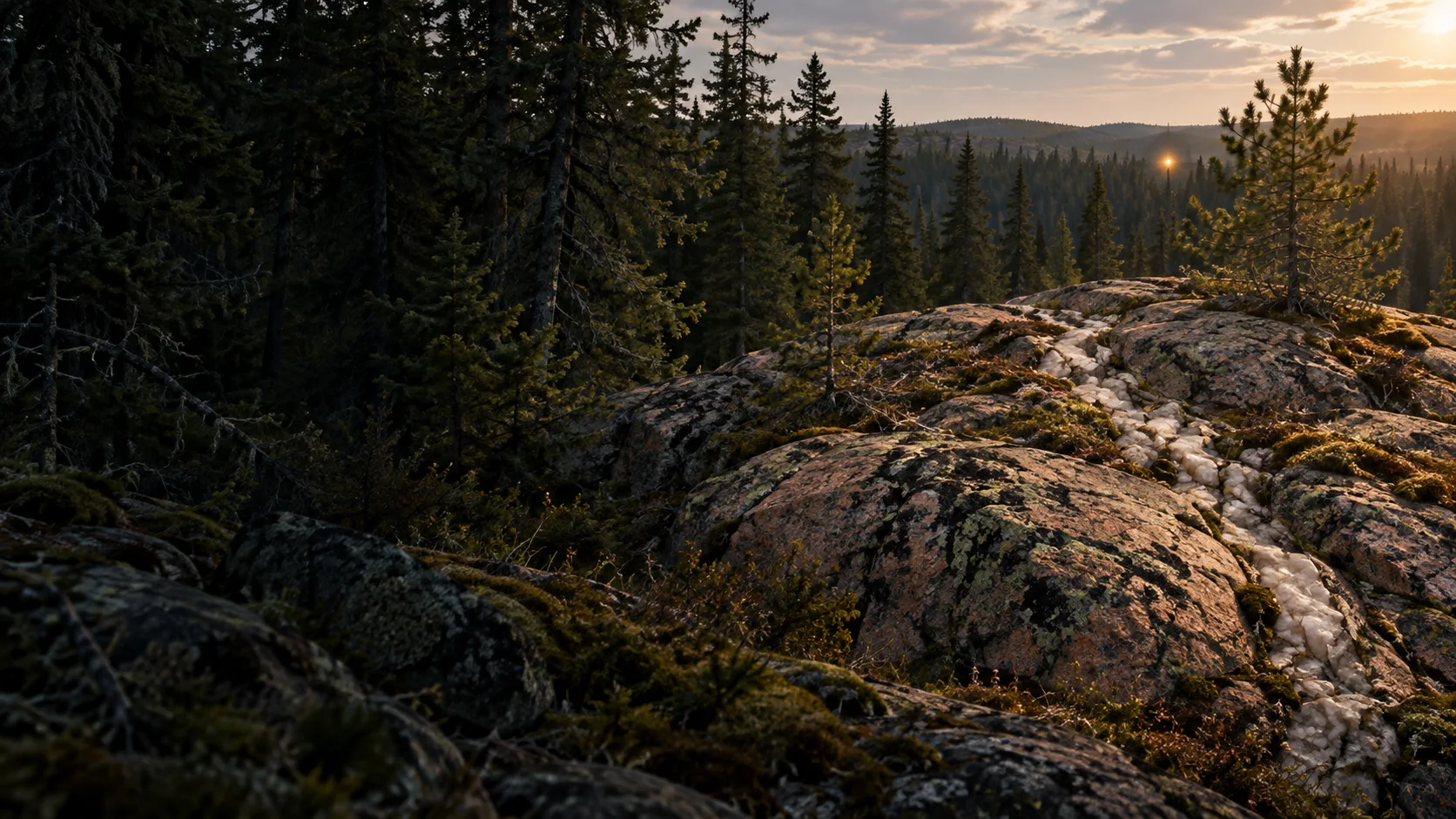
Michalak had travelled from Winnipeg to the Falcon Lake area for the May holiday weekend. The landscape north of the highway was a place to examine exposed rock and quartz veins, rather than the lakeshore of the case’s familiar name. In his 1967 manuscript, read in a Library and Archives Canada programme, he said he left his motel early with a hammer, map, compass, paper and food. His work that morning was ordinary prospecting: following rock outcrops and chipping at quartz.
By his account, the interruption came around midday. Geese nearby began making noise. Michalak looked up and saw two red, glowing objects descending. He said one remained above the ground while the other came down on a rocky outcrop roughly 160 feet from him. The first object then rose and disappeared. The second changed in appearance as he watched, losing its red glow and taking on a metallic look.
This sequence comes from Michalak, not from a second observer in the clearing. The University of Colorado UFO Project’s later case study set out his description in detail: a domed object, openings around its upper section, a hiss, warmth and an unfamiliar smell. He said he watched for a prolonged period, sketched what he saw and eventually noticed an opening in its side. In the account the Colorado investigator recorded, Michalak heard voices and tried several languages, thinking it might be an American vehicle. Nobody answered.
Michalak said he moved close enough to touch the object’s surface with a gloved hand. Then, in his telling, it began to turn. A burst of hot air from a patterned opening struck his upper abdomen, igniting his shirts. He tore them off and stamped at the fire. The object lifted away. Whatever happened in the clearing, this is the event Michalak said explained the burns he carried back to the road.
The Colorado report preserves a vivid account, but it was assembled after the day itself. Michalak’s booklet, also published in 1967, added at least one detail that did not fit his earlier descriptions: the booklet had him looking into the open hatch, while earlier accounts said the light prevented him from seeing inside. That difference does not settle the entire episode. It does show why even a witness’s accounts, recorded months apart, have to be kept in order.
The roadside account
Michalak reached the highway carrying his prospecting equipment and the remains of a shirt. Solotki’s police report, reviewed in Library and Archives Canada’s account, says Michalak was agitated and repeatedly stepped back when the constable tried to approach. Solotki saw a scorched cap but was unable to inspect the shirt. He thought Michalak appeared intoxicated, although he could smell no alcohol. He offered to arrange treatment in Falcon Beach; the report says Michalak declined.
Michalak told a different version. In his own 1967 account, reproduced by Library and Archives Canada, he said the constable left him without help after hearing his story. That conflict has sometimes hardened into the simple claim that the police ignored a burned man. The two accounts agree on the meeting and Michalak’s fear of contamination. They differ over whether help was offered. Neither should silently replace the other.
Michalak made it back to Falcon Beach and later took a bus to Winnipeg. His son brought him to the emergency department at Misericordia Hospital. The Colorado investigation says clinicians treated the abdominal injuries as superficial burns and released him. Michalak did not initially tell the hospital staff a story about a landed object; according to the RCMP’s follow-up report (archival scan), he said an aircraft exhaust had burned him because he feared the fuller account would not be believed.
By May 23, RCMP officers were interviewing him at home. Their report describes him as physically uncomfortable and records a broad, blotchy burn on his abdomen and chest. He complained of headache, nausea, an unpleasant taste and an inability to keep food down. His family doctor, R. Douglas Oatway, examined him; officers also checked his work history and spoke to people who knew him. The police were investigating a report and a sick man’s condition at the same time. The fact that they could see a burn was a firmer observation than any proposed cause for it.
Radiation became an early concern because Michalak feared exposure. Specialists checked him and his clothing. The Colorado report’s review of the medical work says a radiation pathologist found no radiation effects in the burn, blood or clothing and regarded the injury as thermal. A whole-body count a week after the sighting was at ordinary background levels. Those results did not erase his burn or illness. They did undercut the idea that those symptoms demonstrated radiation exposure from a craft.
A place that could not be found
Investigators now wanted the outcrop. A location could hold a trace that a witness statement could not: disturbed vegetation, scorched rock, an object left behind. Michalak said he was willing to return when well enough, although he also wanted to protect the prospecting location from publicity. The search became a test of how precisely the account could be placed on the ground.
On June 1, officers took him back into the bush. The RCMP search report (archival scan) describes hours on foot through dense growth and exposed rock, while Royal Canadian Air Force personnel checked likely places from a helicopter. They found no matching site. The officers returned the next day and searched farther afield from the air, again without finding it. The Colorado Project’s investigator later accompanied another unsuccessful ground search and thought Michalak’s route seemed aimless.
There are several possible reasons a person might fail to relocate a spot in this terrain. None can be established from the failure alone. What matters to the evidence is the interval it created: the alleged landing place was not secured immediately, and the first official searches did not identify it.
Michalak later returned with an associate and said they found the clearing. According to Library and Archives Canada’s review of the files, they removed items and collected soil before officials inspected it. That was the turning point for the physical evidence. The investigators could examine a circle in the moss and rock, but they could no longer observe the scene in the state Michalak said he had left it on May 20.
The official survey did find localized radioactive material. A federal radiation assessment recorded contamination of rock and lichen at the alleged site while leaving its origin undetermined. The Colorado Project’s account of the measurements describes a small contaminated smear along a crack in the rock and some nearby vegetation, with the wider circle and runoff areas testing clean. Samples Michalak supplied were radioactive too. Investigators could document the material’s presence; they could not establish when it arrived or tie it to an airborne object.
Another discovery came later still. In 1968, Michalak and an associate reported finding bent pieces of metal in a fissure at the site. A National Research Council analysis, summarized in the Colorado report, identified largely silver metal with a loose coating of radioactive minerals. It did not identify unfamiliar technology. The pieces had not been recovered in the earlier searches, and their route into the fissure was unknown. Their composition was measured; their connection to the reported encounter was not.
What the record establishes
Falcon Lake has more surviving documentation than many close-encounter stories. The roadside constable recorded an upset man and scorched clothing on the day of the report. Other officers saw an abdominal burn three days later. Medical reviewers described a thermal injury and found no evidence of radiation injury to Michalak. Police and military personnel searched extensively, first without locating the clearing and later documenting a circular area and a small contaminated patch. These observations deserve to be held together, without flattening their different dates and sources.
The central sighting still rests on Michalak alone. The Colorado investigator reported no matching observation from nearby fire lookouts, golfers or radar stations. An absence of reports cannot prove nothing passed overhead, but it leaves no independent track for the two objects Michalak described. The initial failed searches, later handling of site material, difference between versions of his account, and unexplained burn pattern on the back of his undershirt all made the project doubt that the physical evidence established a landed craft.
That skeptical assessment was not a claim that Michalak had no injury. The Colorado report described him as sincere in interview and noted that several officials and physicians considered him credible. Library and Archives Canada recounts an RCMP conclusion that his illness, burns and visible circle remained unexplained. These are assessments of different questions. A credible witness can be mistaken about a cause; a burn can be real without identifying what made it; a contaminated patch can be measured without proving when it appeared.
The best-supported conclusion is narrow: Michalak reported an extraordinary encounter, suffered a documented thermal burn, and later helped identify a site with a localized radioactive trace. The surviving record does not establish that an unconventional vehicle was present or caused any of those findings. It also does not give a demonstrated ordinary sequence that accounts for every part of his experience. The gap between those two conclusions is the case’s enduring tension.
The Bigger Picture
Falcon Lake shows why the timing of evidence matters as much as the amount of it. A police note from the afternoon of an event, a medical examination days later, soil gathered weeks later and metal found a year later may all be genuine records. They do not have the same power to identify one cause. Each step asks a new question about location, handling and what happened between observations.
In its 2023 UAP study, NASA emphasized observations from well-calibrated instruments, with the time, place and conditions needed to interpret them. Falcon Lake began with one person’s account rather than such a sensor record. Investigators worked hard after the fact, but they could not recreate the uninterrupted evidence trail that would have connected an object, the burn and the material in the rock.
The image of a prospector alone in the bush is compelling because the landscape seems capable of hiding an answer. The papers make a more precise demand. To change what can be concluded, there would need to be an independently recorded object or a securely collected sample tied to the moment of the reported encounter. The case has neither. It has a man who emerged from the woods injured, and records that preserve both what he said happened and why investigators could not prove it.
Sources
- RCMP, Constable G. A. Solotki’s report on the May 20 roadside encounter (Library and Archives Canada scan)
- RCMP, Winnipeg investigation report, May 26, 1967 (mirror of the Library and Archives Canada scan)
- RCMP, report on the ground and air searches, June 26, 1967 (mirror of the Library and Archives Canada scan)
- Federal radiation hazard assessment, September 13, 1967 (mirror of the Library and Archives Canada scan)
- University of Colorado UFO Project, Case 22, Scientific Study of Unidentified Flying Objects, 1968
- Library and Archives Canada, “The Falcon Lake incident,” part 1, 2019
- Library and Archives Canada, “The Falcon Lake incident,” part 2, 2019
- NASA, UAP Independent Study Team Report, 2023