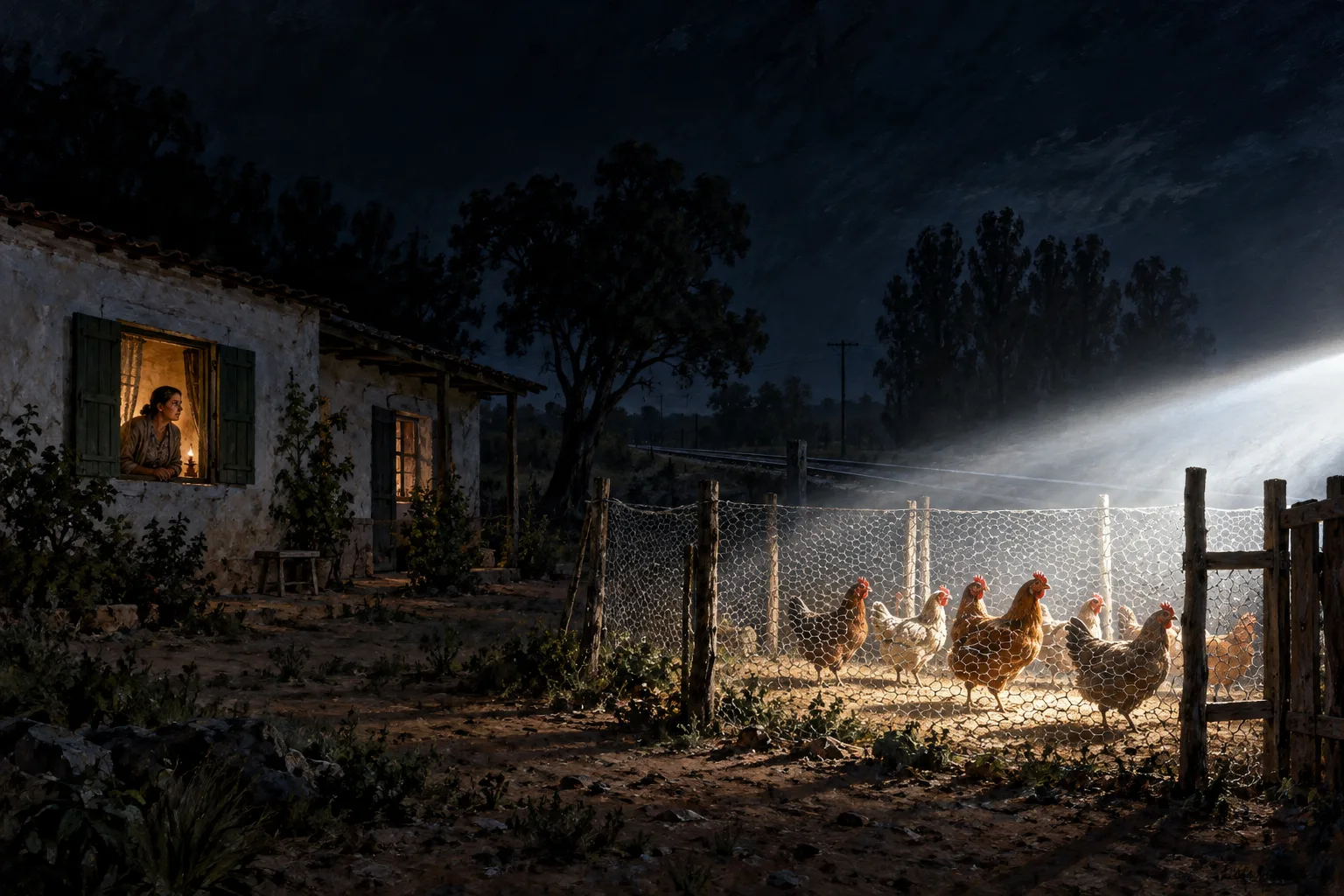
The white beam reached the chicken enclosure, and the birds woke.
Argentina Moreno remembered the clucking. While the light remained on the enclosure, she could hear the chickens; when it moved away, they fell quiet again.
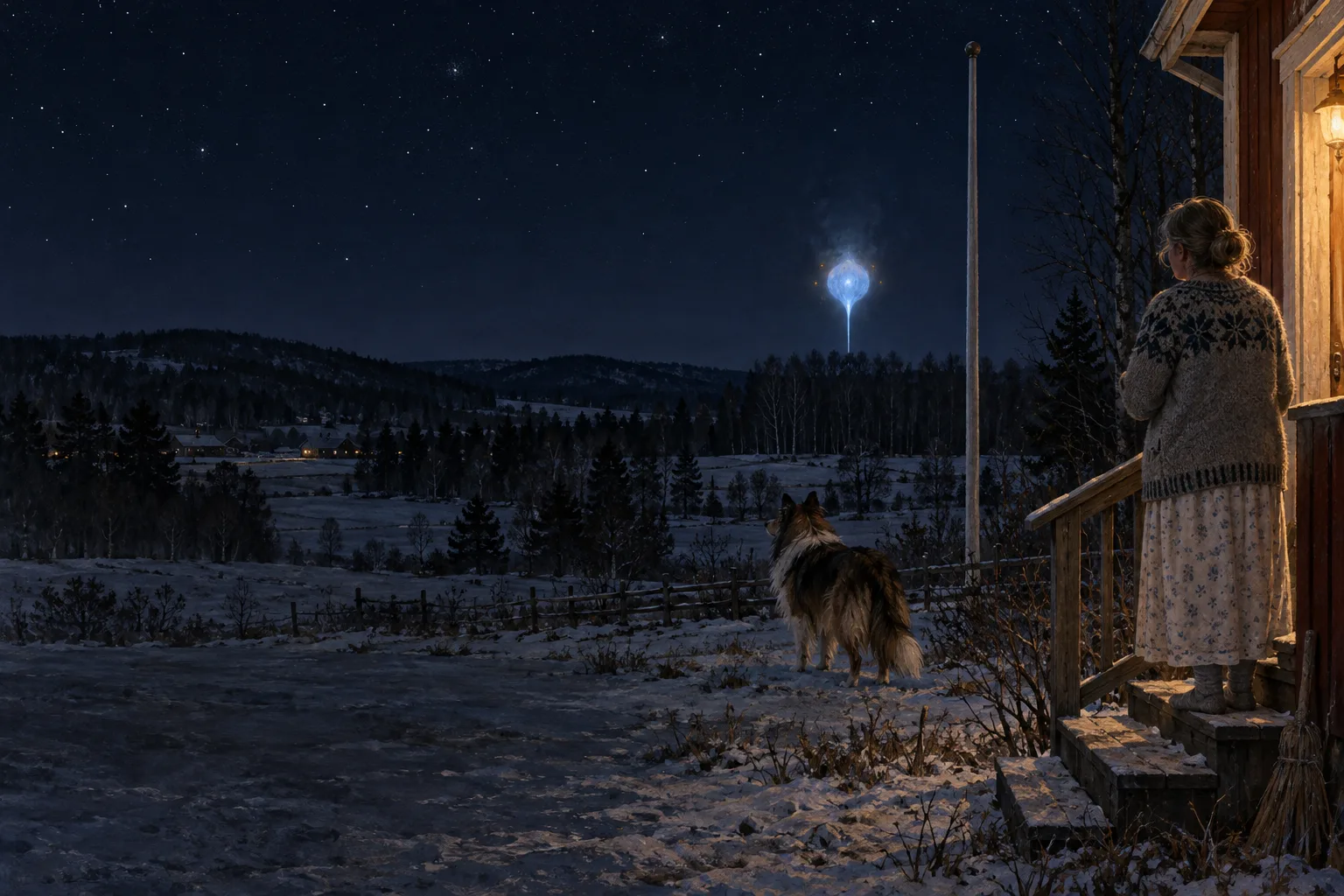
That was how she described the moment in Roberto Banchs’s later interviews. Around her family’s farm near Trancas, in northern Argentina, there were lights she could not explain. One of them was directing its beam across the yard.
It was the night of October 21, 1963. The account that emerged from the house would become one of Argentina’s best-known UFO stories: figures beside a railway, brilliant shafts of light, and a family watching from behind its windows.
For Argentina, one small part of that extraordinary night remained audible. The chickens responded when the light reached them. She did not remember seeing the dogs.
Dora keeps returning
Earlier, the household had been settling down.
In Oscar Galíndez’s account of his interview with Yolié Moreno de Colotti, the farm’s private generator was not working that evening. Lamps and candles supplied the light. The family went to bed early, although Yolié remained awake to give her baby a bottle around 9:30.
Dora Guzmán, the fifteen-year-old domestic worker, came to the room. She was frightened. When she returned, she explained that strange light was appearing outside.
Yolié and her sister Yolanda went to look. At first, they saw nothing. They went back inside; Dora called again. Eventually, the three remained outside long enough to see the illumination towards the railway.
There were bright points and a luminous connection between them. Against that brightness, human-shaped silhouettes appeared to be moving. Vegetation obstructed the view, and the women knelt to see better.
Their first thoughts concerned the tracks: an accident, perhaps, or sabotage. They decided to investigate, returning indoors for clothing and a flashlight. Yolié asked Argentina to watch her baby.
The railway had supplied an explanation for the lights. Approaching them would make the evening much harder to explain.
Beyond the gallery
The earliest local reporting described something familiar before it described anything fantastic.
As La Gaceta recounted its original coverage in 2023, Dora had drawn attention to lights near the Belgrano railway. The house stood outside Trancas, beside the road towards Las Arcas, running parallel to the line.
The sisters and Dora looked out from the gallery. There were lights farther away by the railway and another much closer, around the farm’s front boundary. They left the house and advanced along the entrance path.
One of the women pointed a flashlight towards the nearby light.
The account described a change from white to violet, followed by illumination directed back towards the women. They felt sudden heat and retreated to the gallery.
Inside were Antonio Moreno and his wife, Teresa Kairuz, with their young grandchildren. The disturbance beyond the entrance now concerned everyone in the house. Going outside had brought the women closer to the light; going back inside did not end the encounter.
The family would continue watching from the shelter of the building as the illumination played around their property.
Light at the windows
Within weeks, an English-language version had reached readers of the November 1963 APRO Bulletin.
It described a domed object close to the house, with openings around its circumference. A flashlight was followed by a bright, tubular beam directed towards the building. In this early telling, the observers checked the different windows and counted five discs nearby.
White light came from one, reddish-violet light from another. The interior became intensely hot, and the account associated the disturbance with a sulphurous smell. The family remained inside, afraid to venture out among the objects.
The windows had become separate vantage points onto the same unsettling scene. Looking through one opening could reveal a nearby light; looking through another brought a different part of the grounds into view.
After roughly forty minutes, APRO reported, the object by the tracks moved away and the others followed. The lights of the nearest objects went out. A mist-like residue remained in the air for several minutes.
The newsletter gave its front-page story an unmistakable description: a family besieged by discs.
A cable leaves Trancas
The news travelled through the same railway world towards which the family had first looked.
In a 2023 interview, journalist Arturo Álvarez Sosa recalled covering the case. A cable announcing the incident reached the railway station, and the information made its way to La Gaceta’s newsroom.
Álvarez Sosa left in the newspaper’s truck with a photographer and fellow journalist Ventura Murga. Murga, then a section chief, accompanied them because he was concerned that the account contained too much fantasy. He wanted to see what they were dealing with before it became a newspaper story.
The farm encounter was becoming an assignment: a journey, interviews and a report for readers elsewhere in Tucumán.
It soon travelled considerably farther.
The Italian newspaper Corriere della Sera carried a Buenos Aires dispatch dated October 24. Flying Saucer Review translated it in its January–February 1964 issue, on page 29.
That brief dispatch presented six saucers hovering for forty minutes. It described eight-metre objects, portholes, rising temperature and an odour compared with sulphur. White and purplish-red beams appeared to examine the ground.
Here the farm household had become a much broader spectacle over Trancas. Readers encountered a squadron above the village, with the countryside illuminated beneath it. A domestic disturbance was taking on the scale and vocabulary of an aerial visitation.
The light over the chickens was a much smaller scene than the one now moving through the international press.
The farm in an archive
Captain Omar Pagani of the Argentine Navy investigated the report.
Decades afterwards, researcher V. J. Ballester Olmos described receiving material from Pagani: an official UFO questionnaire and correspondence with a witness. In September 2014, he shared the documents publicly.
His introduction summarised an illuminated, train-like object with openings, figures apparently moving inside, and a beam that dazzled the observers. Those descriptions sat alongside the other surviving versions of the night.
Ballester Olmos also directed readers to two investigators who had studied Trancas closely: Banchs and Galíndez. Both had taken the report seriously enough to pursue it. Their conclusions pointed in different directions.
The encounter had acquired a life in files and interviews as well as newspapers. Returning to it meant returning to people who had stood in different places, remembered different details and spoken at different times.
Sixty years later
In October 2023, La Gaceta interviewed Yolié again.
She still remembered the colours and movements. She described advancing from the gallery towards the entrance, seeing lights beyond the farm, and the nearby light turning violet. The newspaper accompanied its account with photographs of the property and railway.
Yolié also remembered collecting unusual small pieces of material for analysis. She associated areas of poor plant growth with the places where the objects had been. These remained features of her account six decades after the encounter.
The story had not ended, for her, when the lights disappeared. It remained attached to the ground around the house, to things picked up afterwards, and to views across the boundary towards the line.
For readers, the farm was a famous case. For its witnesses, it was also the place where their children had slept while something extraordinary seemed to be happening outside.
What Is Known
Trancas has a substantial documentary history: contemporary press coverage, an early APRO account, naval investigation material, and later interviews. These establish a reported encounter and its investigation. They do not make every published detail interchangeable.
The animals illustrate the problem particularly clearly. Guillermo Daniel Giménez’s later retelling describes silent dogs and poultry, then associates the light with a hypnotic or sleep-like condition. In her 2023 interview, Yolié also recalled dogs remaining silent until the objects left. Argentina’s account to Banchs instead describes chickens clucking under illumination. Not remembering the dogs is different from observing them immobilised.
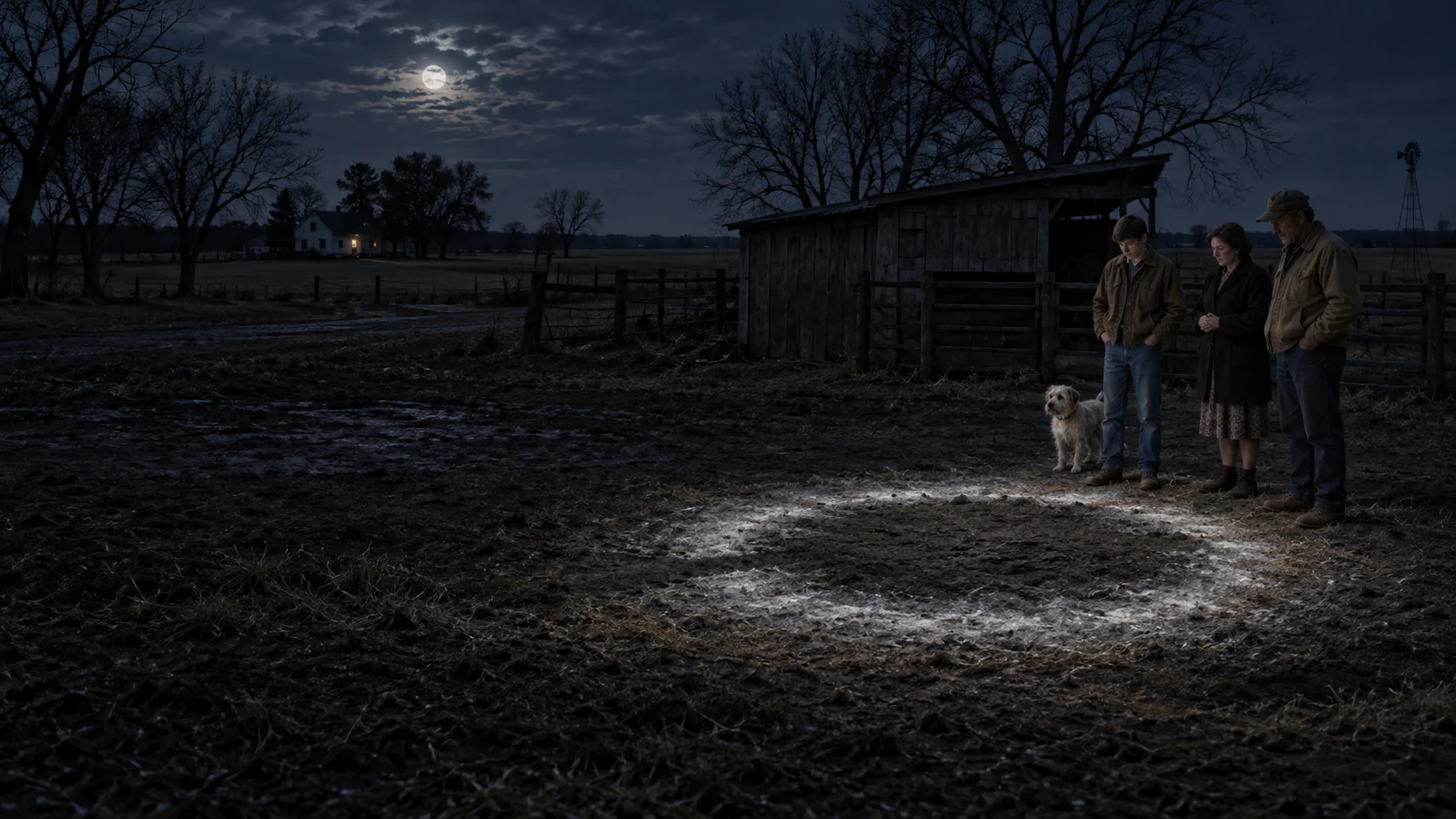
The physical material needs equally precise language. In the second part of his investigation, Banchs reproduces the analysis of a small white powder sample collected from the railway: 96.48% calcium carbonate and 3.51% potassium carbonate. Those are chemical compounds, not almost-pure elemental calcium, as some summaries claim. Identifying them does not identify the source of the lights.
Banchs favoured a military explanation involving troops and searchlights, drawing attention to movements towards exercises in the north. Galíndez regarded Trancas as an extraordinary UFO encounter. Their disagreement should remain visible; the military hypothesis should not be presented as a demonstrated reconstruction of every observation.
The Bigger Picture
The railway was more than a convenient landmark. Argentina’s national heritage account of old Trancas describes how the line bypassed the earlier settlement, contributing to its decline while the modern town grew elsewhere.
That history helps place the encounter in a working landscape shaped by transport. The witnesses initially connected the distant figures and lights with railway activity. News of their experience travelled out through a station. Later investigators returned to the same line when considering troop movements.
Trancas also shows how much changes when an animal’s response becomes a claim about an unknown force. Clucking under a beam, silence after its withdrawal, and an animal rendered helpless are different observations. They carry different implications, even when placed inside the same celebrated story.
Argentina’s recollection leaves a modest but vivid sequence: light reaches the enclosure, the chickens wake, the light moves away, and their voices cease. Keeping that sequence intact allows the farmyard to be heard beneath the legend.
Sources
- Roberto Banchs, Trancas: El informe final, part one: later investigation and direct witness interviews, republished by Visión OVNI.
- Banchs, part two: laboratory record and the investigator’s interpretation.
- Oscar Galíndez, Los asombrosos fenómenos de Trancas: witness-based account in OVNIS 4, November–December 1974; archival transcription.
- APRO Bulletin, November 1963, pages 1 and 5: contemporary newsletter report.
- Flying Saucer Review 10(1), January–February 1964, page 29: translation of Corriere della Sera, October 25, 1963.
- V. J. Ballester Olmos, September 25, 2014: provenance and release of naval questionnaire and correspondence.
- Manuel Riva, La Gaceta: reconstruction using the original coverage, October 21, 2023; Yolié interview, October 22; Álvarez Sosa’s reporting recollection, October 22.
- Guillermo Daniel Giménez, El caso Trancas: later retelling, used to compare animal claims.
- Olga Paterlini de Koch, Iglesia del Sagrado Corazón: independent national heritage context for the railway and settlement.