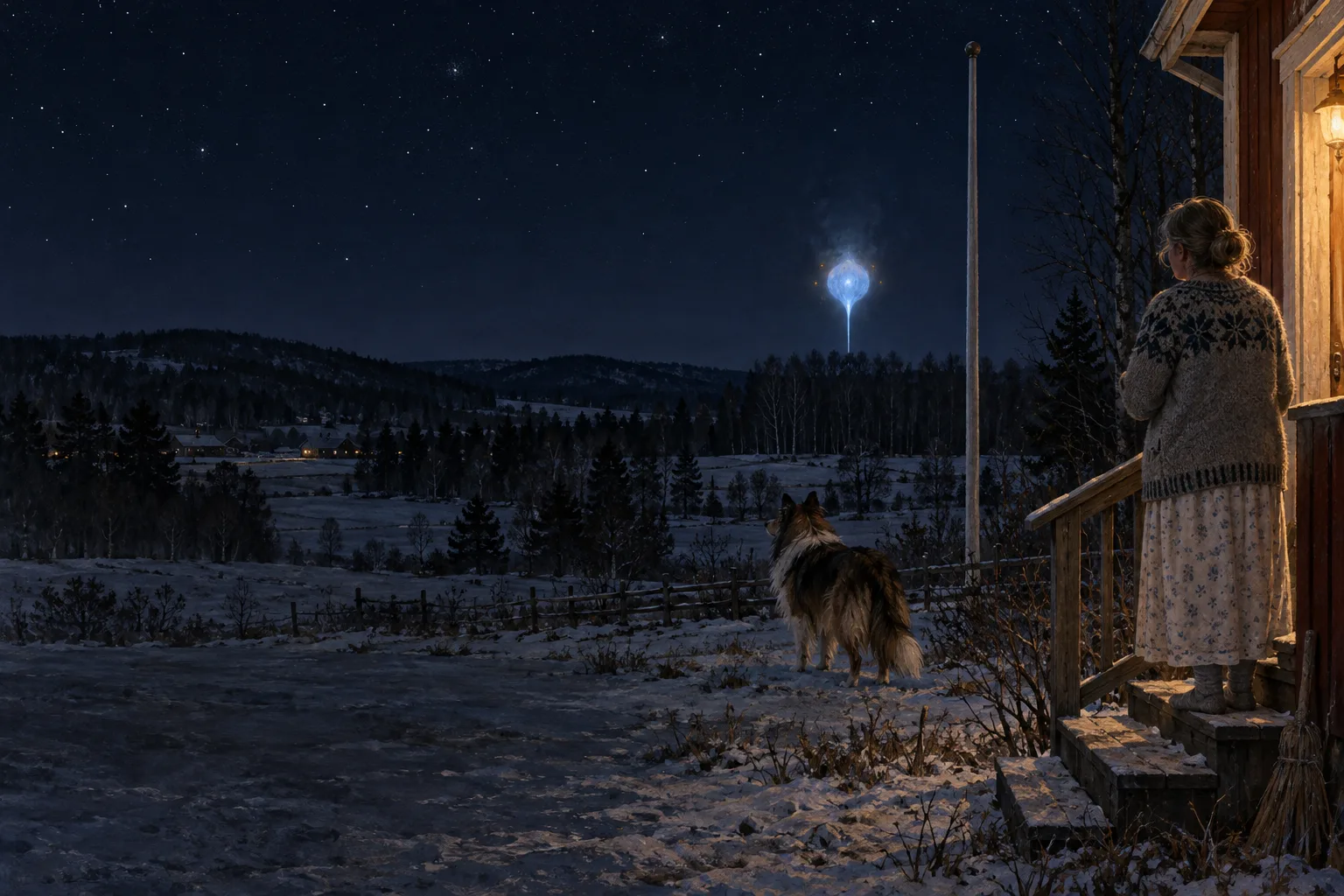
The dog stood motionless outside, its tail between its legs and its jaws chattering.
Karin Lagerstrand had looked through the bedroom window to see what was frightening the animals. They had been restless for hours, wanting to go outside and then return, finding no comfort on either side of the door.
She thought there might be a badger in the yard.
Instead of going out directly towards it, she made her way to the kitchen door. At about half past three in the morning, she stepped outside and saw a blue object hanging near the treetops.
It was December 31, 1987, in Bispberg, a village outside Säter in Dalarna. New Year’s Eve had begun. The night’s celebration was still many hours away.
The animals would not settle
Karin, fifty-nine, and her husband Rune had been asleep when their dog and cat began disturbing them around one in the morning.
In the account by investigator Berit Bergqvist, published in Norwegian in 1989, the animals repeatedly demanded to be let in and out. The dog barked and behaved aggressively. The cat bristled as though it had sensed danger.
Letting them outside did not resolve it. Bringing them back into the house did not resolve it either.
The disturbance continued until around three, when the couple got up to investigate. Their first explanation was an animal outside the home. That possibility made sense of barking and raised fur; it also gave them something practical to look for.
When Karin reached the bedroom window, however, the dog was standing absolutely still.
In Clas Svahn’s later reconstruction, the dog is identified as their collie, Cinda, and placed near the flagpole. Karin went to the kitchen entrance, approaching the yard from another direction because she was wary of an aggressive badger.
The search had brought her from bed to window and then to the steps. There, her attention shifted away from the ground.
At the height of the trees
Bergqvist’s early account describes an icy blue sphere with a distinct outline, surrounded by grey haze containing touches of orange. It appeared to hang at treetop height, an estimated 150–200 metres away.
At its base was an opening shaped like a neck.
From that opening came straight blue flashes. Karin compared them with pointed lances. They seemed to project a considerable distance while remaining attached to the object, as if anchored there. She could not see them strike the ground or anything else.
An especially odd detail remained in her description: the light did not illuminate its surroundings.
The flashes were visible, the object was visible, but the surrounding landscape did not respond as she expected it to. She was watching a luminous form near the trees without seeing those trees lit by it.
Her later description would give the object the shape of an enormous light bulb. The comparison drew together the rounded body and the narrow opening underneath. The lance-like flashes made that lower part the centre of the activity she was watching.
Then, according to Karin, something happened to her own body.
Unable to turn away
Her jaws locked. Goosebumps rose across her skin. Near her hairline, above the left eye, she felt an intensely painful sensation she described in terms of suction.
She reported becoming unable to move.
The account places her on the kitchen steps, aware of the object and of her own distress, but unable to leave. She feared that she was going to die.
The blue form remained in view during this experience. Then it disappeared rapidly. Karin did not describe a clear upward departure; she thought it might have gone sideways or downwards.
With its disappearance, she could move again.
As she turned to go indoors, she felt a sharp stinging or burning sensation near her right shoulder blade. The time recorded in the account was 3:35 a.m.
The episode on the steps had lasted roughly five minutes. The animals’ disturbance had occupied much more of the night.
A sound inside the house
Rune’s experience supplied another part of the account, though he was not described as sharing Karin’s view of the blue object.
He had heard a humming sound before they got up. His comparison was an idling car. He wondered whether their oil-fired boiler was responsible.
He also felt uneasy and thought the air pressure seemed strange. Eventually he lay back on the bed. Afterwards, he found it puzzling that he had not gone outside to see what was troubling Karin and the animals.
At some point during the night, his wristwatch stopped. He could not give a time for that stoppage.
These details followed a different route into the investigation: a sound heard indoors, a familiar household appliance considered as its source, and a watch noticed afterwards. Karin’s experience was unfolding at the kitchen entrance while Rune remained inside.
When she returned, the encounter became something they could discuss together.
Coffee after half past three
Karin complained about the stinging near her shoulder blade. Rune examined her back, but saw no mark there.
She felt ill and had a headache. Her skin remained bumpy, and her jaws continued to tremble for some time. They made coffee and drank it.
Bergqvist’s account says that Karin and the animals smelled of sulphur when they came indoors. Around four, Rune took the dog out for a walk and noticed a burnt smell resembling creosote, the substance used to treat wooden poles.
The dog behaved oddly along the route. It sniffed and crouched as though trying to avoid something, both on their own property and farther along the walk.
Inside the house, the immediate crisis was giving way to its aftermath. There was coffee to make, an animal to walk and a painful sensation to check. Those ordinary actions became the next entries in the record of an extraordinary night.
A mark in the sweater
On New Year’s Day, Karin discovered a mark on the back of her sweater.
It was described as a straight line about five centimetres long, with a thread apparently burnt onto it. The clothing offered the investigators something they could collect and examine after the reported light had gone.
On January 2, 1988, a check arranged through the health authorities in Säter found no indication of radioactivity on the garment.
Bergqvist’s published account also records the difficulty of obtaining a suitable analysis. The investigators approached Svelab in Borlänge, a forensic laboratory in Linköping and Statens Provningsanstalt, the national testing institute.
Svelab normally dealt with soil and water and did not consider itself equipped for the requested work. Other testing possibilities exceeded the investigators’ budget. The article appealed to readers for help finding an affordable examination.
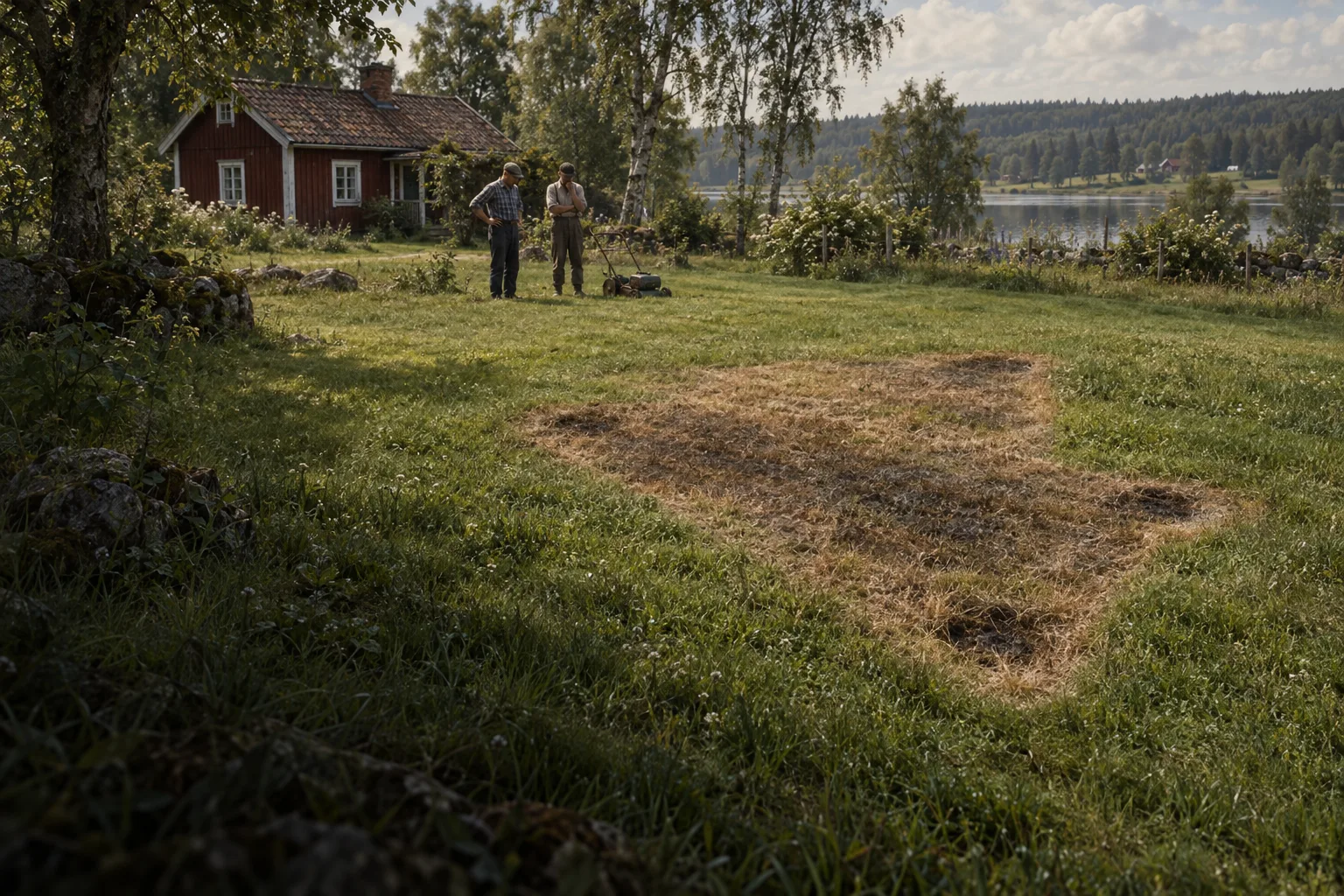
The work moved from the kitchen steps to a garment, from witness descriptions to telephone calls and laboratory enquiries. A photograph of the observation site was used to show where Karin placed the object. Investigators also went door to door, seeking anyone else who had noticed something that night.
Earlier on the road
Svahn’s later account adds a separate observer: nineteen-year-old chef Petri Lyttbacka, driving home from work in Falun.
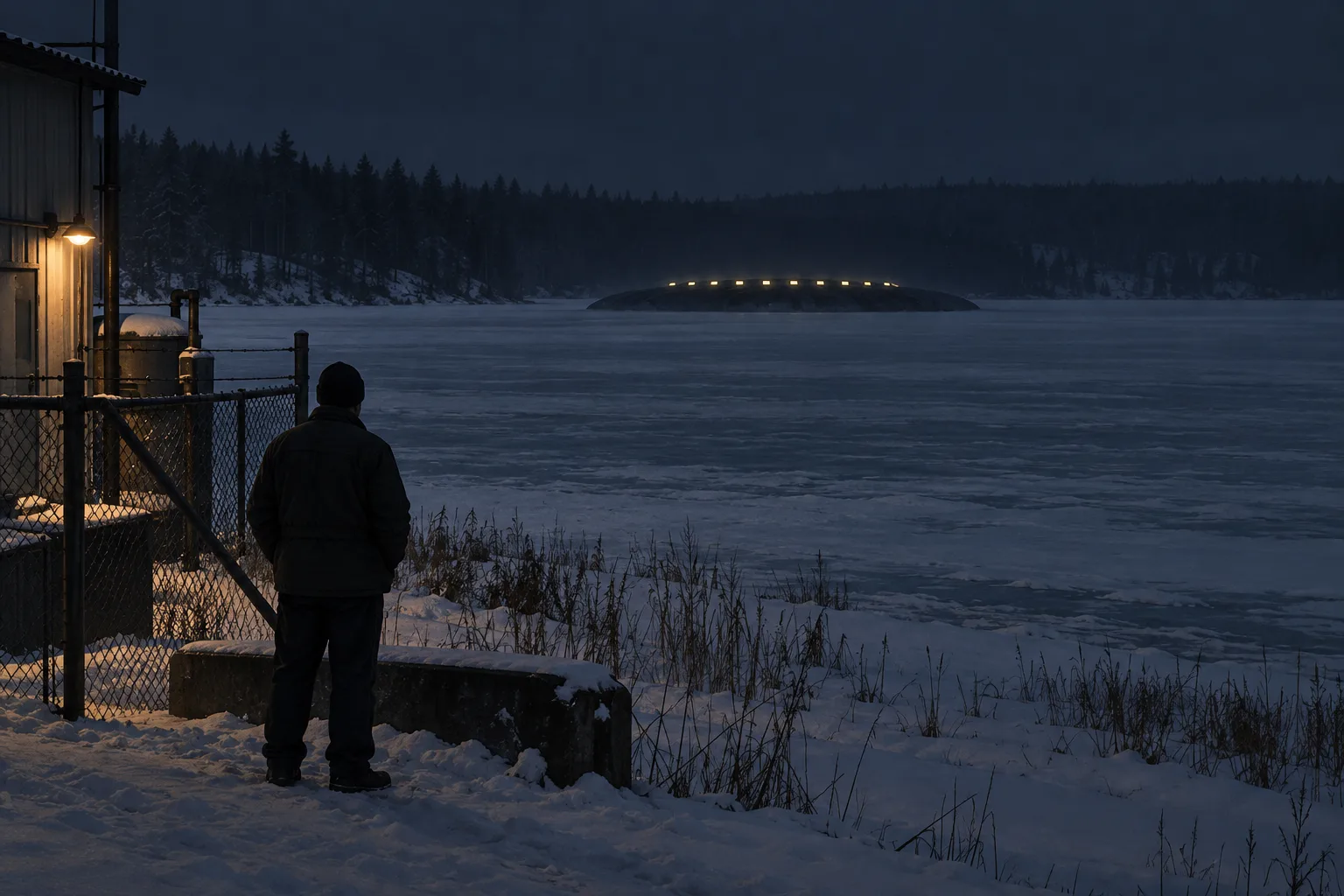
Between approximately one and half past one, near Trollbo, he noticed a blue light with red elements over Bispbergs klack. He stopped and watched through his windscreen for about ten minutes, then continued towards Säter. He reported still seeing it as he approached town.
Svahn says Bergqvist interviewed him within days of the event. His observation concerned an earlier light over the area, rather than Karin’s experience on the steps two hours later.
The investigation now held two viewing positions: a road outside Bispberg and the entrance to a home within it. Their possible connection remained part of the case.
What Is Known
The principal early source examined here is Bergqvist’s investigator account in UFO, number 2, 1989, pages 12–13, translated into Norwegian by Mentz Kaarbø. It preserves witness descriptions, the negative radiation check and efforts to arrange further testing. Its publication date does not date every stage of the investigation: the text retains an appeal for analytical help and says microscopy results were unknown when it was written.
Svahn’s later reconstruction draws on interviews and describes additional examination. He reports that Arne Groth, associated with Sweden’s defence research establishment, interpreted darker fibres attached to the sweater as suggesting a local electrostatic event. Svahn also questions the examination’s rigour. This was an interpretation of the material, not confirmation that an unidentified craft caused it.
There are differences between versions. Bergqvist’s account gives a distance of 150–200 metres; Svahn’s later account gives roughly 500 metres. They should remain estimates attributed to the respective reports.
The sighting, physical sensations, smells and watch stoppage are reported experiences. The investigation documented a clothing mark and a radiation test with no detected increase; it did not establish a common cause for everything described that night.
The Bigger Picture
Bispberg’s landscape had been shaped by activity underground for centuries. Säter’s municipal planning history traces the mining settlement’s medieval origins and its development under Gustav Vasa. The mine closed in 1967 after insufficient economically workable ore was found, bringing departures from the village and changes to its school and railway.
That history gave investigators a local environment to consider as well as a light in the sky. Svahn records discussion of possible mine-related phenomena, without establishing them as the explanation.
The case also shows how an encounter can move through very different kinds of attention. The pets’ behaviour woke their owners. Karin’s account gave investigators a sequence to reconstruct. The sweater gave them a material object to inspect. Each mattered, while each answered a different question.
The human scale remains the story’s strongest thread: a woman stepping outside to look for a badger, finding an unfamiliar light, and returning to a kitchen where her husband checked her back and coffee was made. Whatever its cause, the experience she described had entered the most familiar part of her life.
Sources
- Berit Bergqvist, “UFO-observasjon i Bispberg,” UFO, number 2, 1989, pages 12–13. Early investigator account, translated by Mentz Kaarbø; original issue preserved by AFU.
- Clas Svahn, “Bispberg,” UFO-Sverige. Later reconstruction drawing on witness and investigator interviews; source for Lyttbacka’s account and the later clothing examination.
- Säters kommun, Bispberg planning description and building guidance, November 3, 2015. Independent municipal context for the mining village and its history.