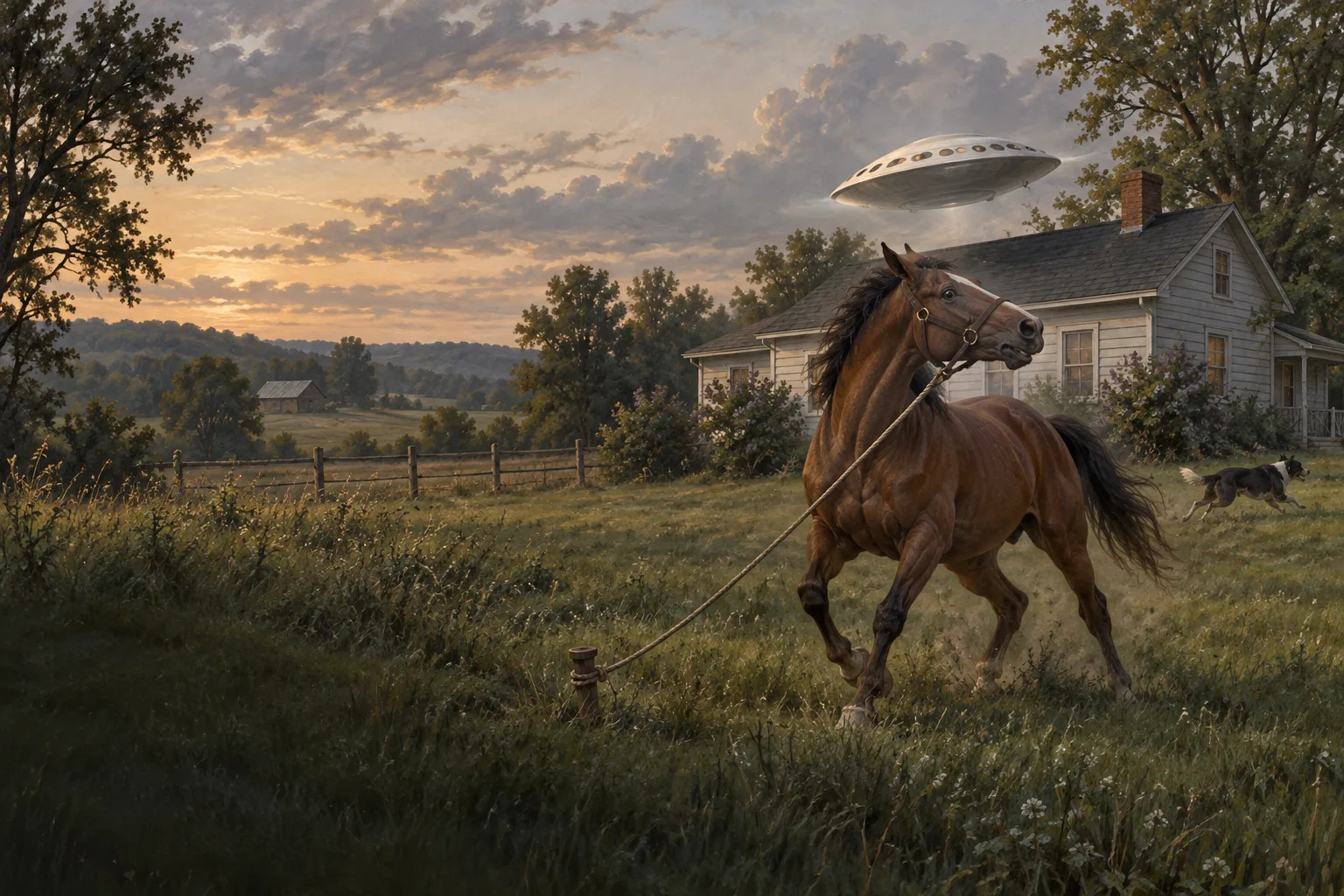
The horse reared as the object passed over the house.
It was staked in a nearby field. When it came down again, it began running about, its ears back and its eyes looking wild. The dog ran away.
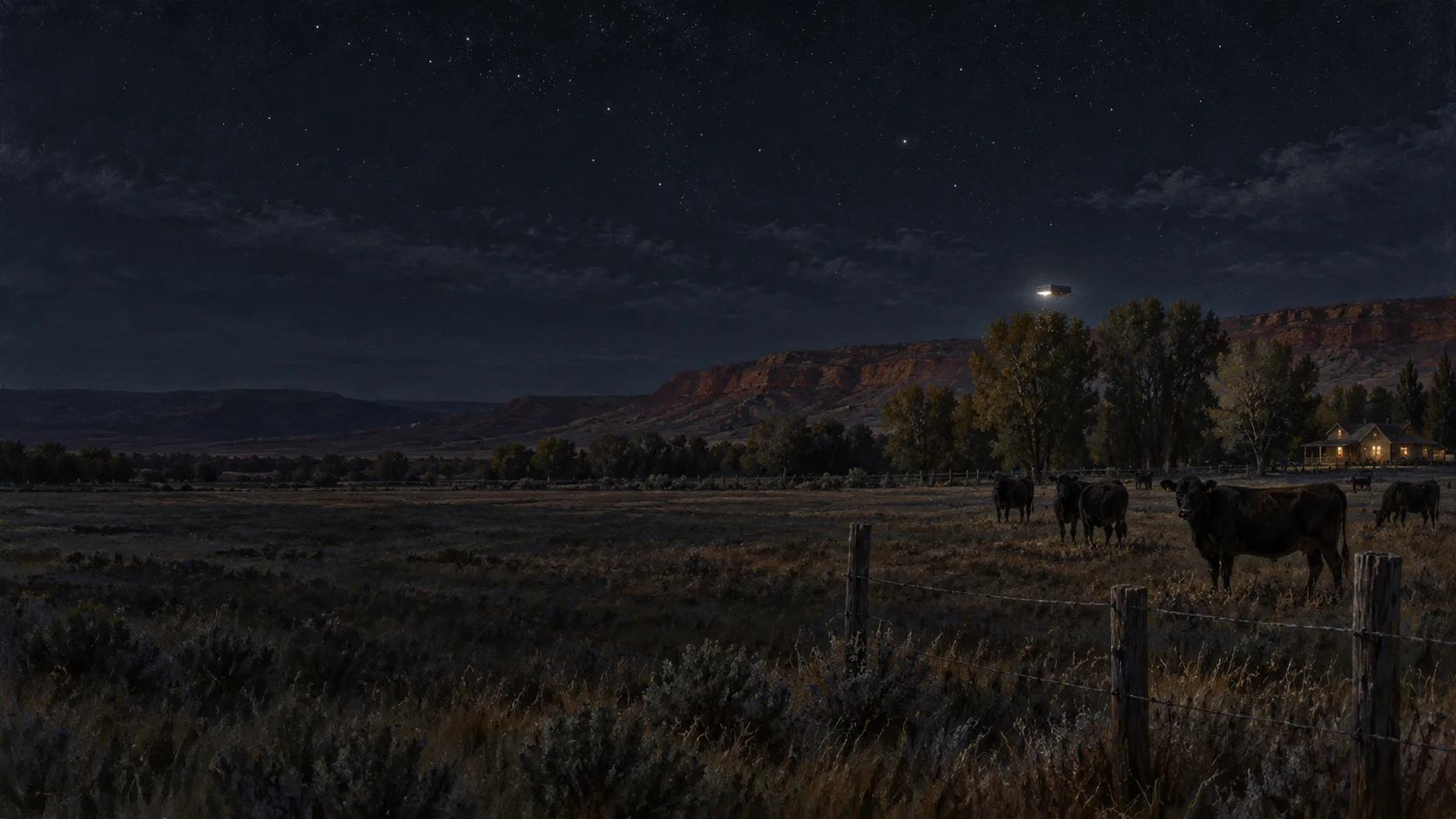
Six members of the McDonald family were watching the sky above their home on Vrooman Road. According to the account they gave, a silvery-white disc had come down over the property and was skimming the rooftop. A low sound accompanied it: something between a buzz and a purr.
It was about seven in the evening on May 20, 1965, in Leroy Township, Ohio. The family would describe the object by its shape, its size and a row of circular ports. But the detail that carried their story into the UFO literature was happening below it, in the field: a horse trying to flee while tethered to the ground.
A house beneath the flight paths
Edward McDonald lived in a part of Ohio where rural life and regular aircraft traffic occupied the same landscape.
Leroy was a Lake County township with a long agricultural history. Its roads preserved the names of early settler families, including Vrooman. The township’s own historical account traces a community built around farming, mills and small industries, its name brought west by settlers from Le Roy, New York.
At the McDonald property, a horse stood in a field close to the house. Above the property were the flight paths of two airports, according to Edward’s statement to the civilian UFO organisation NICAP.
He made a point of explaining that both his horse and his dog were accustomed to passing aeroplanes. This was their home environment. Aircraft were part of what normally happened overhead.
That familiarity would give the incident its most personal comparison. McDonald could describe what his animals ordinarily tolerated, then tell the organisation how differently they had behaved that evening.
Silver over the roof
The contemporary account in the June–July 1965 UFO Investigator describes the object descending over Edward McDonald’s home. Six members of the family watched its low passage.
Their estimate made it approximately the size of a car. Its colour was silvery-white, and its outline was that of a disc. Along it ran a row of ports, each estimated at roughly a foot in diameter.
These were comparisons drawn from ordinary things: the size of a vehicle, the width of a circular opening, the roof of their own house. Together they formed a description of something apparently solid and close, with a visible arrangement of features along its body.
The family also reported hearing a low mechanical-sounding noise. The newsletter offered two comparisons for it, buzzing and purring, and described the witnesses as hearing it from inside the object.
Their account joined sight and sound at the rooftop. The unfamiliar shape was crossing a familiar structure while making a noise they could describe, even though they could not identify what was producing it.
The animals below
As the object passed over the housetop, the newsletter says, both animals panicked.
The account of the dog was brief: it ran. The description of the horse was more detailed. A member of the family reported its rearing movement, followed by running about. They remembered its ears drawn back and the appearance of its eyes.
The horse’s tether mattered to this scene. It was staked in the nearby field, so its attempt to move away took place within the space allowed by that restraint. The family could watch its agitation as well as the object overhead.
The description gives the animal a striking physical presence in the encounter. There is upward movement as it rears, then movement across the ground. Its ears and eyes become part of the testimony, details supplied by someone watching an animal they knew.
McDonald regarded the reactions as very strange. His explanation returned to the aircraft that regularly crossed the property: the animals were used to them. Whatever the family believed had passed over the roof, they felt they had also witnessed a break in the ordinary behaviour of their dog and horse.
The sighting and the alarm entered the report together. One supplied the unfamiliar object; the other supplied a disturbance in the life of the property beneath it.
Beyond the field
The published account extended into neighbouring homes. At the time of the passage, neighbours reportedly experienced interference with television and radio reception.
NICAP described that interference as unusually strong compared with the effects of ordinary aircraft. It used the claim to support its interpretation that an unusual machine had been present.
This brought a third perspective into the story. The McDonalds had looked towards the roof. They had observed their animals in the yard and field. Nearby residents, according to the newsletter, had noticed a change in the reception of their household equipment.
For the organisation preparing the story for publication, the reported coincidence was significant. The account linked an aerial sighting with disturbances noticed on the ground, including in homes beyond the property where the family had watched.
The horse reaches print
The account reached readers through an organisation based on Connecticut Avenue in Washington, D.C. The newsletter’s masthead named retired Marine major Donald E. Keyhoe as director and Richard H. Hall as acting director. Harold H. Deneault, who would later co-author the book that included Leroy, was listed as assistant editor.
The family’s report had entered an established publishing operation. NICAP’s staff selected accounts, assembled its newsletter and circulated an interpretation of what those reports meant. By the time Leroy appeared in UFO Investigator, the organisation had given it a place within a broader argument about animal reactions.
On page five, the Leroy report opened an article headed Animals and Unidentified Flying Objects. The editors argued that such behaviour deserved more attention. To them, animals offered an appealing kind of witness: creatures that could react to their surroundings without being influenced by official statements or the public controversy over flying saucers.
The article even returned to McDonald’s horse in its discussion of publicity. An animal, it argued, could hardly be accused of seeking attention for a UFO story. The tethered horse had become a participant in a dispute taking place far beyond Vrooman Road.
The page ended by asking readers to send comparable reports, with dates and witnesses’ names. Leroy was therefore doing two jobs in the newsletter. It was an account of a family’s experience, and an example meant to encourage the collection of more observations of this kind.
A place in the catalogues
The story continued to circulate after 1965. NICAP’s archival transcription notes its appearance on page 153 of Gordon I. R. Lore Jr. and Harold H. Deneault Jr.’s 1968 book Mysteries of the Skies. The archivist describes that version as containing less detail than the newsletter.
Later, the INTCAT historical catalogue placed the event under May 20, 1965. Its source trail includes a 1970 instalment of Gordon Creighton’s animal-effects catalogue in Flying Saucer Review, as well as the earlier book and another periodical.
Those references show the route the little Ohio account took through the literature. Its domestic scale survived: a house, six family members, a dog and a horse. So did the contrast Edward McDonald had emphasised between familiar aircraft and this particular passage.
The horse had become the feature by which readers could find the case again.
What Is Known
The principal contemporary source examined here is NICAP’s June–July 1965 newsletter, volume III, number 3, page five. It names Edward McDonald, gives Vrooman Road as the location and attributes the observation to six members of his family. Statements about the animals appear alongside the visual description, sound and neighbours’ reported reception problems.
This is contemporary reporting by a civilian UFO organisation. Its publication establishes that the account was recorded in 1965. The organisation’s conclusion that the observations indicated an unusual machine was its interpretation of that testimony.
The later book reference and INTCAT entry document the story’s subsequent circulation. The book citation here comes from NICAP’s archival note; the reference to Creighton’s 1970 catalogue comes from INTCAT. Neither is presented as a newly discovered interview or an independent confirmation of the encounter.
The original page also preserves something important about the report’s reception. NICAP actively wanted animal behaviour to be taken seriously, and selected Leroy to make that argument. The family’s observations and the publisher’s interpretation belong to the same historical record, but they remain distinct parts of it.
The Bigger Picture
An owner knows an animal through repeated encounters with its behaviour. That is what gives McDonald’s comparison its interest: he described creatures that routinely tolerated aircraft, then reported an occasion when they reacted with alarm.
Carey A. Williams, a Rutgers University equine specialist, explains that horses depend on rapid flight responses and can learn to tolerate stimuli that initially frighten them. Familiarity and sudden alarm can coexist in the same animal. The comparison with ordinary aircraft is meaningful as an observation, while the alarm itself cannot identify the thing that prompted it.
The distinction also clarifies NICAP’s enthusiasm. An animal’s response may be free of any interest in UFO publicity, but our account of that response still comes through the people watching it. At Leroy, the horse’s experience reaches us through the family, the newsletter and the later writers who retained the incident.
That chain has preserved a particularly intimate image of a UFO report. The unfamiliar thing was described above a family’s home; its disturbance was expressed through an animal in the adjoining field. More than sixty years later, the story still brings the reader back to that boundary between roof and sky, and to the horse beneath it trying to get away.
Sources
- NICAP, “Animals and Unidentified Flying Objects,” UFO Investigator, volume III, number 3, June–July 1965, page 5. Contemporary report and editorial discussion, preserved by CUFOS; principal source.
- NICAP, archival transcription of the Leroy report. Later transcription and bibliographic note identifying the 1968 book appearance.
- INTCAT, 1965 January–June, May 20 entry. Later catalogue; used for the subsequent source trail, including the reference to Creighton’s 1970 catalogue.
- Leroy Township, “History of Leroy Township”. Municipal historical account; independent local context.
- Carey A. Williams, “Basics of Equine Behavior,” Extension Horses, July 31, 2019. Independent educational context by a Rutgers University equine specialist.