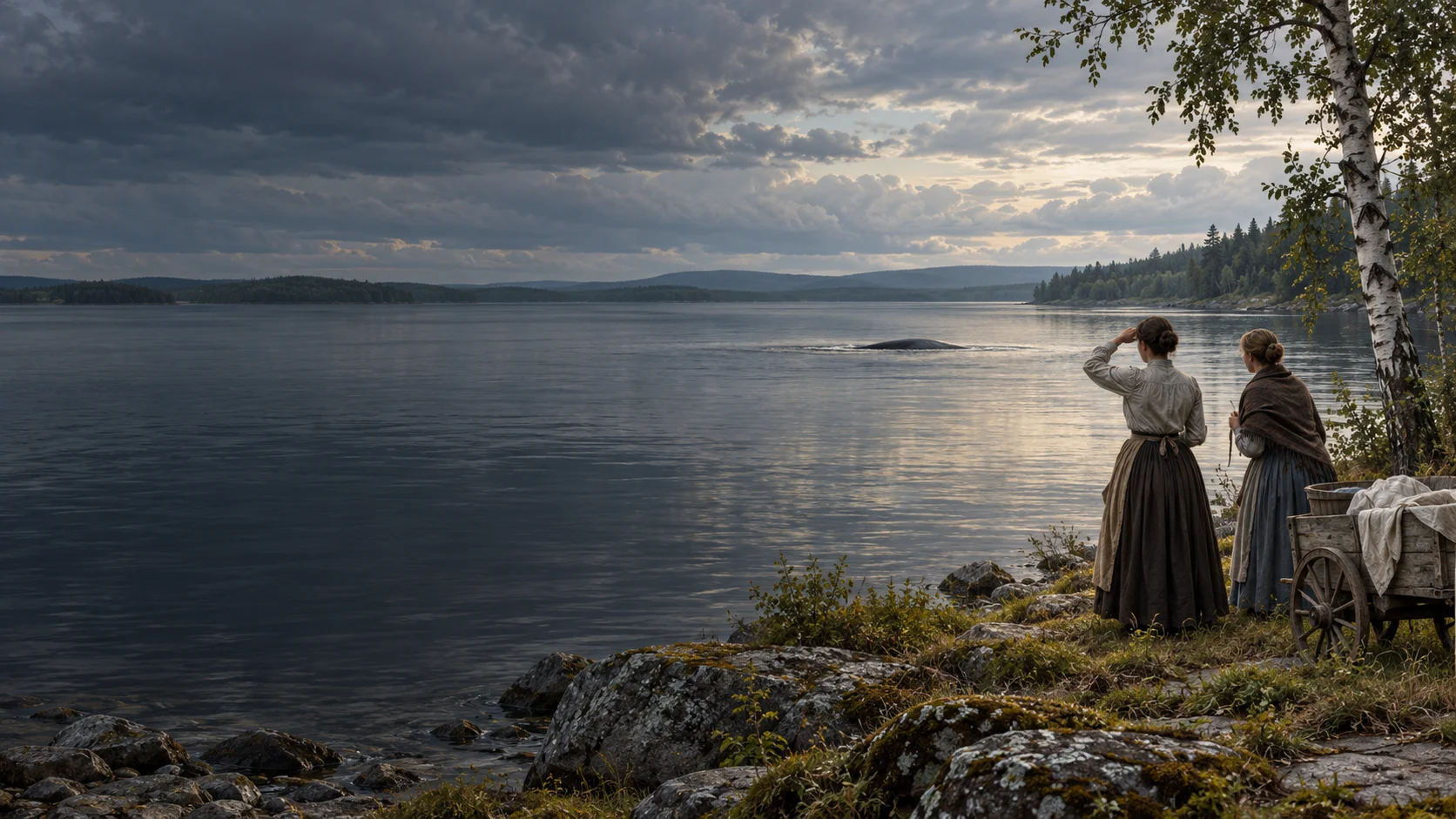
At first, the sisters thought it was a boat.
They were washing clothes near Sörbyn, on the shore of Storsjön in Jämtland. Something was coming across the water from the direction of Östersund. As it approached, the shape stopped making sense.
In a report published by Jämtlands Allehanda on October 18, 1893, the women described a huge animal with an enormous mouth. One sister climbed into a birch tree. The other stayed below and began throwing stones.
The creature, they said, came towards the shore.
Within a year, people in Östersund would organise a company to catch whatever was swimming in their lake. They would prepare a platform, electric lights, a harpoon and an immense trap. The thing the women had tried to drive away with stones was becoming the object of a deliberate hunt.
The sister in the tree
The newspaper account, quoted in Sanna Händén-Svensson’s historical research, placed the animal about thirty metres away. The sisters compared its shape to a frog, but its size to a boat. They described short feet, fins and a powerful tail striking the water.
Its eyes seemed as large as saucers. Its mouth looked wide enough to swallow them both.
The woman on the ground threw her stones out over the lake. According to the report, the animal reacted by swimming rapidly towards land. She retreated farther inland while her sister remained in the birch.
The episode interrupted the ordinary business of washing for roughly an hour. The newspaper also reported that neighbours regarded the sisters as truthful people. Their encounter entered print as something that had happened to women known in the district, beside a shore where they had gone to do their work.
Elsewhere around Storsjön, people were beginning to prepare for encounters of their own.
Chains in the lake
During the winter of 1893, baited iron chains were secured at two places in the water. They carried grapnels and were wrapped in red cloth to make them more conspicuous. Jämtlandsposten described the preparations that December.
The equipment suggested the scale of the animal its hunters expected. A creature capable of frightening people ashore would require something stronger than an ordinary fishing line.
The following summer brought another report from fishermen. In an account published on August 13, 1894, a party using a fishing board said a violent disturbance had suddenly thrown the apparatus into their boat. They believed they were too far offshore for anyone to have struck it with a stone. They knew no fish capable of the blow they described.
They concluded that they had disturbed the lake creature.
The reports reached beyond individual households and fishing boats. Four people in Östersund joined forces: Maria Helin, steamship captain Anders Dedering, treasurer Vilhelm Sköld and merchant O. Dahlin. Their enterprise had a practical purpose. They intended to bring Storsjöodjuret out of the water.
Light beneath the platform
On August 31, 1894, teacher and historian Sven Kardell noted the capture group in his diary. People were making jokes about its members, he wrote, but many also believed the stories.
The hunters had a special platform built on piles. Electric lighting would illuminate their station. Diving lamps were ordered to lure the animal towards it, according to a report in Sundsvallsposten that same day.
A harpoon had been specially ordered, and Norwegian harpooning expertise engaged. When the weapon arrived in Östersund, it was judged too small. A larger one was forged locally.
The plans were becoming substantial: fixed equipment above the lake, light reaching down into it, and a weapon enlarged to meet the imagined strength of the quarry. These were preparations for a close encounter. Something would have to approach the platform before the hunters could act.
They also deployed an enormous baited capture trap. Jamtli, which preserves the apparatus, describes the bait as a whole pig.
The trap caught no monster.
Still, the hunt had left an object behind. Long after the platform’s working days, the great metal mechanism would survive in the museum: a piece of machinery built around the expectation that something large might enter its reach.
The overturned boat
Around 1898, another reported encounter began with a familiar mistake.
Near Vattjom’s landing in Oviken, wharf official P. Åsén saw what appeared to be an overturned boat. His wife said it could not be a boat. The object rose and fell, then began moving fast enough to throw up a wake.
It was travelling against the wind.
This version survives in a submission sent to Sweden’s folklore archive in 1965, rather than a statement recorded at the waterside. Per Svedmark, born in 1885, supplied the story. His account said five other adults had seen the phenomenon simultaneously from farther away. Åsén, it continued, had previously disbelieved in the creature.
The lake was also drawing the attention of zoologists. In September 1898, Jämtlandsposten asked readers to send information about Storsjöodjuret, preferably with witnessed signatures. Letters arrived from people in different walks of life, including farmers and members of parliament.
Peter Olsson, a zoologist who taught in Östersund, assembled twenty-two descriptions for his 1899 investigation. He compared the animal’s reported appearance and behaviour. To Olsson, the accumulated testimony demanded an explanation in the natural world.
The hunt now had another form. Alongside the bait and ironwork were letters, signatures and a printed inquiry.
Something on the line
A century after the capture company, a fisherman would remember finding something much larger than expected at the end of his tackle.
Händén-Svensson gives him the pseudonym Orvar in her published interview. He had fished Storsjön since childhood. The encounter he described belonged to a July night in the early 1990s, near the small islands off Hoverberget.
He and his wife were using a fishing board with lines trailing from it. It was around midnight, but still light. A stone cairn and a narrowing passage prevented him from taking his intended course, so he turned the boat.
One line stretched out across the water. Another hung down.
While he was retrieving a fish on the first, something took the second. A long shape approached the surface. He struggled to describe it, reaching for the size and form of a calf or a cow.
He told his wife to keep the boat on course.
The line leading to the fishing board lifted above the water. Orvar believed the animal’s tail had raised it, although he did not see the tail itself. Whatever was attached to his tackle was close to the propeller, and he feared it might overturn the boat.
His landing net was ready. As the shape came nearer, he realised how inadequate it was.
For a time, he recalled, the boat seemed to hold its position, the pull on the line matching the engine. Then something in the tackle gave way. The shape disappeared downwards, leaving bubbles on the surface.
In his later telling, the encounter also changed his wife’s relationship with the lake. She no longer wanted to accompany him fishing.
The capture company had prepared its weapons before anything approached. Orvar had been holding ordinary fishing gear when the unfamiliar shape appeared. Both stories ended with the quarry beneath the water and the people above it, left with the equipment they had brought.
What Is Known
Storsjöodjuret has a substantial documentary history. The 1893 sisters’ report, the 1894 fishing incident and capture preparations belong to contemporary newspapers quoted and referenced in Händén-Svensson’s 2024 doctoral thesis. Kardell’s diary provides another contemporary perspective, accessed here through a later transcription reproduced in that research. The surviving trap and Jamtli’s collections document the organised effort to catch the creature.
Other accounts have different histories. Svedmark submitted the Vattjom story in 1965, many decades after its stated date. Orvar’s description is a later interview about an early-1990s experience. They preserve what people subsequently said about encounters, rather than observations recorded as they unfolded.
These materials establish reported sightings, investigations, collecting and capture attempts. They do not establish an undiscovered species. Nor do the varied descriptions establish that everyone encountered the same phenomenon. Olsson’s conviction that the reports concerned a real animal belongs to the history of the investigation.
The Bigger Picture
The creature’s place in Jämtland reaches further back than the capture equipment. Händén-Svensson reproduces a 1685 antiquarian account connecting a serpent in the water with the runestone on Frösön. Local tradition held that moving the stone had brought disturbances in the strait; returning it restored order. The serpent was bound to the inscription.
Sweden’s Institute for Language and Folklore places lake monsters among the water beings of traditional belief. Its archive holds both origin legends and accounts of encounters, preserving different ways people have understood what might inhabit familiar waters.
By the late nineteenth century, the search at Storsjön had taken on the tools of a different age. Electric lamps and a specially forged harpoon promised physical contact. Zoologists gathered testimony in the hope of identifying an animal. The same lake could accommodate an old story about binding a serpent and a new effort to capture a specimen.
For her own research, Händén-Svensson travelled around Storsjön with people who described sightings. They showed her the places where their encounters had occurred. The shore remained an essential part of the telling: somewhere a person had stood, a direction they had looked, a stretch of water that had suddenly changed.
At Jamtli, the great trap has become part of that history. It preserves the moment when people stopped waiting for another report and built something meant to catch its subject.
The machinery came ashore. The answer never did.
Sources
- Sanna Händén-Svensson, Storsjöodjuret i ett kalejdoskop, Lund University, 2024. Doctoral research; relevant full-text passages examined. Contemporary newspaper extracts, diary transcription and capture history, pp. 66–80 and 105; later Orvar interview, pp. 108–110; 1685 tradition, pp. 55–58. The original newspaper issues and diary manuscript were consulted through these extracts and transcriptions, not examined separately.
- Jamtli, “Storsjöodjuret.” Museum account of its exhibit, surviving capture trap, bait and archival collections.
- Institute for Language and Folklore, “Sjöodjur.” Independent folklore context and archival transcription of Per Svedmark’s 1965 submission, record 26069, including the encounter assigned to about 1898.
- Lund University, “Vad döljer sig i djupet av Storsjön?” Interview describing Händén-Svensson’s research methods and fieldwork; the same research programme as the thesis.