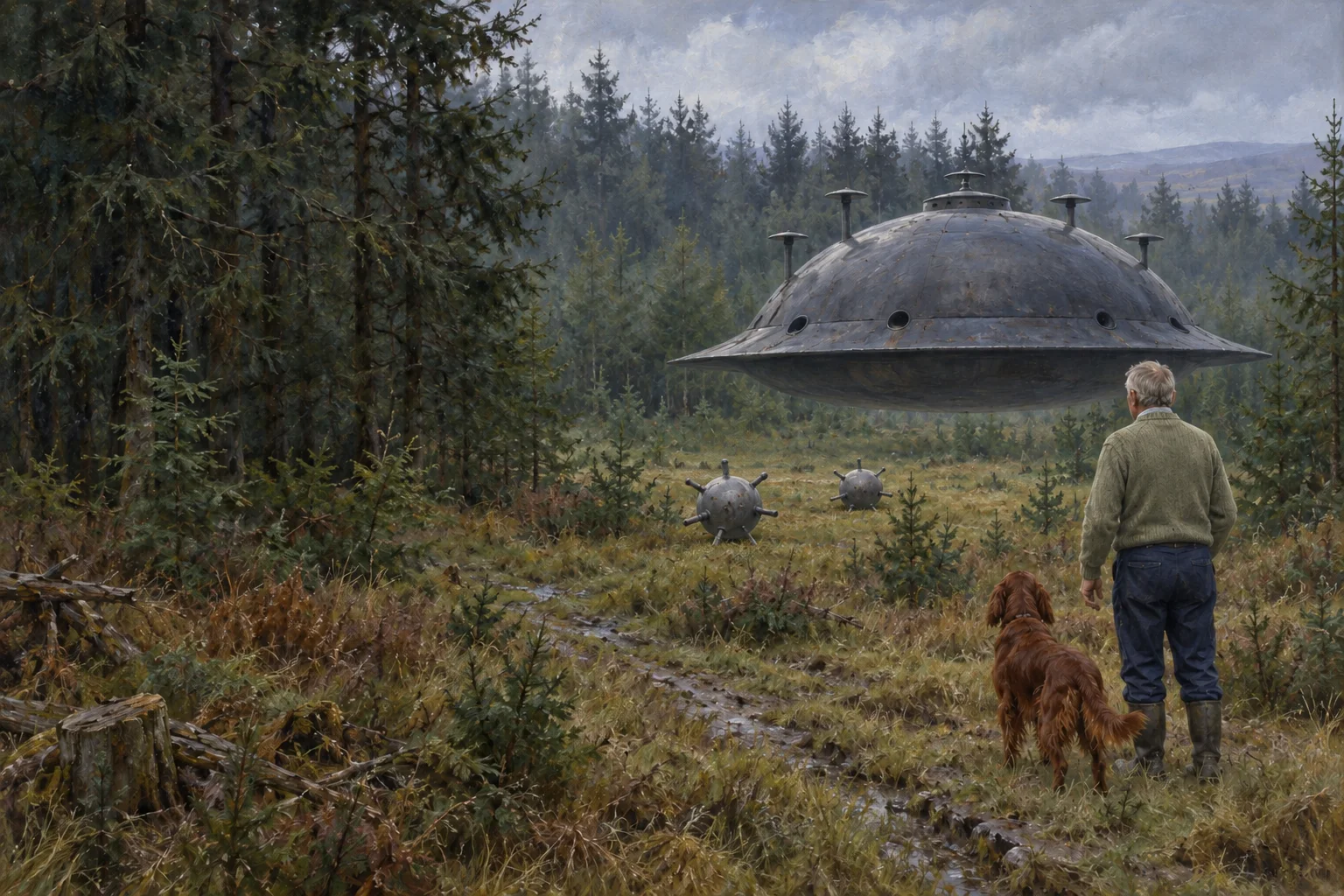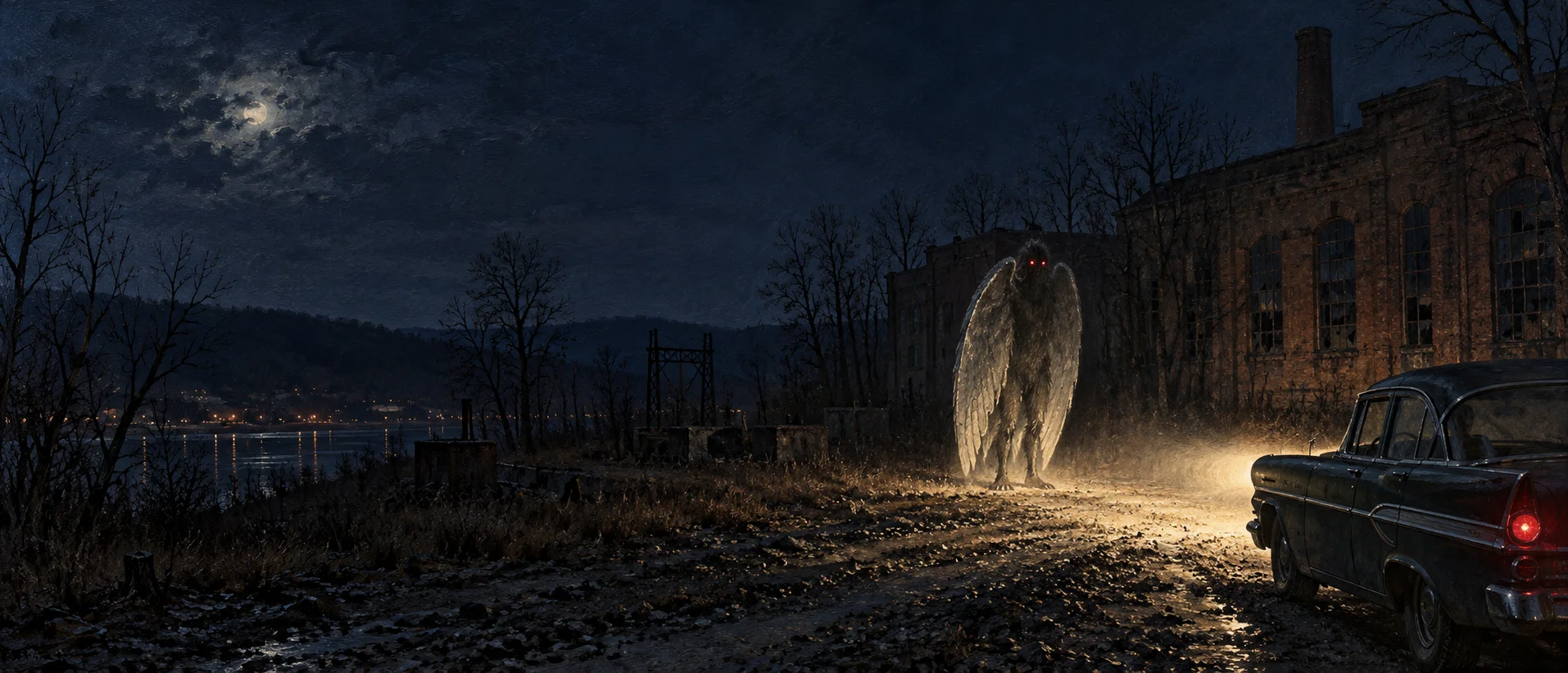
The eyes showed red when the car’s lights reached them.
It was near midnight on November 15, 1966. Roger and Linda Scarberry were driving with Steve and Mary Mallette through the TNT area outside Point Pleasant, West Virginia. Near an abandoned power plant, they said, stood a grey figure taller than a man.
Its wings were folded against its body. The four could make out a shape and two large eyes, but struggled to describe a head.
They drove away. The figure appeared again beside the road, spread its wings and rose into the air. As the car accelerated towards town, something was moving above it.
By morning, the Point Pleasant Register would be trying to find a word for the encounter: a bird, a creature, something. The people in the car had brought back an account that would soon send other residents out onto the same roads.
Above the car
The car belonged to Scarberry. In the later source compilation maintained by Fortean Archives, it is identified as a black 1957 Chevrolet. The four had been driving around a familiar local meeting place when the eyes drew their attention.
Their descriptions gave the figure a height of six or seven feet and an estimated wingspan of ten feet. On the ground, it seemed awkward. In the air, they said, it could glide along with the car even as its speed approached a hundred miles an hour.
They reached town, turned around and went back. According to the next day’s Register account, they saw the figure again, scurrying across a field and passing over the car. Their last reported view was near the gate of the C. C. Lewis farm on Route 62, where they heard wings and watched it rise almost vertically.
They contacted the police. At about two in the morning, deputies and city officers went to the area. They did not see the creature. Deputy Millard Halstead reported dust near a coal field, without claiming to have identified what caused it.
By daylight, the men were tired from the night’s events. Scarberry said he would have kept silent had he been alone. There had been four of them.
A drawing and a name
The figure also took shape on paper. A sketch attributed to Roger Scarberry, preserved among John Keel’s files, shows two dark eyes within a narrow body enclosed by long folded wings.
The newspaper language was less settled. The original witnesses spoke of a man with wings. They said the eyes appeared red when illuminated, and that a distinct head had not been the feature that caught their attention.
On November 17, Pat Siler’s Huntington Herald-Dispatch report put “Moth Man” into a headline alongside a playful reference to Batman. The name was entering circulation while residents were still trying to work out what the description meant.
At the McClintic Wildlife Station, staff consulted their bird manuals. None supplied a description they could confidently match to the report. They noted that geese were migrating through the area.
Outside, the roads were filling. Siler described sightseers travelling north from Point Pleasant to search the abandoned industrial grounds. The volunteer fire department had been called to help direct traffic. A place that four people had driven through late at night had become a destination for a crowd.
At the house
The next encounter reached police from a home in the same area.
The Register’s November 17 report named Raymond and Cathy Wamsley, Marcella Bennett and Ricky Thomas. They described a large grey creature in the yard of Ralph Thomas’s house, northeast of White Church Road. It came around their car, looked towards them and flew away. The newspaper placed this at about ten the previous evening.
John Keel’s 1975 reconstruction gives a more intimate account of Bennett’s experience. She had gone with the Wamsleys and her baby daughter, Teena, to visit the Thomas family. As they returned to their car, she said, a large grey figure rose from the ground behind it.
In that later telling, Bennett was so frightened that she dropped the baby. Wamsley helped her and the child back into the house. They shut and bolted the door, then reported sounds on the porch and red eyes at a window while he telephoned police.
Keel placed the call at nine. His version and the contemporary newspaper differ in their timing and detail, but both carry the encounter to the same domestic setting: people beside a parked car, a figure close to the house, and a request for officers to come.
By the time police arrived in Keel’s account, it had gone.
The search after midnight
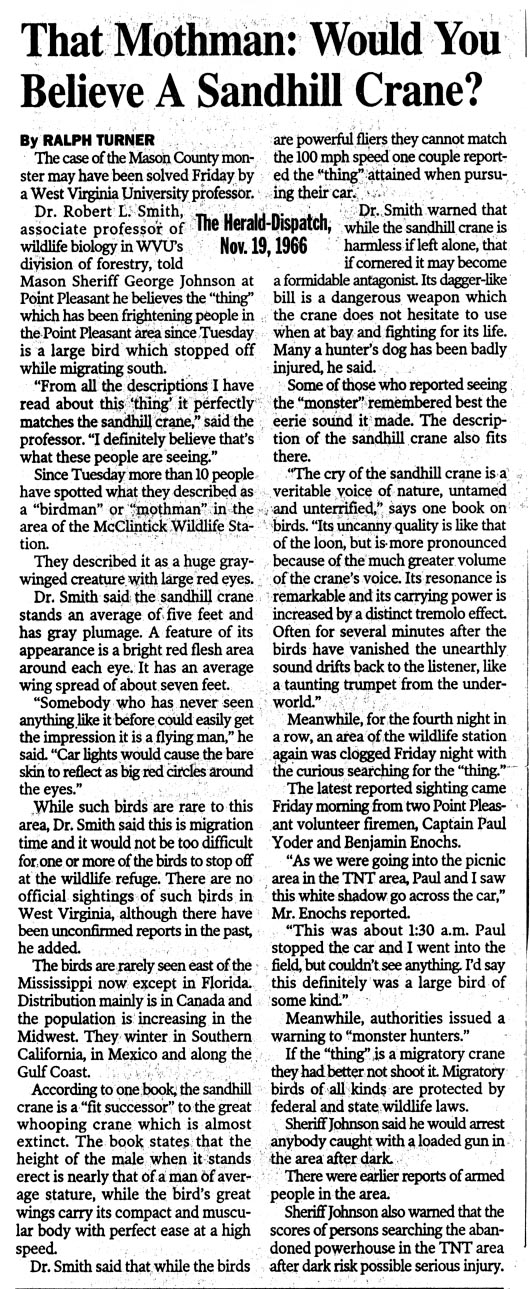
The searches continued. In Ralph Turner’s November 19 Herald-Dispatch report, two volunteer firemen described their own moment in the TNT area.
Captain Paul Yoder and Benjamin Enochs had been driving towards a picnic area at about 1:30 on Friday morning. A shadow passed across their car. Yoder stopped. Enochs went into the field to look, but found nothing he could see.
He believed they had encountered a large bird of some kind.
Sheriff George Johnson warned that anyone caught with a loaded gun there after dark would be arrested. He also warned against searching the abandoned powerhouse at night.
The search was becoming an operation that required protection for the people taking part.
Roads beyond the powerhouse
Not every account came from the original building.
On November 21, the Register reported another group of four: Billy Burdette, Darrell Love, Johnny Love and John Morrow. They had been on Camp Conley Road, about a mile back from Route 62. They described red eyes, then a creature flying away as they approached.
Calls and letters were still reaching Halstead. The roads around the TNT area had carried hundreds of sightseers, although the newspaper reported that traffic had begun to diminish.
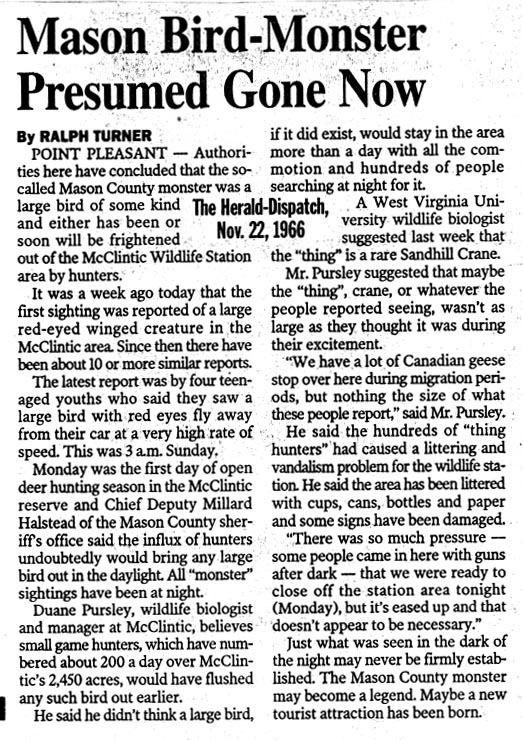
The following day, Turner spoke to McClintic manager Duane Pursley. Hunting season had opened, bringing another stream of people onto the grounds. Pursley estimated that small-game hunters had already been moving through the area at roughly two hundred a day.
He had a different aftermath to show: discarded cups, cans, bottles and paper, with signs damaged by visitors. So many people had come after dark with guns that staff had considered closing the station at night.
The sheriff’s office expected the influx of hunters to bring any large bird into daylight. Pursley thought a bird might already have been driven away by the commotion. The November 22 headline announced that the monster was presumed gone.
Three mornings later, a driver on Route 62 would give that conclusion a new complication.
After Thanksgiving
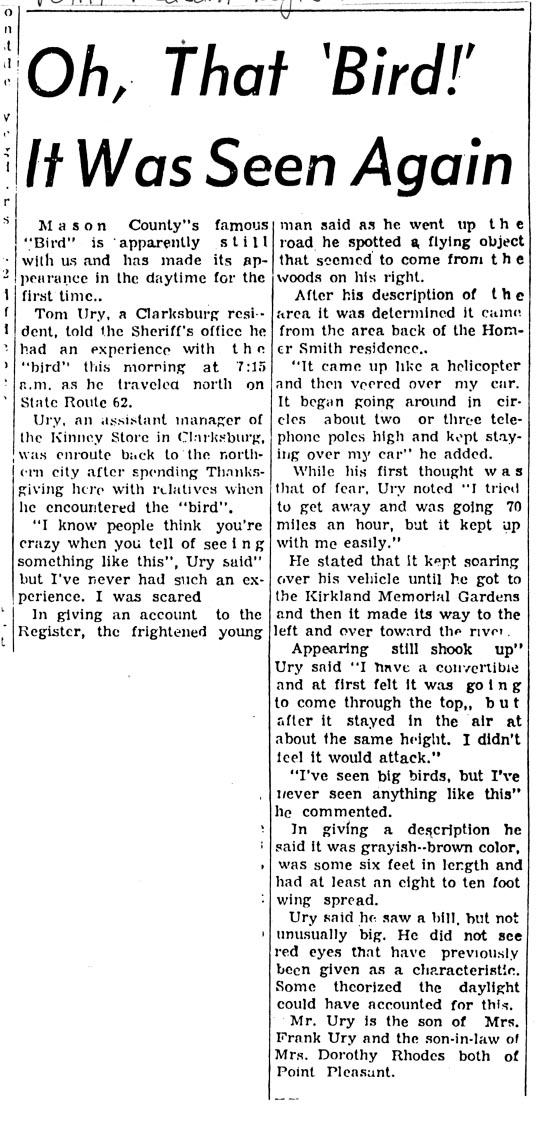
Tom Ury was leaving Point Pleasant after spending Thanksgiving with relatives. At 7:15 on November 25, he was driving north towards Clarksburg when something rose from the woods beside the road.
In the Register report published that day, he described an ascent resembling a helicopter’s. The shape veered over his convertible and began circling, remaining at a height he estimated as two or three telephone poles.
He accelerated to seventy miles an hour. It kept pace.
At first he feared it might come through the car’s roof. As it remained above him, he began to feel it would not attack. It continued over the vehicle until Kirkland Memorial Gardens, then moved left towards the river.
Ury described a greyish-brown creature about six feet long, with wings spanning eight to ten feet. He saw a bill. He did not see red eyes.
His account brought the story into daylight, with a different driver and a different description. Once again, it followed the course of a car journey: an unexpected movement near the road, something overhead, speed gained in fear, then a departure towards the water.
A clipping sent home
By the end of November, the story had travelled much farther than Route 62.
On November 28, the Register described clippings arriving from Vietnam. Sergeant Morton A. Jackson, from Point Pleasant, had found a report in the November 19 Pacific edition of Stars and Stripes and mailed its front page to his family. His sister was Halstead’s wife.
Another serviceman, Lieutenant Colonel William L. Latta Jr., sent articles to his wife, who forwarded them to the Register. Requests for copies of the local newspaper were arriving from elsewhere in the United States.
December added another pursuit. As summarised in Eleanor Hasken’s study of the contemporary coverage, a December 5 report described five men seeing a fast-moving bird at the Gallipolis airport, across the river in Ohio. Everett Wedge took a camera and went up in his aircraft to look for it. He could not find it to photograph.
The search had moved from a car on a dark road to a plane above the valley. The first night’s witnesses had wanted to get away from what they saw. Others were now setting out in the hope of seeing it.
What Is Known
The surviving record begins with contemporary newspaper accounts of reported encounters and the response around them. West Virginia Archives and History’s source guide identifies the early clippings; its website reproduces the November 19 and 22 Herald-Dispatch reports and Ury’s November 25 Register account.
These establish that witnesses made reports, officers searched, visitors crowded the area and local staff dealt with the consequences. They preserve descriptions given at the time. The reported heights and speeds were witness estimates, rather than measurements of a captured or instrumentally tracked creature.
In the November 19 report, West Virginia University biologist Robert L. Smith proposed a sandhill crane, citing its size, grey plumage and red facial skin. He acknowledged it could not match the claimed hundred-mile-an-hour pursuit. The first witnesses continued to describe a more human-shaped figure.
Scarberry’s sketch survives as a photocopy in Keel’s files. Keel’s book is a later reconstruction; its house scene contains details and a timing that differ from the next-day newspaper report.
The Bigger Picture
In David Clarke’s study of legendary storytelling, the searches become part of Mothman’s history. People went to a place already associated with an extraordinary account, testing the story by entering its setting. The experience of looking could itself become a story carried home.
Clarke also traces Keel’s role in bringing the encounters to a wider audience through The Mothman Prophecies. The book connected local reports with a much larger pattern of ominous experiences. That later framework has shaped how the first night’s figure is remembered.
The Silver Bridge disaster belongs to this subsequent history. On December 15, 1967, thirteen months after the couples’ encounter, the bridge collapsed and forty-six people died. Later interpretations made Mothman an omen of that loss. The National Transportation Safety Board’s investigation established a mechanical cause: a fracture in suspension eyebar 330, following the growth of a flaw through stress corrosion and corrosion fatigue. It did not establish a connection to the sightings.
Hasken’s folklore research follows how recognisable features—red eyes, wings, unusual size—allow the legend to travel between places and generations. The image can become familiar even to someone who has never read an early clipping.
Returning to those clippings restores the smaller, unsettling sequence beneath the famous name. Four people in a car. Officers arriving later. A house asking for help. A driver watching something circle above his roof. The story began in the effort to describe those moments, and in the journeys other people made to look for themselves.
Sources
- Point Pleasant Register, “Couples See Man-Sized Bird…Creature…Something,” November 16, 1966. Contemporary report reproduced in Hasken’s study.
- John Samsell, “City Getting ‘The Bird,’ Want It Or Not,” November 17, 1966. Later transcription of the Register clipping; checked against Hasken’s reproduction.
- Pat Siler, “Mason Countians Hunt ‘Moth Man,’” November 17, 1966. Later transcription of contemporary Herald-Dispatch reporting.
- Ralph Turner, “That Mothman: Would You Believe a Sandhill Crane?” November 19, 1966. Original clipping held online by West Virginia Archives and History.
- Ralph Turner, “Mason Bird-Monster Presumed Gone Now,” November 22, 1966. Original clipping on the searches and wildlife station.
- Point Pleasant Register, “Oh, That ‘Bird!’ It Was Seen Again,” November 25, 1966. Original clipping recording Ury’s account.
- Register reports of November 21 and 28, 1966. Later transcriptions published by Fringe Paranormal.
- Roger Scarberry’s sketch. Archival photocopy published by Doug Skinner.
- John Keel, The Mothman Prophecies, 1975, chapter 6. Later reconstruction, used for Bennett’s house encounter.
- Fortean Archives, 1966–67 datasheets. Later synthesis, used for the car and early encounter sequence.
- Eleanor Hasken, “The Mothman: The Migration of a Local Legend,” 2026. Independent folklore study and documentary compilation.
- David Clarke, “The Mothman of West Virginia,” 2022. Independent study of legend trips and Keel’s influence.
- West Virginia Archives and History, Mothman source guide. Official bibliography and clipping index.
- National Transportation Safety Board, Silver Bridge investigation. Official findings on the December 1967 collapse.