Something came out of the trees ahead of the car.
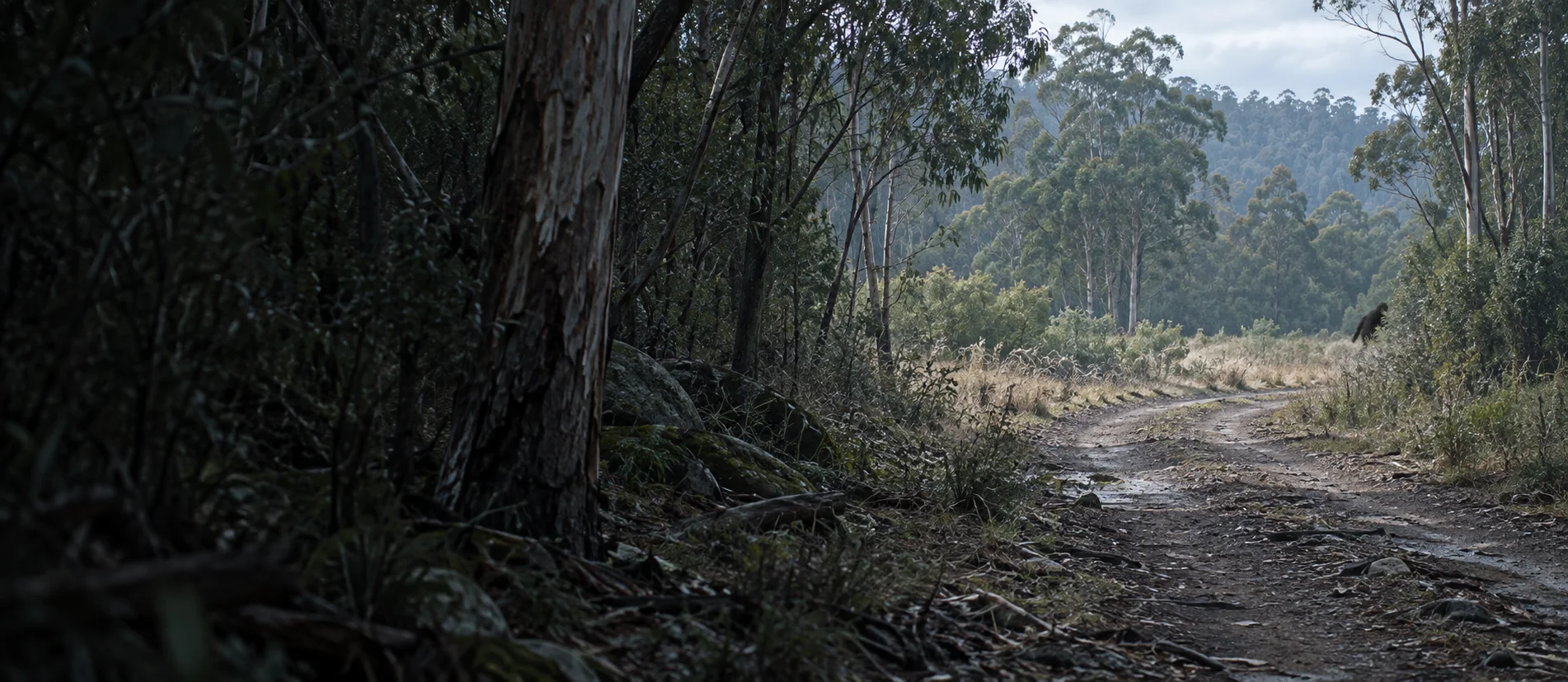
Across a rough forest track, a dark figure was moving towards the opposite tree line. For the driver, the road had suddenly become the setting for an encounter he would later describe to Australian Yowie Research.
His name was Warren.
The road back
He had gone into the woods for firewood. A logging trail led to a clearing; there he decided to turn his Honda Jazz around. Beyond a corner, the track straightened.
Then the figure crossed from left to right, forty to fifty metres ahead.
Warren described black hair and a height of four to five feet. Its powerful hind legs drove it forward while its forelimbs brushed the ground. The rocky surface seemed to make little difference to its speed.
A shape in motion
His first comparison was a boar. Then the movement suggested something chimp-like. He thought of a small yowie.
Those changing comparisons give the account its unsettling quality: an animal shape, followed by movement that seemed to belong to something else. The name he reached for came after the glimpse. The motion was what made the encounter memorable.
The figure kept facing its direction of travel. Warren slowed, then drove on. He later told his wife and son.
The story ends with the track leading onward and the figure back among the trees. There is no prolonged confrontation to bring it into clearer view. The forest crossing itself is the centre of the account: a brief interruption of an ordinary journey, followed by a memory that remained difficult to name.
Older shadows on the island
Warren’s account sits beside older Tasmanian stories in the same archive. They belong to other places and other witnesses, but reading them together gives the recent crossing a longer narrative backdrop. Long before a driver described a dark figure on a logging track, visitors and hunters were telling stories of shapes appearing at the edge of familiar surroundings.
At Lake Dulverton, near Oatlands, a damaged tyre interrupted a holiday in January 1987. Bill Johnstone and Stella Donohue, visitors from Melbourne, camped beside the lake while waiting for a repair. According to a newspaper report reproduced by Australian Yowie Research, noises resembling bird calls woke them around two in the morning.
Donohue opened the tent flap. She described a figure about two metres tall, silvery in appearance and resembling an ape.
The archive also reproduces a later magazine interview in which the couple described a figure in the water, a torch beam that seemed to reflect dazzlingly back, and a hurried departure by car.
The campsite story carries a different atmosphere from the Christmas Hills crossing. A tent opening becomes the frame through which something unfamiliar appears. A holiday stopped by a mechanical problem becomes a story about a creature beside the water. Its setting is a night interrupted; the newer account begins with a morning errand.
Eyes beyond the truck
Another account in the archive’s Tasmania collection, labelled Smithton, 1992, begins with a shooting party observing a pair of eyes. The narrator described three or four people watching for about twenty minutes before an approach prompted the figure to bolt.
A separate episode in that account involved heavy footsteps beyond a bank. When the observers went to look, they reportedly glimpsed a fast-moving black figure, including the back of its head and shoulders. The narrator placed the two episodes about six months apart.
Here the story unfolds through fragments: eyes first, then sound, then a retreating outline. The observers’ approach ends the opportunity to look. What remains is a description assembled from the parts that were visible before the figure moved away.
Together, these accounts form a small collection of Tasmanian encounter stories, each with its own scene and sequence. They offer the reader several ways into the same unsettling theme: something appears close enough to attract attention, then leaves before the encounter can become familiar.
Christmas Hills brings that theme back to a road in daylight. The opening in the trees briefly makes a moving figure visible. The track gives the driver a line of sight; the opposite forest closes it again. The journey continues, but the crossing becomes the part worth recounting.
What Is Known
The source for the Christmas Hills case is a published witness interview. It preserves an account that readers can examine, including the interviewer’s questions. The record should be read at two levels: what the witness described, and the identity he considered assigning to it.
The interview’s opening suggests it was conducted the following day. The page does not supply a sighting photograph or a documented track examination. The witness did not report a clear view of facial features. These limits matter when moving from a description to an identification.
A prompt account is useful because it gives an investigation an early version to work from. It still needs corroboration before estimates of scale, movement and appearance can become established measurements. The record available here supports reporting the encounter as testimony; it does not settle which animal, if any, produced it.
The older accounts provide narrative context, rather than corroboration of the 2024 event. The Lake Dulverton material is reproduced press coverage; its later magazine version adds details and gives a larger height estimate than the earlier newspaper item. The Smithton entry is a first-person account with sparse provenance and approximate timing. Their similarities do not establish that the witnesses encountered the same animal.
The details an identification needs
The Tasmanian Land Conservancy’s wildlife identification guide illustrates how much depends on specific features. It distinguishes wallabies and related animals using ear shape, facial markings, body proportions and tail length. Posture and behaviour also help. Even experienced observers working with photographs can be left with an unidentifiable animal, for which the guide recommends an unknown classification.
Its treatment of image sequences is particularly useful. An indistinct frame can become intelligible when the frames before and after it show a recognisable animal. Context can recover information that an isolated shape cannot provide.
That guidance concerns camera records. Applying it here offers a way to frame further investigation, rather than an identification of Warren’s sighting. A measured crossing point, a detailed account of distinguishing anatomy, or a recorded sequence of movement would allow a more concrete comparison with known species.
A proposed ordinary explanation needs that comparison just as an extraordinary one does. Resemblance alone cannot resolve the case. The most defensible classification remains an unidentified reported encounter.
The Bigger Picture
Forest encounters have an awkward relationship with documentation. The event may be over before an observer has decided that anything unusual is happening. Returning to a location can establish distances and terrain, but cannot replay the crossing. A record made at the time has a different value from a reconstruction afterwards.
Tasmania also offers an example of how patient wildlife monitoring can build a richer record. A University of Tasmania report published in 2022 described a camera network spanning more than 1,300 surveyed sites, with 600 active cameras. The researchers used animal detection and classification trained on common species, while noting the challenge of identifying animals rarely represented in the images.
That was a wildlife research project, and those figures describe its network at the time of the report. They do not demonstrate coverage of the Christmas Hills crossing. They show what sustained observation can contribute: records with times and locations that can be compared, revisited and interpreted by more than one person.
Coverage remains essential to understanding what such records mean. A camera observes a particular place during a particular period. Its silence cannot describe every animal beyond that view. Conversely, an ambiguous image becomes more useful when its location, scale and surrounding sequence are preserved.
The Conservancy’s WildTracker programme extends wildlife monitoring to private landholders through camera surveys and shared observations. The programme addresses gaps in biodiversity knowledge on private land, where information can be thinner than in public reserves.
For unusual encounter reports, a comparable approach would give researchers something beyond another retelling. Repeated observations could reveal a consistent appearance or a recurring route. Independent records could establish whether different witnesses were describing the same kind of animal. Even an ordinary identification would add knowledge about the place where the encounter happened.
The appeal of Christmas Hills begins with the sudden crossing. Its future as a case depends on whether that glimpse can acquire a second, independent record. Until then, the track remains the boundary between a vivid account and an animal still unnamed.
Sources
-
Australian Yowie Research, Christmas Hills Reserve, Tasmania, 2024. Primary witness interview; the case title and identification originate with this account.
-
Tasmanian Land Conservancy, Wildlife Identification Guide. Independent context for species recognition and uncertain observations.
-
University of Tasmania, Innovative camera network keeps close eye on Tassie wildlife, 2022. Independent research context, not a Christmas Hills investigation.
-
Tasmanian Land Conservancy, WildTracker. Independent context for wildlife monitoring on private land.
-
Australian Yowie Research, Lake Dulverton, 1987 newspaper report. Reproduced contemporary press account, used for historical narrative context.
-
Australian Yowie Research, Lake Dulverton magazine account. Later press interview reproduced in the archive.
-
Australian Yowie Research, Tasmania collection, Smithton 1992. First-person account with limited dating and provenance.