The two men wanted the exact spot.
Jim Templeton had already told them where to stop the car. Now, in his account, they got out and he walked with them onto Burgh Marsh. He showed them where he had stood with his camera. One man looked at the other. Then came a question about the figure behind his daughter. Was this where he had seen it?
Templeton hadn’t seen anybody there. He had said so since he first showed people the picture. But he was back on the English shore of the Solway Firth with two strangers, answering a question about someone he had seen only on a print.
The middle frame
The first trip to the marsh had been a family outing in May 1964. Templeton was a Carlisle firefighter who took photographs in his spare time. He had brought a single-lens reflex camera loaded with Kodacolor film. In a letter to the Daily Mail nearly four decades later, he remembered taking three pictures of Elizabeth in much the same pose.
The shore west of Carlisle opens out into saltmarsh and tidal flats. The Solway Coast landscape authority describes the marshes as grazing commons, where sheep and cattle help keep the grass short. In the photograph Elizabeth is five years old. She looks towards the camera with flowers in her hands. The low ground leaves much of the upper part of the frame to the sky.
When Templeton went to collect the film, the person at the shop drew his attention to the figure behind her. In the version he told researchers David Clarke and Andy Roberts, Templeton had to look at the prints himself to see what the assistant meant. There, just beyond Elizabeth’s head, was something white that suggested a helmet and the upper part of a suit. A dark area on the head looked like a visor. Elizabeth was close enough to fill the foreground, and the pale figure appeared to rise directly behind her.
There were three photographs. Templeton said the middle one was the one that came back with the figure in it. The other frames had given him much the picture he had gone there to take. He could remember taking all three, but he could recall seeing nobody in the place the figure seemed to occupy. By the time he could ask anyone else to look, the family had already come home from the marsh.
The picture leaves Carlisle
Templeton took the picture to the police. In his later letter he remembered them examining it and finding nothing suspicious. The Cumberland News picked up the story and the picture went further than anyone in the family could have expected. It was reproduced abroad, including in Australia. Templeton recalled receiving letters for years from people who thought they could tell him what he had photographed. As late as 2002, a reader was still writing to the Daily Mail to ask whether anyone had established what the picture showed. Templeton answered in his own name and went back through the details of taking the three frames. He said that he had received no payment for the photograph and was still puzzled by the figure.
The word spaceman gave readers something to look for before they saw the picture. It was easy to pick out the white shape once the headline had told them where to look. What a newspaper reader could see at a glance, though, was only the surface of the print. Templeton was the person they could ask what he had seen when his daughter was standing there.
The attention fell on Elizabeth as well. Clarke and Roberts report that she was taunted and bullied after the picture became public and that her father took her out of school for a time. The face people recognised belonged to the girl in the foreground. She had posed for her father and ended up in a picture that strangers were passing around to examine something behind her.
The local paper approached the Ministry of Defence about the case. According to Clarke and Roberts, the Ministry expressed interest in analysing the photograph and wanted the original film and camera. Templeton declined to send them. Later that summer, as he remembered it, two men came to the fire station and spoke to him in person. Their request concerned the place where he had used the camera.
Nine and Eleven
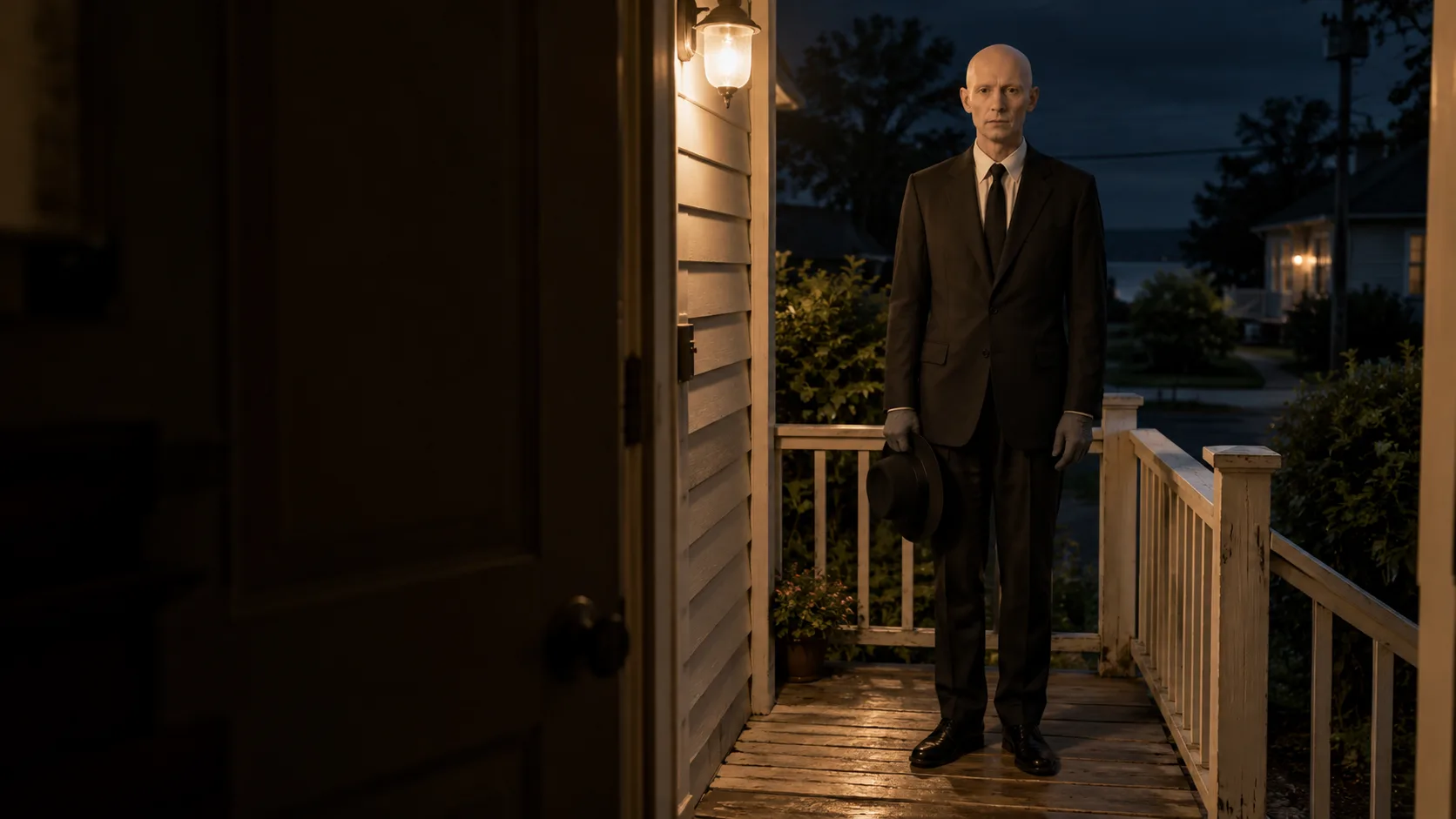
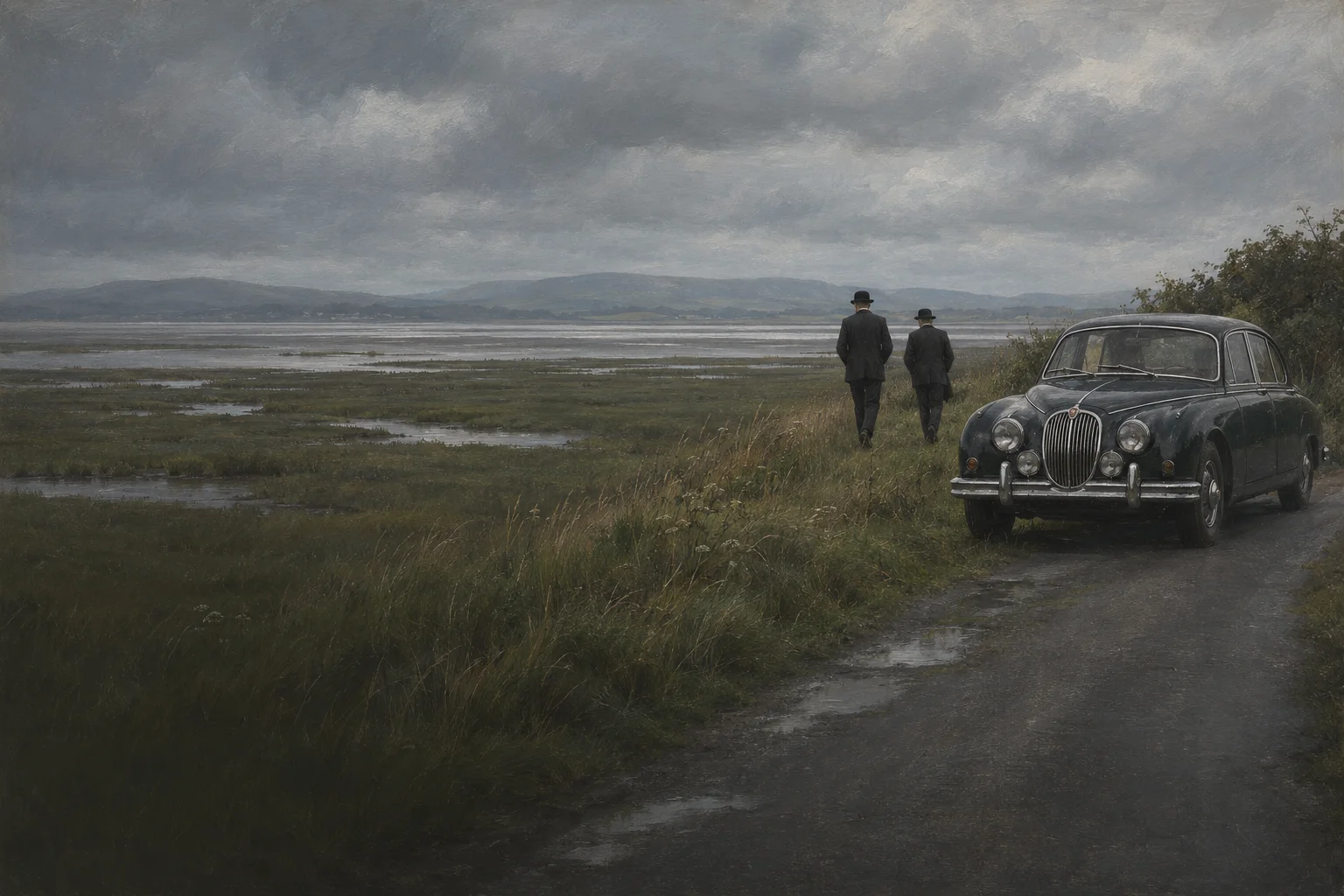
They wore black and came in a black Jaguar, Templeton said. He asked who they were. In the account he later gave Clarke and Roberts, one showed him a card bearing a crest and the word Security. They said they were from the Ministry. He came away with no names. The detail he remembered was how they addressed one another, using the numbers Nine and Eleven.
They needed him to show them the way. Templeton remembered that they struggled with local place names, which made him think they were from elsewhere. He went with them in their car towards Burgh Marsh. When they reached the place, they asked him to narrow it down further. He could take them from the road to the spot where he had stood and point it out on the ground.
That was where one of the men put the question to him. The way Templeton remembered it, the man asked where he had seen the figure. Templeton said he had seen nobody. It was the same answer he had been giving about the photograph all summer. On the marsh, the men had the person who had looked through the viewfinder and the place he had been standing. There was still nothing he could point to beyond the place itself.
In Templeton’s telling, the conversation ended abruptly. One of the men thanked him and walked away. The pair drove off in the Jaguar, leaving him to walk about a mile to a garage, where he could get a lift back to Carlisle. He told Clarke and Roberts that he never saw them again.
What he told the paper
By September the story of the meeting had reached the newspapers. Readers could see a copy of the photograph for themselves, but to learn who had taken Templeton out to the marsh they had to ask him or the police. The Cumberland News asked Detective Chief Inspector Stanley Armstrong. In the newspaper passage quoted by Clarke and Roberts, Armstrong said he knew nothing about the meeting or who the men were. He had told Templeton he ought to have taken the car’s registration number and reported the encounter.
Templeton sounded doubtful when he spoke to the paper. He thought someone might have played a joke on him. As the newspaper quoted him, he was sure the men were not security agents and had no idea why they would pass themselves off as such. Templeton could describe the car. Its registration number never entered the story.
When Clarke and Roberts asked him about it in 2001, he had come to believe the visitors really had been sent by the British government. He was still telling the story of the same trip out with two men he couldn’t name. It was the question of who had sent them that he answered differently.
What Is Known
Templeton’s photograph survives and is reproduced from a copy in the UK National Archives file DEFE 24/1983/1. In his 2002 letter, Templeton dated the outing to May 23, 1964. Clarke and Roberts give May 24. The visit was already being reported in September 1964, as shown by the Cumberland News passages they reproduce. The fuller account of the trip in the Jaguar and the men’s use of numbers comes from Templeton’s later recollections. The surviving accounts leave the visitors’ identities open.
The Bigger Picture
The Solway is an estuary with an English shore and a Scottish shore. Its grazing marshes sit alongside flats that the tide covers and uncovers. Across the generations, people have made their living there and used its open ground for ordinary outings like the Templetons’. In the photograph, that familiar place is reduced to a strip of grass and a piece of sky.
The picture travelled much farther than the photographer. People who had never been to Burgh Marsh could pick Elizabeth and the white shape out of a newspaper. The two men, as Templeton remembered it, wanted something a copy of the picture couldn’t give them. They wanted him to walk out with them and show them where he had stood.
Sources
- James Templeton, “Rocket clue to spaceman,” Daily Mail, December 13, 2002. Templeton’s letter on taking the three photographs, taking the print to the police, and receiving correspondence after publication. Reproduced in UFO Newsclipping Service 402.
- David Clarke and Andy Roberts, “The Solway Spaceman photograph,” Fortean Times 286, April 2012. Includes Templeton’s later account of the visit and excerpts of the September 1964 Cumberland News reporting with Templeton and Detective Chief Inspector Stanley Armstrong.
- David Clarke, “UFO Drawings from the National Archives,” The Paris Review, March 12, 2018. Reproduces the photograph with its archival reference, DEFE 24/1983/1.
- Solway Coast National Landscape, “Salt Marsh”. Independent landscape context for the Solway’s tidal marshes and grazing commons.