The stranger, Harold Dahl said, already knew what had happened on the boat.
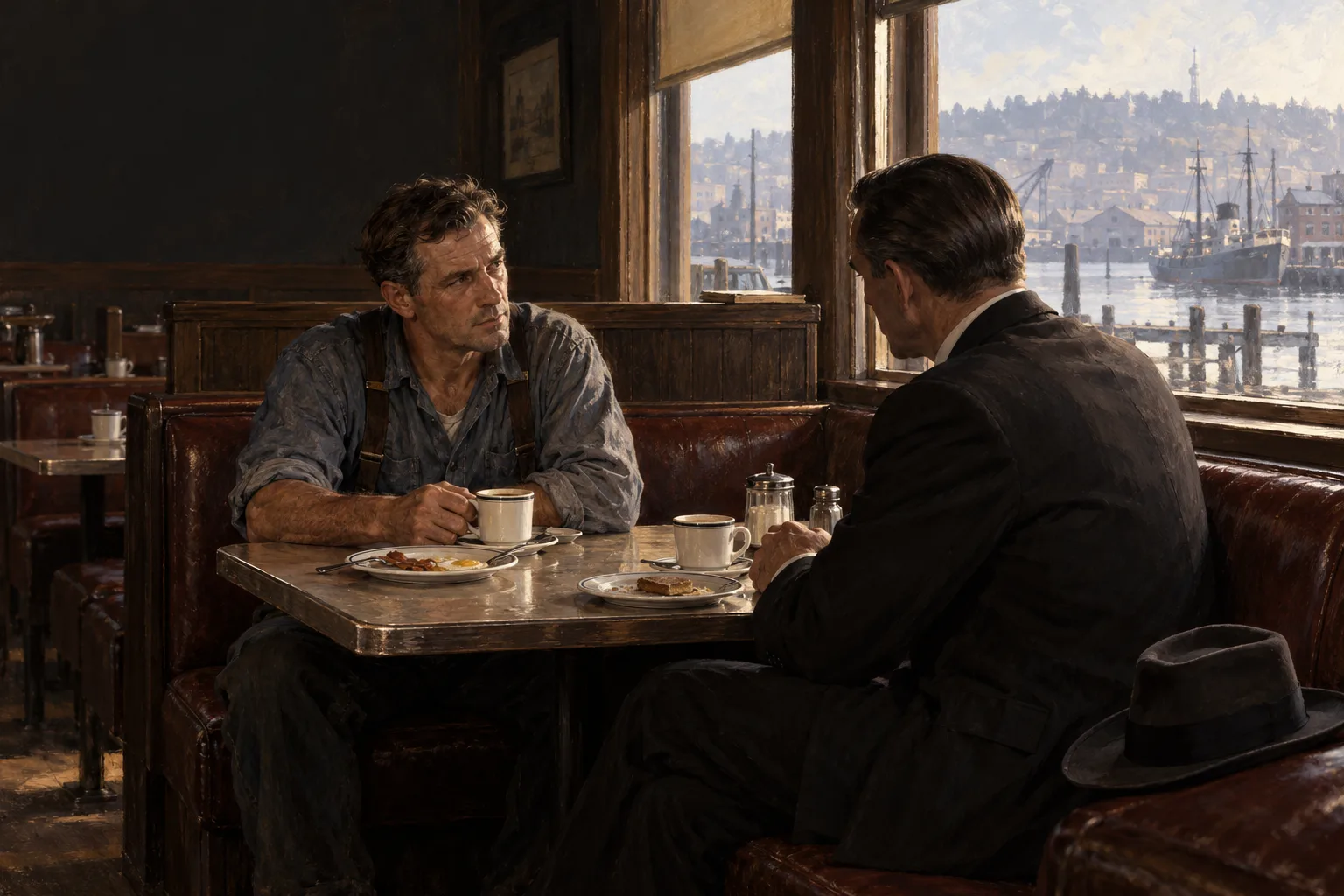
He had appeared at Dahl’s home early in the morning and invited him to breakfast. That was not extraordinary in itself. Dahl worked around boats and logs; business callers sometimes arrived early. The man wore a black suit and looked ordinary enough to be selling insurance.
According to the account later published in Kenneth Arnold and Ray Palmer’s The Coming of the Saucers, Dahl followed him to an uptown café. There, the visitor described the previous day’s incident in detail, apparently knowing things that someone aboard the boat would have known.
Then came the warning. Dahl said the man invoked his family and his own welfare: he should stop discussing what he had seen.
In the book’s telling, Dahl did not obey. He continued talking about the encounter. Yet the breakfast would become one of the most durable parts of his story—a private conversation with a stranger whose knowledge seemed harder to explain than his appearance.
Something falling from the sky
The incident Dahl described belonged to June 21, 1947, in Puget Sound near Maury Island, south of Seattle.
In HistoryLink’s summary, Dahl reported six large, doughnut-shaped objects above the water. One seemed to be in trouble. Material fell from it, striking the boat. His son was injured and the family dog was killed; Dahl sought shelter at the island before returning to Tacoma and telling his associate, Fred Crisman.
The shapes mattered. These were not merely distant lights. Dahl’s account gave them bodies, openings and a mechanical emergency. Something overhead could fail, shed material and harm people below.
Edward Ruppelt’s later history of the Air Force’s UFO investigations preserved the story’s elaborate sequence: another object approached the troubled one, a thud sounded, and falling material changed from light flakes to darker fragments. His book used pseudonyms for the principal civilians, but the episode was recognisably Maury Island.
For anyone hearing Dahl’s account, the danger did not end when the objects departed. He claimed there were pieces left behind. A sighting could become a sample that someone else might hold.
The story reaches Tacoma
Three days after the claimed boat incident, Kenneth Arnold reported unfamiliar objects near Mount Rainier. National headlines followed. As HistoryLink emphasises, the Maury Island story emerged publicly after the flying-saucer excitement had begun, despite its earlier claimed date.
Ray Palmer, a publisher interested in extraordinary stories, became involved. Fragments were offered as material connected with the encounter. Arnold, already famous because of his own sighting, was drawn into investigating another man’s report.
The route from the island to the public therefore passed through a publisher and a newly prominent witness. What reached investigators was already a story being proposed for wider circulation, with objects accompanying it.
In Ted Bloecher’s reconstruction of the 1947 wave, Arnold went to Tacoma in late July and stayed at the Winthrop Hotel. United Airlines captain Emil J. Smith joined him. Smith had also reported unusual aerial objects that summer; now he helped Arnold question the men behind this account.
Dahl’s warning acquired another audience. The stranger at breakfast was no longer solely a figure in a boatman’s story. He belonged to an encounter being discussed among men trying to determine what had fallen into Puget Sound.
Room 502
Two Army Air Forces intelligence officers, Captain William Davidson and Lieutenant Frank Brown, came to Tacoma on July 31.
Their involvement survives in an Army investigative report. Brown had received a call from Arnold. The officers flew to McChord Field and met Arnold, Smith, Dahl and Crisman at the hotel. Palmer’s financing of Arnold’s inquiry formed part of the report’s background.
The meeting connected the civilian investigation to military intelligence. The fragments could now travel beyond the hotel, into the hands of people with official responsibilities and access to technical examination.
The Army record mentions samples in a box and a heavy cardboard carton later placed aboard the officers’ aircraft. Its account of the carton came from the crew chief, who had not looked inside. That distinction sits quietly within the paperwork: he could describe a load being carried without certifying its contents.
The report also records that the officers’ interview notes were destroyed in the aircraft accident that followed. The meeting itself was documented; part of its immediate written record would not survive the journey home.
A caller outside the room
Another strand of the episode was unfolding through newspaper telephones.
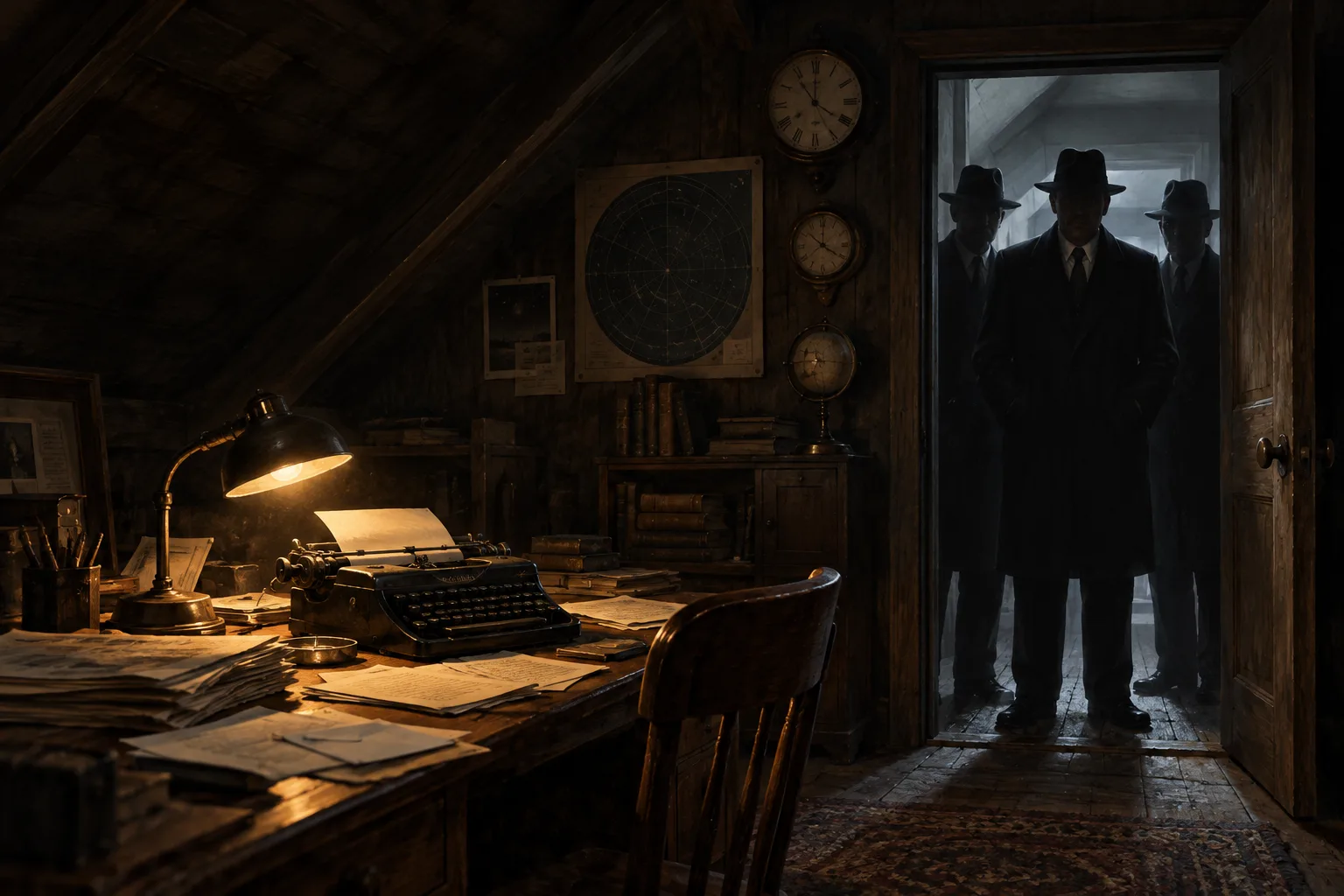
An FBI letter from August 1947 describes five anonymous calls between July 31 and August 2. The caller supplied information about the investigation, including Arnold’s room number, 502, at the Winthrop.
Here was a public counterpart to Dahl’s claimed breakfast: an unidentified person apparently knew what was happening around the witnesses. In one version of the story, knowledge arrived across a café table. In the other, it reached a reporter over the telephone.
The two episodes invited the same response from a listener. Someone seemed to have access to information before it should have become widely available. The caller’s identity became part of the unfolding mystery, although the calls and the alleged stranger were different claims with different documentary histories.
After the officers left Tacoma, the calls took on a much darker significance.
The flight south
Early on August 1, the B-25 carrying Brown and Davidson crashed near Kelso, Washington. Both officers died. Two other men escaped by parachute.
In Ruppelt’s retrospective account, the aircraft suffered an engine fire and structural failure. Rumours nevertheless gathered around its mission and cargo. The officers had just visited the men reporting saucer debris; their deaths could be made to sound like another chapter of the same extraordinary affair.
The anonymous caller promoted that connection. The FBI account says he supplied the dead officers’ names before they had been publicly released and advanced a sabotage explanation.
Those calls joined real news to an allegation about its cause. Correct information about the deaths gave the caller a stronger claim on the reporter’s attention. It did not follow that his explanation of the crash was correct, but the combination helped make the episode feel as though information was escaping from somewhere hidden.
The loss was real. Whatever became of the saucer account, two men who had participated in its investigation would not return from the flight.
The file becomes a legend
The public investigation moved towards rejection. Bloecher records an August 4 newspaper denial by Dahl that the exhibited material was saucer wreckage. On August 8, a Fourth Air Force spokesman publicly described the reported incident as unfounded. The fragments were identified as slag of a kind found around local smelting operations.
But the story continued through publication. Arnold and Palmer’s 1952 book gave the Tacoma episode an extended treatment, carrying the alleged warning, hotel meetings and crash into a connected narrative that later readers could revisit.
One of those readers was Gray Barker.
In They Knew Too Much About Flying Saucers, published in 1956, Barker described returning to his Maury Island file while considering Albert Bender’s account of visitors in black. His notes drew largely on Palmer’s book. Dahl’s alleged visitor offered a precedent: a witness, a dark suit, unexplained knowledge and pressure to remain silent.
Barker did not insist that the same individual had visited both men. He acknowledged that black clothing alone proved little. Nevertheless, placing the stories together gave the older warning a new role. It could be read as an early occurrence of a pattern.
The disc-shaped objects and falling fragments supplied Maury Island’s original claim. The stranger supplied something easier to carry into another story: an apparently ordinary person whose arrival suggested that someone had been watching.
What Is Known
Investigators treated the underlying Maury Island saucer story as a hoax. This article concerns that hoax’s history and its place in the origins of the Men in Black legend.
An FBI memorandum dated August 14, 1947 summarised an August 7 signed statement: Dahl and Crisman acknowledged falsely representing the fragments sent to Palmer as material from flying discs. The contemporary military records also attribute the fatal crash to fire and structural failure; investigators reported no indication of sabotage.
Accounts of Dahl’s recantation require more care than a single sentence about a confession allows. In a Humanities Washington interview, researcher Steve Edmiston highlights another FBI passage suggesting Dahl was prepared to call his story a hoax to avoid further trouble. Edmiston also acknowledges that Dahl could have been lying in that account. This qualification complicates the wording of the recantation; it does not authenticate the sighting or the stranger.
Ruppelt’s 1956 account firmly classified the affair as a hoax. Arnold and Palmer’s book remains a participant’s later published account, rather than independent verification of Dahl’s breakfast story. Barker’s return to that book documents the legend’s transmission, not a second investigation establishing the visitor’s existence.
The Bigger Picture
Maury Island occupies an unusual place in UFO folklore: its influence extends beyond whether the original report was believed. The incident could be rejected while one scene from it continued to attract readers.
The HISTORY overview of Men in Black origins places Dahl’s warning within a tradition later developed through Barker and popular culture. In this early telling, the visitor’s power came from knowing the witness’s experience and making a personal threat. Elaborate equipment and an otherworldly appearance were unnecessary.
The publication trail matters. A claimed event in 1947 became a sustained book narrative in 1952, then a precedent in Barker’s 1956 treatment of mysterious visitors. Each stage made it available to readers who might encounter it apart from the investigation’s conclusions.
The debris story ended in a hoax finding. The stranger remained seated at the breakfast table, apparently knowing everything.
Sources
- FBI and Army Air Forces records, 1947: contemporary reports, preserved in FBI file 62-HQ-83894, section 3; scanned pages 15, 33 and 35–36.
- Kenneth Arnold and Ray Palmer, The Coming of the Saucers: participant’s published account, 1952; online transcription.
- Gray Barker, They Knew Too Much About Flying Saucers: 1956 book, especially pages 147–150; evidence of the legend’s development.
- Edward J. Ruppelt, The Report on Unidentified Flying Objects: former Project Blue Book chief’s retrospective, 1956, chapter 2.
- Ted Bloecher, Report on the UFO Wave of 1947: documentary reconstruction, 1967, section I, pages 15–16.
- Walt Crowley, HistoryLink: independent regional history and publication chronology.
- Humanities Washington, interview with Steve Edmiston: later archival interpretation and local cultural context.
- Justin Sablich, HISTORY, Men in Black origins: independent context on the legend’s development.