Herbert Hopkins put down the telephone and went to turn on the outside light.
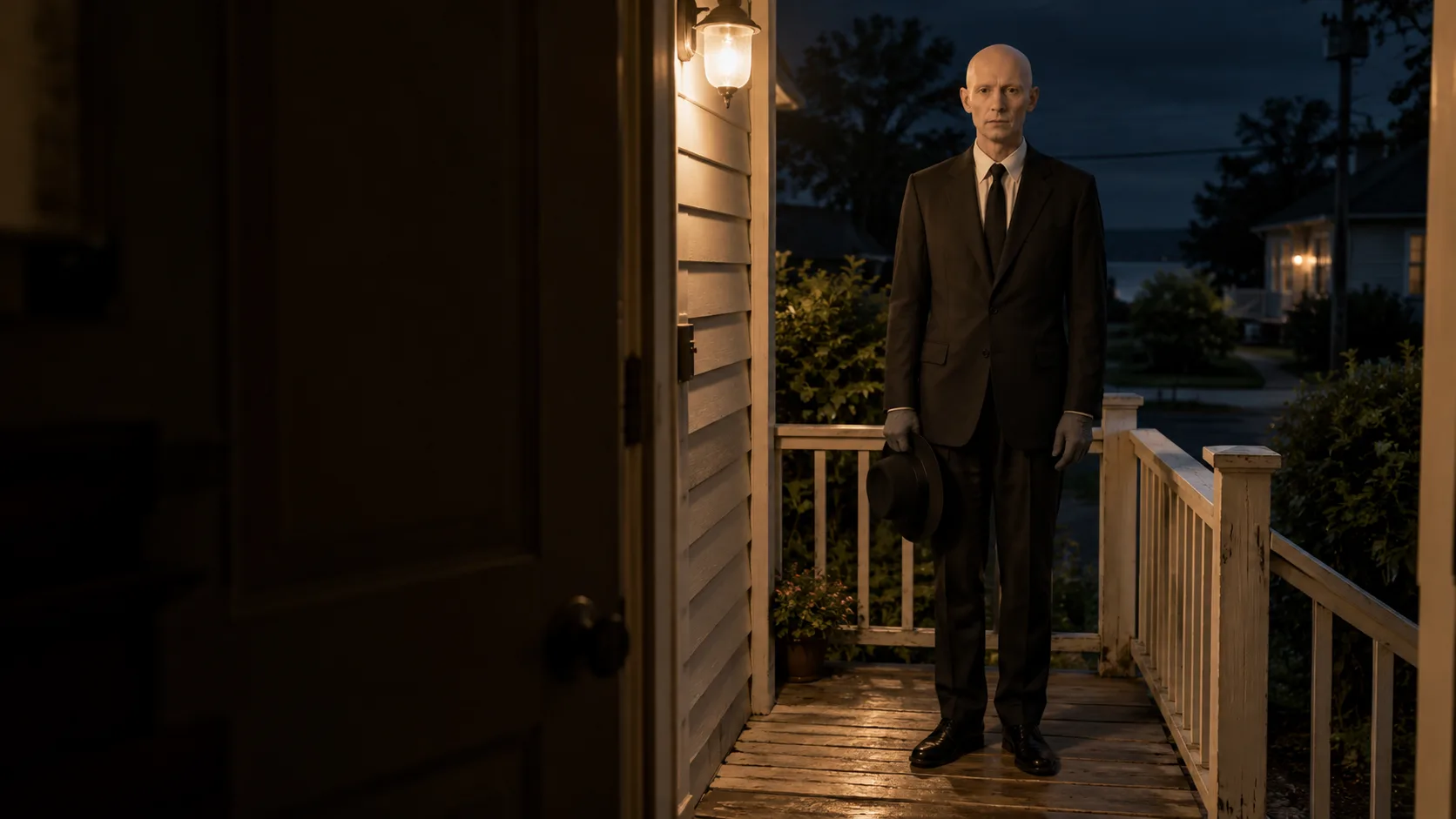
A man had just asked permission to visit him. He wanted to discuss a UFO case. Hopkins had agreed, and now, looking towards the porch, he saw his caller already coming up the steps.
That was how the physician described the beginning of his encounter on September 11, 1976, in Old Orchard Beach, Maine. The interval between the call and the arrival seemed scarcely long enough to cross the house. Later, he would return to that detail: how had the man reached his door so quickly?
For the moment, according to Robert Bull’s later BUFORA account, Hopkins let him in.
The case behind the call
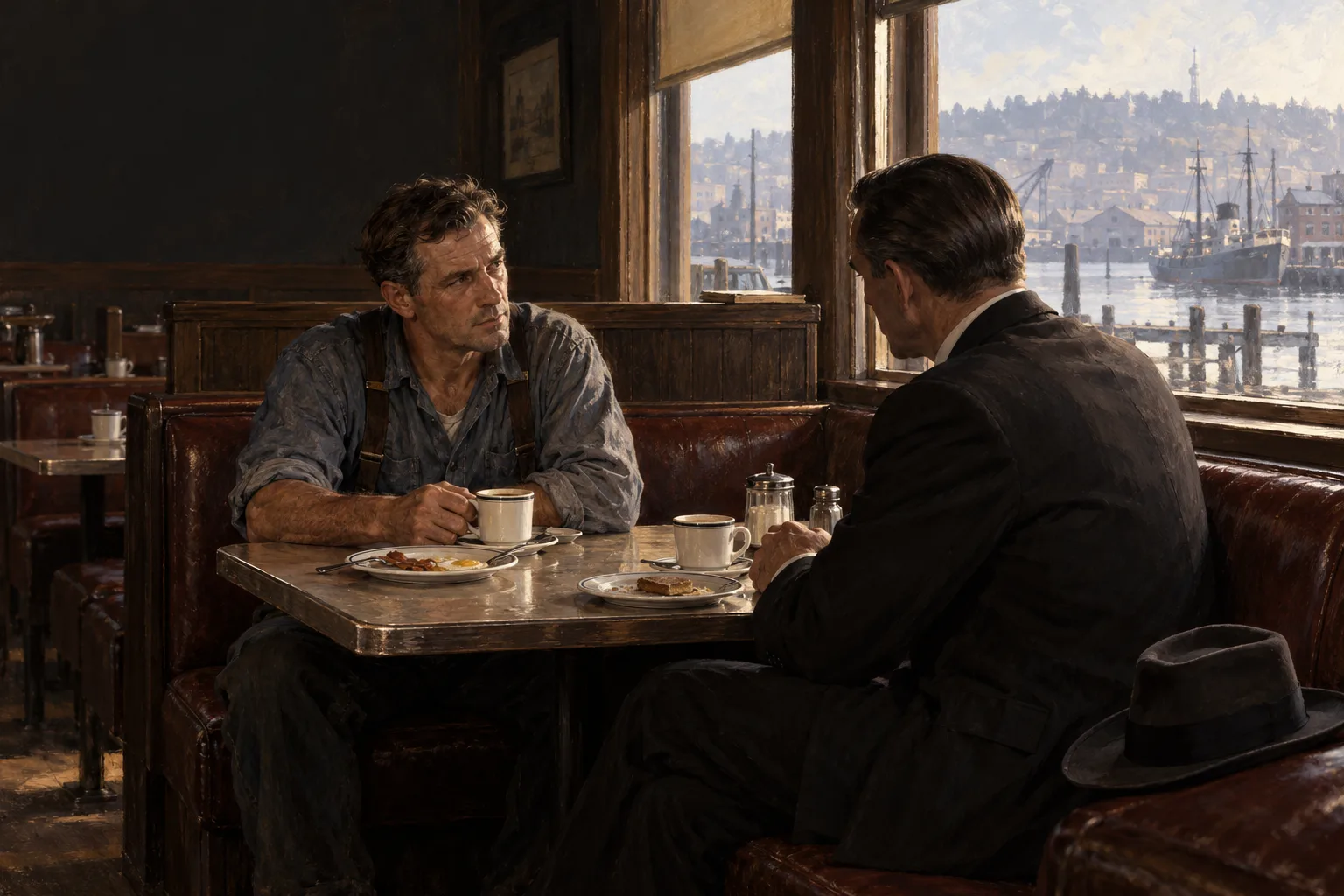
The caller’s subject was familiar. Hopkins had been helping investigate David Stephens’s account of an encounter near Tripp Pond, Maine, the previous October.
Stephens and a companion described strange lights during a drive, an unsettling disruption of their journey and a period they could not readily account for. The story had drawn local investigators Shirley Fickett and Brent Raynes. Hopkins’s involvement brought it into a room where questions could be asked, responses recorded and the missing interval explored through hypnosis.
Thomas Bullard’s 1987 catalogue places eight sessions between December 1975 and March 1976. Under hypnosis, Stephens described beings and an examination aboard an unfamiliar craft. Those were accounts emerging during the sessions; Hopkins was the physician recording them.
By September, there was a body of material associated with his work. A visitor asking about Stephens had a particular subject to discuss, and Hopkins had something more substantial than a passing sighting to relate.
The caller claimed to be vice-president of the New Jersey UFO Research Organization. The title supplied a reason for the approach: another investigator wanted to compare information.
A man dressed for a visit
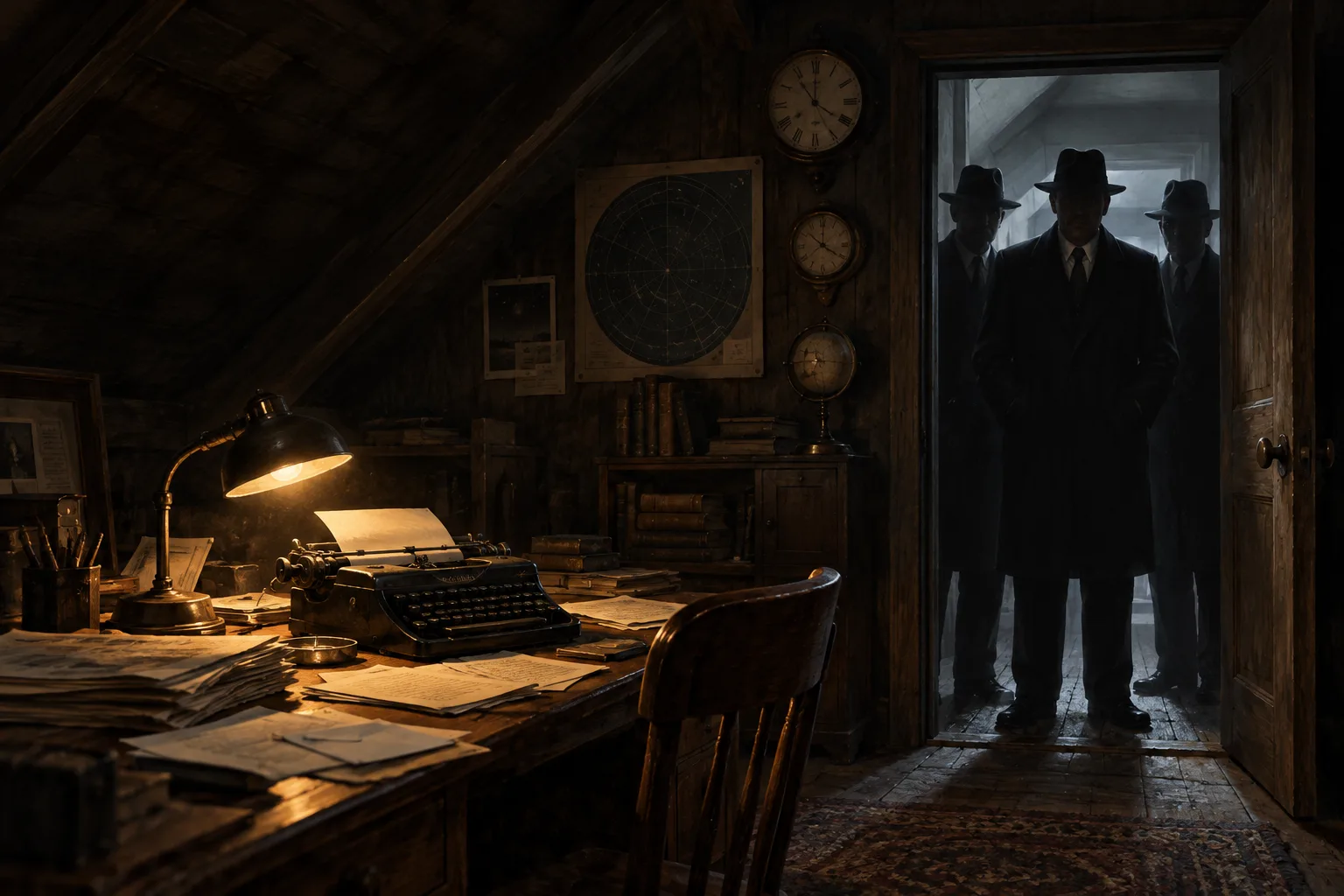
Hopkins was fifty-eight. Schwarz’s subsequent background report described a general practitioner specialising in allergy, with interests extending into electronics, sound technology and hypnosis. He also had a sustained interest in Spiritualism and had become an ordained Spiritualist minister.
His working life already crossed several kinds of inquiry. The Stephens investigation was one strand of that larger curiosity.
That Saturday evening, his family had gone to a drive-in cinema. He was alone when the telephone rang, around eight o’clock. In the account preserved by Schwarz and later retold by Strange New England, Hopkins accepted the proposed meeting without first establishing the caller’s name.
The visitor’s clothes were exceptionally neat: black suit, black tie, white shirt, black shoes and a derby hat. There were grey gloves. The sharpness of the clothing stayed in Hopkins’s description alongside the man’s much stranger features.
When the hat came off, he saw a completely bald head. There were no eyebrows or eyelashes. Against the pale face, the lips appeared vividly red.
The colour on the glove
The man asked about Stephens.
Hopkins described an expressionless voice and an unusually rigid bearing. In the account catalogued by Albert Rosales, drawing on Schwarz, the visitor’s head remained fixed relative to his body. His mouth was a narrow line that hardly opened as he spoke.
The conversation continued, but a small movement gave Hopkins another detail to remember. The man passed the back of his gloved fingers across his mouth. Red colour smeared onto the glove.
Hopkins concluded that his visitor was wearing lipstick.
The man had entered under the ordinary description of a fellow researcher. Now the physician was watching the face, the gloves and the stiffness of the person sitting opposite him. The questions concerned a case he knew; the questioner had become the unfamiliar part of the meeting.
Then the stranger turned the discussion towards something in Hopkins’s pocket.
The penny
He said Hopkins had two coins.
According to the doctor’s account in Schwarz’s first report, there was a dime and a penny. Hopkins was told to take one out and hold it on his open palm. He chose the penny.
As he watched, he said, its colour changed to silver, then light blue. The coin blurred while his hand remained clear. It became a small, indistinct round shape and gradually faded from view.
Hopkins asked for it back.
The stranger replied that nobody on this plane would see it again.
The reported demonstration led directly into a warning. In the version Rosales preserves, the visitor invoked Barney Hill, the deceased participant in the famous New Hampshire abduction account. He claimed Hill had died because he knew too much, and linked the disappearance of the coin to a grotesque claim about Hill’s heart.
Then came the instruction: destroy the recordings and correspondence connected with the Stephens investigation, and the other UFO material. Otherwise, Hopkins would meet the same fate. These were the stranger’s alleged claims about Hill, delivered as a threat.
Running low
As the meeting ended, Hopkins noticed another change.
The voice was slowing. The man rose with difficulty, his movements uncertain. The figure who had arrived so promptly now seemed to struggle with leaving.
“My energy is running low. Must go now. Goodbye.”
Those words appear in the Time-Life account reprinted by MUFON Arizona in 1994. Its retelling preserves the odd contrast between Hopkins’s composure during the conversation and his alarm afterwards. While the man remained in the house, he continued talking with him. After the departure, the encounter’s strangeness overtook him.
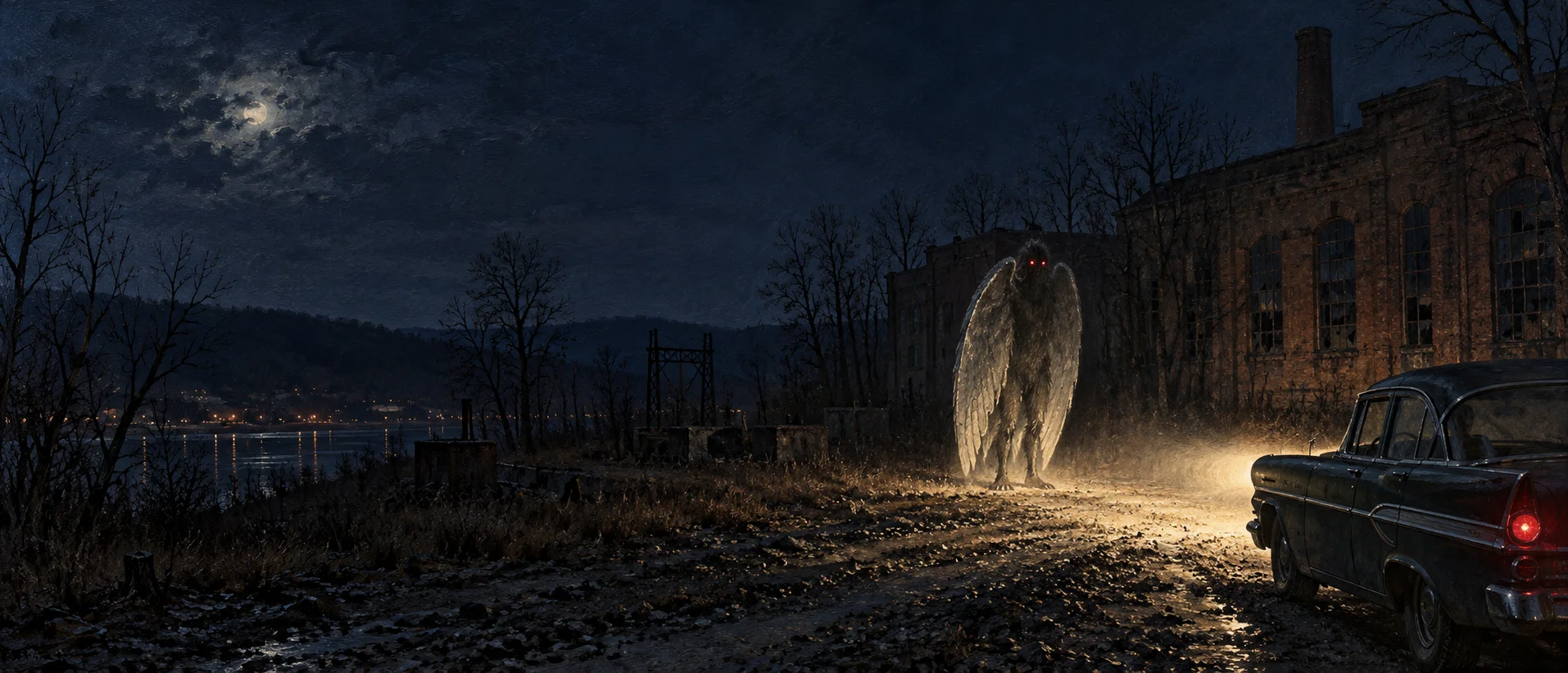
Outside, Hopkins reported a bright bluish light in the drive. He could not identify a departing car. The visitor who had appeared on the steps was gone.
After the door closed
When the family returned, Hopkins told them what had happened. They examined the driveway and reported unusual marks near its centre. Bull’s account says these had disappeared by the following day.
The warning concerned work Hopkins had already done. Complying meant returning to the recordings of Stephens’s sessions and removing them. He said he erased his tapes and abandoned his involvement in the case.
Schwarz’s report records his wife finding the house brightly lit when she returned, and her husband sitting at a table with a gun. The conversation, the penny and the warning were over; their effect was now part of the family’s evening.
The family’s story continued thirteen days later. John Hopkins and his wife Maureen described receiving a call and meeting two visitors, a man and a woman, whose conversation and movements struck them as peculiar. Howard Hopkins later discussed this related account, recalling how the stories circulated within his family. Another telephone invitation had become another troubling visit.
By the time investigators came to hear the physician’s account, the doorstep encounter had acquired an aftermath: discarded research, family recollections and a second reported meeting. A caller who had introduced himself as a researcher had become the reason Hopkins said he would stop researching.
What Is Known
Schwarz’s investigation is an early, detailed record of the allegations. He described using letters, recordings and direct interviews, including a visit to the Hopkins home on December 1, 1976. Family testimony covered the aftermath; the extraordinary conversation and coin episode rested on Hopkins’s own account.
The Stephens investigation had already entered the research literature. Ted Bloecher’s 1976 conference paper cited press coverage, a police report, Fickett’s inquiry and copies of Hopkins’s taped sessions supplied through the Center for UFO Studies. Hopkins’s reported destruction of his tapes therefore should not be read as the disappearance of every copy or record of the case.
Later summaries are not additional witnesses. Bull’s 1997 account, for example, puts the coin in the visitor’s hands; Schwarz’s early account places it in Hopkins’s palm.
There is also a directly conflicting family assessment. In January 2008, nephew Howard Hopkins called the story an invention, describing his uncle as prone to exaggeration and attention-seeking. His retrospective accusation matters, but it is not an eyewitness account of the meeting or a demonstrated reconstruction of it. The case remains disputed testimony, not established evidence of a nonhuman visitor.
The Bigger Picture
The Men in Black legend was already in print long before Hopkins’s telephone rang. Gray Barker’s 1956 book, They Knew Too Much About Flying Saucers, connected UFO research with mysterious approaches, warnings and the abandonment of inquiry. The feared visitor belonged to the world around an investigation: letters, organisations, interviews and people who appeared to know more than they explained.
Hopkins’s account gave that pattern an intimate setting. The visitor claimed affiliation with a research organisation, asked about recorded testimony and allegedly demanded its destruction. Authority came first through a title on the telephone. The threat developed inside a conversation about work.
Its enduring images are correspondingly small: a glove, a penny, a porch light. Each belongs to an ordinary domestic visit, yet each acquires a disturbing role in the physician’s account. The coin becomes a warning; the courteous caller becomes an intruder; the departure leaves the host afraid in his own house.
The story begins with almost no wait at all. Hopkins agrees to receive a visitor, goes to light his way—and finds him already there.
Sources
- Berthold Eric Schwarz, “The Man-in-Black Syndrome…1,” Flying Saucer Review 23(4), pp. 9–15. Early investigation and testimony.
- Schwarz, “The Man-in-Black Syndrome…2,” FSR 23(5), pp. 22–25. Follow-up profile and investigator’s interpretation.
- Robert Bull, Men in Black: A Preliminary Report, BUFORA, 1997, pp. 16–17. Later synthesis.
- Thomas E. Bullard, UFO Abductions: The Measure of a Mystery, Volume 2, 1987, case 140. Retrospective Stephens catalogue.
- Albert Rosales, Humanoid Encounters 1970–1977, entry 255, pp. 838–839. Later catalogue citing Schwarz.
- Time-Life, “The Ominous Men in Black,” 1987, reprinted in MUFON Arizona, September 1994, p. 6. Popular retelling and folklore context.
- Tom Burby, “Men in Black in Maine,” Strange New England, June 2017. Later retelling; misnames nephew Howard.
- Howard Hopkins, “The Truth About a Man in Black,” January 13, and “More MIB Weirdery,” January 23, 2008. Later family criticism.
- Ted Bloecher, Close Encounter of the Third Kind, BUFORA conference paper, 1976, note 5. Contemporary research bibliography.
- Gray Barker, They Knew Too Much About Flying Saucers, 1956. Independent historical context.