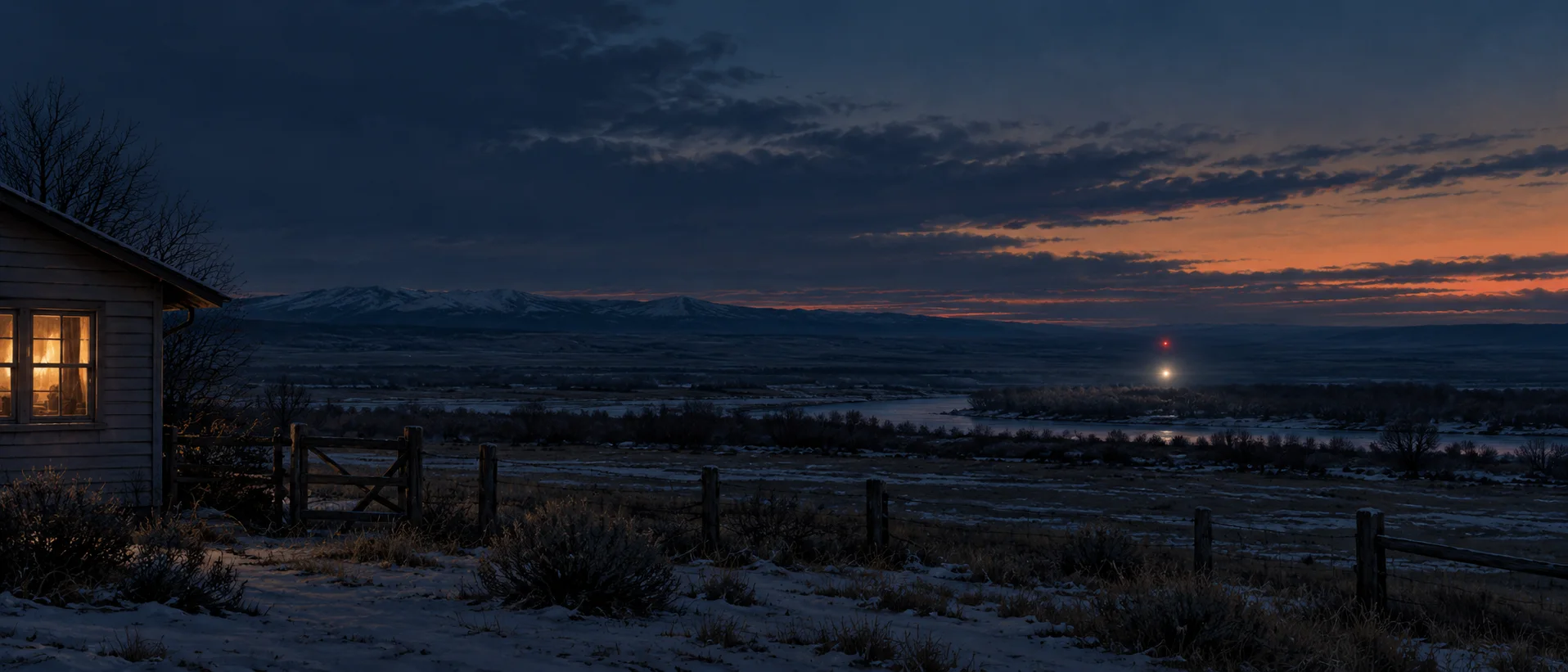
A white light seemed to come down near the Sun River. A smaller red light sat above it. From their ranch near Simms, Montana, a woman and her children watched it remain briefly in the area, then rise and travel west towards Augusta.
That is how their sighting on the evening of December 8, 1975, appears in the account published the following year by journalist Roberta Donovan and Cascade County sheriff’s captain Keith Wolverton. The woman said that as the light rose it seemed to roll sideways: the red light, previously on top, now appeared off to one side. The object left at a low level.
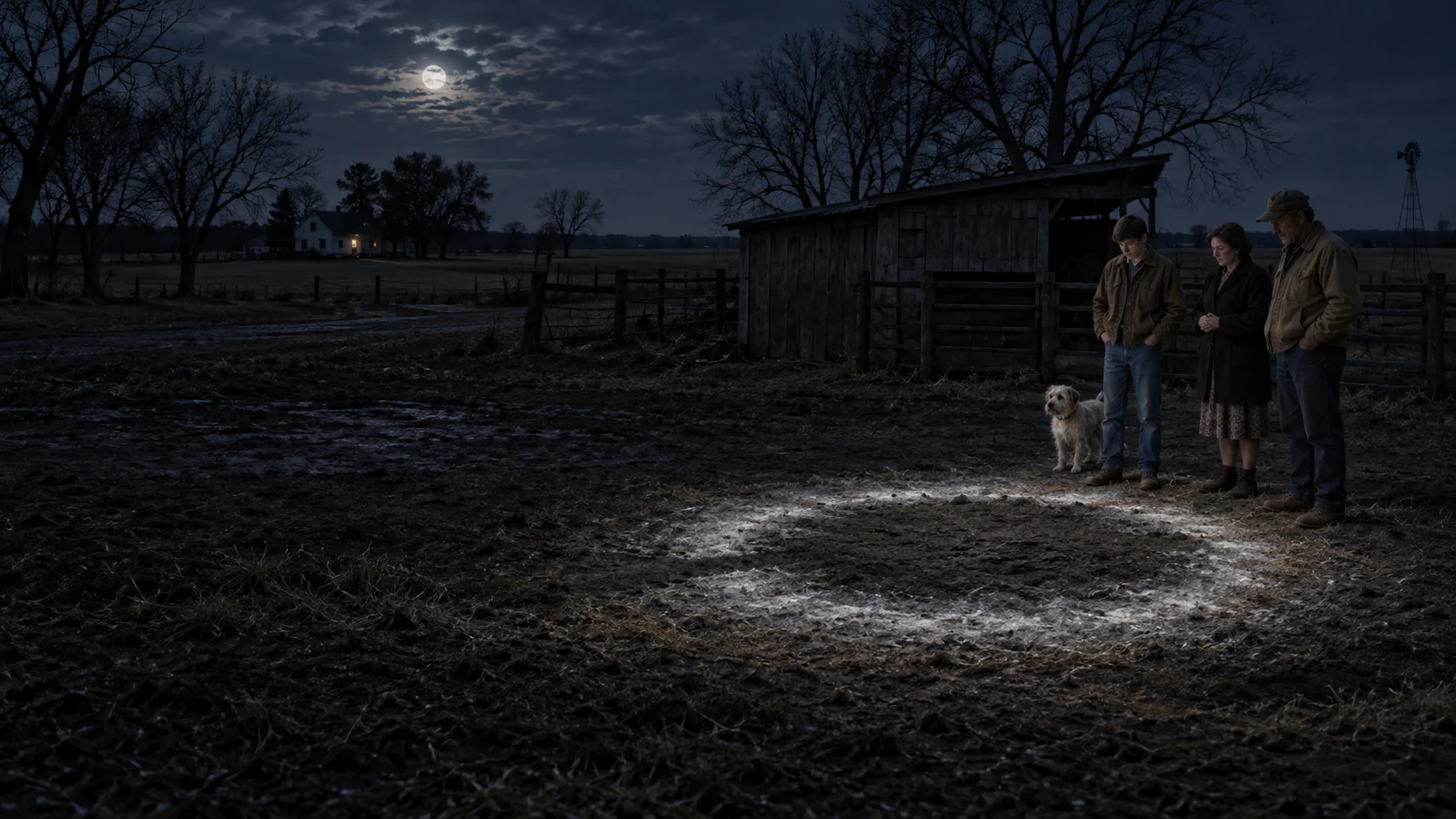
Beyond the house, about half a mile away, lay a dead calf. Its owner had dragged the body into brush near the river. It had died roughly five days before the family saw the light. For the moment, the family had witnessed an unusual movement in the direction of a place they knew well. What had happened to the calf was a separate discovery still to come.
The place by the river
The rancher’s account fixed the calf’s location in relation to the house. He had moved it to a brushy area beside the Sun River, and the 1976 narrative says the only road approach to that spot passed through the ranchhouse yard. The family was therefore watching a particular part of its own land, rather than trying to place a distant light against an unfamiliar horizon.
Their description remained visual. The woman reported a large white light and a smaller red one. She and the children said it descended to the area of the calf, stayed a short time and departed. The later book calls these movements landings, but its account of what the family actually saw is a light going down, remaining there briefly, then going up again. It does not describe anyone seeing a machine touch the ground, or anyone approaching the carcass.
The direction of departure mattered to the sequence. On the first evening, the light travelled west towards Augusta. That gave the family a beginning and an end to the event: a descent near the river, a pause, a change in the position of the red light, and a low flight away.
The next evening, at almost the same hour, something appeared again.
A second evening
The December 9 sighting was shorter. According to Donovan and Wolverton, the object, or one resembling it, remained for about a minute and then flew east. The change of direction made this more than a simple repetition of the first account. The family had reported a similar presence near the same part of the ranch on successive evenings, but the two departures pointed opposite ways.
By then the rancher had another reason to speak with investigators. He later found that part of the calf’s body was missing. When deputies interviewed the woman and examined the carcass, the light reports and the animal’s condition entered the same investigation.
The rancher had not initially wanted to describe the sightings. The book says he feared people would think him foolish. He eventually gave officers his account and urged his wife to tell them what she had seen. Her description supplied the appearance and movement of the light; his supplied the calf’s location and the history of its body before the two evenings.
One detail in his account was especially consequential. He said the calf had no such marks when he last looked at it two days before the first sighting. The absence of marks at that earlier check made the later condition striking to him. It did not identify the hour when the damage occurred. Between his last look and the family’s first sighting lay two days in which the calf was already dead and left beside the river.
The deputies’ visit
Captain Wolverton and two other deputies went to the ranch, spoke with the woman and examined the calf. In their 1976 account, the bag area had been removed. They described cuts around that area as resembling cuts in earlier cases that pathologists had attributed to a very sharp instrument. They sent samples of hide to a laboratory.
Those are specific investigative actions, rather than a later legend with only a strange light at its centre. Officers heard the family’s account, saw the carcass and collected material for analysis. The published passage, however, gives no laboratory finding for this calf. Its comparison with earlier cases is the deputies’ assessment as presented in their own book, not a documented result establishing who or what altered the body at Simms.
The rancher wanted to be ready if the light returned. Donovan and Wolverton report that he planned to come home early with weapons and wait for it. The deputies chose to return prepared to photograph another appearance. On December 10, three of them went back to the house with camera equipment.
Nothing appeared that evening. Their watch ended without a third observation or a photograph of the light. The case was left with the family’s reports of two evenings, the deputies’ inspection of a calf that had already died, and a sample sent away for testing.
The account that survived
Simms did not enter the record as an isolated tale remembered many years afterward. In 1976, Donovan and Wolverton placed it among the reports the Cascade County Sheriff’s Department had been handling across the region. Wolverton was one of the officers who visited the ranch. His participation gives the narrative proximity to the inquiry, although it is still a published account of the investigation rather than the original interview transcript or laboratory report.
Years later, the National Institute for Discovery Science reviewed Wolverton’s files, including sheriff’s blotters, memoranda and photo negatives. Its case tables list a December 9 report of an object near the ground in the Simms area, with a mutilated calf nearby, and a separate animal-mutilation entry for Simms on that date. The table entries confirm that the reports were part of the department’s wider case collection. They do not add an eyewitness to the moment the calf was damaged.
The image that makes Simms memorable is the light low by the river, returning the next evening while a dead calf lay in the brush. The strongest version of the story is also the most precise: the family said they saw lights; deputies later saw damage. No one in the surviving account saw the damage happen.
What Is Known
The central source is Mystery Stalks the Prairie, published in 1976 by Roberta Donovan and Captain Keith Wolverton. It records the family’s reported observations on December 8 and 9, the calf’s earlier death and placement by the river, the deputies’ examination, their collection of hide samples and their unsuccessful watch on December 10. It is a close-to-event account written in part by an investigator, but it presents the witnesses’ statements through the authors’ narrative.
The rancher’s last reported check of the calf was two days before the first sighting. The book does not give a time of death more exact than about five days before that sighting, a result from the submitted hide samples, or a witnessed act that links the light to the changes found on the carcass. Its description of cuts similar to earlier sharp-instrument cases is an investigative comparison, not a demonstrated cause in this individual case.
The later NIDS summary documents that the sheriff’s collection contained entries for the Simms light and calf. NIDS drew on Wolverton’s files, so the entries are useful archival context rather than independent confirmation of the family’s observations.
The Bigger Picture
Simms belonged to a much larger 1970s concern about injured livestock across the American West. The FBI’s archive of animal-mutilation material describes reports from western and midwestern states and public requests for federal investigation. The bureau says it generally lacked jurisdiction, apart from cases on Indian lands, and that its surviving files mainly contain correspondence and press clippings from 1974 to 1978. Local sheriffs, including those around Great Falls, carried the direct burden of responding to ranchers.
That wider setting helps explain why a light near a dead calf drew deputies back with cameras. Investigators were receiving two kinds of reports—unusual activity in the sky and changes to animal carcasses—and were trying to see whether they met in a single case. The NIDS retrospective later catalogued 192 reports of UFOs or unidentified helicopters and 67 reports of animal mutilations in Wolverton’s files. Its authors cautioned that they knew of no unambiguous data establishing a link between the two categories. Those totals count reports, not verified extraordinary events.
At Simms, the overlap was vivid but narrow. The family knew where the calf lay and saw a light descend in that direction on two evenings. Deputies found an altered carcass. Yet the calf’s death preceded the first light, and its condition was not checked immediately before either sighting. The unanswered interval, beside the Sun River, is the part of the story the returning deputies could not photograph.
Sources
- Roberta Donovan and Keith Wolverton, Mystery Stalks the Prairie (1976), pp. 42–43. Close-to-event account co-written by an investigating Cascade County sheriff’s captain; the source for the Simms sequence and deputies’ visit.
- National Institute for Discovery Science, Summary Report on a Wave of UFO/Helicopters and Animal Mutilations in Cascade County, Montana 1974–1977 (2001). Later analysis of Wolverton’s sheriff’s files, including case tables; dependent on those records rather than an independent witness account.
- FBI Vault, Animal Mutilation collection. Independent federal archive overview of the period’s reports and jurisdictional limits.