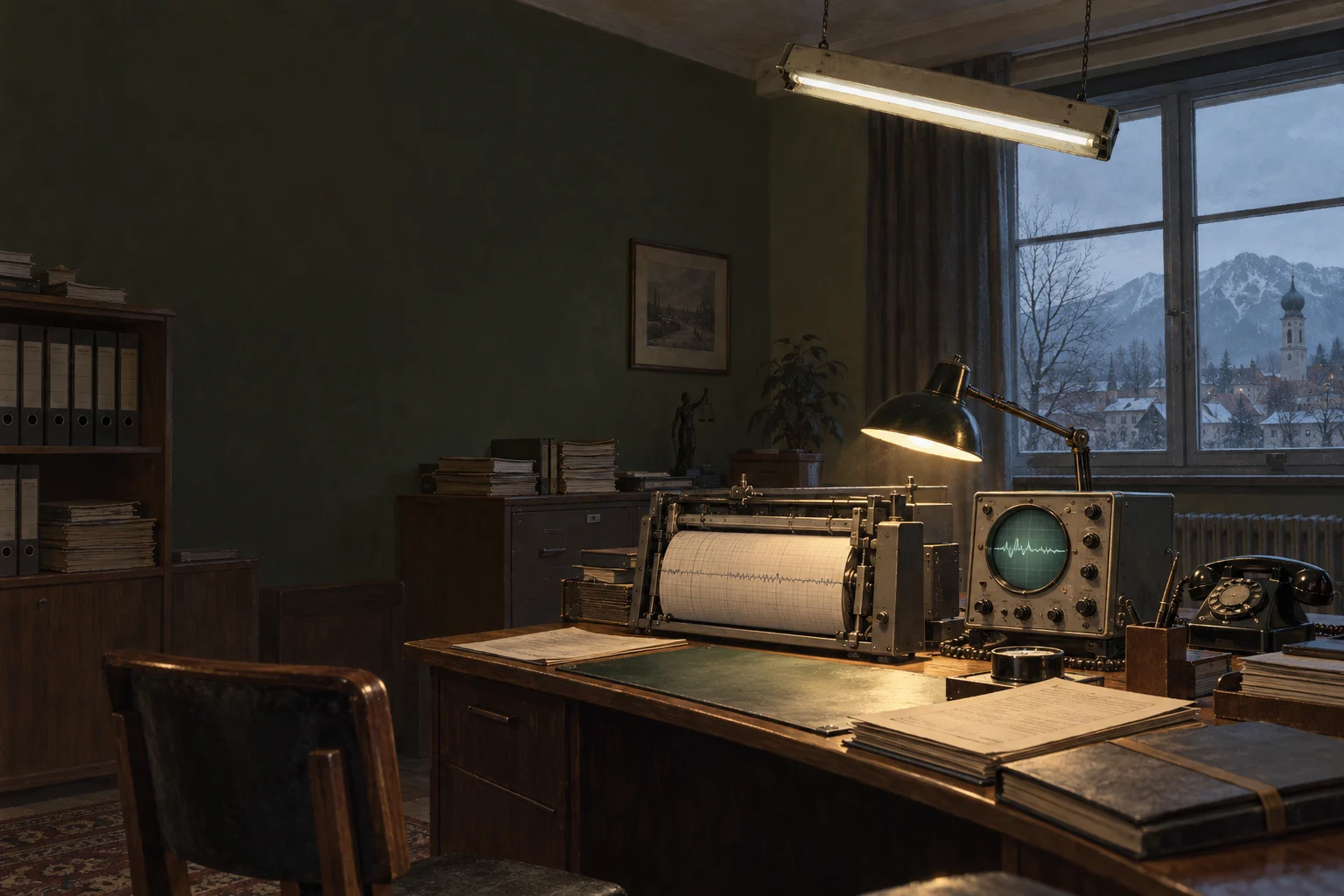
Between 4:30 and 5:48 on the afternoon of December 8, 1967, a pen in a Rosenheim law office made roughly fifteen sharp departures from its ordinary course. The instrument was supposed to record changes in the building’s electrical supply. Each mark suggested a sudden disturbance. But the physicists standing nearby had connected another instrument to watch that supply independently, and its screen was giving them a different answer.
They sometimes heard a hard report in the room at about the same time as a pen moved. Sometimes there was a report without a mark. Sometimes a mark appeared without a report. On the evidence of their published account, they could not make the events behave like a fault in the mains.
By December, the law office had drawn municipal electricians, police investigators, a psychologist, and two physicists. Each attempt to pin down one disturbance seemed to leave another loose.
Four telephones
Sigmund Adam’s practice occupied rooms in the Bavarian town of Rosenheim. According to psychologist Hans Bender’s 1968 preliminary report, the trouble began with the telephone system in the summer of 1967. The four sets in the office sometimes rang together. Conversations broke off. Bills climbed unusually high.
Then the trouble became harder to confine to a telephone line. Bender recorded reports of sharp bangs, automatic circuit breakers operating without an apparent cause, and copying-machine developer spilling. Fluorescent tubes fixed to a ceiling about two and a half metres high repeatedly went out. Electricians found some turned partway out of their holders. At the end of November, press accounts carried the events beyond the office.
Adam asked the Rosenheim municipal utility to investigate a possible electrical fault.
Its testing department began work on November 16 under P. Brunner. It installed chart recorders to monitor current and voltage. Office staff were asked to note unusual events, so a mark on a recording strip could be compared with a report from a room.
That procedure produced a disturbing entry on November 20. Bender reproduced the utility’s account: at 7:30 a.m., after a loud bang in Adam’s room, a fluorescent tube fell and shattered. The circuit breakers had not operated, yet the current recorder showed two full-scale movements, to about 50 amperes. At the end of a stroke, the pen made a loop instead of the straight return inspectors expected. A real current that large should have affected the circuit. Bender’s reproduction is the public source; the utility report is a separate underlying document.
The falling tubes posed an obvious hazard, so the office replaced them with ordinary bulb fittings. On November 21, one of those bulbs burst in the anteroom. Around that time, the recording paper showed three more full-scale excursions. Six other excursions that day were not paired with another reported event. The two kinds of record did not always move together.
Following the cable
The utility connected the office directly to a transformer station, bypassing the normal route into the building. The bangs, bulb failures, and chart marks continued. On November 30, hanging lights began to swing whether switched on or off. Utility inspectors witnessed it; checks of upstairs movement and street traffic gave them no explanation. At Adam’s insistence, an emergency generator was also tried. Bender’s chronology and the physicists’ account agree that changing the power source did not end the reported disturbances.
West German television had arrived by the end of November. The question presented to viewers was whether the office had a technical problem or someone was causing damage deliberately. On December 1, Bender and two colleagues from his Freiburg institute began their own inquiry.
The timing immediately interested them. The chart marks and unusual events appeared during office hours. Bender noticed that activity was often strongest after two young employees, nineteen-year-old Annemarie Sch. and seventeen-year-old Gustel H., entered. He came to associate the events particularly with Annemarie. In his telling, hanging lamps began to swing after she passed through the corridor, and fragments from failed bulbs flew in her direction. The association was an observation and an interpretation made by his team, not a demonstration of what caused the motion. His report gave her surname only as an initial.
A second instrument
Bender asked physicist Friedbert Karger to examine the recorder problem. Karger and Gerhard Zicha worked in the office from December 6 to 8. They placed a storage oscilloscope beside the utility’s chart recorder and connected channels to monitor mains voltage, nearby electrical potential, a magnetic-field probe, and a microphone. The two machines could then be compared during an event. Their technical paper describes the arrangement and its sensitivity.
On the afternoon of December 8, the utility recorder’s pen again swept across the paper. The oscilloscope had been set to trigger on an increase in mains voltage smaller than the changes implied by those chart marks. It did not trigger when the anomalous marks appeared. Karger and Zicha checked that their trigger worked before the episode and continued checking during it. For them, this was the crucial narrow result: those particular pen movements were not readings of a corresponding rise in the supply voltage. The marks were real marks on paper; their electrical meaning was in doubt.
The pair checked interference, discharges, magnetism, vibration, loose parts, and a hidden mechanism. None reproduced the marks. They stood near the recorder during many events and guarded against a thread pulling it from outside. Yet the pen was seldom seen making a mark; usually they saw the trace seconds later. That limit matters as much as their list of checks.
Later, at their suggestion, the utility fed the recorder with a 1.5-volt battery instead of the mains. Strong marks still appeared. This reinforced the conclusion that the marks did not represent fluctuations in the building’s power supply. It did not, by itself, identify the force moving the pen.
The paper offered another clue. Some strokes bent into S-shaped turns, some scratched the strip, and one tore it. Karger and Zicha argued that such shapes resembled mechanical interference with the writing system more than an ordinary electrical signal. They did not identify a person or a device responsible. Their article also noted that the anomalies stopped at night, on Sundays, and at lunch, apart from an occasion when Annemarie was reportedly present on a Saturday. The instrument observations and timing comparison made the law office’s people part of the question.
The number for the time
Meanwhile, the telephone problem acquired a precise number: 0119, the time-announcement service. Bender wrote that the telephone authorities replaced the office’s Siemens system with a single test telephone and automatic call counter. Their records still showed repeated calls to 0119, sometimes four or five within a minute. The authorities concluded that the calls must have originated in the office; the office denied making them.
One episode was set down with unusual specificity. On October 19, between 5:35 and 5:55 p.m., a visiting tax adviser, Dr Schmidt, watched the only telephone in use at the time and signed a statement saying no one spoke on it during his visit. The automatic call record, Bender wrote, counted roughly twenty calls to the time service in the same interval. His published account of the statement and counter is a striking collision of records. It is still an account of records, not a public reproduction of the original telephone logs or Schmidt’s signed page.
The telephone authority and the people in the room gave incompatible accounts of the calls. Bender explored how the dial mechanism might register 0119 without its dial turning. He favoured psychokinesis; the contradiction between the records and the office’s account remained.
Pictures on the wall
By December, the inquiry had moved beyond lines and circuits. Bender reported that framed pictures began swinging or rotating on their hooks. He cited Brunner’s account of standing near a flower picture when it turned sharply as Adam entered the room; another utility inspector, A. Mayr, said he saw the same movement. The lawyer’s son later recorded a picture turning on video in the presence of the utility’s technical lead. Bender’s own group filmed lamp movement and recorded bangs, but, by his admission, did not capture the new picture movement on its video system while its members were present. These are different levels of documentation within the same preliminary report.
The Freiburg team could not keep a permanent observer at the office, so it received telephone updates. Bender described a December 18 call interrupted four times while Mayr reset circuit breakers. After Christmas, Annemarie came in irregularly. His report says drawers moved out, a heavy filing cabinet shifted about thirty centimetres, and pictures or calendars fell or turned. When she left for another workplace, the reported activity in Adam’s office ceased. Bender’s January chronology rests on intermittent visits, reports, and recordings—and leaves the cause unnamed.
What Is Known
The strongest public documentation is the pair of 1968 papers by Bender and by Karger and Zicha, digitized in full by Freiburg University Library. Bender’s was explicitly a preliminary report. It quotes passages of Brunner’s utility review, describes police involvement and witness interviews, and says extensive underlying material was still being evaluated. The physicists’ paper gives the instrument layout, checks, sample traces, and the limits of what they saw. Together they establish that a serious investigation took place and that the investigators observed chart marks they did not attribute to voltage rises. They do not make every office incident equally well observed or prove Bender’s proposed psychokinesis.
Karger and Zicha concluded that the events looked like short, nonperiodic, apparently mechanical effects, and they went further in speculating about an intelligently directed force. Their concluding pages should be read as the authors’ interpretation of a limited investigation, not as a measured property of an unknown force. Their finding about the voltage trace is narrower and more secure than their explanation for it.
The case was disputed soon afterward. A 1970 Die Zeit report placed Rosenheim in a court dispute over allegations of tricks. A later account from the German skeptics’ organization GWUP describes an illusionist’s claim that nylon threads had been found on fixtures; it also records the opposing claim that at least one thread belonged to an investigators’ test setup. That dispute cannot be settled by the published chart traces. Nor does evidence that a light could be moved with a thread explain every telephone entry or recorder mark. The sensible boundary is event by event: what was recorded, what was witnessed, and what each observer inferred.
The Bigger Picture
Rosenheim became famous partly because the investigators came from worlds that normally ask different questions. The utility wanted a fault it could isolate. The telephone authority wanted to account for calls. Karger and Zicha looked for signals their instruments could reproduce. Bender, founder of the Freiburg Institute for Border Areas of Psychology and Mental Hygiene, studied extraordinary experiences and interpreted the pattern around a young employee as spontaneous psychokinesis. Deutsche Biographie’s account of his career places Rosenheim within a much longer research program—and a longer history of criticism over how he handled apparent fraud.
That is why the recorder strip remains the most revealing object in the story. A pen made a mark; an independent instrument challenged the mark’s first meaning. The investigators were right to follow that contradiction. They were also looking at a workplace with many moving people, intermittent observation, public attention, and rival explanations. The paper kept a trace. It could not, on its own, tell them whose hand—or what else—had moved it.
Sources
- Hans Bender, “Der Rosenheimer Spuk – ein Fall spontaner Psychokinese,” Zeitschrift für Parapsychologie und Grenzgebiete der Psychologie 11 (1968), 104–112. Contemporary investigator’s preliminary report, incorporating quotations from the December 1967 municipal utility review and accounts of witnesses, police files, and telephone records.
- Friedbert Karger and Gerhard Zicha, “Physikalische Untersuchung des Spukfalles in Rosenheim 1967,” same journal 11 (1968), 113–131. Contemporary technical report on the instruments, observations, and follow-up tests.
- Alexander Adrion, “Geister oder Nylon?,” Die Zeit, April 10, 1970. Near-contemporary reporting on the later dispute over trickery.
- Bernd Harder, “Der Spuk von Rosenheim,” GWUP, November 21, 2013. Later skeptical account of the contested nylon-thread allegation and responses to it.
- “Hans Bender,” Deutsche Biographie. Independent historical context for Bender’s institute, methods, and reception.