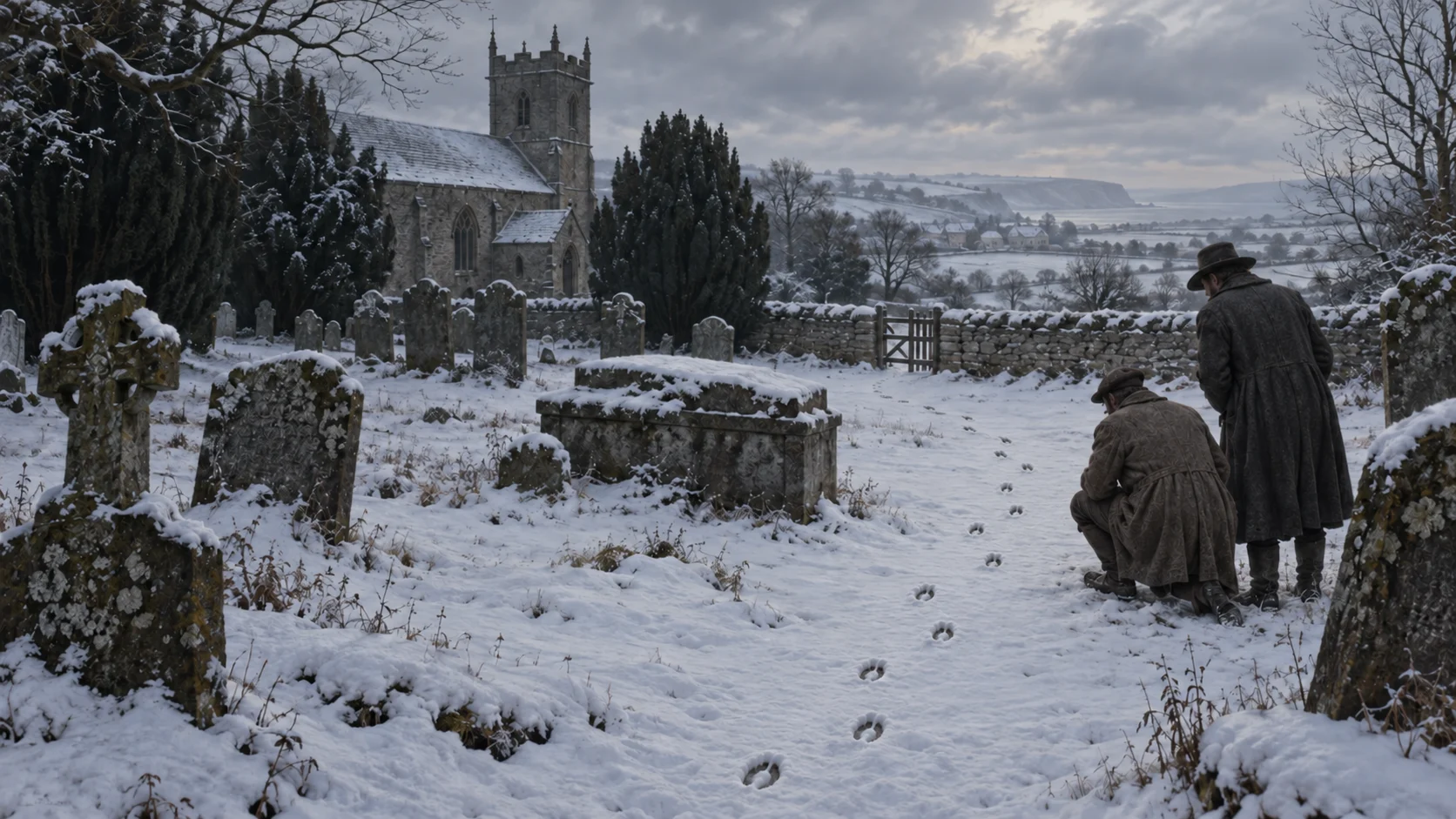
The search began among the graves.
In Dawlish, a party of tradesmen and other residents took guns and clubs and went after the strange marks in the snow. From the churchyard they followed them towards Luscombe, through Dawlishwater and on to Oaklands. They spent much of the day looking for whatever had passed that way.
According to the local report published on February 17, 1855, they returned without an answer.
The footprints had been there. Their maker remained beyond the search.
Across the Exe, other people were finding similar impressions near their own houses. Gardens that had been shut for the night contained unexpected tracks. Some led towards doors. Reports placed others on walls and rooftops. By the time letters reached the London newspapers, a winter morning in Devon had become the story of a visitor whose journey seemed to disregard the boundaries of ordinary life.
The morning after the snow
Snow fell on Thursday, February 8.
The Dawlish correspondent described a fall of about four inches, followed late in the evening by milder weather, sleet and rain. By morning, a thin covering of ice lay over the ground. Another contributor to the same newspaper remembered an easterly wind and a frost after the rain.
The changing weather left a surface on which people could read the night’s movements. What drew attention was a set of marks resembling the shoe of a donkey, repeated with short intervals between them.
The Western Luminary’s February 13 account put the Dawlish impressions at roughly three and a half inches long and two and a half inches wide, with about a foot between steps. Its writer thought the regular spacing suggested something travelling on two feet.
Tracks appeared between graves and inside gardens surrounded by high walls. People followed them for miles. Already, the newspaper reported two very different suggestions circulating locally: an escaped monkey with something attached to its feet, and a visitor whose name the writer left as a blank.
Behind the garden gate
At Exmouth, the discovery drew people together in groups of six or a dozen.
The Western Times described them examining the impressions, comparing the shape with a donkey’s hoof and trying to account for the arrangement. The footprints seemed to proceed one after another. A donkey had four feet; the marks gave observers a different impression of how their visitor had moved.
The locked gardens were especially puzzling. Gates had remained closed overnight, and some enclosing walls stood seven feet high. Residents could see the tracks inside but could not work out where the animal had entered or left.
Around Lympstone, a correspondent signing himself Spectator described impressions approaching several house doors and then turning back. In many marks, snow remained in the middle while the outline exposed the surface beneath it. Some looked divided; others formed an unbroken shoe-like shape.
Spectator’s letter gave measurements and described the arrangement of the steps. Looking at the snow had become an exercise in comparison: the breadth of an impression, the interval to the next one, the way a line crossed a familiar patch of ground.
Each garden offered a small part of the same unsettling scene. Something appeared to have been close to the house during the night. In daylight, the residents could follow its movements for a little distance without meeting it.
On either side of the water
Reports extended through communities around the estuary: Exmouth, Littleham, Lympstone, Woodbury and Topsham, with Starcross, Teignmouth and Dawlish on the other side.
The Gazette’s February 17 correspondence moved between those places, carrying accounts of marks in open fields, courtyards and enclosed gardens. It also described reports from the tops of houses and narrow walls.
For a resident inspecting one garden path, the mystery lay in a few impressions. Seen through the growing correspondence, those paths became part of a much larger landscape. The same general shape was being discussed in towns separated by the Exe, in places that no single search party could inspect during its day’s pursuit.
The Dawlish searchers had followed their route out of the churchyard. Elsewhere, people gathered around garden tracks, measured them or passed what they had heard to a newspaper. Accounts travelled beyond the places where the marks had been found.
They also reached the churches. The impressions were acquiring a name, and with it a meaning that could frighten people more than an unidentified animal.
A word from the pulpit
On the Sunday after the snowfall, the Reverend George Musgrave spoke about the footprints at Lympstone Church.
Spectator’s contemporary letter described the sermon. Musgrave was discussing Satan as a tempter, continually crossing human paths while remaining unseen. The tracks provided a topical reference. He suggested that they might have been made by a kangaroo.
Musgrave later explained his intervention in a letter published on March 3. A story about escaped kangaroos was circulating, and he had welcomed an opportunity to turn his listeners away from the belief that the Devil himself was nearby.
He recalled resistance from someone who connected the incident with an approaching end of days. The clergyman considered his remarks useful, but the footprints continued to trouble him as an observer. He wrote to the British Museum, the Zoological Society and the keepers of animals in Regent’s Park, seeking help with the impressions.
His role moved between reassurance and inquiry. He had addressed a congregation; now he was sending descriptions and drawings to people who might recognise an animal’s track.
The letter to London
On February 24, the Illustrated London News published an account signed South Devon.
The correspondent described hoof-like marks four inches long and two and three-quarter inches wide. In his account, they followed one another in a single line, generally separated by eight inches or a little more.
He reported tracks across gardens, farms and courtyards, over roofs and hayricks, and beyond very high walls. A fourteen-foot wall appeared among the obstacles. Locked gates seemed to have made no difference to the places visited.
The letter and its accompanying drawing gave readers far beyond Devon something they could picture: a regular series of shoe-shaped impressions progressing across the snow. The writer argued that the combined journey through all those places must have exceeded a hundred miles.
He also supplied an arresting description of the edges. The impressions seemed sharply cut, exposing the ground while leaving snow within the outline. His comparison was to marks branded by hot iron. It was a description of their appearance, offered amid his effort to explain why these particular tracks looked so distinct.
South Devon wrote that he had spent a winter tracking animals in Canada. He recognised familiar tracks elsewhere in the snow and found these different. His letter presented the puzzle with confidence, inviting a national readership to imagine the journey that might connect so many discoveries.
Pen and pencil
The next exchange brought more drawings.
In the March 3 issue, Musgrave challenged the published outline. He described making a careful copy of impressions on a clergyman’s lawn. He and the clergyman followed the marks through a circular opening in a low privet hedge, about a foot across.
They applied a ruler to the intervals. Musgrave recorded eight and a half inches between impressions. An acquaintance who measured similar marks in another garden reported the same spacing.
His letter gathered other people’s pursuits as well. Two men had followed a line for three and a half hours, tracing it beneath gooseberry bushes and trained fruit trees. After losing it, they reported finding impressions on nearby roofs. A separate report described tracks passing into a six-inch gutter.
An observer at Topsham, writing on February 26, had examined marks with another medical man. Their letter described smaller details within the hoof-like outline: impressions they interpreted as toes and a pad. They had seen tracks beneath low branches, over a low wall and across the tiles of an outbuilding.
Richard Owen, the naturalist, also contributed to the March 3 issue. A zoological acquaintance had sent him a drawing from Luscombe. Owen identified it as a badger’s hind-foot impression and described how front and rear footprints could overlap. The correspondence now linked people measuring snow in Devon with a specialist studying a drawing elsewhere.
Around the rectory
At Clyst St George, the Reverend Henry Thomas Ellacombe collected letters and information from neighbours.
His own account survives in a March 13 letter transcribed by folklorist Theo Brown in 1952. Ellacombe said he had seen the impressions two or three days after their first discovery. They crossed a lawn on his premises, went around the house and continued towards a pump shed.
He recorded the snowfall, thaw and subsequent freeze, and said that his dog and neighbours’ dogs had barked during the night. Parishioners described the marks to him. Two neighbours following tracks across a field reported finding droppings, and Ellacombe wrote that he had sent samples to Owen.
Other reports reached him from Exmouth. Some described impressions isolated in the middle of a field. In a walled garden, a line reportedly reached the end, turned and came back part of the way. At Marley, near Exmouth, he was told that marks appeared on a second-storey window sill.
Ellacombe assembled the traces of that February morning in another form: observations, messages, sketches and questions sent between people. The tracks on his lawn were still visible days after the snowfall. The papers kept their outlines and the paths people had followed long after the ground had changed again.
What Is Known
The surviving record includes local newspaper reports from February 1855, the illustrated account of February 24 and the correspondence published on March 3. These document discoveries, searches, measurements and competing identifications while the incident was still being discussed locally.
The Ellacombe papers add private correspondence and drawings. His March 13 letter distinguishes impressions he inspected himself from descriptions supplied by parishioners and neighbours. Theo Brown published extracts in 1952; the date of that transcription differs from the date of the underlying letter.
The records preserve variation in the shape, size, spacing and arrangement of the marks. Some describe a single file; others describe alternating steps. The hundred-mile journey was South Devon’s estimate connecting reported locations, rather than a route measured by one party from beginning to end.
Mike Dash’s later source collection brings these materials together and separates contemporary documents from subsequent recollections and interpretations. Together, they establish a substantial episode of reported tracks and public inquiry. They preserve what people found and said about it without establishing one maker for every impression.
The Bigger Picture
The Devon mystery unfolded in a culture where a local drawing could become a national image.
The National Portrait Gallery’s history of the Illustrated London News describes a weekly founded in 1842 and known for turning sketches and accounts from distant places into printed illustrations. Its special issue covering Wellington’s funeral in 1852 circulated 150,000 copies. A drawing sent from Devon entered an established channel through which readers encountered events they could never inspect themselves.
The correspondence also belonged to a world of local collecting and scientific curiosity. Musgrave’s February 26 letter to Ellacombe identified South Devon as young D’Urban. Later, William D’Urban became the first curator of Exeter’s Royal Albert Memorial Museum. The museum preserves an 1868 admission ticket bearing his signature, from the year its doors opened to visitors, readers and students.
Those connections give the story its human scale. Clergymen measured impressions, residents followed paths, correspondents drew outlines and a naturalist received specimens. Each worked with a different part of the mystery.
What endures is a morning when people found an unfamiliar trace in a familiar place. A garden gate had stayed shut. A churchyard lay under snow. Beyond the next impression, there was another, and people went after it.
Sources
- Western Luminary, February 13, 1855. Contemporary Dawlish report; document 1 in Dash’s collection.
- Exeter & Plymouth Gazette, February 17, 1855. Contemporary Spectator letter and Dawlish search report; document 3.
- Western Times, February 17, 1855. Contemporary Exmouth report; document 4.
- Illustrated London News, February 24, 1855, p. 187. South Devon’s contemporary account and drawing; digitised issue.
- Illustrated London News, March 3, 1855. Contemporary letters from Owen, Musgrave and other correspondents; document 11.
- H. T. Ellacombe, March 13, 1855, and related correspondence. Contemporary records transcribed in Theo Brown’s 1952 A Further Note on the Great Devon Mystery; document 23.
- Mike Dash, The Devil’s Hoofmarks, Fortean Studies 1 (1994). Retrospective source collection and analysis; modern commentary distinguished from reproduced historical texts.
- National Portrait Gallery, Australia. Independent context on the Illustrated London News.
- Royal Albert Memorial Museum & Art Gallery. 1868 admission ticket and museum context, published through Google Arts & Culture.