The crews could clear the surface. The trouble was keeping it clear.
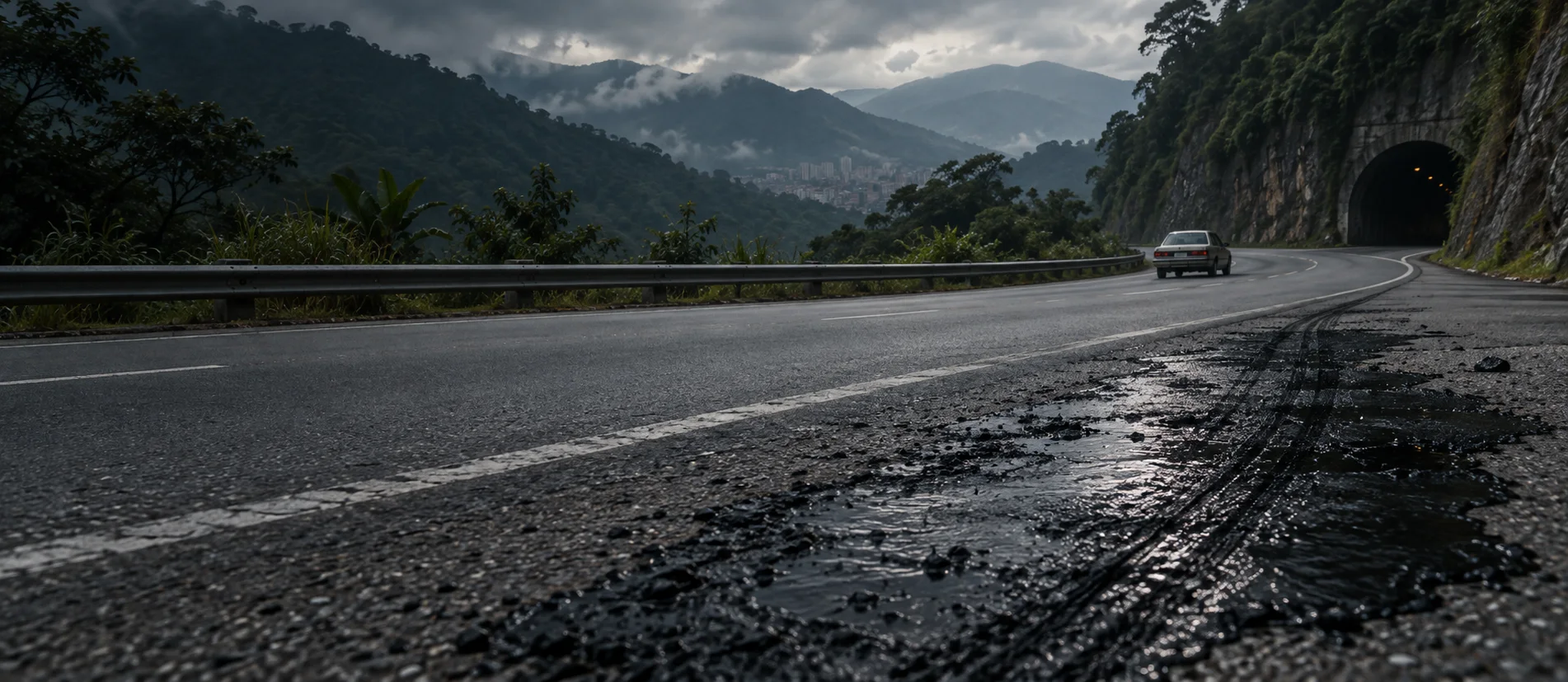
A 1992 newspaper clipping described a dark, slippery deposit on Venezuelan highways. An engineer reported its return after cleaning. Its name was La Mancha Negra, the Black Stain.
The best-known location was the highway between Caracas and its international airport. This was Venezuela, rather than Brazil, where the remembered story is sometimes placed. Its enduring image is unsettling enough without a supernatural explanation: a familiar stretch of road, a black coating, and repeated efforts to make it safe.
The mystery that travelled abroad was bigger. It became a tale of an unidentified substance spreading for miles and resisting every attempt to destroy it. The surviving record shows how a real road problem acquired that reputation—and why the word “unidentified” needs care.
The stain takes a name
Gary Marx’s 1992 report places the first patches during highway repairs about five years earlier. Later accounts give 1986; the early chronology is better treated as the mid-to-late 1980s than assigned an exact discovery date.
It described deposits along roughly eight miles, particularly in tunnels and uphill lanes, with a gum-like consistency. These were reported characteristics, rather than a published chemical identification.
That distinction affects the mental picture. An affected distance of eight miles does not necessarily mean a single, continuous mass advancing across the landscape. It can describe patches along a route. Likewise, a deposit returning after removal does not establish that the removed material regenerated. New contamination or a recurring problem in the pavement would produce another dirty surface.
The name helped gather these experiences into one story. A driver encountered a dangerous patch; a cleaning contractor encountered a persistent deposit; an official encountered a problem that demanded an explanation. “The Black Stain” made them sound like encounters with one thing. Whether every patch had the same composition is a separate question, requiring samples from identified locations and dates.
Cleaning becomes part of the story
The clipping lists water, detergent, powdered limestone and surface replacement among attempted remedies. The practical question remained how to prevent recurrence.
A later 2016 review of the story describes complaints about dust after limestone was applied. It also questions the frequently repeated claims about investigative spending and casualties, noting how much of the later mystery literature depends on older news coverage. It is a retrospective assessment, rather than a cleaning log or laboratory report.
The unsuccessful treatments became an important part of the legend. If washing fails, scraping fails and a replacement surface also becomes dirty, a reader can easily imagine a substance immune to removal. But these are different interventions. Washing acts on a deposit; resurfacing changes the pavement; absorbent material changes the condition of the surface. Their outcomes would have to be compared under similar traffic and weather conditions to establish what each treatment actually accomplished.
The missing maintenance details matter here. How much material was removed? From which section? How soon was that section inspected again? Did the new coating resemble the old one chemically, or merely look dark? The published accounts consulted do not provide a complete sequence of measurements answering those questions.
Oil from the traffic
Later local reporting offers a more concrete explanation than the international “unknown goo” narrative. A Courrier International article credited to El Nacional describes a commission formed in 1994 and the views of Giuseppe Giannetto, a chemist at the Central University of Venezuela. He attributed the stain to accumulating oil leaks from vehicles.
The article reports observations that supported that explanation: deposits followed the centres of traffic lanes and occurred where vehicles tended to heat up, including inclines and congested stretches. These are useful spatial clues. A contaminant dropped from passing vehicles should relate to their paths; a deposit emerging from the pavement might instead follow the distribution of a particular material or repair.
Municipal officials associated with mayor Freddy Bernal alleged deliberate oil dumping. A spokesperson reported samples containing sixty percent brake fluid and forty percent used oil. Those are reported statements, without the underlying laboratory documentation or proof of sabotage.
Its dates require care: the URL contains an April 2001 date, while the page displays publication on October 1, 2003. It is used here as later reporting, without assigning every quoted statement a more precise date than the accessible record supports.
The two proposed sources illustrate an important fork. Finding automotive fluids would support an ordinary source for the material. It would not, by itself, distinguish gradual leaks from intentional dumping. The chemical question and the allegation about someone’s actions require different evidence.
A road can bleed
There is also a recognized pavement defect with features resembling the descriptions. The Federal Highway Administration’s distress manual calls it bleeding: excess bituminous binder at the surface, often in wheel paths. It can obscure the aggregate and leave a shiny, reflective, tacky coating. That is an engineering category, not a diagnosis of the Caracas samples.
The Washington Asphalt Pavement Association explains that heat and traffic compaction can bring excess binder onto the surface. Too much binder or insufficient space within the asphalt mixture can contribute. The resulting film can become slippery when wet. Surface treatments may remove or absorb some of it while leaving the underlying cause in place.
This provides a conventional reason why a dark coating might keep returning. A road is not an inert platform beneath the mystery: its own material can be part of the process. Removing the visible film may not remove the condition that produces it.
In 2024 interviews with Popular Mechanics, petroleum engineers Reinaldo Gonzalez and Ramanan Krishnamoorti favoured an asphalt-related explanation over underground oil seepage. Gonzalez had worked in Caracas at the time but acknowledged hazy recollection; his proposed separation of treated asphalt was a retrospective hypothesis, not a newly reported sample test. He also said the phenomenon was no longer a current problem.
These explanations need not be treated as evidence that every dark patch came from one source. Traffic residue and pavement binder could affect different sections, or contribute to the same surface. Sorting them out would require location-specific testing. The apparent simplicity of “oil on a road” does not make maintenance easy, but it does place the problem within familiar chemistry and engineering.
What the record establishes
La Mancha Negra was a reported road-surface hazard with contemporary witnesses, cleanup efforts and public concern. The reviewed material supports the existence of troublesome deposits much more securely than the sensational claim that scientists encountered an inexplicable new substance.
The often-repeated figure of 1,800 deaths should remain unverified. The clipping gives a five-year road toll without an underlying dataset. A road’s total fatalities and those caused by one surface condition are different statistics. Repetition does not supply the missing attribution.
The evidence for composition also has limits. The later local account supplies a commission’s vehicle-leak explanation and a municipal spokesperson’s reported fluid proportions. The original commission report, sample-handling records and laboratory results were not located for this article. That gap limits how precisely the substance can be described; it does not make every proposed cause equally plausible.
The strongest explanations in the accessible record involve familiar materials: automotive contamination, asphalt bleeding or some combination varying by location. The engineering sources establish that a recurring shiny, slippery road film can arise conventionally. They do not determine which mechanism dominated each Venezuelan section. There is no evidence here for a living deposit or an extraterrestrial substance.
Nor does the available reporting establish that the historical problem persists unchanged today. Gonzalez’s 2024 recollection points in the opposite direction, but it is not a current survey of the highway. The responsible conclusion is narrower: the famous historical hazard has plausible ordinary explanations, while its complete technical and maintenance history remains difficult to reconstruct from accessible sources.
The Bigger Picture
A useful comparison comes from a different road investigation. In Public Roads, the FHWA described forensic work in Hawaii where asphalt rose to a pavement’s surface. Researchers used elevated vanadium in a tack-coat material as a chemical marker and examined material through the pavement layers. Their work traced the bleeding to excessive tack coat. This was a separate case, not a solution to La Mancha Negra.
The comparison shows what a strong explanation looks like. The researchers connected the surface material to a source beneath it, using a measurable signature and the construction history. Appearance alone would have left several candidates open. Samples with known locations and a documented method allowed the inquiry to move beyond resemblance.
For Caracas, the most valuable finds would be the original commission and laboratory files, records of the road mixtures and repairs, and maintenance logs identifying when specific sections were cleaned. Crash records could separately test the human toll. Together, those documents could establish whether “La Mancha Negra” named one recurring process or several hazards grouped under the same memorable phrase.
The story’s atmosphere survives that scrutiny. A dangerous surface that returns after cleaning is frightening for the people who must drive over it. The question worth preserving is how it returned and what would stop it—not whether a familiar chemical becomes extraordinary because its full paperwork is missing.
Sources
- Gary Marx, 1992 newspaper clipping reproduced in Noesis 74, October 1992, p. 3. Contemporary reporting and direct interviews; the clipping is dated August 6, 1992. Its OCR is imperfect, and it is not a laboratory or crash-investigation record.
- Courrier International, “A Caracas, l’énigme de la tache noire,” credited to El Nacional. Later local reporting on Giannetto’s commission and municipal claims. The displayed publication date is October 1, 2003, despite the 2001 date in the URL; original laboratory attachments were not available.
- Sarah Wells, Popular Mechanics, January 23, 2024. Direct expert interviews recorded decades later; retrospective interpretations, not fresh testing of historical deposits.
- Today I Found Out, August 25, 2016. Retrospective source review questioning repeated casualty and investigation claims; not used as technical proof of a cause.
- Federal Highway Administration, Distress Identification Manual, asphalt surface defects, 2003. Primary engineering guidance defining pavement bleeding; not a Caracas investigation.
- Washington Asphalt Pavement Association, “Bleeding”. Industry guidance on causes, loss of grip and the limits of surface repairs.
- Federal Highway Administration, Public Roads, Autumn 2023. A separate Hawaiian pavement investigation illustrating chemical source tracing; used only as methodological context.