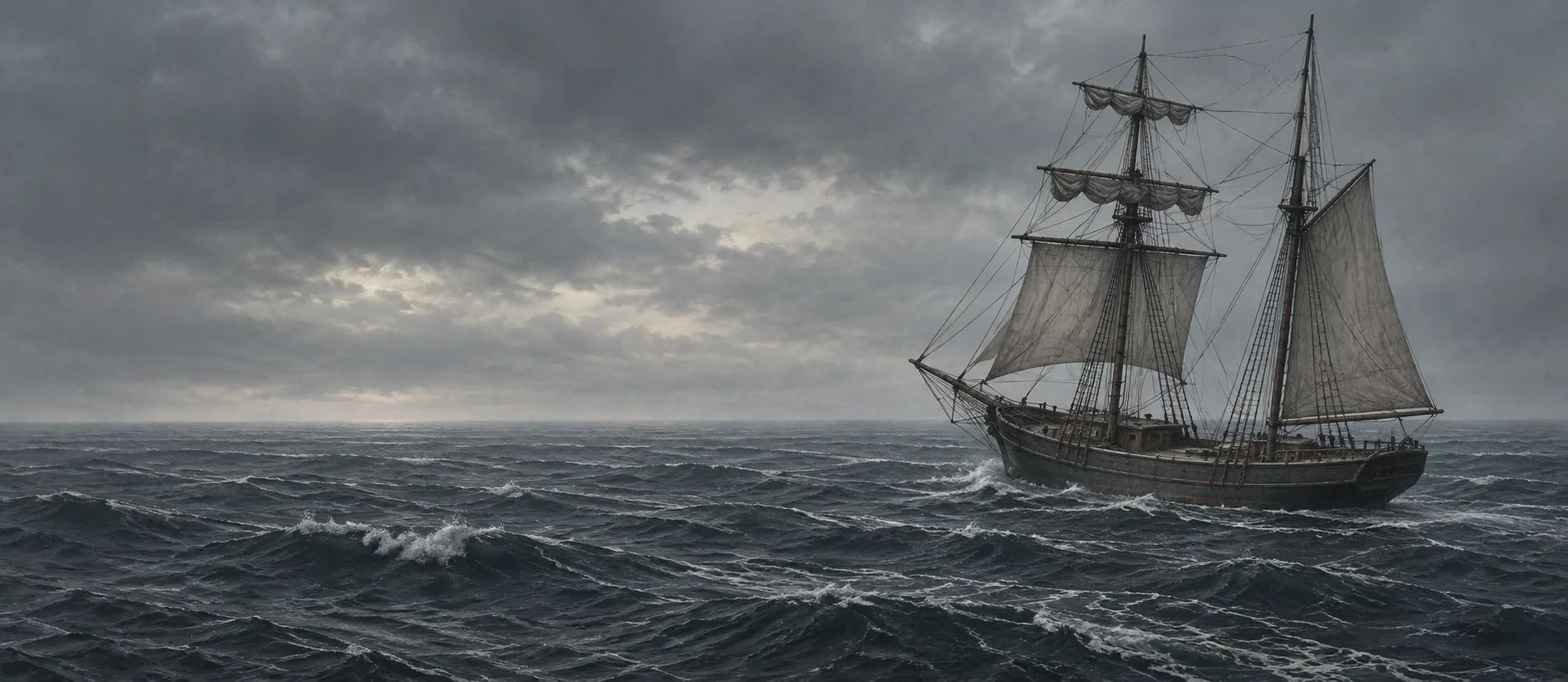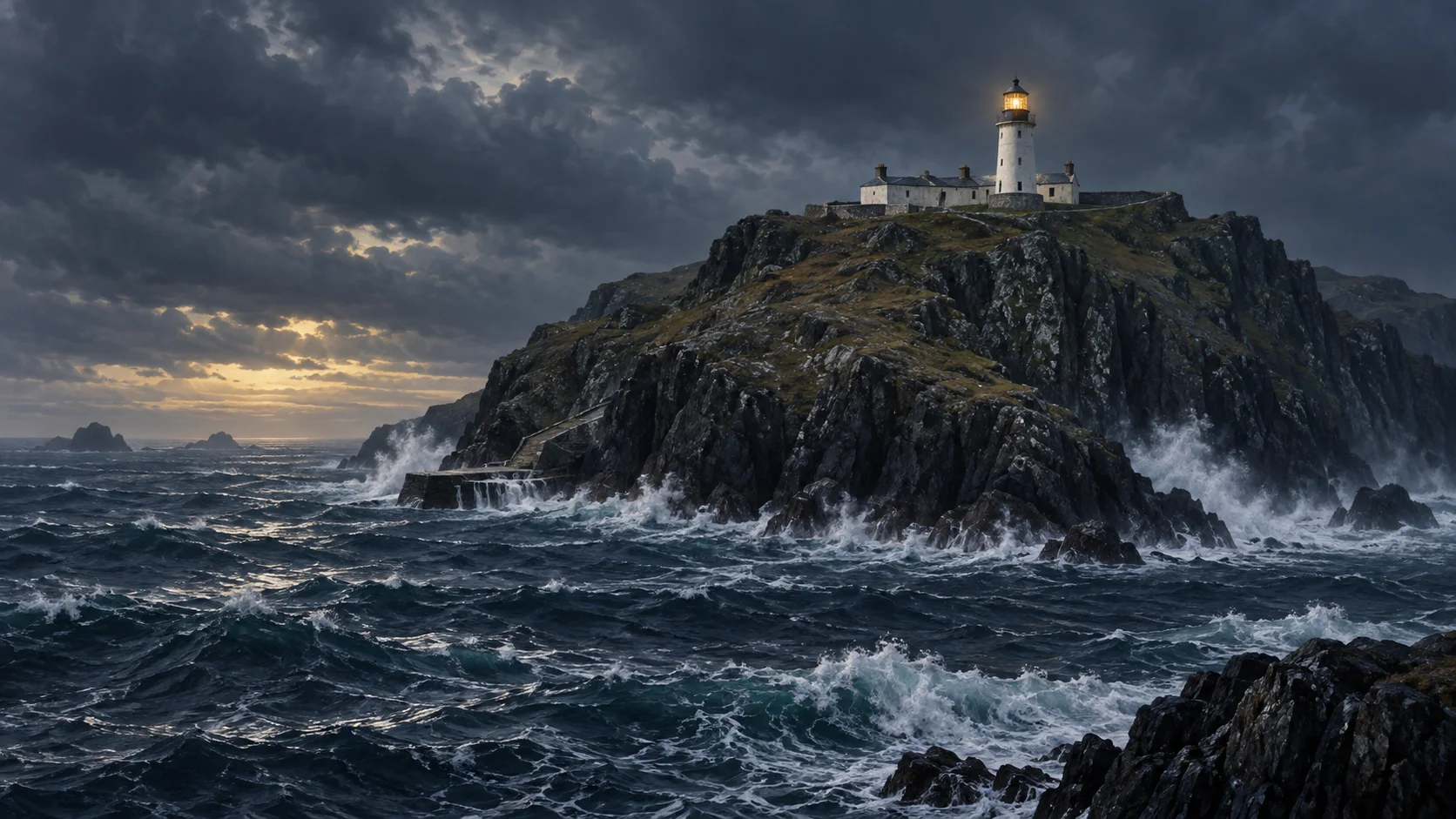
The Hesperus arrived at the Flannan Isles on 26 December 1900 for an ordinary change of lighthouse staff. No flag appeared at the station. The ship sounded its horn and siren. When neither brought an answer, Captain Harvie fired a rocket. There was still no reply.
Assistant keeper Joseph Moore went ashore and climbed to the lighthouse. The entrance gate and outside doors were closed. Inside, the beds were empty, the fire had been out for days, and the lamp had been cleaned and prepared for use. The three men meant to be tending it—James Ducat, Thomas Marshall, and Donald McArthur—were nowhere on the island. These details come from Moore’s letter of 28 December and superintendent Robert Muirhead’s later report, both reproduced by the Northern Lighthouse Board.
That evening, Moore and three volunteers lit the lamp. Its return was a practical necessity for passing ships, but it did not explain why it had gone dark. Eleven days separated the keepers’ last recorded work from the relief crew’s arrival. Whatever had happened fell into that interval.
An island built around a light
The lighthouse stood on Eilean Mòr in the Outer Hebrides, where the Flannan Isles meet the Atlantic west of Lewis. It had entered service only the year before the disappearance. Historic Environment Scotland’s building record describes a tower joined to the keepers’ house on steep ground. Supplies and people had to come by sea; landing places and their gear were essential parts of the station.
Its watch was staffed by Ducat, the principal keeper; Marshall, the second assistant; and McArthur, an occasional keeper standing in for William Ross, who was on sick leave. Moore, another assistant, was away from the island and due to return with the relief. The Board’s record names all four roles, an important detail in a story often compressed to three men alone in a tower.
The light mattered beyond the station. A vessel passing around midnight on 15 December later reported that it had not seen it. That information reached the Board only after the Hesperus discovered the men missing. By then the question had changed from whether a light had failed to where its keepers had gone.
The delay was not simply indifference. The Board employed a lookout on Lewis to watch for signals from the rock and note whether the light could be seen. But distance and poor visibility limited what an absence meant. Muirhead later found that the tower itself had not been visible from shore, even through a telescope, over much of December. The light had also failed to appear on several earlier nights when the men were plainly still at work. A missing light alone could not tell observers whether the problem was weather, equipment, or an emergency. Muirhead examined the lookout’s return book and described that difficulty in his January report.
The relief boat’s unanswered signals
At about noon on 26 December, the Hesperus came to make its scheduled relief. No usual preparations for landing were visible. Harvie tried the whistle, siren, and rocket before sending Moore in a boat to the east landing. Moore managed to get ashore, reached the station, and found the building deserted. He returned to the boat to report what he had seen. Then he and others searched again. The captain’s telegram, Moore’s letter, and Muirhead’s report give closely related accounts of that sequence.
Harvie’s telegram treated the event as an accident from the outset. He suggested that the men had been blown over the cliffs or drowned while trying to secure equipment. That was an immediate judgment, not something the arriving crew had witnessed. Night was approaching, and the ship could not remain indefinitely while the station stood unattended.
Moore went back with buoymaster Allan MacDonald and seamen A. Campbell and A. Lamont. They kept the light operating and searched the island the next day. Moore wrote that the east landing’s ropes remained where they had been left after the previous relief on 7 December. At the west landing, the scene was different: a box used for mooring ropes and tackle was gone, ropes lay among the rocks, and sections of railing had been torn away. Moore’s letter reported those observations before Muirhead reached the island.
The contrast mattered. The east landing was where Moore had arrived. The west landing held the clearest signs of damage. Neither location supplied a direct account of the missing men’s movements, but the west side offered investigators a physical reason they might have gone outside.
The last work they left behind
Inside the station, the lamp was ready for the next lighting. The lens and machinery had been cleaned; oil containers were filled; the kitchen and cooking utensils were in order. Ducat had recorded weather and other particulars on a slate on the morning of Saturday, 15 December, to be entered in the log later. The written log itself ended earlier. The Board’s transcription of Muirhead’s report distinguishes the slate from the logbook, a small distinction with large consequences for the timeline.
The completed morning work suggested that the men had remained at the station into 15 December. The report from the passing ship placed the unlit lighthouse later that night. Together, those records make an afternoon disappearance the likeliest timing. They do not identify the hour or explain what drew all three men out.
Clothing offered another clue. Moore said Marshall’s sea boots and oilskins were gone, as were Ducat’s sea boots and waterproof coat. He associated that gear with trips toward the landings. McArthur’s usual coat remained behind. Moore inferred that McArthur may have gone out in his shirt sleeves, perhaps after the others, but he did not see them leave. His 28 December letter keeps the observation and the inference close together; they should still be read separately.
There was no eyewitness to the final trip outside. An orderly lamp and kitchen tell us what tasks had been completed. Missing clothing and broken gear suggest where the men may have gone. The record does not supply the missing step between those facts.
What the west landing showed
Muirhead arrived on 29 December to investigate. The sea was still too heavy for him to descend all the way to the west landing, but he inspected the higher crane platform and approach. His report, submitted on 8 January 1901, describes an intact crane surrounded by more revealing damage.
A wooden box that had held landing ropes and crane handles, secured well above the water, had been swept away. The ropes were tangled among rocks and crane legs, still coiled rather than laid out for use. Iron railings had been displaced and twisted. A heavy stone block had moved from its place above to the path below. A lifebuoy fixed to the railings had vanished, although the ropes that held it had not been untied. Fragments of its canvas remained at the fastening. Muirhead read these marks as evidence of water reaching unusually high up the slope.
The condition of the ropes weakened one specific possibility: that the men had been working the crane when they disappeared. Muirhead found no sign of that task, and the crane itself remained secured. His stronger hypothesis was that they had gone toward the west landing to secure the rope box or inspect damage and that an exceptionally large wave struck while they were there. Water rising above them and then running down the slope could have carried all three into the sea. He considered wind as an alternative, but thought its direction made a wave more likely.
The physical damage shows the force of the sea at the west landing. The route, task, and exact moment in Muirhead’s account remain a reconstruction. He had evidence for the hazard, but no witness to the accident.
The people left with the question
After completing his inquiry, Muirhead went to see the widows of Ducat and McArthur. He also left Lamont at the station for a time because Moore appeared distressed and nervous. His report remembered having worked with the missing keepers during the lighthouse’s construction and having seen them at the previous relief on 7 December. The record ends as an account of colleagues and families as well as of damaged equipment. Those details appear in Muirhead’s closing paragraphs.
The administrative aftermath is traceable too. National Records of Scotland’s catalogue lists the Board’s telegrams, correspondence, and report, along with minutes concerning pensions, gratuities, and a claim by Marshall’s father. The records do not resolve the loss. They show how the lighthouse service continued its work while families dealt with the consequences.
What the record establishes
The closest surviving accounts establish a narrow but substantial sequence. Ducat, Marshall, and McArthur were at work on the morning of 15 December. A ship passing that night did not see the light. On 26 December, the relief crew found no keepers, an orderly station, and severe damage near the west landing. Moore observed the scene within days of the likely disappearance; Muirhead inspected it soon afterward and judged a wave the most likely cause. Their accounts and Harvie’s telegram are preserved in the Board’s published transcriptions.
Those documents carry different kinds of evidence. Moore’s description is a near-contemporary witness account of the discovery, not of the disappearance. Muirhead’s measurements and observations describe the damaged site; his explanation for how the men died is an official inference. The passing ship’s report supports the timing but gives no view of the island. None can establish that all three went to the west landing together or that one particular wave took them.
The logbook is another limit. National Records of Scotland says it does not hold the original Flannan Isles logbook; it was not among the Board records deposited there. Its account of the archival evidence confirms that the last written log entries were for 13 December and that later observations were on a slate. A dramatic quotation attributed to a final log entry needs an identifiable original source before it can bear any weight.
The best-supported explanation remains an accident at the west landing. The sea had damaged fixtures far above its ordinary reach, and two men appeared dressed for work outdoors. Historic Environment Scotland’s site record likewise describes an unexpected large wave as the likeliest cause. That conclusion explains the physical evidence without claiming to know the men’s final actions. No bodies or direct eyewitness account settled the matter.
The Bigger Picture
Flannan Isles is often told as a sealed-room puzzle: three men gone, a functioning lighthouse left behind. The original material makes it a different kind of case. It shows the ordinary systems that allowed a dangerous gap to remain unseen. The station depended on scheduled relief, signals that required visibility, and a distant lookout who could not always distinguish a dark light from poor weather. Muirhead recommended a clearer instruction for reporting a light that ought to have been visible. He also considered a daily “all well” signal and judged that haze could make it unreliable. Both discussions are in his report.
The story also shows how easily a precise record can become a more dramatic one. The actual record of the last morning is a slate of routine observations, followed by an orderly kitchen and a prepared lamp. Read as evidence, those details fix a time window; they do not reveal the keepers’ state of mind. The damaged west landing, missing gear, and force of the sea deserve more attention than an imagined final scene. The distinction matters because the men were real workers, not characters placed on an island to complete a riddle.
The disappearance entered literature as well as maritime history. National Records of Scotland notes Wilfrid Wilson Gibson’s poem Flannan Isle; its own account of lighthouse work describes the duties as routine and potentially dangerous. Both histories can be told, provided the poem is not mistaken for testimony and the accident is not reduced to atmosphere.
What would change the historical conclusion? A securely dated first-hand account of the men after the morning of 15 December, or a contemporaneous record that places them somewhere other than the west landing, would alter the sequence. In its absence, the strongest explanation remains Muirhead’s: a sudden force of water caught men who had gone toward damaged landing gear. The exact event remains unseen. The light was restored; the three keepers never returned.
Sources
- Northern Lighthouse Board: Flannan Isles, including the 1900 telegram and letter and the 1901 superintendent’s report
- National Records of Scotland: guide to the Commissioners of Northern Lighthouses records
- National Records of Scotland: The Flannan Islands Lighthouse: A disappearance
- National Records of Scotland: A Place of Threat
- Historic Environment Scotland: Eilean Mòr lighthouse listed-building record