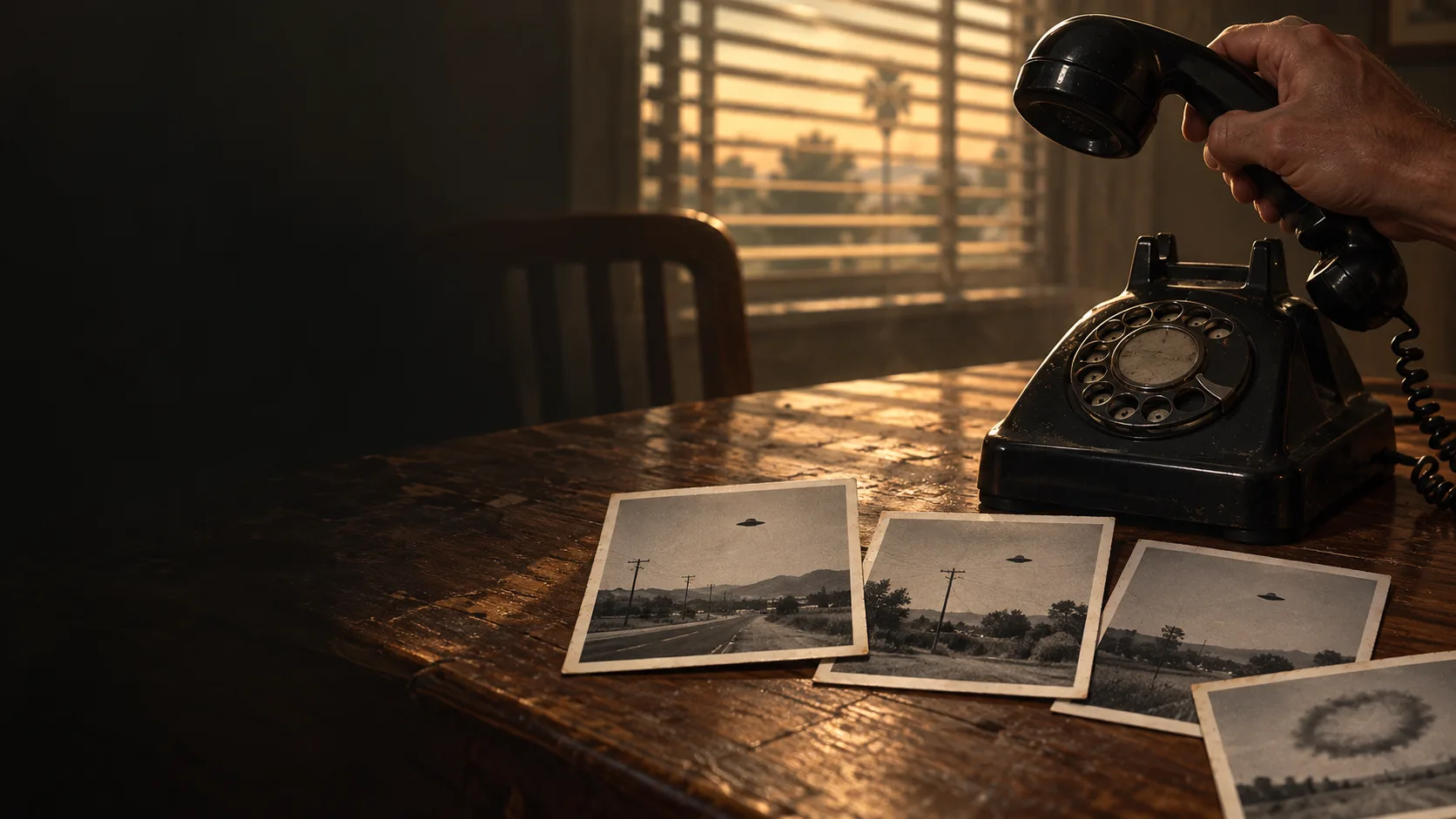
The men wanted the metal. Robert Richardson said he could not give it to them: he had already turned it over to the Aerial Phenomena Research Organization for analysis.
In Coral and Jim Lorenzen’s later account, two strangers in dark suits had come to Richardson’s Ohio home about a week after an encounter on a country road. They first seemed to question whether he had struck anything at all. Then they asked for the fragments he had collected. One pressed him to get the material back. Richardson refused, and the conversation ended with an alleged threat concerning his wife.
Richardson believed few people knew he had found the fragment. How had these visitors learned what to ask for?
To understand why a piece of metal had become the centre of the story, the route returns to a bend in the road between Maumee and Whitehouse, west of Toledo, on the night of July 13, 1967.
The road to Whitehouse
Richardson, twenty-one, was driving with his friend Jerry Quay, also twenty-one. According to the July–August 1967 APRO Bulletin, they were going to check whether Whitehouse Quarry, a local swimming place, would be open for the weekend. Richardson was travelling at roughly forty miles an hour.
As the road bent, a brilliant blue-white light filled the view ahead. The men later estimated the lit shape at about eight feet high and twenty-two feet across. APRO’s report described their impression of a long rectangle lying across the roadway. The dimensions were estimates made in an abrupt encounter, not measurements of an object subsequently found there.
Richardson braked and closed his eyes, expecting a collision. Quay closed his eyes too. Both reported a jolt. When they looked again, the road was clear. The impact, as they described it, lay between the last view of the light and the first view of an empty road.
Neither man was hurt. Quay was shaken. The two drove first to Waterville to telephone the police, then to Maumee, where they contacted the state highway patrol. They were directed to the Maumee police station. In APRO’s telling, local officers and state patrolmen questioned them, and two patrolmen accompanied the pair back to the site late that night.
The road held skid marks where Richardson said he had braked. The early APRO account said nearby soybean plants and soil appeared undisturbed. Its investigator, Nils H. Paquette, checked two farmhouses; no resident supplied a matching observation. A railway crossed the road just west of the reported location, with an electrical substation to the north-east.
A return to the bend
Richardson went back the following day. On the road, he said, he found a small lump of metal. Investigators also examined his car. Paquette reported damage to the bumper and hood, with an area of chrome plating apparently missing near a dent. He found the way the plating looked unusual and thought the slight damage fitted the idea that the object had begun to rise when the car reached it. That was Paquette’s interpretation of the reported jolt and the car’s condition, not an observed takeoff.
APRO recorded two pieces of metal from the road and a thin, fibrous-looking strip from the front bumper. They were sent for analysis. Unlike the light, these were things an investigator could pass to a laboratory.
Richardson had reported the event promptly. On Saturday, July 15, APRO headquarters in Tucson received his telegram. The organisation telephoned him and assigned Paquette, who lived in Toledo, to investigate. The Lorenzens later wrote that Richardson mentioned the lump and material from his car during that first call. The case therefore travelled quickly from a roadside report to a network of people in two states.
The material changed what a visitor might ask. A stranger who knew about the metal could demand something specific. In Richardson’s later account to APRO, this was exactly what happened.
Two visits
The Lorenzens placed a first visit on July 16, around eleven at night. Two men in their twenties came to Richardson’s home and questioned him for about ten minutes about the road incident and where it occurred. He considered them reasonably friendly. They gave no names, and he did not ask. He later said they drove away in an older black Cadillac and that a licence number he noted had not yet been issued when he checked with Toledo police. The book records that claim; the cited sources do not include the police lookup itself.
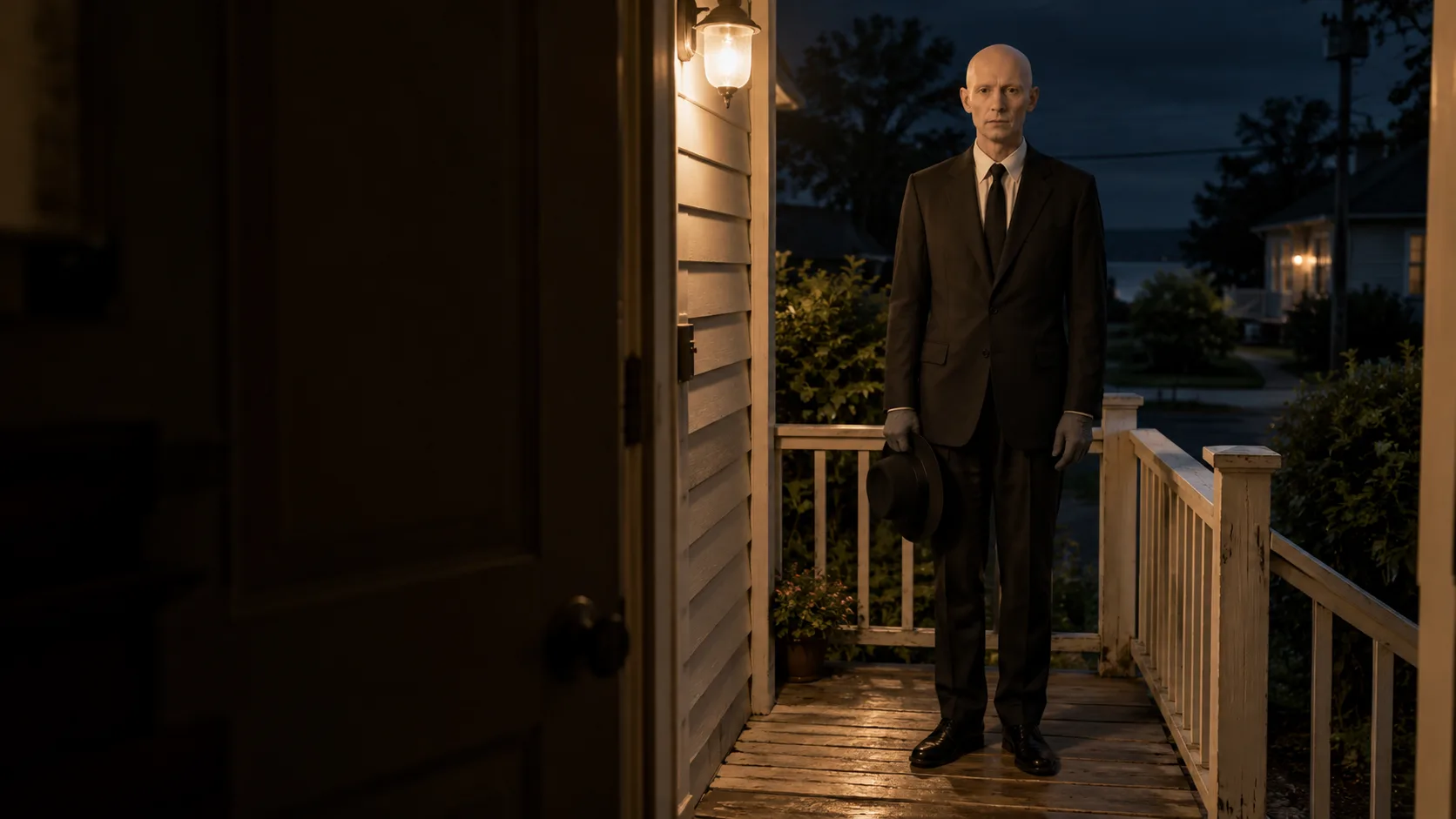
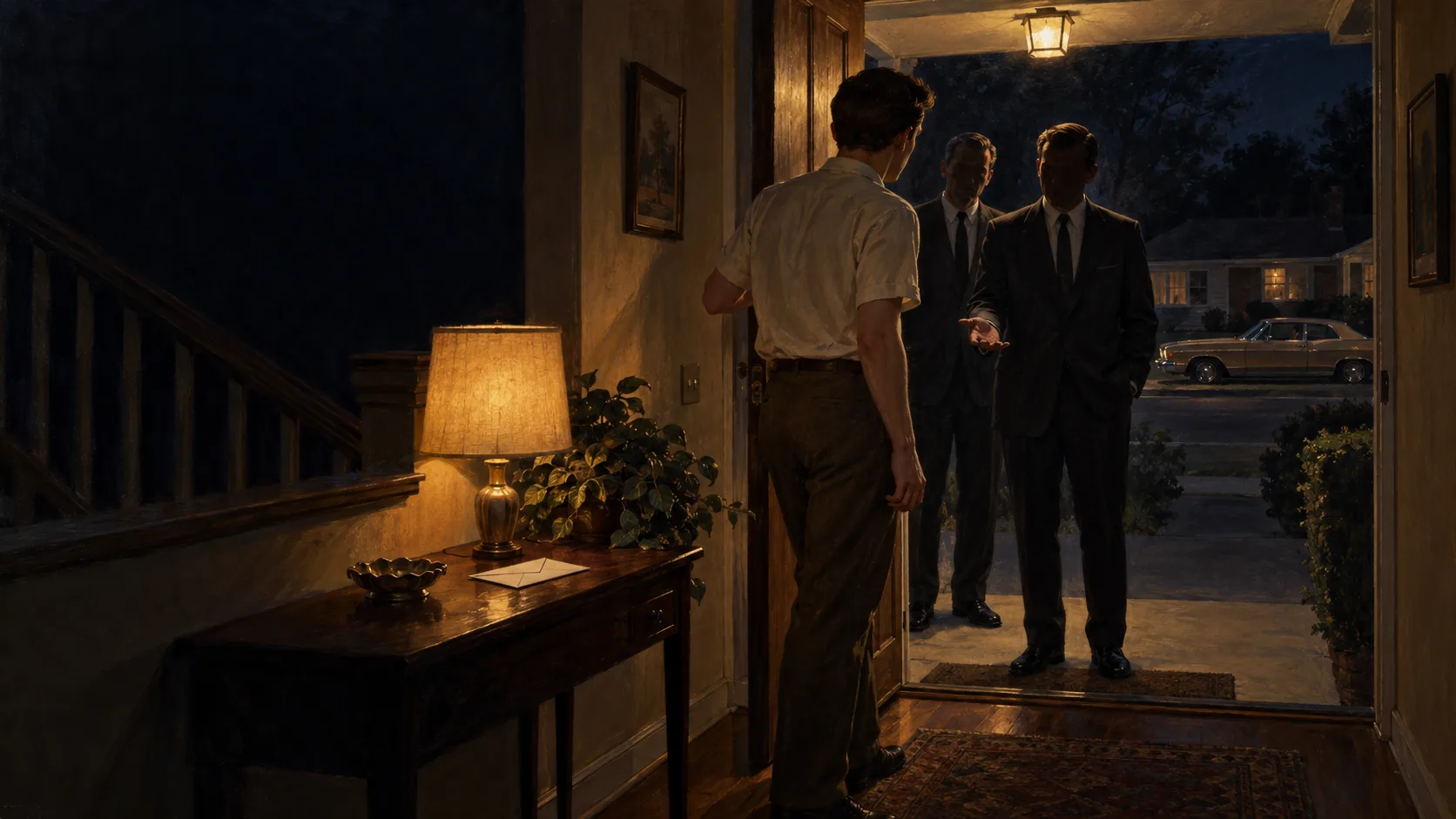
About a week later, according to the same account, a different pair appeared while Richardson was alone. This time the men wore black suits. One spoke with an accent; the other spoke fluent English. Richardson felt they were trying to persuade him that nothing had been struck on the road. Then they asked for the material he had recovered. He told them APRO had it. They wanted to know whether he could retrieve it.
The alleged final remark made the visit a threat rather than merely an inquiry. The Lorenzens reported one man warning Richardson that, if he wanted his wife to remain unharmed, he should get the metal back. They said she was pregnant and that Richardson became anxious about leaving her alone when he went to work. The account describes the men leaving in a tan, current-model Dodge. It does not identify either visitor or connect the two pairs beyond Richardson’s sequence of encounters.
APRO’s later account reasoned that knowledge of the fragments was confined to the household, Lorenzen and Paquette. It wondered whether a telephone call had been monitored. That was suspicion, not evidence of a tapped line. The path by which anyone else might have heard of the fragments was never established.
The file moves on
The first APRO bulletin presented a shorter version while analysis was still under way. It said two strangers with specific knowledge of the evidence had approached Paquette and questioned him. It did not yet tell the Cadillac story, the second doorstep visit or the threat to Richardson’s wife. In the later book, the centre of that visitor narrative moved to Richardson’s home. The two publications cannot simply be read as identical transcripts of the same interview.
Meanwhile the samples travelled farther than the men in the cars. APRO’s consultant Allen Utke examined the lump and reported iron and chromium with other constituents. The University of Colorado UFO Project, then conducting an Air Force-funded study, also received material through APRO. Its investigator Roy Craig described one thin rolled sample containing magnesium, aluminium and zinc. The larger, several-gram sample was an iron-chromium-manganese alloy with an unworked crystalline surface.
The Lorenzens’ 1976 account reported percentages from a March 1968 test and thought a magnesium-rich alloy odd on a car bumper. Craig’s Colorado analysis concluded that both materials could be made by ordinary technology. Their composition did not reveal where they had been before Richardson collected them.
That result left the road story and the doorstep story in different kinds of uncertainty. The two men in the car had promptly told APRO about a light and a jolt; later investigators handled metal. Richardson also said unknown visitors sought the fragments and threatened his wife. Chemistry could test the fragments’ composition. It could not identify the light at the bend, or the men who may have come to the door.
What Is Known
APRO’s July–August 1967 bulletin is the nearest substantial report located for this article. It names Richardson and Quay, dates the driving incident to July 13, describes the telegram received July 15, and records Paquette’s site and car observations. It reports skid marks and damaged car surfaces, but the cited material includes no independent patrol report or photograph proving contact with another object. The bulletin’s brief account places the strangers’ questions to Paquette.
The fuller account of two visits to Richardson, including the alleged threat, comes from the Lorenzens’ Encounters with UFO Occupants, published in 1976. It is APRO’s own later telling, but no visitor identity, contemporaneous interview transcript or independent witness to the doorstep exchange is supplied. A later timeline also gives different visit dates, July 18 and 23. The Colorado report refers to a collision of July 16, whereas APRO’s initial bulletin explicitly says July 13. The early APRO date is the one used here for the road event.
The University of Colorado tested two submitted samples. Craig found conventionally producible alloys. His report explains the missing link: a sample’s composition cannot prove that it was present before an alleged encounter, arrived because of it, or passed through a secure chain of custody. The laboratory finding establishes what the samples were, not what Richardson and Quay hit or who later sought the metal.
The Bigger Picture
Richardson’s story arrived after the “Men in Black” figure had already entered UFO culture. Historical reporting on the legend traces its popular form through Gray Barker’s 1956 book and earlier claims that UFO witnesses or researchers had been warned into silence. The Toledo report fitted that familiar pattern: a witness speaks, material goes to investigators, and unnamed men arrive knowing more than expected.
Yet its contemporary and later versions show how a pattern can sharpen in the telling. The first bulletin made a guarded note about strangers questioning an investigator. The Lorenzens’ later book supplied the older Cadillac, a second car, dark suits and a threat at the witness’s door. Those details are the source of the story’s force, and their publication dates are essential to reading it. The Colorado laboratory provided a parallel lesson: a material fact can be real without proving the explanation attached to it.
What remains is a sequence with an unusually tangible centre. Richardson and Quay reported a sudden light; Richardson found metal; APRO passed it on; men were said to want it back. The road was empty when the two friends opened their eyes. Years later, the question at the doorstep still depended on the same small thing: where had the metal come from, and why would anyone ask for it?
Sources
- Aerial Phenomena Research Organization, “UAO Struck by Automobile in Ohio,” The APRO Bulletin, July–August 1967, pp. 1 and 3. Near-contemporary report based on Richardson’s telegram, telephone interview and Nils Paquette’s investigation.
- Coral and Jim Lorenzen, Encounters with UFO Occupants (1976), “UFO-Car Encounters.” Later APRO account of the two alleged visits and fragment tests, reproduced in a web transcription of a compiled excerpt.
- Roy Craig, “Direct Physical Evidence,” University of Colorado, Scientific Study of Unidentified Flying Objects (1968). Independent project analysis of the two submitted alloys and the limits of their provenance.
- George Eberhart, UFOs and Intelligence: A Timeline, July 13, 1967 entry. Later chronology and source trail; its visit dates differ from the Lorenzens’ account.
- History, “The UFO Sightings That Launched ‘Men in Black’ Mythology.” Independent context for the established Men in Black narrative before 1967.