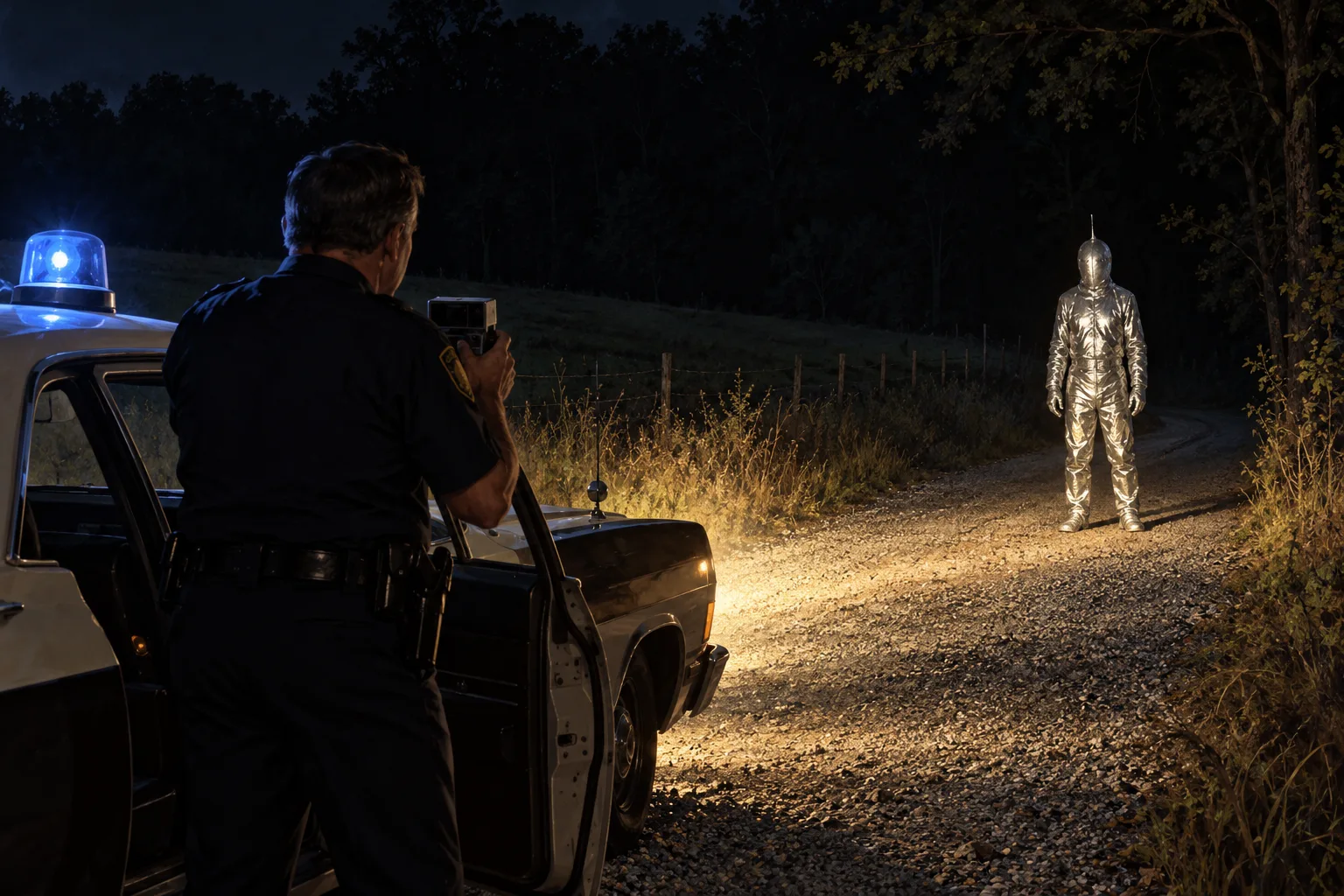
The figure stood in the gravel road, reflecting the light from Jeff Greenhaw’s vehicle.
It had a human outline. The covering over its body shone silver. Greenhaw stopped, got out, and tried the greeting that would soon appear in newspaper headlines: “Howdy, stranger.”
There was no answer.
According to the account published soon afterwards, the figure began walking towards him. Greenhaw reached for his Polaroid camera.
It was the night of October 17, 1973, outside Falkville, Alabama. The police chief had gone looking for a reported spaceship. What he would bring back was something different: photographs of a solitary figure on a country road, and an account of a pursuit he could not finish.
The call from outside town
Greenhaw had been hired as chief that January. He was Falkville’s only full-time policeman, serving a small town in Morgan County, in north-central Alabama.
The place had grown around a railway station in the nineteenth century. Its local history included stores, timber businesses, cotton gins and a school. The Encyclopedia of Alabama’s account describes a community connected to the wider state by rail and highways. That October, another kind of connection would carry its name much farther: a newspaper story about its police chief.
The October 19 report in The Birmingham News, preserved in Ralph and Judy Blum’s Beyond Earth, placed Greenhaw at home when a woman telephoned. She said an object with flashing lights had landed in a field west of town.
It was around ten at night. He took a camera and drove out to investigate.
The search initially produced nothing resembling the reported craft. In NICAP’s November 1973 account, Greenhaw checked the field and then continued down a side road. There, in the vehicle’s lights, was the figure.
The call had brought him to the area. The figure gave him something to approach.
Silver in the headlights
At first, Greenhaw thought he was dealing with a prankster. He stopped and spoke as he might to a stranger found standing on a road at night.
The figure’s appearance complicated that ordinary exchange. Its head and neck seemed joined beneath a covering. There were no recognisable facial features. A short projection rose from the top of its head, described in the newspaper as an antenna.
Greenhaw would describe a surface whose brightness changed with the angle of the light. The NICAP case directory preserves his comparison with mercury rubbed on nickel. What readers later called a Metal Man was, in his description, something wrapped or clothed in a remarkably reflective material.
It remained silent.
He described its movements as stiff and mechanical. The resemblance to a robot came from the way the human-shaped figure moved as well as its covering. There was no conversation to explain its presence, no visible face to supply an expression, and no identification offered to the officer.
The camera became his means of recording it.
Four photographs
Greenhaw said he made four exposures. The early newspaper account described him using the flash as the figure approached; NICAP’s contemporary summary placed it within approximately ten feet before it stopped.
These were instant photographs, made during an encounter rather than a later reconstruction. At least, that was the origin Greenhaw claimed for them. The prints would become inseparable from his account.
In the surviving reproduced image held on NICAP’s case page, bright patches outline a head, torso, arms and legs against a dark background. Much of the surface is broken into folds and reflections. It is possible to recognise a standing, human-shaped subject while finding its precise covering difficult to interpret.
The image offers a different experience from the officer’s description. His account supplies approach, silence and movement. The photograph holds one position. The person looking at the print has time to study what the officer said he confronted briefly beside his vehicle.
In Greenhaw’s telling, however, there was little time left to stand and take pictures.
The blue light
He switched on the police beacon. The figure turned and ran.
Greenhaw returned to his vehicle and followed. The encounter had become a pursuit along loose gravel, with the reflective subject moving ahead of him.
The 1974 NICAP investigation recorded his claim that he could not catch it at twenty miles per hour. Then the vehicle lost traction. The figure escaped into the darkness.
The earlier November 1973 summary described the wheels spinning and the car going off the road’s edge. When Greenhaw recovered and got back onto the road, his quarry had disappeared.
He returned with the photographs. He had no person in custody, and no spacecraft to show the people who would ask what happened.
A story in the morning paper
The report moved quickly. A later documentary study by Vicente-Juan Ballester Olmos and Luis Ruiz Noguez traces Greenhaw’s contact with The Decatur Daily to about 11:30 that night. The newspaper carried the encounter on October 18.
The following day’s Birmingham News headline built itself around his greeting. The quiet opening to the encounter had become its public introduction: a small-town policeman saying hello to a supposed visitor from space.
The photographs travelled with the story. The same later study describes copies retained by the civilian research organisation ICUFON and records their subsequent transmission to Ballester Olmos in 1975. The images had begun an archival life beyond the officer’s possession.
Meanwhile, Greenhaw’s own circumstances were deteriorating.
The council meeting
On November 15, less than a month after the encounter, Greenhaw resigned at a Falkville council meeting. The next day’s Decatur Daily report, also reprinted in Beyond Earth, said the mayor had asked him to step down.
The article described other losses during the intervening weeks: his marriage had ended, his car needed an engine replacement, and his mobile home had burned while he was attending a high-school football game. It reported that he injured his eyes with smoke while attempting to enter the burning home.
Those events appeared together in the newspaper’s account of a man facing an uncertain future. Their succession does not establish that the sighting caused each of them. It does establish that the public story had acquired a painful aftermath while it was still fresh news.
The silver figure had vanished in minutes. Greenhaw remained the person reporters could find.
The pictures he kept
Decades later, Greenhaw was still recounting the night. A 2021 Cullman Tribune article quoted a filmed interview made the previous year.
He remembered the figure moving with an unusual, springing motion and described pursuing it at thirty-five miles per hour—a higher figure than NICAP printed in 1974. He also described withdrawing from public attention as people turned against him.
For years, he said, he kept the four original photographs and looked at them repeatedly. Then, in 1983, a break-in took the prints, his service revolver and a shotgun. The newspaper reported his statement that he filed a police report about the theft.
Copies survived elsewhere. The originals, according to their photographer, were gone.
What Is Known
Falkville has contemporary reporting, reproduced photographs, a published civilian investigation and later witness recollections. Greenhaw did not report seeing a spacecraft himself. The identification of the figure as an extraterrestrial occupant was an interpretation, not something the photographs established.
NICAP investigator Marion Webb tested a practical explanation. Wearing a reflective firefighting suit, with foil added at the hood and feet, he posed for comparison photographs. The October 1974 newsletter reported similarities but treated the proposed hoax explanation as unconfirmed. It also noted that the cumbersome suit made rapid movement difficult; Webb suggested the failed pursuit could have covered only a short distance.
Later assessments were firmer. Ballester Olmos and Ruiz Noguez document Ground Saucer Watch’s photographic conclusion favouring a hoax. They also reproduce NICAP president John Acuff’s 1977 claim that a participant had admitted involvement, identifying the alleged costumed person only as a seventeen-year-old in private correspondence.
That is a documented claim of a confession, not a confession independently verified here. Francis Ridge’s 2007 NICAP assessment likewise calls the case a hoax, while leaving open whether Greenhaw staged it or encountered someone else’s prank.
The evidence favours a human figure in a reflective costume. It does not establish an alien or a robot, and the officer’s precise involvement remains disputed.
The Bigger Picture
The date places Falkville within an extraordinary burst of UFO publicity. Only six days earlier, Charles Hickson and Calvin Parker had reported their Pascagoula encounter. NICAP’s November newsletter described investigators struggling to follow the volume of reports while also sorting out pranks and misidentifications.
That setting matters without deciding every individual case. Police were being called to investigate extraordinary claims; cameras were being brought along; newspapers were circulating accounts faster than investigators could settle them.
Falkville’s photographs gave its story unusual staying power. They preserved a visible subject, but identification still depended on testimony, comparison and interpretation. The enduring question is how a reflective human-shaped figure became a Metal Man in public memory.
Greenhaw’s greeting survived all of it: publication, investigation, resignation and decades of retelling. On that dark road, he said, he had tried to begin an ordinary conversation. The figure never answered.
Sources
- NICAP, UFO Investigator, November 1973, pages 1 and 4. Contemporary encounter summary and reporting-wave context.
- The Birmingham News, October 19, 1973, and The Decatur Daily, November 16, 1973. Contemporary reports reprinted in Ralph and Judy Blum’s Beyond Earth; consulted through an online transcription.
- NICAP, “Police Chief’s Nightmare: Real or Contrived?”, October 1974, pages 1–2. Investigation and costume-comparison photographs.
- Christy Perry, “Do You Believe in the Metal Man?”, The Cullman Tribune, July 10, 2021. Later reporting quoting Greenhaw’s filmed recollections.
- Vicente-Juan Ballester Olmos and Luis Ruiz Noguez, “Pictures of Aliens in USA, October 1973,” 2020. Documentary study reproduced online, tracing press coverage, photographic copies and later hoax findings.
- Francis Ridge, Falkville case directory, January 17, 2007. Later assessment and a reproduced encounter photograph; the page also includes a separate UFO Casebook retelling.
- Christopher Maloney, “Falkville,” Encyclopedia of Alabama. Independent geographical and historical context.